
Inactive· since Apr 28, 2026
- 4
- days it ran
- 1
- relaunches
- 3
- EU reach
Ad copy
Forty-three years old, and the most dependable man in every room. Also the loneliest. There's a moment I keep coming back to. My wife was crying in the kitchen. Not a dramatic cry — the quiet kind, the kind she does when she's been holding something for too long and it finally slips out. I walked in, saw her face, and I did what I always do. I fixed it. I asked the right questions. I found the thing that was wrong and I addressed it. I held her while she settled. I made her tea. And when she stopped crying and said "I don't know what I'd do without you," I smiled. And I felt absolutely nothing. That scared me more than I knew how to say. I've been the fixer for as long as I can remember. At work, I'm the one they call when it's already on fire. In my friendships, I'm the one who drives people to appointments and remembers their kids' names and checks in after the hard conversations. At home, I handle the things that don't get handled. I have never, in my adult life, been the one in crisis. I have never been the one who needed the tea. And I used to think that was strength. I used to think I was just built differently — more capable, more resilient, less needy than the people around me. I told myself I didn't require what other people required. I was self-sufficient. I was solid. I was fine. The truth is I was terrified. Not of the problems I was solving. Of what would happen if I stopped solving them. Of what would be left of me if I stopped being useful for five minutes and someone looked at me the way I looked at them — needing, open, unsure — and saw nothing worth staying for. I don't know when I learned that. I know that I learned it early. My father was a man who showed love by providing. That was the whole vocabulary. He worked, he fixed, he showed up with solutions and without softness, and you did not burden him with your interior life because he did not have the equipment for it, and anyway he was tired. I learned very young that the way to matter in that house was to be useful. To not add to the pile. To be the kind of child who handled his own things, who didn't complain, who was old enough, who was fine. I was always fine. I became the kid who other kids came to with their problems. And I found that I was good at it — genuinely good at it — and that being good at it felt like something close to being loved. People needed me. People sought me out. People said I was the most reliable person they knew. And I held onto that the way a drowning man holds onto a rope, because somewhere underneath the competence I already knew: if I am not useful, I am not safe. If I am not needed, I will not be kept. That's a heavy thing to carry at ten years old. It's a heavier thing to carry at forty-three, because by now the program runs so deep that I can't turn it off even when I want to. Even when I'm exhausted. Even when I'm sitting in a hospital waiting room with my own chest hurting and thinking "someone should probably ask me how I'm doing" and then immediately thinking "don't be ridiculous, you're fine." Here is what the loneliness of a fixer feels like from the inside. It feels like being surrounded by people who genuinely love you and feeling none of it land. Because they love the version of you that handles things. They love your steadiness and your availability and your capacity to absorb their panic and return it to them as calm. They love what you do. And you have never, not once, shown them anything else — so they don't know there's anything else to love. And because they don't ask, you conclude that they don't care. And because you conclude they don't care, you go a little colder. And you fix a little harder to earn back something you can't even name. And the cycle goes around again. The resentment, when I finally let myself feel it, wasn't aimed at my wife. It wasn't aimed at my friends. It was aimed at me — at the version of me that kept running this program and calling it generosity when it was actually fear. Fear dressed up as love. Fear wearing the mask of strength. Fear that had become so familiar it felt like a personality. The moment it cracked open for me wasn't dramatic. I was in the car alone after a long weekend of being everything to everyone, and the radio was off, and it was quiet, and I thought: I cannot remember the last time someone asked if I was okay. Not as a complaint. Just as an observation. And then, following it like a thread: I cannot remember the last time I would have told them the truth if they had. And I sat with that for a while. I started using an app called Liven. A friend had mentioned it — not as a cure, not as a fix, just as a thing that helped him understand what was happening underneath the surface when the surface was all he'd ever shown anyone. It has a short quiz, maybe three minutes, that maps the emotional patterns you've built and the nervous system logic underneath them. I took it expecting to feel assessed. Instead I felt recognized. Not because it told me anything I could have written down. Because it named the architecture of something I'd been living inside for decades without ever having the language for. The part of me that learned to earn love. The part that conflated usefulness with safety. The part that had been running a childhood survival strategy in an adult life and calling it character. I'm not going to tell you that I've stopped fixing things. I haven't. I probably won't, entirely, and I'm not sure I'd want to — some of it is real, some of it is genuinely who I am. But I know now that there's a difference between giving from fullness and giving from fear. And I know which one I've been doing. I also asked my wife, for the first time in probably fifteen years of marriage, if she thought I was okay. She looked at me for a long moment. Then she said: "I've been waiting for you to let me answer that." If something in this landed, Liven's three-minute quiz is the thing I'd point you toward. Not because it fixes anything — but because it might be the first time something tells you the truth about the pattern you've been running, in a language that actually makes sense of it. Link is below.
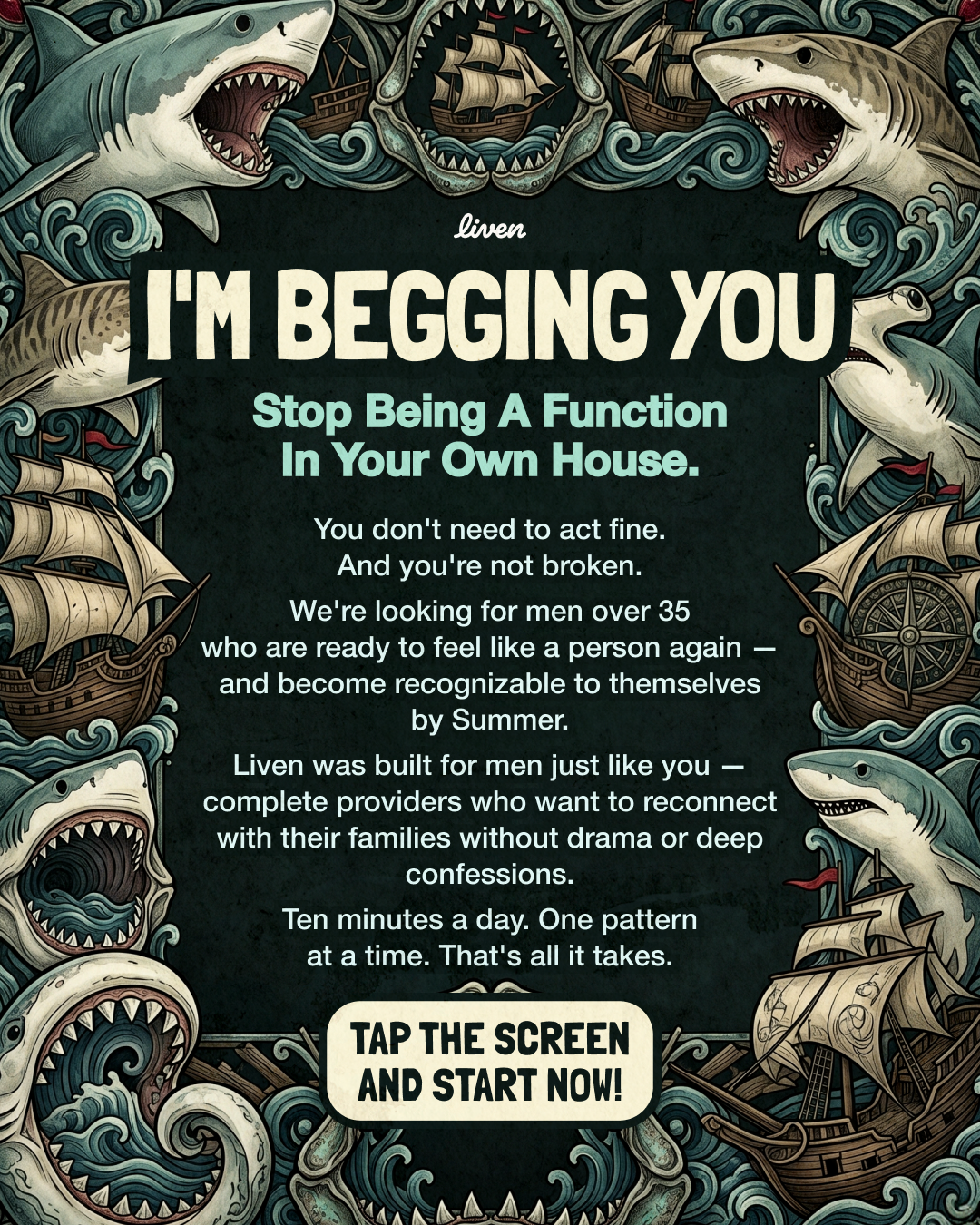
The most dependable man in the room. Also the loneliest.
LEARN MORELike this ad? Make it yours.
Crush rebuilds this exact creative around your product — your brand, your colors, your offer — in about a minute.