BC Rental Project
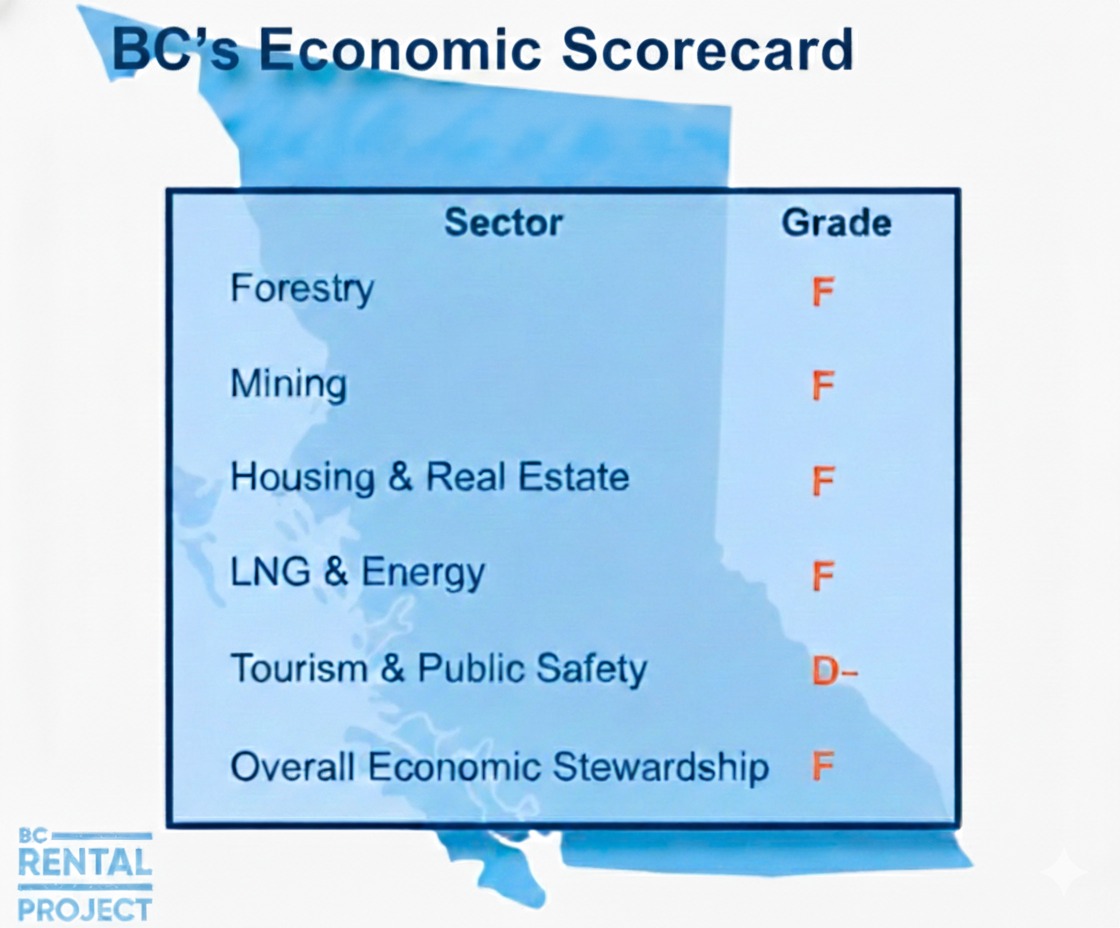
BC Rental Project Facebook ad: “BC’s Economic Scorecard”
Ran for 108 days, from February 13 to June 1, 2026, the last day Crush saw it.
Run by BC Rental Project on Facebook. Crush is not the advertiser and does not verify its claims. See this ad in Meta's Ad Library(opens in a new tab)
Want an ad like this for your product?
Crush makes new ad images for your product from this ad: your logo, your product photo, your offer.
Trials from $19.95 USD, then $79.95 USD a month. Cancel anytime.
About this ad
- Meta Ad Library ID
- 1965755770698941
- Platforms
- Facebook and Instagram
- Relaunches
- 1
Ad text
BC’s Economic Scorecard British Columbia is not experiencing a slowdown — it is experiencing a systemic economic collapse. David Eby and the BC NDP want the public to believe the economy is holding steady because they can point to one talking point: “rent prices dropping.” But rents aren’t dropping because BC is thriving — they’re frozen because the economy is breaking. People can’t afford to move. Businesses can’t invest. Private capital has fled. When an economy seizes up, prices don’t rise — they stall. No one in British Columbia is finding life more affordable. Families are being squeezed, investment is vanishing, and the province is losing the very economic engines that once sustained it. At the same time, provincial finances are deteriorating rapidly. A projected multi-billion-dollar surplus has flipped into an $11-billion-plus deficit — and the government’s response to failing institutions has been to spend more, borrow more, and deliver less. Deficits are now being financed through debt, pushing BC’s total debt from $89.4 billion in 2022–23 to a projected $155.1 billion — an extraordinary surge in just a few years. As a result, interest payments alone are projected to hit $5.1 billion, effectively becoming one of the largest “ministries” in government — roughly the fourth-largest line item — and draining resources away from frontline services. What follows is how government policy drove sector after sector into decline — and why the cost is now showing up in every household’s bottom line. 1. Forestry — Grade: F Why Forestry Matters Forestry was once a cornerstone of BC’s economy, supporting rural communities, First Nations contractors, manufacturing, and export revenues. What Went Wrong • Chronic mismanagement and constant regulatory change • Failure to balance conservation with sustainable harvesting • Policy uncertainty around Indigenous consultation and veto powers • Mills closing due to fibre shortages while forests burn or rot Economic Consequences • Thousands of lost jobs • Mill closures across the Interior and Coast • First Nations forestry businesses disproportionately harmed Verdict: The government has failed to manage forests as an economic, environmental, and community asset. 2. Mining — Grade: F Why Mining Matters BC is rich in critical minerals and metals needed for global electrification, clean tech, and infrastructure. What Went Wrong • Regulatory paralysis and overlapping approval processes • Unclear Indigenous consent frameworks creating investor uncertainty • Court rulings and policy signals discouraging new mining claims Economic Consequences • Investment fleeing to competing jurisdictions • Missed opportunity during a global commodity boom • Loss of high-paying jobs, especially in northern and rural BC Verdict: Despite world-class resources, BC has become one of the least competitive mining jurisdictions in North America. 3. Housing & Real Estate — Grade: F Why Housing Matters Real estate and construction once represented roughly one-third of BC’s GDP, driven by private capital, risk-taking developers, and skilled trades. What Went Wrong • Over-taxation and over-regulation of private development • Punitive policies targeting home builders • Government attempting to replace the private housing supply with taxpayer-funded projects Economic Consequences • Private home builders exiting BC • Housing starts collapsing • Taxpayer dollars replacing vital first-dollar private investment in the economy • Fewer homes in the pipeline, higher costs, and stalled projects Verdict: The government didn’t fix housing — it crowded out the private sector and made the economic crisis in BC dire and burdened the taxpayer with the cost of providing housing. 4. LNG & Energy — Grade: F Why LNG Matters Liquefied Natural Gas represented one of BC’s largest missed economic opportunities — capable of delivering: • Tens of billions in private investment • Long-term Indigenous partnerships • Stable, high-wage employment • Global emissions reductions by displacing coal What Went Wrong • Years of regulatory delays and moving environmental goalposts • Policy hostility toward fossil fuel investment • Uncertainty created by Indigenous consent frameworks under DRIPA • Inconsistent signals to global investors While other jurisdictions moved quickly, BC stalled. Economic Consequences • Canada entered the LNG market late, missing peak pricing windows • Competitors like the U.S., Qatar, and Australia secured long-term contracts • BC projects faced higher costs, slower timelines, and reduced competitiveness • Indigenous communities lost years of potential revenue and equity participation Who Was Hurt Most • Indigenous Nations ready to partner and build wealth • Workers and trades seeking long-term careers • Small businesses tied to energy supply chains • Government revenues that could have funded healthcare and infrastructure Verdict: BC had the resources, the demand, and willing partners — but government delay and indecision cost the province billions. 5. Tourism & Public Safety — Grade: D– Why Tourism Matters Tourism depends on safety, cleanliness, and public confidence. What Went Wrong • Rising street disorder and violent incidents • Open drug use and unchecked crime in tourist corridors • Government reluctance to restore enforcement and public order Economic Consequences • Damaged international reputation • Visitors avoiding downtown cores • Hospitality and small tourism operators suffering losses Verdict: BC is undermining one of its most visible global industries through neglect of public safety. Final Assessment: Overall Economic Stewardship — Grade: F BC’s economy was once driven by private investment, housing, resource development, and small businesses. Those engines have been stalled or dismantled by teh BCNDP. The provincial government has: • Replaced private capital with taxpayer dependency • Driven away investment through uncertainty • Weakened rural, Indigenous, and working-class communities • Broken the back of every small business and household This is not a victory lap for “rent prices dropping” — it is an economic collapse driven by policy failure. The most alarming part is what happens next. The government’s approach to every failing system is the same: spend more, increase the deficit, increase the debt — and still show no measurable improvement. The bill is simply passed forward to our children. But many young people are already leaving BC because they can’t afford to build a future here. If the next generation is priced out, who will be left to pay for this financial mismanagement? And the cost is no longer theoretical. Every year this continues, more investment leaves, more workers give up, and more families fall behind — while government becomes less capable of delivering even basic services. At a certain point, the damage stops being cyclical and becomes structural. BC is at the point of no return. This is not a temporary downturn. It is a complete economic collapse — and without a change in direction, BC may not get a second chance.
Where the ad sends people
bcrentalproject.ca
bcrentalproject.ca
Learn more: bcrentalproject.ca(opens in a new tab)