Lesley Marshall
Lesley Marshall Facebook ad: “Read This Before Your Next Vet Bill”
Ran for 34 days, from July 24 to August 27, 2026, the last day Crush saw it.
Run by Lesley Marshall on Facebook. Crush is not the advertiser and does not verify its claims. See this ad in Meta's Ad Library(opens in a new tab)
Want an ad like this for your product?
Crush makes new ad images for your product from this ad: your logo, your product photo, your offer.
Trials from $19.95 USD, then $79.95 USD a month. Cancel anytime.
About this ad
- Meta Ad Library ID
- 2012884676000911
- Platforms
- Facebook, Instagram, Audience Network, Messenger and Threads
- Relaunches
- 0
Ad text
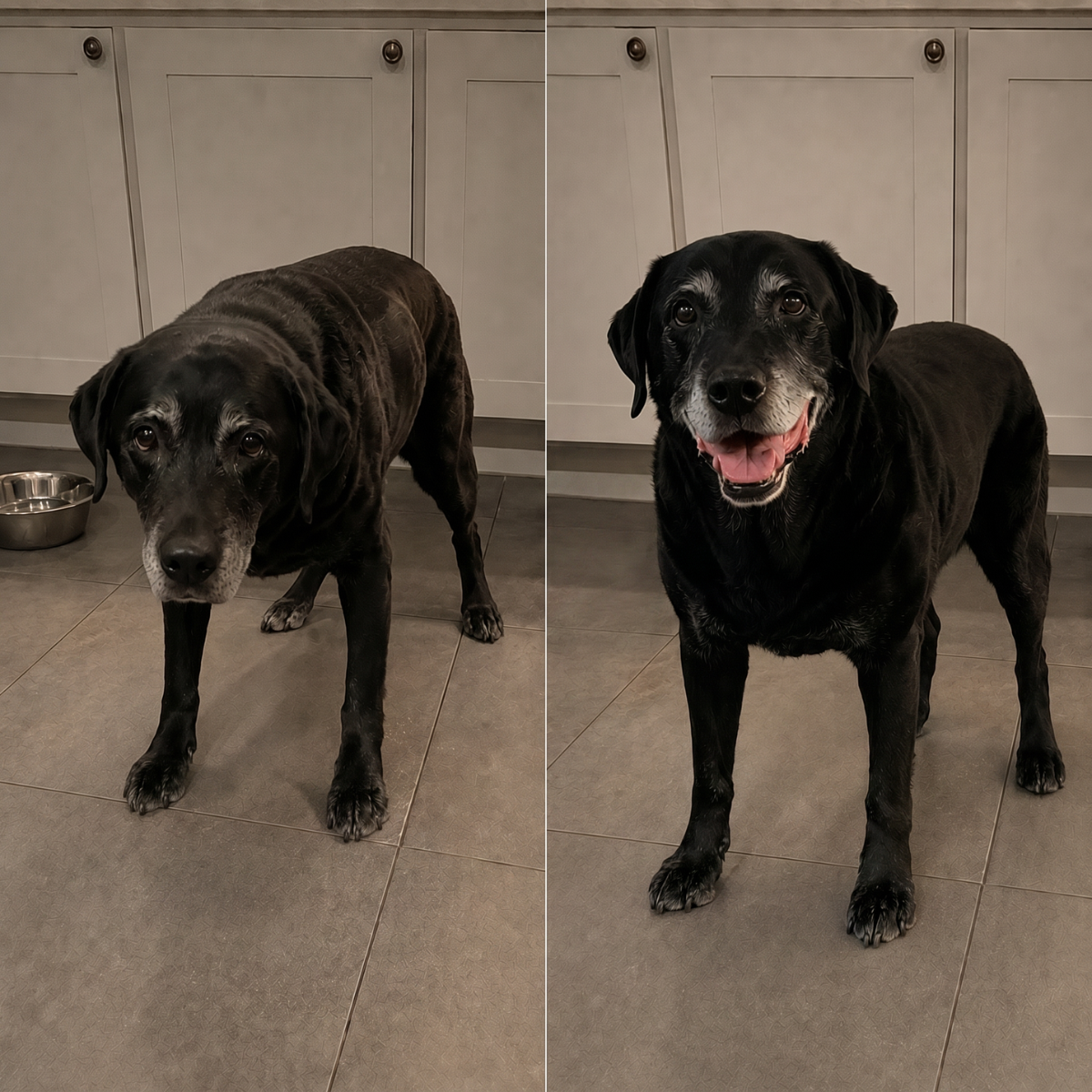
I am going to say something that nobody who has a senior dog with weak back legs wants to hear and I genuinely do not care if it upsets you. Glucosamine is not going to fix your dog. Not glucosamine. Not Galliprant. Not Adequan injections. Not the Librela shot your vet just recommended. NONE OF IT IS GOING TO FIX THIS. I know because I tried ALL of it. Every medication. Every injection. Every supplement. For two years. And my dog got so bad that my vet started using the words "keep her comfortable." Because I spent two years treating symptoms of a problem that nobody ever bothered to explain to me. And the worst part? My second dog started showing the exact same signs. Same age. Same hind legs. And I almost let the whole nightmare happen again because I was still following the same advice that was failing my first dog. I'm done being polite about this. If your senior dog is slipping and you're in here asking whether to increase the Adequan dose or try Librela or add another joint supplement, you are wasting time and money your dog does not have. Read this entire post. Every word. Because the answer is in here and it is NOT another prescription. I live in Manchester with my husband James and our two dogs. Rosie was 8 years old. My shadow. The kind of dog who'd plant herself at your feet the moment you sat down and just stay there. Wherever I was, she was. Bear is 5 years old. Completely different personality. Loud. Clumsy. Steals everything off the kitchen counter. Two completely different dogs. But they had the same problem. They both had weak back legs. Getting worse every month. Every single month. For Rosie, it started when she was about 7. The kitchen tiles first. Then the hallway. Then every smooth surface in the house. She'd splay out sideways trying to stand up after lying down. I'd watch her scramble — front legs doing all the work, back end dragging behind. She started kicking one leg out like a kickstand just to stay upright. At night I'd hear the sound of her claws scraping the floor. Over and over and over. Trying to find grip that wasn't there. I took her to the vet. "Arthritis. Very common in dogs her age. Let's start her on Galliprant." £80 a month. But it helped. For the first few months she moved more easily. Got up quicker. Seemed less stiff. I thought we were on top of it. Then it started coming back. Not all at once. Slowly. Like someone turning the dial down one notch at a time. A little splaying after long walks. Some hesitation before getting up. Then the scraping on the tiles again. Faintly at first. Then every morning. I told my vet. "Let's add Adequan injections." We added them. Helped for maybe 6 weeks. Then the weakness crept back. "Let's consider Librela." £110 every four weeks. On top of the Galliprant. On top of the Adequan. Monthly spend: over £200. And Rosie was still slipping. Still splaying on the kitchen tiles. Still needing me to help her up after lying down. Still struggling to make it up the two steps into the garden. £200 a month for a dog who was still getting weaker. I posted in a Facebook group. "Rosie's on Galliprant AND Adequan AND Librela and her back legs are still getting worse. Has anyone dealt with this?" Everyone had suggestions. "Get yoga mats. Lay them everywhere so she can't slip." "Try toe grips. They stick on the toenails." "Hydrotherapy. Gets the muscles working without the load." "Glucosamine chews. Give it time." "Physiotherapy. My dog responded really well." So I tried. I tried everything they told me to try. Yoga mats and carpet runners laid across every room like a sidewalk. She still splayed out the moment she stepped off the edge. Toe grips. Two sizes. She shook them off within an hour. Glucosamine chews. £35 a month for three months. £105 total. Rosie ate them every morning wagging her tail. Still slipped every night. The chews tasted good. That's all they did. Fish oil. CBD oil. I was adding so much to her food she'd sniff the bowl and walk away. Physiotherapy. £90 a session. Three sessions. She'd be steadier for a day. Then back to the same. I was driving 40 minutes each way for one good day out of seven. I stopped adding up the total because the number made me physically sick. And Rosie was getting worse. Her back end went from weak to almost useless. I could see the muscle wasting — her haunches that used to be strong and round were sunken. Her hind legs had lost mass no matter what we did. The Librela had helped the pain, but two weeks after the injection she couldn't get herself up off the floor at all. I had to deadlift her back end every time she needed to go outside. At 2 AM. At 4 AM. Every night. She stopped coming to greet me at the door. Stopped following me room to room. She'd just lie on the cool tiles and wait for me to come to her. She wasn't distressed. But her eyes looked different. Tired. Like she'd accepted that this was her life now. Like she'd stopped expecting things to get better. That look is what broke me. I sat on the floor next to her one night and held her while she lay there unable to get up. And I thought: I am watching my dog disappear. Slowly. Week by week. Month by month. And I can't stop it. I started Googling "quality of life assessment for dogs." I'm not proud of that. I read through the criteria. Mobility. Hygiene. Happiness. Pain. I scored her honestly. I closed the laptop and sobbed on the kitchen floor. Rosie dragged herself over to where I was sitting and put her head in my lap. She couldn't stand up to reach me. But she still came. She didn't understand why I was crying. She just knew I was sad. My dog was comforting me. While her back legs were failing underneath her. I wanted to scream. That was a Tuesday. I remember because the next day — Wednesday — Bear slipped on the kitchen floor for the first time. He was 5. Same size Rosie was at that age. Same build. Same breed. His back legs slid out sideways. He scrambled. Got up. Looked at me. I recognized it immediately. The exact same start. The exact same floor. The exact same look. I knew what was coming. I'd watched the entire two-year decline with Rosie. I knew exactly what the next two years looked like for Bear. Two years of medications that help then fade. Two years of injections getting closer together. Two years of supplements aimed at the wrong target. Two years of vet bills stacking up while the problem gets worse underneath everything. I could not do it again. I could not spend another £3,000. I could not deadlift a second dog at 2 AM. I could not watch another pair of eyes go from hopeful to resigned. I could not sit on the kitchen floor and cry anymore. I needed to understand WHY. Not "what to try next." WHY. Why did the Galliprant help and then stop? Why did the Adequan need to get more frequent? Why did the glucosamine do nothing for her strength? Why did the Librela manage the pain but leave the weakness? Why did the problem get worse every single month no matter what I threw at it? Three vets in two years. Not one of them answered WHY. They all answered WHAT. What to prescribe. What to inject. What to try next. Not one of them told me why everything kept failing. I spent two weeks researching. Every night after James went to sleep. Reddit. Facebook groups. Veterinary research papers. I read everything I could find. And at 2 AM on a Tuesday, I found a post from a woman who'd taken her dog to a veterinary research consultant. The consultant had explained something no vet had ever told her. And when I read it I felt like the floor opened up underneath me. Because it explained everything. Why the Galliprant fades. Why the Adequan injections need to get closer together. Why glucosamine never touched her strength. Why the Librela managed the pain while the weakness kept growing underneath. And it was so simple. So obvious once someone explains it. That I wanted to throw my phone at the wall because three vets had charged me £200 a month for two years without ever mentioning it. Here's what nobody told me for two years: By age 8, dogs lose more than 50% of a compound called NAD+ inside their muscle cells. Inside every one of your dog's muscle cells is a tiny engine called a mitochondrion. That engine produces the energy that allows the muscle to fire. The fuel for that engine is NAD+. In young dogs, NAD+ levels are high. In senior dogs, they crash — by more than 50% by age 8. When NAD+ drops, the engines run out of fuel. Muscle cells weaken. The hind legs lose strength, stability, and the ability to hold your dog upright. Then the cycle accelerates. The dog moves less. The muscles atrophy more. The joints take more load. The cartilage wears faster. The dog moves even less. That's the splaying. That's the scraping on the floor. That's the kickstand leg. That's the bunny hop on walks. That's the back end that sinks after five minutes standing. All of it. Every single symptom. One cellular fuel shortage showing up in different muscles at different speeds. And here's the part that made me feel physically ill: Glucosamine supports cartilage. That's ALL it does. It does not touch the mitochondria. It does not restore NAD+. The cellular fuel keeps depleting while the glucosamine treats a completely different problem. That's why it never made a difference to her strength. It wasn't failing. It was aimed at the wrong target entirely. And the pain medications — Galliprant, Adequan, Librela — they manage the pain signal. They do not restore cellular energy. So the dog moves more comfortably for a while. But the muscle cells keep losing fuel. The weakness keeps deepening underneath the pain relief. So you increase the dose. Helps for a bit. Cells get weaker. So you add injections. Helps for a bit. Cells get weaker. So the injections get closer together. Every 4 weeks. Then every 3. Then the vet suggests Librela. More pain relief. Bigger fuel shortage. Shortage keeps growing. The pain relief can't keep up. It will never keep up. And it gets worse. The veterinary research consultant explained that when dogs are in pain they move less. When they move less, the muscles that depend on NAD+ for energy atrophy even faster. So the medications that reduce pain and encourage a little more movement are working against a cellular engine that has no fuel left to run on. So the medication I was spending £200 a month on wasn't just failing to fix the cause. The underlying fuel shortage was accelerating through all of it. For two years. Two years. Three vets. Galliprant. Adequan. Librela. Glucosamine. Physiotherapy. Toe grips. Yoga mats. £3,500+. And the weakness got worse through all of it. Because not ONE person told me about NAD+ depletion. Not once in two years did anyone say the word "mitochondria" to me. Not one vet. Not one Facebook group. Not one pet store. Nobody. They told me WHAT to buy. They never told me WHY it wouldn't work. The why is the cellular fuel. I emailed every veterinary research consultant I could find the next morning. Found one recommended in a longevity research forum. Had a call that week. Didn't care about the cost. She was the first person in two years who didn't suggest another prescription. Dr. Sarah Hollis. Veterinary research consultant. She said she doesn't profit from Galliprant or Librela. She said she'd rather explain the actual problem and let owners decide. She confirmed everything I'd read at 2 AM. The NAD+ depletion. The mitochondrial fuel shortage. The death spiral — moves less, atrophies more, joints take more load, cartilage wears faster, moves even less. The medication race. The acceleration. All of it. And then she said the thing that made everything click. "The muscle cells need their fuel restored. NAD+. The actual compound the mitochondria run on. You cannot restore cellular energy with glucosamine. You cannot restore it with pain medications. You cannot restore it with fish oil or CBD. None of those things are NAD+. You need NMN — the direct precursor that the body converts into NAD+ inside every cell." "So I just buy NMN?" "Not that simple. NMN in standard chew or capsule form barely absorbs. Studies show less than 30% reaches the bloodstream. The rest passes through your dog's system without ever reaching the muscle cells. Most of what you give in chew form never arrives at the cells." "What about the NMN supplements I've seen online?" Her expression changed. "I've looked at them. Most are underdosed, in the wrong format, with no delivery system that survives stomach acid. I've been tracking the NMN supplement market for dogs for three years." She pulled out her notes. "The only delivery system that solves the absorption problem is nanoliposomal — a liquid technology that wraps each NMN molecule in a microscopic protective shell. The shell survives stomach acid and delivers the compound directly into the bloodstream. Up to 98% absorption. That's the difference between a supplement that contains the right ingredient and one that actually fuels the muscle cells." "Most brands don't use it. It's expensive. It has to be liquid — you can't compress nanoliposomal delivery into a chew. Most brands take the cheaper route because it's more profitable. The ones that do it properly are the ones where owners actually see results." She pulled out a piece of paper. "There's one formula I keep coming back to after everything I've reviewed. I don't sell it. I don't profit from it. I recommend it because I've seen what it does in the dogs I follow — and I've seen what everything else doesn't." I ordered it that night. £38 a bottle. I got the multipack and it came out to about £28 a bottle. I started Rosie on it the next morning. One dropper on her food alongside everything else. Dr. Hollis told me not to stop any medications. Just add it and let the cellular fuel restore underneath. I started Bear on it the same day. His slipping had just begun. He was 5. Early. Before the spiral. For Rosie — the dog who'd been declining for 2 years: First 2 weeks: I kept watching. Kept listening at night for the sound of her claws scraping. Kept waiting. Week 3: The night scraping decreased. Not gone. But less. I lay in bed holding my breath, listening. Fewer attempts. Longer pauses between them. Week 4: Rosie got up from her bed on her own. The entire way. First time in over three months without me helping. I woke up and heard her moving in the kitchen. I ran in. She was standing at her bowl. On her own. No splay. No scramble. I stood there and watched her eat for five minutes. Week 6: She made it up the two garden steps on her own. I'd been carrying her back end up those steps for four months. I kept expecting her to stop and wait for me. She didn't stop. She just went up. I called James into the garden. "Watch this." He watched. "She just... did it?" "She just did it." Week 8: The splaying on the kitchen tiles stopped. She was walking with her paws flat on the floor. Not perfectly. But flat. I took a video every week. You could watch the strength coming back in the way she moved. Month 3: I tapered the Galliprant with my vet. Half dose for two weeks. Then stopped. No increase in weakness. The Adequan injections went from weekly to monthly. Then we stopped those too. Month 4: She was on one dropper on her food. Nothing else. £28 a month. Her back end had filled out again. The muscle wasting that had made her haunches look sunken was reversing. She was following me room to room again. Waiting at the door when she heard me coming home. She brought me her lead the first morning after we stopped the Adequan. Carried it across the kitchen floor and dropped it at my feet and wagged her whole body. I sat on the floor and held her and cried for twenty minutes. For Bear — the dog who was just starting: Week 3: The slipping on the kitchen floor stopped. Just stopped. Month 2: No hind leg weakness developing. No splaying. No scraping at night. Nothing progressed. The cellular fuel was being restored before the spiral could take hold. He never went on Galliprant. Never needed Adequan injections. Never had a Librela shot. Never cost me £200 a month. Never cost me a single sleepless night carrying him outside. Because I caught him at 5. Before the NAD+ crash got bad. Before the muscles started losing mass. Before the spiral. One dropper a day. Before the nightmare. I sat down one night and added up what I spent on Rosie over 2 years. Galliprant: £960. Adequan injections: £780. Librela: £440. Glucosamine chews: £280. Physiotherapy: £270. Vet visits and diagnostics: £600. Yoga mats, toe grips, ramps, non-slip socks, everything else: £200. £3,530. £3,530 on treatments that were all doing the same thing — managing the symptoms while the cellular fuel kept depleting underneath. Not one pound went toward restoring the NAD+ inside her muscle cells. Not one. 4 months of it: £112. Rosie is stronger on £28 a month than she ever was on £200 a month. Because £200 a month was aimed at the wrong target. Every pound managed the symptom. Not one pound fixed the cause. And the cause was always the cellular fuel. Bear will never go through what Rosie went through. I will never spend £3,000 on his hind legs. I will never deadlift him outside at 2 AM. I will never watch his eyes go from hopeful to resigned. I will never sit on the kitchen floor and cry about him. Because I started him on £28 a month before the NAD+ crashed. And it never will. The product is Zoomies NB-1. NMN, NAD+, Resveratrol, CoQ10. Liquid. 98% nanoliposomal absorption. Vet-formulated. tryzoomies.com/products/zoomies-nb-1 Start it alongside whatever your dog is on right now. Don't stop any medications. Just add one dropper to their food. Let the cellular fuel restore underneath. 2–4 weeks for the first signs. That's what it took for Rosie after 2 years of everything else failing. You'll see it before you expect it. The morning she gets up on her own. When her paws are flat on the floor instead of splayed. When she makes it up the stairs without waiting for your help. When she brings you her lead again. That moment is what £28 a month looks like. I wish I'd found it two years and £3,530 ago. P.S. Rosie declined for 2 years while I spent £3,530 on treatments that managed the symptoms while the cellular fuel kept depleting underneath. 4 months of £28/month did what 2 years of £200/month prescriptions couldn't. The NAD+ depletion was the problem the entire time. Every vet treated the pain signal. Nobody treated the cellular cause. Because there's no recurring revenue in restoring cellular fuel. There's recurring revenue in monthly Galliprant prescriptions and Adequan injections and Librela shots forever. £200/month forever. That's the model. £28/month that addresses the cause. That's not something the prescription model wants you to find. P.P.S. If your dog is 6 or 7 and just starting to slow down — you are in the best position possible. The NAD+ crash hasn't fully set in yet. The muscle loss is small. Start now. Before the splaying. Before the scraping. Before the first Galliprant prescription. Before the first £200 month. Bear is proof. Same household. One got it early. One didn't. The difference is £3,530 and two years of watching her disappear. Don't wait. tryzoomies.com/products/zoomies-nb-1
Where the ad sends people
tryzoomies.com
Read This Before Your Next Vet Bill
Zoomies
Learn more: tryzoomies.com(opens in a new tab)