
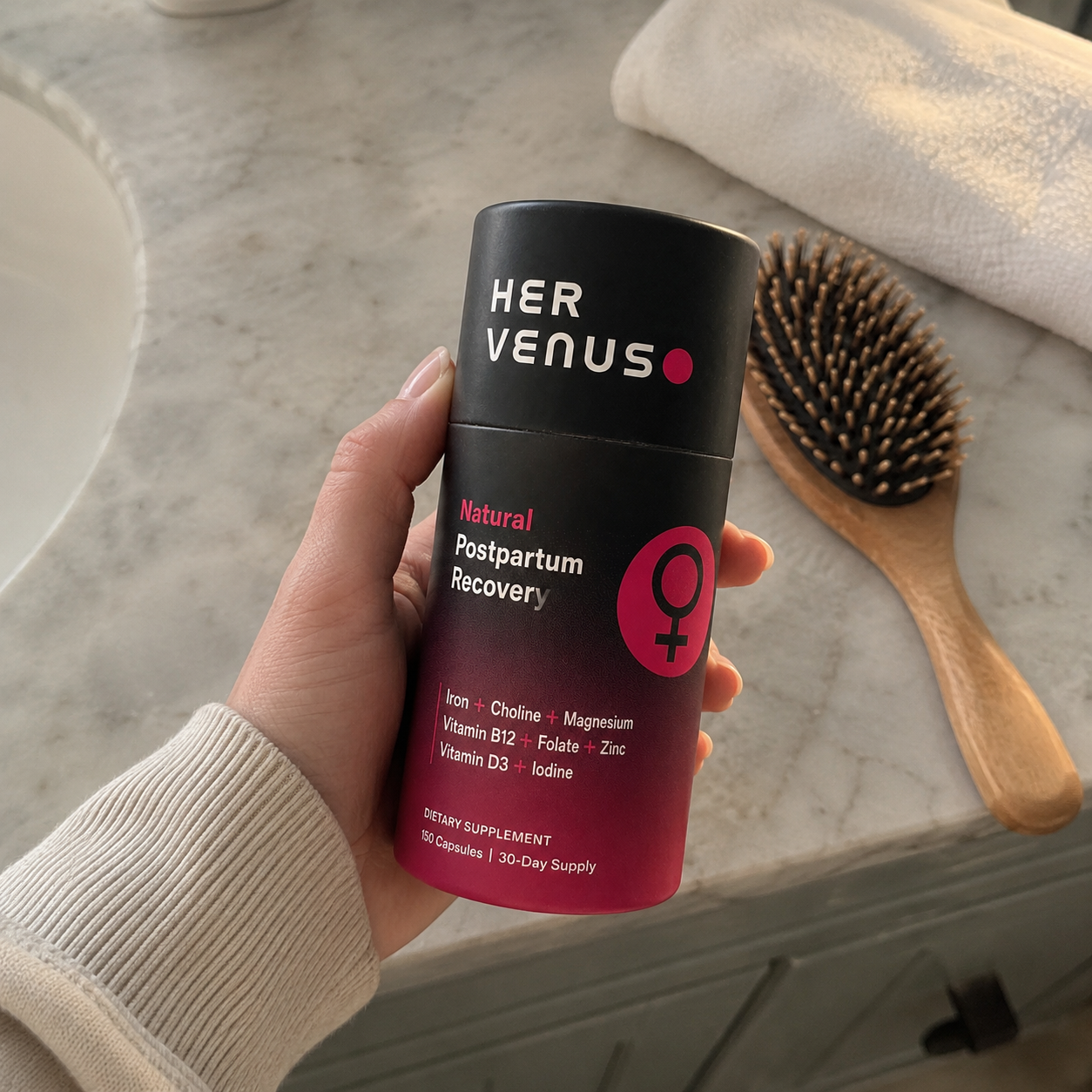

Her Venus
Active· since Jul 14, 2026
- 68
- days running
- 0
- relaunches
Ad copy
Everyone prepares you for what pregnancy does to your body. Nobody warns you the real hair loss doesn't even start until after she's already here. I read every book. I joined every app. I knew, going in, that pregnancy might change my skin, my nails, my waistline. What nobody mentioned — not the books, not my OB, not a single one of the forty-seven Instagram accounts I followed for "realistic" pregnancy content — was that the hair loss doesn't happen during. It happens after. Once you're already exhausted. Once you're already stretched so thin you don't have an ounce of bandwidth left to deal with something new. Nobody warns you about that. So when it happened to me, I genuinely thought something was wrong. Month one, month two: nothing. For the first two months postpartum, if anything, my hair felt thicker. Fuller than it had been in years — which tracked, because everyone had told me pregnancy hormones do that. Nobody mentioned that this was borrowed time. That thick, glossy, doesn't-shed-normally hair during pregnancy is exactly the setup for what comes next. Month three: the first sign. It started small. A few more strands in the shower drain than usual. I noticed it, shrugged, moved on. Month four: I started counting. By month four I wasn't shrugging anymore. I found more hair in the shower drain than on my actual head some mornings — genuinely, visibly more. I started counting strands on my pillow in the morning, which is a strange, quietly panicked thing to catch yourself doing at 6am with a baby monitor going off in the next room. My ponytail — the one I'd worn the same way for a decade — went from needing a full fist to wrap the hair tie around, to fitting comfortably around two fingers. Three months. That's all it took. Month five: the shame started creeping in. It wasn't just the hair loss itself. It was what it started to do to how I saw myself. I began avoiding mirrors in bright light. I started wearing hats to the grocery store — not for warmth, just to avoid anyone seeing the widening part down the middle of my head. I remember standing in my bathroom one night, running my fingers along my part, feeling this strange grief that I didn't know how to explain to anyone. It felt too small a thing to be upset about — I had a healthy baby, I should have been grateful, and I was grateful — but grief doesn't really care about proportion. I was grieving my hair the way you grieve anything that quietly stops being yours. The moment that actually broke through. The moment that got to me wasn't dramatic. It was small, and it happened in a hair salon chair. I'd finally booked my first postpartum trim — something I'd been putting off for months, partly because I didn't want anyone confirming what I already suspected. My stylist, someone who'd done my hair for years, went quiet partway through, running her fingers along my part in the mirror. "Is everything okay?" she asked, gently. "Are you going through something?" I didn't know what to say. I just said "new baby," like that explained everything, and let her change the subject. But I went home and actually looked — really looked, under bright bathroom light, at how thin it had gotten. And for the first time, instead of just feeling ashamed of it, I got curious. Angry, almost. I wanted to know why nobody had warned me this was coming, and whether there was anything actually within my control, or whether I just had to sit and wait it out for a year. The rabbit hole. I did what everyone does at 1am with a sleeping baby and a laptop glow in a dark room: I fell into a research spiral. Here's what I learned, and it actually helped, even before anything changed physically. Postpartum hair shedding — the clinical term is telogen effluvium — is driven primarily by the sudden drop in estrogen after birth. During pregnancy, elevated estrogen keeps a much higher percentage of your hair in its active growth phase than normal, which is why so many women report thicker hair while pregnant. It's not extra hair. It's hair that should have shed months earlier, held in place artificially by hormones that are about to disappear. When estrogen drops after birth, all of that "overdue" hair shifts into its shedding phase more or less at once. That's the clump in the drain. That's the disappearing ponytail. It's not a sign anything is wrong with you. Something like 40-50% of postpartum women go through a version of this, typically starting two to four months after birth — almost exactly the timeline I was on. That part, on its own, is basically unavoidable. Knowing that helped me stop panicking, but it didn't answer the question I actually cared about: why does it seem so much worse and last so much longer for some women than others? That's where it got interesting. Why some women recover faster. The shedding trigger — the estrogen drop — is universal. But how severe it gets, and how long it drags on before regrowth catches up, has a lot to do with what your body actually has left to work with while it's trying to rebuild. Delivery costs you blood. Blood loss costs you iron — sometimes significantly, especially with a longer labor, a C-section, or any degree of postpartum hemorrhage, which is far more common than most of us realize going in. And iron deficiency doesn't just affect energy. It's directly tied to hair follicle health, because your follicles are some of the most metabolically active cells in your body — they're some of the first things your body deprioritizes when iron stores run low, because growing hair is, biologically speaking, optional in a way that your heart and brain are not. Zinc plays a real supporting role too — it's involved in the actual protein synthesis your follicles need to rebuild hair, and postpartum depletion of zinc is common and rarely screened for. So the shedding itself, I couldn't stop. Nobody can. But how depleted my body was while trying to recover from it — that part was actually addressable. I went and checked the label on my prenatal, the one I'd been taking faithfully since week twelve. It had a small dose of iron in it — nowhere close to what's actually recommended for postpartum replenishment, and no meaningful zinc at all. Which made sense, in a frustrating way, once I thought about it: that vitamin was built to support a growing baby. Nothing about it was built to rebuild a mother who'd already given birth. Trying to fix it. I want to be honest that I didn't get this right immediately. I tried a basic iron supplement from the pharmacy first — the kind everyone's grandmother has taken for decades. It upset my stomach within days and I gave up on it within two weeks, more depleted and more discouraged than when I started. That's when a friend — someone who'd gone through a rough postpartum recovery herself two years earlier — mentioned HER VENUS. Not as a miracle. Just as "the only thing that was actually dosed for what postpartum takes from you, instead of just being a prenatal with a different label." I didn't expect much. I was tired of expecting things from bottles. What actually happened. I started taking it consistently, five capsules a day, mostly because I'd committed to giving it a real chance instead of quitting after two weeks like the last one. Weeks one and two: honestly, nothing dramatic. The shower drain situation didn't visibly improve. I told myself I hadn't expected it to — hair doesn't work on a two-week timeline, no matter what anyone claims. Week four: the first thing I noticed wasn't my hair at all. It was that the 3pm wall — the bone-deep exhaustion that had been hitting me every single afternoon for months — wasn't quite as brutal. I could get through the afternoon without needing to sit in my car for ten minutes before I could face going back inside. Week seven: I noticed, running my fingers through it after a shower, a faint prickle of new growth along my hairline — those short, wiry baby hairs that everyone talks about as the first real sign things are turning around. Week ten: my stylist, at my next appointment, ran her fingers through my part the same way she had before — but this time she smiled instead of pausing. "This is filling back in," she said. I didn't tell her about the supplement right away. I just sat there, quietly relieved, because someone else had confirmed what I'd started to hope I wasn't imagining. Three months in: the drain stopped being something I dreaded looking at. My ponytail still isn't back to what it was before — but it's not shrinking anymore. It's growing back. I still find loose hairs some mornings. That's normal, and it probably always will be, to some degree. But I stopped wearing hats to the grocery store. I stopped avoiding mirrors in bright light. What I'd tell someone at month four, standing where I was standing. If you're finding more hair in the drain than feels normal. If your ponytail is shrinking faster than you can explain. If a hairstylist has ever paused and asked, gently, if you're okay — I want you to know two things. First: what's happening to you is common, hormonal, and not a sign that something is broken in you. Nearly half of postpartum women go through some version of this. Second: how long it lasts, and how severe it gets, isn't entirely out of your hands. Replenishing what birth actually costs your body — iron and zinc specifically — is something real you can do, even while the hormonal shedding itself runs its natural course. Nobody warned me the hair loss came after, not during. I'm telling you now, so it doesn't blindside you the way it blindsided me — and so you know there's something real you can actually do about it, instead of just waiting it out in a hat. See what's actually in HER VENUS, and why it's dosed for postpartum recovery → https://www.shegoestovenus.com/products/natural-postpartum-recovery
Like this ad? Make it yours.
Crush rebuilds this exact creative around your product — your brand, your colors, your offer — in about a minute.