
Inactive· since May 27, 2026
- 3
- days it ran
- 0
- relaunches
- 9
- EU reach
Ad copy
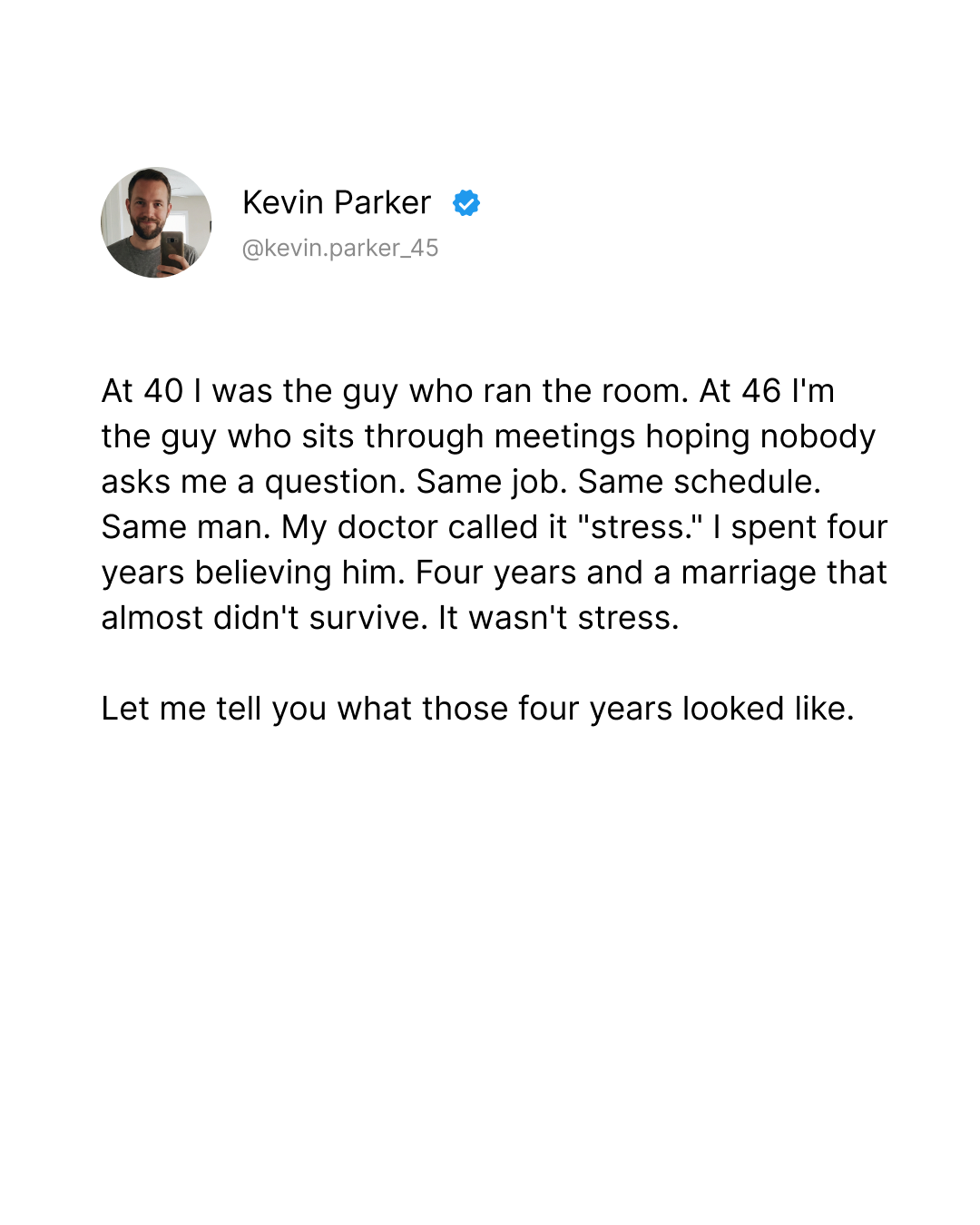
My husband used to be the patient one. Between the two of us, I was the one who'd snap. He was the calm one. The one who'd talk the kids down, who'd laugh off traffic, who'd say "it's fine" and actually mean it. Then somewhere around 41 that man disappeared. Now everything makes him angry. The traffic. The kids. The dishwasher that loads wrong. The way someone breathes. Same house. Same man. His doctor said it was stress. Work pressure, long hours, normal for his age. Eighteen months believing that. It wasn't stress. Let me tell you what I watched. Because watching someone you love turn into someone you don't recognize is its own kind of grief. At 40, he started coming home tight. Not angry — just tight. Like he'd been holding something all day and hadn't put it down yet. I'd give him twenty minutes. He'd decompress. Then he'd be back. At 41, the twenty minutes stopped working. He'd come home tight and stay tight. Through dinner. Through the kids' homework. Through bedtime. He'd go to bed tight and wake up the same way. At 42, the snapping started. Small things. The kids being loud at dinner. A slow driver. Me asking what he wanted for dinner in the wrong tone. He'd snap and then immediately look like he hated himself for it. That look — that flash of shame right after — that was the thing that broke my heart. He wasn't enjoying it. He wasn't choosing it. It was coming out of him before he could stop it. I watched him try. He started going for walks after work. Thirty minutes, headphones in, around the block. He'd come back and be okay for an hour. Then the tightness would come back. He tried going to bed earlier. He tried cutting coffee. He tried a meditation app for eleven days and then stopped without saying why. Nothing touched it. His doctor ran bloodwork. Everything normal. "You're in great shape," the doctor said. "Just manage your stress better." He came home from that appointment quieter than usual. I asked how it went. "Fine," he said. In the voice that meant: not fine. I watched my husband apologize to our kids more times in one year than in the previous ten combined. I watched him sit on the edge of the bed at night with his head in his hands. I watched him say "I don't know what's wrong with me" in a voice so quiet I almost didn't hear it. He knew something was wrong. He just didn't have a name for it. Then one night — a Wednesday, 11 PM — I was in bed scrolling while he was in the shower. I found a post in a women's health group. A woman had written about her husband. Same story. Same snapping. Same shame after. Same doctor saying "bloodwork is fine." She wrote: "It wasn't his personality. It was his cortisol. His nervous system had been running in threat mode for so long it had no buffer left. Every small thing felt like an emergency because his body was already treating everything like an emergency." I read it twice. She explained: when cortisol stays elevated for months — the kind of chronic low-grade stress that comes from years of high-pressure work, poor sleep, never fully recovering — the nervous system loses its ability to filter. Normal irritations get processed as threats. The brain's threat response fires at things that don't deserve it. The person isn't angry. They're dysregulated. And they can feel it happening and can't stop it, which makes it worse. The shame spiral. The "I don't know what's wrong with me." That wasn't weakness. That was a man watching his own nervous system misfire and not knowing why. He came out of the shower. I showed him the post. He stood there in the doorway reading it. Towel around his waist. Still wet. Reading. He looked up. "The buffer thing," he said. "That's exactly it. It's like I have no buffer. Everything just — hits." "Yeah." "But it's not — I'm not actually angry at the kids." "I know." "I don't want to be like this." "I know." The post mentioned Liven. Not anger management. Not therapy. Something that works with the nervous system directly — to bring cortisol down so the buffer comes back. So the threat response stops firing at dishwashers and slow drivers. He took the quiz that night. Still in the doorway, towel still on. The quiz didn't ask about anger. It asked about the state he'd been running in. About feeling wired but exhausted. About waking up already behind. About the gap between how he wanted to respond to things and how he actually responded. About carrying something all day that he couldn't put down. He clicked yes to almost everything. "I thought this was just who I was becoming," he said. "I thought this was just 42." "It's not 42." He downloaded Liven. 11:45 PM. Still in the doorway. Here's what I watched happen. Week 1: He came home and the tightness was still there. But he caught it. He said "I need ten minutes" and went outside and came back and was actually back. Not performing back. Actually back. That was new. Week 2: Dinner. The kids were loud — the way kids are loud, the normal chaos of it. He looked up. I braced. He laughed. Actually laughed. I looked at him. He looked at me. "I don't know," he said. "It just didn't land the same way." Week 3: He slept through the night. Fully. He woke up and the first thing he said was "I didn't wake up at 3." Like he'd been waiting to say that for months. Week 4: Our son knocked over a full glass of juice at breakfast. All over the table, the floor, his work bag. I watched my husband's face. I watched him take one breath. Then he got up and got the paper towels and said "okay, let's clean it up" in a voice I hadn't heard in two years. Our son looked at me. I looked at my son. Week 6: He came to bed and said something I've been thinking about since. "I feel like I can hear myself again. Like there's space between what happens and how I react. I forgot that space existed." It's been four months. The man who came home tight every night and snapped at dishwashers and sat on the edge of the bed with his head in his hands — I don't see him anymore. I see my husband. The patient one. The one who laughs off traffic. The one who was always there. He came back. Not because he tried harder. Not because he managed his stress better. Because someone finally asked about his nervous system instead of telling him his bloodwork was fine. Last week our daughter climbed into his lap while he was reading. He put the book down and just held her. No tightness. No performing patience. Just there. I watched from the kitchen. I didn't say anything. Some things you just watch and hold onto. If your husband snaps at things that don't deserve it — if he apologizes and means it and does it again anyway — if his doctor says "bloodwork is fine" and you both know something isn't — It might not be his personality. It might not be stress. His nervous system might be stuck in something nobody has thought to ask about. Show him this. Not as "you need to fix yourself." As: "I think your body lost its buffer. And I think there's a way to get it back." Liven has a quiz. A few minutes. Free. Link is below. 💙 P.S. He loaded the dishwasher last Sunday. The wrong way — the way that used to set him off when I did it. I watched him notice. He closed it and said nothing. That was everything.
THIS IS what you need to do
LEARN MORELike this ad? Make it yours.
Crush rebuilds this exact creative around your product — your brand, your colors, your offer — in about a minute.