Crysta Rollins
 Facebook ad: “You are reading the Bible wrong.”
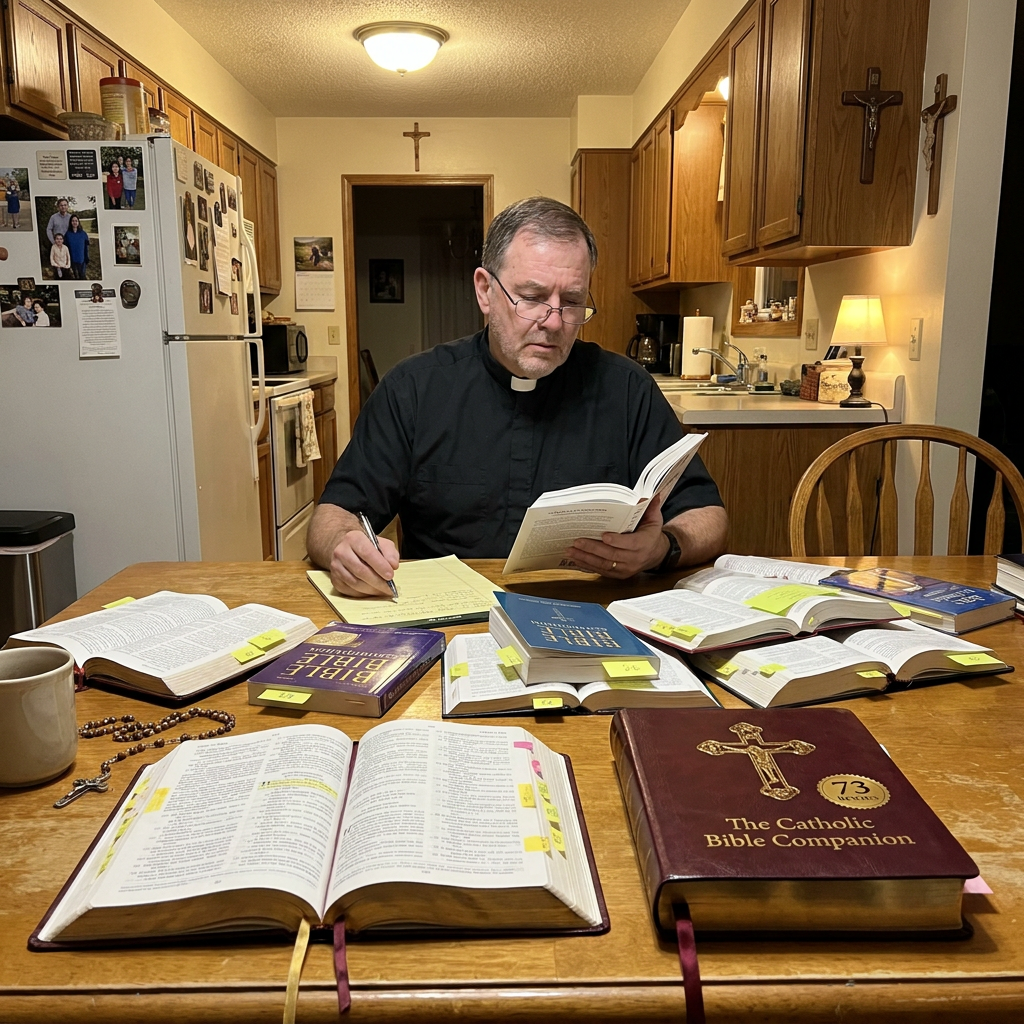
Ran for 46 days, from September 17 to November 2, 2026, the last day Crush saw it.
Run by Crysta Rollins on Facebook. Crush is not the advertiser and does not verify its claims. See this ad in Meta's Ad Library(opens in a new tab)
Make your own version of this ad
Crush makes it, launches it in your own Meta ad account, scales the winners and pauses the losers.
About this ad
- Meta Ad Library ID
- 2124738154916431
- Platforms
- Facebook, Instagram, Audience Network, WhatsApp and Threads
- Relaunches
- 0
- Niche
- Education & Courses
Ad text
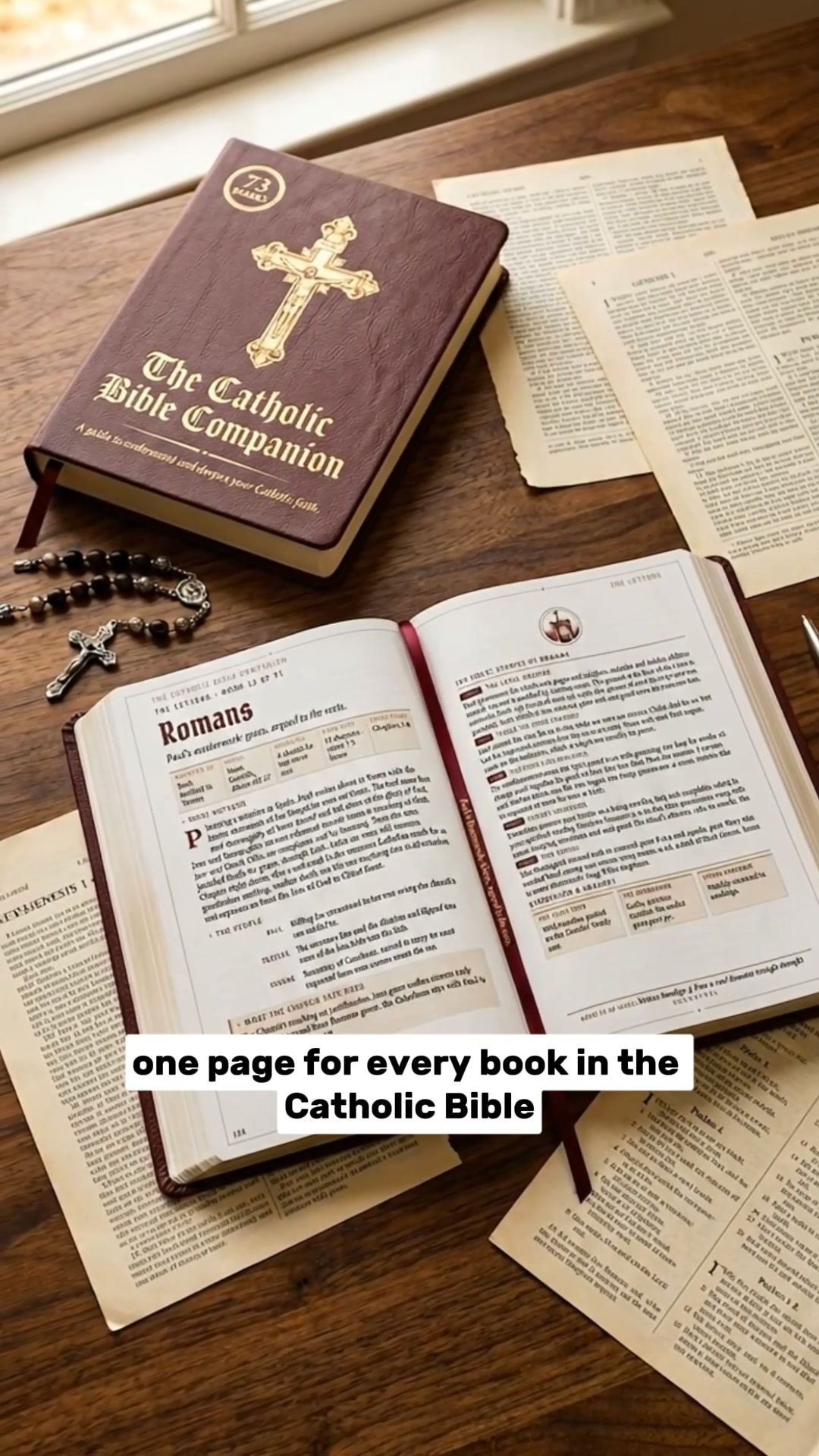
Every Catholic Bible companion on the market is built for the wrong Bible. I know because I bought 14 of them and counted. 66 pages. 66 pages. 66 pages. Every single one. Including three that said "Catholic Edition" on the cover. Your Bible has 73 books. Every companion on the shelf covers 66. And the 7 books missing from every one of them contain a prophecy of the crucifixion, the scriptural foundation for praying for the dead, the guardian angel tradition, the words of the Hail Mary, the Easter Vigil reading, and the clearest declaration of resurrection hope in the entire Old Testament. The 7 most distinctly Catholic books in the entire Bible. Missing from every tool on the market. Including the ones with a Catholic label on the spine. I am a permanent deacon. I have been ordained for 12 years. Before that I taught parish Scripture studies for another 8. I have a theology degree from a Jesuit university. I preach homilies at Mass. I teach RCIA. I baptize. I preside at funerals. I have stood at the ambo and proclaimed readings from every section of the Catholic Bible for over a decade. And for most of that time I was sending my own parishioners home with tools built for someone else's Bible. I did not know it. Not until the night 12 women showed me. It was a Tuesday. Our parish women's prayer group. I had been leading the Scripture portion for about 4 years. 12 women. Combined Catholic experience of roughly 600 years. Mass every Sunday. Rosaries every evening. Novenas completed. Candles lit. Holy hours attended. These were not lukewarm Catholics. These were the backbone of the parish. The women who show up to everything. The women who hold the whole operation together. We were studying the letter to the Romans. It had been the second reading at Mass the previous Sunday. I had preached the homily on it. I asked them what Paul meant when he wrote "there is therefore now no condemnation for those who are in Christ Jesus." Everyone nodded. One woman said it means we are forgiven. Another said it means God does not hold our sins against us. Good answers. Safe answers. The same answers they could have given before my homily. The same answers they could have given without ever reading Romans. Then I asked the question that broke everything. "Why did Paul write that specifically to the church in Rome? What was happening between the Jewish and Gentile believers in that city? And how does the argument Paul is making connect to what I placed on your tongue last Sunday at the altar?" Silence. 12 women. 600 combined years. Not one of them could tell me who Paul was writing to, what was happening in Rome, why the letter exists, or how the argument in Romans connects to the Eucharist they receive every Sunday from my hands. I had preached the homily on this passage 4 days earlier. I had spent 8 minutes explaining it from the ambo. They had nodded. They had said Amen. And by Tuesday they could not reproduce a single element of what I had said. Because my homily gave them my understanding. Not theirs. They borrowed it for 8 minutes and it was gone by the time they reached the parking lot. Maureen, Catholic for 68 years, said it plainly. "Deacon, I know the verse. I do not know what it means. I have never known what it means. I hear your homily and it makes sense while you are talking. But by Tuesday I cannot remember what you said. I just remember the verse sounded important." I drove home that night and sat in my kitchen for a long time. I was not angry at Maureen. I was angry at myself. And I was angry at something bigger than myself. Because I realized that everything I do at the parish, every homily I preach, every RCIA session I lead, every Bible study I facilitate, is built on the same broken model. I stand in front of people and I explain the Bible to them. They listen. They nod. They leave. And by midweek my explanation has evaporated because it was never theirs. It was mine. They were borrowing it. I had been giving them fish for 20 years. I had never once taught them to fish. But that was only the first problem. The second problem was worse. Because after that Tuesday night I went looking. I searched for the tool I should have been giving these women instead of my homilies. A simple companion. One page per book. Context before reading. Plain language. No seminary weight. The kind of thing any Catholic woman could read in 4 minutes at her kitchen table before she opens her Bible and actually understand what she is about to read. I found dozens. Every Christian bookstore had them. Every Amazon search returned them. Bible companions. Bible guides. One page per book. Context before reading. 66 books. Every single one. I bought 14. I stacked them on my kitchen table. I counted pages. 66. 66. 66. 66. 66. Three had "Catholic Edition" on the cover. I opened those three with hope. The best of them had 66 pages of main content and a 3-page appendix in the back covering all 7 deuterocanonical books combined. Three pages. For 7 books. I stared at that appendix for a long time. Three pages for the Book of Wisdom. The book that contains in chapter 2 a prophecy of the crucifixion so specific I have used it in homilies for 12 years. The book that contains in chapter 3 the passage I read over every casket at every funeral I preside at. The book that contains in chapter 11 the theology of mercy that Paul is building on in the very letter my women's group could not explain. Three pages shared with 6 other books for 2 Maccabees. The book that contains the verse I cite every single time a grieving widow asks me if her prayers for her dead husband reach him. "It is a holy and pious thought to pray for the dead, that they might be loosed from their sins." The verse that grounds every Mass intention. Every candle. Every rosary prayed for the departed. Sharing 3 pages with 6 other books. Three pages for Tobit. The book that contains the most detailed angel narrative in the entire Bible. The story of Raphael walking beside Tobias in disguise. The source of the guardian angel prayer I taught my own children. Reduced to a paragraph. Three pages for Judith. The book whose warrior widow was praised with the words "blessed are you among women." The words of the Hail Mary. The words I hear my parishioners pray 50 times every rosary. Reaching back through a deuterocanonical book to a woman who crushed the enemy's head. Crammed into a shared appendix. Three pages for Baruch. The book I proclaim from the ambo at the Easter Vigil every year. "Take off your garment of mourning and affliction, and put on forever the beauty of the glory from God." The promise the newly baptized are wearing when I pour the water over their heads. Treated as a supplement. I sat at my kitchen table at midnight looking at 14 Bible companions stacked in front of me and I understood for the first time what Maureen's real problem was. It was not just that nobody had given her context before reading. It was that nobody had given her context for HER Bible. Her Catholic Bible. All 73 books. Every tool she had ever used was built for a Protestant Bible. Even the ones with Catholic on the cover. The 66-book framework was the default. The deuterocanonical books were an afterthought. An appendix. A sidebar. And the books being treated as a sidebar are the books that contain the most distinctly Catholic material in the entire Bible. Maureen has been navigating a 73-room house with a map that shows 66 rooms. And the 7 rooms missing from the map are the ones with the Catholic furniture inside. The prophecy. The prayers for the dead. The guardian angel. The Hail Mary. The Easter Vigil. The Eucharistic theology. She could not find what she was looking for because the map did not show the rooms where it was kept. And she concluded she was the problem. She was never the problem. The map was wrong. The map has always been wrong. I stopped looking. I built the right one. It took me 14 months. Not because 73 pages takes 14 months to write. Because doing it right takes 14 months. Every page had to answer the same questions. Who wrote it. When. Why. What was happening. The key themes. How it connects to Catholic teaching. How it connects to the Mass. In language plain enough for Maureen to read at 6am with her coffee and deep enough for a seminarian to respect. The deuterocanonical pages could not be afterthoughts. They had to be built from primary Catholic scholarship. Not borrowed from Protestant commentaries that do not recognize those books as Scripture. Not adapted from the appendix pages I had found in every existing resource. Built from scratch. Wisdom gets the same page as Genesis. I wrote the page on Wisdom 11 times. Because Wisdom is the book that changes everything for a Catholic reader. Chapter 2 prophesies the crucifixion. Chapter 3 comforts every funeral I have ever presided at. Chapter 11 grounds the mercy. Chapter 16 names the bread from heaven as the food of angels. Four threads. One book. A deuterocanonical book. And no resource on the market had ever given it the page it deserves. Sirach gets the same page as Romans. Because Jesus echoed Sirach when He said "come to me, all who are weary." And the invitation in Sirach 51 is the invitation to the Eucharist. And my parishioners have never been told. Tobit gets the same page as the Gospel of John. Because the guardian angel prayer comes from Tobit. And the Feast of the Archangels on September 29 cannot be fully understood without a book most Catholics have never opened. Judith gets the same page as Psalms. Because the Hail Mary carries Judith inside it. And every rosary bead echoes a deuterocanonical warrior. Baruch gets the same page as Isaiah. Because I proclaim Baruch at the Easter Vigil every year and most of my parishioners have never known what they were hearing. 1 and 2 Maccabees get the same pages as 1 and 2 Kings. Because the verse that grounds the prayers for the dead deserves more than a paragraph in a shared appendix. 73 pages. Equal treatment. Equal depth. Because the Catholic Bible is 73 books and not one of them is supplementary. Then I designed the physical object. Because the physical object matters. I know who is going to use this. I have been watching her sit in my pew for 20 years. I have been placing the Eucharist on her tongue. I have been hearing her confession. I have been preaching homilies she forgets by Tuesday. I know exactly who she is. She is 58 years old. She has a rosary worn smooth from decades of use. Her faith is expressed through physical objects. Candles. Holy water. Medals. Scapulars. The Bible on her nightstand. The missal she carries to Mass. The Companion had to feel like it belongs in her hands. Like it belongs beside her Bible. Like it belongs in the tradition she has been living for 55 years. Real leather. Because the Bible beside it is leather and the Companion should match. Gold foil. Because the gold should echo the gold on the tabernacle and the gold on the chalice I elevate at Mass. Sewn binding. Because it should open flat beside her Bible without cracking. Ribbon marker. Because she uses one in her missal. Large clear type. Because she is reading at 6am with her coffee and her glasses. Every physical detail designed for Maureen. Not for the seminary. Not for the scholar. For the woman in the pew who has been faithful for 55 years and has been given Protestant tools her entire Catholic life. 14 months. 73 pages. 11 drafts of the Wisdom page. Leather and gold and sewn binding. Then I brought it back to the Tuesday group. Same room. Same chairs. Same 12 women. I set one at every place. "Before we pray tonight," I said, "read the page on Romans. 4 minutes." I watched their eyes move across the page. Maureen finished first. She looked up and her face was different than I had ever seen it in 4 years of leading this group. Not confusion. Not the polite attention I had been reading as comprehension for 4 years. Not the nodding. Understanding. "Paul wrote this to a church he had never visited. Divided between Jewish believers who felt the law still bound them and Gentile believers who felt freed from it. And the argument about justification that he is building is the argument the Catholic Church has been teaching at every altar for 2,000 years." She paused. "I have been hearing Romans read at Mass for 68 years. I have been hearing your homilies on Romans for 4 years. And this is the first time I have understood it myself. Not your understanding. Mine." That sentence almost broke me at the table. Because that was the whole problem stated in two words. Your understanding versus mine. For 20 years I had been giving them mine. The Companion gave her hers. Then I opened the page on the Book of Wisdom. "Now read this. 4 minutes." Most of them had never heard of the Book of Wisdom. The book I quote from the ambo. The book I read at funerals. The book that carries the theology I preach. And my own parishioners had never heard of it. They read the page. Then I said, "Open your Bibles to Wisdom chapter 2." Pages that had never been turned. I could hear the stiffness from where I was sitting. Paper untouched for decades in Bibles that had been carried to Mass every Sunday. They read the prophecy. A righteous man mocked and tortured and condemned. Written a century before Christ. Angela said, "This has been in my Bible for 57 years?" "Your whole life." "A prophecy of the crucifixion. In a book nobody told me about. Deacon, you preach from this book. You quote from it at funerals. Why did nobody ever tell us to READ it?" Because nobody built the tool. That is the honest answer. I could preach from Wisdom because I have a theology degree. Maureen could not read Wisdom because nobody had ever given her 4 minutes of context before she opened it. And no resource on the market provided those 4 minutes. For any of the 7 deuterocanonical books. Then Wisdom chapter 3. "The souls of the just are in the hand of God, and no torment shall touch them." Maureen held the Companion against her chest. "I have heard you read this over every casket. Over my husband's casket 3 years ago. And I never knew what was in the chapter before it. The crucifixion prophecy and then the funeral reading. The suffering and then the peace. Two chapters. One argument. In a book I have never opened." She looked at me. "The verse that comforted me at my husband's funeral and the verse that prophesied the crucifixion are one chapter apart. In a deuterocanonical book. In my Catholic Bible. And I have been carrying it for 68 years without knowing." Then 2 Maccabees. The prayers for the dead. Maureen said very quietly, "I have been offering Mass intentions for my husband for 3 years. You told me those prayers reach him. I believed you. But I never knew the verse. I never knew it was in my Bible. 'It is a holy and pious thought to pray for the dead.' In a book that every resource I have ever used pretends does not exist." She looked at me with something I had never seen from her in 4 years. Not gratitude. Anger. "Why did it take you 14 months to build this and 20 years to realize I needed it?" I did not have a good answer. Because she was right. Then Tobit. The guardian angel. "Angel of God, my guardian dear." Traced to a deuterocanonical book. Patricia said, "I have been praying that prayer since I was 5. I am 61. And tonight is the first time I know where it comes from." Then Judith. The warrior widow. "Blessed are you among women." Angela said, "The words of the Hail Mary. First spoken about a warrior in a deuterocanonical book. I have prayed the Hail Mary roughly 200,000 times and I did not know those words reach back through a book most Catholics have never read." Then Baruch. The Easter Vigil promise. Joan, the quietest woman in the group, said, "You read Baruch at the Easter Vigil every year. From the ambo. In your vestments. And I have never known what it was or that it was a deuterocanonical book or that Protestants do not have it. I have been hearing it as liturgical background noise. It is not background. It is the promise being fulfilled in real time on the most sacred night of the year." Then Sirach. "Draw near to me, you who are untaught, and lodge in the house of instruction." Jesus echoing it: "Come to me, all who are weary." At the end of that night Maureen came up to me. She was holding her rosary in one hand and the Companion in the other. "I have had the rosary for 68 years. I have had the Bible for 68 years. You have been preaching to me for 4 years. Father Tom has been preaching to me for 20 years before that. And until tonight nobody ever connected the rosary to the Bible. The Companion connects them. Every mystery of the rosary sits inside the whole story. And the whole story has 73 chapters. Not 66." She held up the Companion. "You built this?" "I built this." "Why did nobody build it before?" "Because Catholic publishing defaulted to the 66-book framework. Because the deuterocanonical books were treated as supplements. Because nobody asked Maureen what she needed. They kept building tools for the seminary and the scholar and never built one for the woman in the pew." She held both objects up. The rosary and the Companion. "This belongs beside my Bible. Not the study Bible with 1,400 pages of footnotes. Not the reading plan that dies in Leviticus. Not the Protestant podcast that covers 66 books. This. 73 pages. For my 73 books. In my hands. At my kitchen table. Before I read." Since that night the Companion has moved through my parish the way understanding moves. One person at a time. Patricia gave hers to her daughter who left the Church 6 years ago. Her daughter picked it up off the counter and read the page on Wisdom. She called Patricia that night. "Mom, there is a prophecy of the crucifixion in our Bible that nobody told us about." Three months later Patricia's daughter was texting her about the Book of Sirach. "Mom, the invitation to come and rest echoes Jesus. From a deuterocanonical book. How is this not the first thing they teach in RCIA?" She is right. It should be. Angela's husband, the skeptic who has been sitting through my homilies for 35 years without engaging, picked it up off the nightstand and read the page on Exodus. The next Sunday at Mass when I said "Lamb of God," he leaned over to Angela and whispered, "The Passover lamb." The first time in 35 years he had ever said anything during Mass that was not a complaint about the length of my homily. Joan started speaking at meetings after 11 years of silence. Her husband called me. He said she came home from our Tuesday group and talked about the Book of Wisdom for 20 minutes. 40 years of marriage and she had never talked about the Bible for 20 minutes. The RCIA director asked me what I had done to my prayer group because three of the women had started volunteering as sponsors and they were better prepared than any sponsors she had ever had. Three parishes in our diocese are using it. Two parish priests have ordered copies for their staffs. A Catholic school principal bought 30 copies for her 8th grade confirmation class. And I have changed the way I preach. I still give homilies from the ambo. I still explain the readings. But now I end every homily the same way. "If you want to understand what you just heard, read the context page on Saturday night before you come to Mass. 4 minutes. And Sunday's readings will land the way they are designed to land." My parishioners are showing up to Mass with understanding they did not get from me. Understanding they built themselves. At their kitchen tables. With the Companion and their Bible. 4 minutes. Before the reading. I am still giving them fish on Sunday. But they are learning to fish on Saturday night. And the fish they catch themselves is the fish that stays. Maureen leads the rosary at our parish every Saturday morning now. Before each decade she reads from the Companion. The context for the mystery they are about to pray. 2 minutes. Then the decade. She told me, "The rosary has been my prayer for 68 years. And now every bead carries the whole story. The Passover underneath the Lamb of God. Judith underneath the Hail Mary. Wisdom underneath the funeral mystery. Maccabees underneath every prayer for my husband. I am not praying fragments anymore. I am praying the whole Catholic Bible on every bead." I built this for her. Not for scholars. Not for seminarians. Not for priests who already have the training. For Maureen. For the woman in the pew who has been faithful for 55 years and has been given Protestant tools her entire Catholic life. For the woman who thought she was the problem. For the woman who concluded after 68 years of trying that something was wrong with her specifically because every tool she tried was built for someone else's Bible. Nothing was wrong with her. The tools were wrong. The map was wrong. And the 7 missing rooms were the most important ones. The Catholic Bible Companion. 73 pages. One for every book of the Catholic Bible. Every deuterocanonical book given the same full page as Genesis and Romans and the Gospels. Not a sidebar. Not an appendix. Not 3 pages for 7 books. 7 full pages for 7 full books. Real leather. Gold foil. Sewn binding. Ribbon marker. Large clear type. Built for the woman who is going to use it. Context before reading. For all 73 books. Including the 7 nobody ever told you about. I built it because it did not exist. I built it because I bought 14 companions and counted 66 pages in every one. I built it because the Catholic Bible has 73 books and Catholic women deserve a companion built for the Catholic Bible. Not a Protestant companion with a Catholic sticker on the cover. One page before you read. Every book. Every time. All 73. https://selinary.com/pages/list P.S. I bought 14 Bible companions and counted. 66 pages in every one. Including three labeled "Catholic Edition." The best of those had a 3-page appendix for all 7 deuterocanonical books. Three pages for the prophecy of the crucifixion, the prayers for the dead, the guardian angel tradition, the Hail Mary, the Easter Vigil reading, the echo of Christ's invitation, and the resurrection hope. The Companion gives each of those 7 books the same full page as Genesis. Because they are not supplementary. They are foundational. And 14 months of building taught me that the Catholic Bible has never had a companion built for the Catholic Bible. It does now. P.P.S. Maureen asked me why nobody built this before. The honest answer is that Catholic publishing defaulted to the Protestant framework. 66 books became the standard. The deuterocanonical books became supplements. And the women in the pew who have been carrying 73-book Bibles for 55 years were given 66-book tools and told the problem was their discipline. The problem was never their discipline. It was the page count. 73 books in the Bible. 66 pages in the companion. 7 books invisible. The 7 most Catholic books in the Bible. The Companion fixes the page count. 73 pages for 73 books. And 68 years of fragments become one continuous story the first time you use it. P.P.P.S. My homilies have not changed. I still preach from the ambo every Sunday. But what has changed is what my parishioners bring to the homily. They are arriving with context they built themselves on Saturday night. 4 minutes with the Companion. Then the readings at Mass land differently because they already know who wrote them and when and why. They are not borrowing my understanding for 8 minutes anymore. They have their own. Built at their kitchen tables. With the Companion and their Bible. And the 8 minutes I give them from the ambo now land on top of the foundation they already built instead of floating past them into the parking lot. That is the difference between giving someone fish and teaching them to fish. The Companion teaches them to fish. I just point to the water.
Where the ad sends people
https://selinary.com/pages/list
You are reading the Bible wrong..
Selinary
Learn more: selinary.com(opens in a new tab)