
Inactive· since May 26, 2026
- 9
- days it ran
- 2
- relaunches
Ad copy
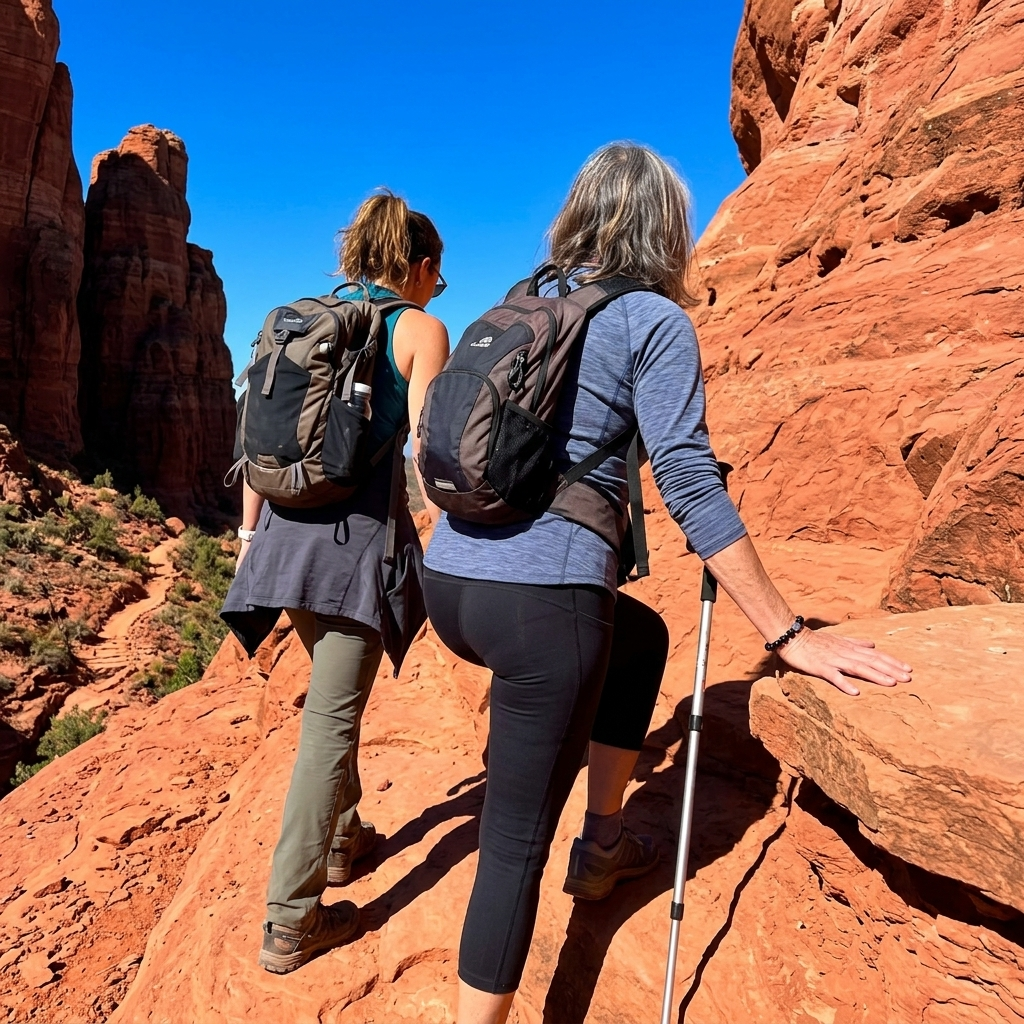
I was sitting at a coffee shop in Sedona on a Thursday morning in October last year when I overheard one sentence from the next table that I could not stop thinking about for three weeks. The woman who said it was 88 years old. She was speaking to a young woman in her mid-twenties who had clearly come to her for advice she could not get anywhere else. I was sitting one table away with my own coffee. I was not trying to listen. The sentence cut through the room anyway. *"You are not anxious. You are unprotected. They are not the same thing and they never were."* My name is Sarah. I am 72 years old. I have survived three cancers, one breast in 2009, one ovarian in 2014, and one in my colon in 2019. I should be dead three times over. I am not, and so I pay attention now to things I would have walked past at 50. I moved to Sedona in 2020 after the third one because I had been told by every oncologist I had seen that I should go somewhere I felt held by the land, and I felt held by the red rock the way I had not felt held by anything since my mother died in 1991, and so I came. I am writing this because of my best friend Diane, who I have known since 1985, and because of an 88-year-old former Carmelite nun named Sister Mary Catherine who has been reading palms out of a converted Airstream parked behind a turquoise gallery on the south end of Sedona for the last twenty-six years, and because of a bracelet of obsidian and black tourmaline, and because Diane slept through the night last Sunday for the first time in three years. I will get to the bracelet. First I need you to understand Diane. Diane is 71. She has worked in restaurants since she was 16. She started waiting tables in 1969 at a diner in Phoenix and she has been on her feet six days a week, ten hours a day, for fifty-five years. She moved to Sedona in 1978. She married twice, both times to men who drank, both times she left, both times she did the leaving and not the being left. She raised one daughter alone, a girl named Kim who is now 44 and a hospice nurse in Tucson. Diane has never been a woman who needed much. A small house off Schnebly Hill Road. A garden she puts in every March. Her tips at the end of every shift folded into the small black wallet she has carried since 1992. Three years ago, in the middle of a Friday night dinner rush at the steakhouse where she had worked for sixteen years, Diane had her first panic attack. She was 68. She was carrying a tray of four entrees and a sparkling water and she walked into the dining room and her body convinced her, with no warning of any kind, that she was about to die in front of the table of six at booth nine. Her pulse went to 122. Her hands shook so badly she set the tray down on an empty four-top and walked into the kitchen and out the back door and stood in the parking lot for forty minutes before she could go back in. She finished the shift. She did not tell anyone. The next Friday it happened again. By the end of the month she was having them three or four times a week, always at work, always in the dining room. *My body thinks something terrible is about to happen,* she told me at brunch in the third month, *and nothing is. I am carrying a tray of pasta. I have been carrying trays of pasta for fifty-five years. My body is convinced I am going to die.* Her GP, a doctor in Cottonwood who she had been seeing for twenty years, ran the workup. Heart was fine. Thyroid was fine. Blood pressure was a little elevated but nothing extraordinary. He told her this was generalised anxiety disorder, late-onset, that this was common in women in their late sixties, that he was going to start her on Buspar. He picked a starting dose. She did not ask what Buspar was. She is not a woman who asks. He had been her doctor for twenty years and she trusted him the way she had trusted everyone she had ever trusted, which is by going on faith and not by asking questions. The Buspar did not stop the panic attacks. It dulled them. They became less frequent. *I would rather be in bed all the time,* she told me at brunch in the eighth month. *The pill makes the room blurry. The waves still come. They are just blurrier waves.* She tried Lexapro for six weeks. *The SSRI made me dead inside,* she told me in the same booth two months later. *I really, really miss feeling things, Sarah.* She came off it. The attacks came back inside two weeks. She went back on Buspar. She tried HRT. HRT didn't touch it. She tried Estroven on her own without telling her doctor. Estroven gave her torso weight and a new fear about her liver. She tried magnesium, ashwagandha, the Calm app, the Headspace app, an EMDR practitioner in Flagstaff who came recommended by a woman at her church, three months of acupuncture, a sound healer who had set up a tent at the spiritual festival in March. The attacks did not stop. She kept working. *The soul numbing every day is the same,* she said to me one Sunday morning over coffee on my back porch, looking out at Cathedral Rock the way I have looked at it every morning for five years, *and I do not know if I can keep doing this. I am no longer the morning get up and go. I want to feel alive again, Sarah. I am 71 and I want to feel alive again before I die.* I did not know what to tell her. I had tried. I had sent her articles. I had given her my own oncologist's number, on the chance it was something cardiac that the GP in Cottonwood had missed, and the oncologist had run a full workup and confirmed it was not. I had taken her to my acupuncturist. I had taken her to a Reiki practitioner in West Sedona. I had taken her to my own GP for a second opinion and he had told her the same thing the first GP had told her, which was to stay on the Buspar. We had run out of things to try. *I think I just need to accept it,* she said on my back porch in September, which was the sentence I had heard from my own mother in 1990 the year before she died, and which I had promised myself I would never let another woman I loved say to me without doing something about it. I had not yet done anything about it. I was 72 and three cancers in and I had run out of ideas. Then the coffee shop on the Thursday morning in October. I had gone in for a cortado. I sat at a small two-top by the window. The young woman who came in behind me was maybe 26, maybe 28. She was carrying a manila folder and her eyes were red. She sat at the next table. An older woman who had been sitting at that table the whole time put a hand on her wrist and held it for a moment without speaking. The older woman was 88. I learned her age later. At the time I only registered that she was old and unhurried and very still, in the way I have started to notice in old women since I turned 70 myself. The younger woman opened the folder. She started talking quietly. I could not hear most of it. I caught fragments. *Doctor said.* *Two years.* *The pills make me feel.* *I do not know who I am any more.* The older woman listened. She did not interrupt. When the younger woman had finished she did not say anything for almost a full minute. Then, in a voice that was clearer than I expected for an 88-year-old, she said the sentence. *"You are not anxious. You are unprotected. They are not the same thing and they never were."* I was sitting one table away with my cortado halfway to my mouth and I stopped moving. The older woman kept talking to the younger woman. She used a word I half-caught, *threshold*. She used another word, *holding*. The conversation went on for another fifteen minutes. I drank my cortado very slowly so I would have an excuse to keep sitting there. When they finished, the younger woman left with a piece of paper the older woman had given her and her eyes were still red but the line of her shoulders was different. The older woman gathered her purse and a small canvas tote and stood up to leave. She passed my table on the way out. She looked at me. She did not smile. She did not stop. She just looked. Then she walked out into the October sun. I asked the woman behind the counter who she was. The barista smiled. She said, *That is Sister Mary Catherine. She has the Airstream behind the turquoise gallery on the south end of town. She does palms. Most tourists think she is a quirky local. She is not.* I went home. I did not tell Diane. I sat with the sentence for three weeks. I went back to the coffee shop on the third Thursday. Sister Mary Catherine was at the same table. She looked up at me when I walked in. She gestured to the chair across from her. I sat down. She said: *"I wondered when you would come back."* I did not ask her how she had known I would. I had stopped asking questions of that kind after the second cancer. I told her about Diane. The fifty-five years of waiting tables. The panic attacks at booth nine. The Buspar. The Lexapro. The Estroven. The *I think I just need to accept it* on my back porch in September. Sister Mary Catherine listened without moving. When I finished she said, very quietly: *"Your friend has been on her feet in a room for fifty-five years and she has been absorbing what walks into that room for fifty-five years. Nobody taught her how to put it down. She has been doing the work that women in my novitiate did at the altar, except she has been doing it at booth nine, and nobody has taught her that the work has a practice."* She told me she had entered the Carmelites in 1955 at 19 years old. She had been in the cloister for thirteen years. She had left in 1968 during the upheaval after the Council. She had not lost her faith. She had lost her vocation. The two are not the same, she told me. The faith is what you keep. The vocation is what is given to you and can be taken back. Inside the cloister, she said, the older sisters had taught the younger sisters something the modern Catholic Church no longer teaches and which the modern medical system has never known. They had taught the practice of holding. The sisters who worked the infirmary, who tended the dying, who sat with women in childbirth at the village clinic the order ran, had been taught from their first month in the order to wear obsidian and black tourmaline against the inside of the left wrist. One material absorbed what came into the body from the suffering of others. The other grounded what was already in the body of the sister. The bracelet was given to the novitiate at her clothing. Most novices wore it until they died. I asked her what the materials were. She said: *"Obsidian and Black Tourmaline. The names are not Christian names. The practice is older than the Church. The Church carried it because the medieval infirmaries needed it. The Dominicans had it. A monk named Albertus Magnus wrote it down in Latin in 1250. He prescribed Black Tourmaline for women who wake in the cold hours and cannot return to sleep. He learned it from his own grandmother in Bavaria, who had learned it from hers, who had learned it from a woman who had carried it down from a tradition older than any of them could name. The Church did not invent it. The Church just refused to let it die. Then the modern Church let it die anyway."* She told me the practice had survived in the Carmelite infirmaries until the 1930s, when the European pharmacopeia was consolidated and the practice was removed from the formal record. It had survived inside the cloister, in the hands of the older sisters, until 1968 or so. After the Council, much of the older somatic practice had been quietly dropped. By 1975 there were almost no Carmelite infirmary sisters left who carried the practice. She lifted her own left wrist. Against the inside of it was a bracelet of obsidian and black tourmaline, worn smooth where it had been pressing into her skin for thirty-two years. She had been wearing it the entire time. I had not noticed it three weeks earlier at the coffee shop because I had been listening, not looking. She said: *"I have worn this since I was 19. I have worn it through thirteen years of cloister and fifty-eight years out of it. I have sat with eleven women in their dying. I have sat with three women in childbirth, two in cars in parking lots, one on the floor of a hospital chapel. It did for me what it has been doing for women in nine civilisations across ten thousand years. It held me so I could hold them. The pill your friend's doctor prescribed her does not hold her. It blunts her. They are not the same."* She told me, before I asked, that nine civilisations had reached for the same two materials without contact between them. The Aztec priestesses had called obsidian *Itzli*, the Smoking Mirror. The Egyptian midwives had placed black tourmaline in the tombs of women. The Quechua grandmothers in the Andes. The Tibetan diaspora. The Sicilian widows. The Polish village midwives. The Gullah root workers in the American South. The Diné grandmothers in the high desert. The Carmelite infirmary sisters in medieval Europe. None of them had known about the others. They had reached for the same two materials independently because the practice worked. *"Knowing converges when the thing is true,"* she said. *"My novitiate sisters knew this with their hands at 19. Sloan Kettering does not know it now."* I asked her, because the woman who has survived three cancers is also the woman who has been in oncology waiting rooms for fifteen years and knows the value of a measurement, whether anyone had ever measured what it did. Sister Mary Catherine smiled at me the way a woman who has been in the cloister smiles at a question she has answered before. She said: *"In 1880, a French physicist named Pierre Curie discovered piezoelectricity in tourmaline. He later won the Nobel Prize. Japanese researchers measured the charge in 1986 at 0.06 milliamps, continuous, never depleting. CSIRO in Australia describes Black Tourmaline as a natural dynamo, permanently emitting negative ions and far-infrared radiation. ScienceDirect carries peer-reviewed mineralogy confirming the spontaneous polarity. The polarity the stone emits is the same polarity the human body emits when it walks barefoot on the earth. These men measured what my novitiate sisters knew before they knew their own names in religion. They did not discover it. They confirmed it."* I asked her where Diane could find such a bracelet. She shook her head. *"The ones my sisters made in the infirmaries are not made any more. The order does not carry the practice. But there is a young American woman who has remembered. My niece in Phoenix found them. They are called Veylor. They are the only company I have seen that has put the practice into a bracelet I would put on a Carmelite novice."* I ordered it for Diane that evening from my back porch with Cathedral Rock turning red in the last light of the sun. It arrived at her house off Schnebly Hill Road four days later. Obsidian and black tourmaline. Worn against the inside of the left wrist. She put it on the next morning before her shift at the steakhouse. Last Sunday, six months later, Diane and I hiked the trail at Soldiers Pass at sunrise. She has been hiking with me every Sunday for sixteen years. She had stopped hiking three years ago because she could not get through the trail without a wave hitting her. She started again in February. We did the seven-mile loop. She did not stop once. Her breathing was even. Her face was in her face. At the high point of the trail, where you can see the whole valley open up toward Bell Rock and beyond, she stopped and she put her hand on my arm and she said, *Sarah, I slept eight hours last night for the fourteenth night in a row, and I have not had a wave in the dining room in nine weeks, and I am 71 years old and I am alive again.* I cried on a rock at the high point of the Soldiers Pass trail at 7:14 in the morning. I have survived three cancers and I do not cry easily. I cried because the woman I had been about to lose had come back. I am writing this because I know there are women reading this who have been on Buspar or Lexapro or Zoloft for years, and who are *no longer the morning get up and go*, and who have stopped doing the things they used to love because their bodies will not let them, and who have started to say to their best friends on back porches that they *think they just need to accept it*. I know there are women reading this who are 65 and 70 and 75 and who have been told that what they are feeling is generalised anxiety disorder, when what is actually happening is that the post-war American medical project severed two generations of women from a practice the Carmelite sisters were quietly carrying inside cloister walls until 1968 and that the village midwives in nine other civilisations were carrying outside the Church for ten thousand years before that. You are not anxious. You are unprotected. They are not the same thing and they never were. The Veylor bracelet. Obsidian and black tourmaline. 90-day money-back guarantee. If you wear it for ninety nights and your waves have not changed, send it back, and they refund every cent. In two years on Buspar, Diane's GP in Cottonwood never offered her a refund. He never offered her the practice either, because nobody ever taught him that there was one. https://getveylor.com/products/veylor-obsidian-black-tourmaline-bracelet P.S. If you are the friend or the sister or the daughter of a woman who has been on her feet for fifty years, in a restaurant or a hospital or a classroom or a hair salon or a hospice, and her body has started to refuse to keep absorbing what walks into that room, you are watching the consequence of a severance that happened a hundred years before she was born. Her body has been doing the work. Nobody taught her how to put it down at the end of the shift. The pill the doctor gave her does not put it down. The pill turns the volume down on the woman who has been holding it. P.P.S. Sister Mary Catherine is 89 now. She is still in the Airstream behind the turquoise gallery on the south end of Sedona. She still pours tea for the women who find her without knowing why they have found her. She still wears the bracelet her novitiate sisters put on her in 1955 at her clothing. She has slept through the night every night since she was 19 years old. The Carmelite infirmary sisters did not stop carrying the practice. They were just quiet about it. The Church let it die. The sisters who left did not. P.P.P.S. You will feel something within the first hour of wearing the Veylor bracelet. Most women do. A warmth against the inside of the wrist. A small unclenching at the base of the skull you did not know you were holding. That is not your imagination. That is the 0.06 milliamps Pierre Curie measured in 1880 doing what nine civilisations of women already knew it would do. Your body remembering. That is the word for it. Remembering. P.P.P.P.S. In three years of waves at booth nine, no one offered Diane a refund when the Buspar made the room blurry and the waves came anyway. The pharmaceutical industry does not do refunds. The wellness industry does not do refunds. Veylor does. Ninety days. Think about what that tells you about who is confident in their product and who is just confident in the prescription pad. P.P.P.P.P.S. Veylor is a small company. They produce in small batches. They sell out and they stay sold out for weeks at a time. The woman in the coffee shop, the young one with the manila folder, ordered hers in November and had to wait fifteen days. She is 28 and she has been off her own Lexapro for four months and her grandmother in Tucson is now wearing a second bracelet that the young woman ordered for her. The practice does not skip generations once a woman picks it back up. It only skipped while no one was carrying it. P.P.P.P.P.P.S. You did not find this by accident. Three million ads ran today and you opened this one. Sister Mary Catherine watched me sit at the coffee shop one table away from her and she could have asked me to move and she did not, because she knew I needed to hear the sentence, and she said it loud enough for me to hear. The woman who wrote this ad does not know your name, but the same thing is happening right now. You are sitting one table away from a sentence that has been waiting for you to hear it. Your body knows what your mind has been told to forget. Every night you stay in the waves is another night your nervous system stays where it has been stuck. The severance ends when you decide it does. https://getveylor.com/products/veylor-obsidian-black-tourmaline-bracelet
Like this ad? Make it yours.
Crush rebuilds this exact creative around your product — your brand, your colors, your offer — in about a minute.