StoryGo
StoryGo Facebook ad: “Click to read the full novel”
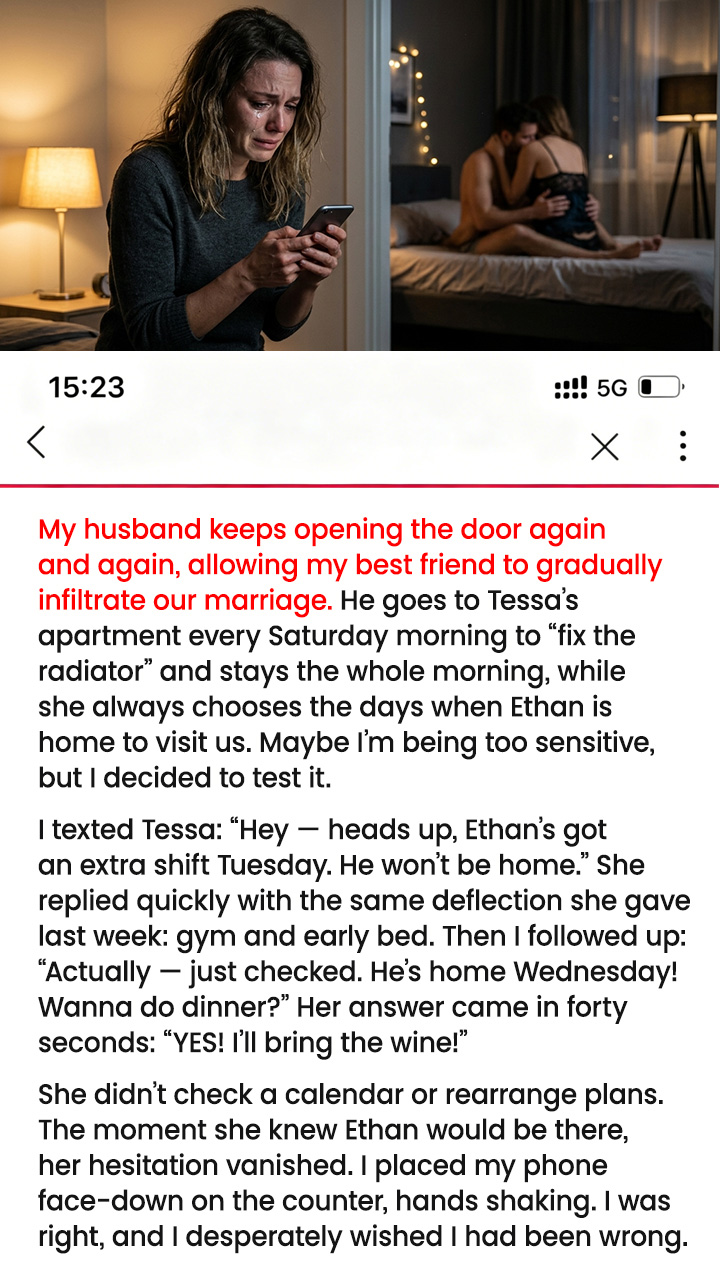
Ran for 2 days, from June 18 to June 20, 2026, the last day Crush saw it.
Run by StoryGo on Facebook. Crush is not the advertiser and does not verify its claims. See this ad in Meta's Ad Library(opens in a new tab)
Want an ad like this for your product?
Crush makes new ad images for your product from this ad: your logo, your product photo, your offer.
Trials from $19.95 USD, then $79.95 USD a month. Cancel anytime.
About this ad
- Meta Ad Library ID
- 2208340539739350
- Platforms
- Facebook, Instagram, Audience Network, Messenger and Threads
- Relaunches
- 0
- Niche
- Parenting & Kids
Ad text
My husband keeps opening the door again and again, allowing my best friend to gradually infiltrate my marriage. He goes to my best friend’s apartment on Saturday mornings to fix the radiator and ends up staying there the whole morning. Meanwhile, she always chooses the days when my husband is home to come over to our place. Maybe I’m being too sensitive, but I’ve decided to test it out. I text Tessa: "Hey — heads up, Ethan’s got an extra shift Tuesday. He won’t be home." This is a lie. Ethan is off Tuesday. Three dots appear. Then: "Oh no, poor Ethan! Long week. Hey — I actually have plans Tuesday anyway. Gym + early bed. But let’s hang soon? " Plans. Gym. Early bed. The exact same deflection she gave me last Tuesday. Then I type again: "Actually — just checked. He’s HOME Wednesday! Wanna do dinner Wed?" Also a lie. The reply comes in forty seconds: "YES! I’ll bring the wine! " Forty seconds. She didn’t have to check a calendar. She didn’t have to rearrange her gym schedule or her early bedtime. She transitioned from an outright “can’t” to an enthusiastic “yes” in the time it took her to read the word “Wednesday” and connect it to one crucial piece of information: Ethan will be there. I place my phone face-down on the counter. My hands are shaking. Not from anger – not yet. But because I was right. I was right, and I desperately wanted to be wrong. ———— Tessa is here again. I count the wineglasses on the counter. Three. Always three now. From the rack, I retrieve the Malbec – the good one, reserved for my own solace after a grueling fourteen-hour parent-teacher conference day – and pour. A precise third, a third, a third. Laughter drifts from the living room. Ethan’s, a robust, full-chested sound that means something genuinely amuses him. Beneath it, Tessa’s. Higher, breathier, a laugh that seems to lean, to seek a specific target. I carry the glasses in. Tessa is curled on the couch, her legs tucked neatly, body angled towards Ethan like a sunflower tracking the sun. He’s recounting the raccoon-in-the-engine-bay story from last week’s shift. I’ve heard it twice. Tessa either hasn’t, or she’s an exceptional actress. “You did not just grab it,” Tessa exclaims, her hand lightly slapping his arm. “Gloves on. Thick ones. Thing was pissed.” He grins, those dimples deepening – the same ones that charmed me into a second date six years ago. “Here.” I extend her glass. She takes it without a glance, her focus unwavering from Ethan. “Thanks, babe.” She sips, eyes still locked on him. I settle into my armchair – my grading chair, positioned by the lamp. I observe. Ethan accepts his glass, offers a small, mock-toast towards Tessa, and concludes his story. She laughs again. That laugh. I don’t mind. This is my internal mantra. Tessa is navigating a personal hel!l. Her divorce, three months past, was from Leo – everyone knew he was terrible, she deserved better. She’s lonely. She seeks refuge here because we’re a safe harbor. Because I am her oldest friend, and Ethan is kind, and our home offers warmth, and she has nowhere else to go. This is what friends do. “How’s the apartment?” I ask, breaking the spell. Tessa finally turns to me. “God, depressing. The radiator makes this sound all night – like an old man dying. I barely sleep.” “You should consider a space heater,” I suggest. “I should get a new apartment.” She laughs, but it’s a different sound now. Shorter, emptier, devoid of the vibrancy she’d just shared with Ethan. Her gaze shifts back to him. “Do firefighters know anything about radiators?” “Plumbers, maybe. Not us.” He shrugs. Yet, he doesn’t dismiss it. He doesn’t say, Call your landlord. Instead, he offers: “I could take a look this weekend if you want.” “Really?” Her entire face illuminates, as if he’d offered a life-saving organ, not a twenty-minute favor. “You’re the best. Seriously, Ethan. The absolute best.” She touches his arm. A feather-light brush. Her fingers linger on his forearm for a full two seconds. I drink my wine. The first instance occurred two months ago, immediately after her divorce was finalized. She arrived on a Tuesday, a bottle of cheap rosé in hand, mascara streaking her face. “I don’t know who I am without him,” she’d confessed, and I held her on this very couch while she wept. Ethan had made pasta. We’d eaten together, and by the end of the night, she was laughing. I’d thought: This is friendship. This is what twenty-two years looks like. After that, she returned. Thursday. Then Saturday. Then Tuesday again. Then, I began to notice, whenever Ethan wasn’t on shift. Wait. No. That wasn’t quite right. She came every night Ethan was home. When had that realization solidified? Last week, perhaps. Or the one before. It was a thought that had previously drifted through my mind like smoke – an olfactory hint, dismissed before it could be grasped. She canceled when he was at the station. She materialized when his truck occupied the driveway. But that’s normal. Right? She feels safer with a man around. Leo had made her feel insignificant. Ethan has a way of making people feel important. It’s his defining trait – the reason the guys at Station 7 revere him, the reason my students brighten when he collects me after school. He makes you feel seen. Of course she gravitates toward that. Of course. “Another?” Ethan holds up the empty bottle. “I shouldn’t.” Tessa stretches, a languid, catlike movement. Her shirt subtly rides up, revealing an inch of tanned midriff. She’d started at that new gym on Oak Street, the one with the large windows. “But okay, twist my arm.” He heads to the kitchen. Tessa’s eyes follow his retreating figure. I watch her watch him. “You okay, Elara?” she asks, turning to me, her expression soft, feigning concern. “Fine. Long day. Sophomore essays.” “God, I don’t know how you manage it. Thirty fifteen-year-olds? I’d be drinking at lunch.” She tucks her hair behind her ear. New earrings. Small gold hoops. She hadn’t worn gold before. Ethan returns with a second bottle, something cheaper – our everyday reserve. He refills Tessa’s glass first. Then mine. I register the order. I resent that I register the order. “So – Saturday?” Tessa prompts Ethan. “The radiator?” “Yeah, I’ll swing by after my run. Around ten?” “Perfect. I’ll make coffee.” She pauses. “You still drink it black?” She remembers his coffee preference. Fine. I remember how all my friends take their coffee. It’s normal. It’s what people do. “Black, two sugars if I’m feeling wild,” Ethan confirms. “Two sugars.” Tessa nods, filing the detail away. I drain my glass too quickly. The wine, warm and sour, coats my tongue. It’s nearly eleven when she departs. She offers me a quick, sideways, one-armed hug at the door. Then she embraces Ethan. Both arms. Two seconds longer. Her chin rests on his shoulder, eyes closed. “Thank you for tonight,” she murmurs. To both of us. But her gaze is fixed solely on him. “Drive safe,” I say. “Always.” She waves from the driveway, enters her car. The headlights sweep across our front windows, and she’s gone. Ethan locks the door, yawns. “She seems better lately. Don’t you think?” “Yeah.” “The divorce really messed her up. But she’s getting there.” “Yeah.” He looks at me, head tilted. “You good?” “Tired.” “Come on.” He takes my hand, gently pulls me towards the stairs. “Early shift tomorrow. Up at five.” I follow him upstairs. He brushes his teeth, strips to his boxers, and falls into bed with the practiced efficiency of a man who confronts burning buildings for a living. Asleep in three minutes. I lie beside him, staring at the ceiling. Three times this week. Monday. Wednesday. Tonight. She never comes on Ethan’s shift days. Never. I’d been rationalizing it as coincidence – she checks the schedule, she knows when I’m alone, she doesn’t want to be a burden when it’s just me. But that’s backward. She comes when he’s HERE. She actively avoids the nights when it’s just me. If her visits were truly for me – for our twenty-two years of friendship, for support – wouldn’t the ratio be inverted? Wouldn’t she appear on the lonely nights, when I’m eating cereal on the couch, watching true crime alone? Wouldn’t those be the moments her best friend genuinely needed company? She never does. Not once. Not a single time in two months. I roll onto my side. Ethan’s breathing is slow, heavy. His arm, warm against mine. He hasn’t done anything wrong. He’s just friendly. He’s Ethan – he’d fix a stranger’s radiator if they asked. But she didn’t ask a stranger. She asked my husband. For a Saturday morning. Alone. And she knows how he takes his coffee. I close my eyes. I tell myself I’m being irrational, the paranoid wife conjuring something from nothing. Tessa is my best friend. She loves me. She’s enduring the worst period of her life, and I should rise above this – above counting her visits, above analyzing who she looks at when she laughs. But there’s a truth I cannot escape. A detail that refuses to allow sleep. She never looks at me when Ethan is speaking. Not once. Not even a fleeting glance across the room – none of those shared, conspiratorial smiles friends exchange when someone is telling a story. The kind of look that says, We’re in this together, witnessing this man’s absurdity. She used to give me that look constantly – at parties, at barbecues, at our wedding. Now her eyes never leave him. And I don’t yet comprehend the full implications. I don’t know if it means anything at all. But I am wide awake at midnight, dissecting every detail, while Tessa drives home with my husband’s coffee order meticulously filed in her memory. And something in my chest feels precisely like the moment before you open a test you instinctively know you’ve failed. I just don’t know what the question is yet. Millfield, Ohio. Population 4,200. One high school, two churches, a diner open since 1973, and a rumor mill that churned faster than any Wi-Fi connection. This was my home. Tessa’s home. Our mothers belonged to the same book club. Our fathers frequented the same bar on Route 9 until it shuttered in 2014. We met at nine, on the Millfield Elementary playground. My mother’s mantle still held the framed photo: me in pigtails, Tessa in an oversized denim jumper, both clutching opposite ends of a jump rope. Twenty-two years. A bond that outlasted most marriages. Saturday morning found me at the kitchen table, grading essays. Ethan had left at six for his run, then headed straight to Tessa’s to fix her radiator. I’d told him to grab the toolbox from the garage. He’d replied that it was already in the truck. Already in the truck. Which meant he’d loaded it last night. Before bed. He’d been thinking about it. Stop it. I circled a C-minus on Noah Harrison’s paper and poured my second cup of coffee. The house felt unnervingly quiet for a Saturday. Usually, our mornings were a shared ritual: Ethan cooking eggs, me reading the news aloud, a playful debate over whose turn it was to mow the lawn. Today, he was at Tessa’s apartment, and I was alone with thirty-two essays on The Great Gatsby and a mind that refused to be silenced. Millfield lore often claimed we were mismatched at birth. Tessa, the daredevil, was the one who, at thirteen, leapt from the rope swing into the quarry. I was the one who sat on the rock, guarding everyone’s shoes, heart pounding, ready to scream for help when she stayed submerged four seconds too long. She married Leo Maxwell at twenty-three in her mother’s backyard, barefoot and three months pregnant with a baby she’d tragically lose six weeks later. Leo, a welder smelling of metal and cheap beer, had a temper. I knew of one time he hit a wall; I suspected many more. Their marriage dissolved within three years, but the divorce became a four-year battle, Leo contesting every detail like a sport. My path was different. Ohio State, teaching certification, then back to Millfield. Where else would I go? My people were here. Ethan asked me out during the Fourth of July fireworks in 2019. He was twenty-seven, two years into the fire department, still possessing that new-recruit zeal, recounting every call like a movie scene. I was drawn to his steadfastness, his lack of complication. Tessa, ever blunt, had said: “Finally, someone boring enough to keep you happy.” I believed she meant it as a compliment. Mostly. Our wedding was in 2020, a small ceremony at the Methodist church on Elm. Tessa, my maid of honor, wore a green dress and wept more profusely than my own mother. In the photographs, her gaze was fixed on me in every frame—beaming, tearful, laughing with unbridled joy. Her expression seemed to declare: That’s my girl. That’s my person. I couldn’t recall the last time she’d looked at me that way. My phone vibrated. Tessa. “The radiator was SO EASY for him. Fixed in ten minutes. I owe you guys dinner!” I typed back: “Glad it’s sorted!” Three dots appeared, then another message: “He’s still here — I made him coffee. Is that ok? I don’t want to keep him if you need him home.” My gaze locked on the screen. She was asking permission. Which implied she knew she should. Which meant she sensed that something about this wasn’t entirely normal—a married man, alone in her apartment, sharing coffee on a Saturday morning while his wife sat home. Alone. “Totally fine,” I typed. “No rush.” Because what else could I say? Come home immediately? Why are you having coffee with my best friend alone? I’d sound unhinged. He’d fixed her radiator. She’d offered him coffee. That’s simply what polite people did. It was what Tessa did—generous, warm, always feeding anyone who walked through her door. But she hadn't invited me over too. She’d asked if she could keep him. Not us. Just him. I returned to Noah Harrison’s essay. He believed Jay Gatsby was “just a simp.” I scribbled “Elaborate” in the margin and tried to convince myself the knot in my stomach was merely from bad coffee. He returned at noon. He smelled of her apartment—that vanilla candle she burned in the bathroom. I hated knowing the scent of her place. I hated even more that I could detect it on him. “All fixed,” he announced, dropping his keys on the counter. “The bleed valve was stuck. A five-minute job once I got the wrench on it.” “She said ten.” “What?” “She texted me. Said it took you ten minutes.” He shrugged. “Yeah. Something like that.” He opened the fridge, pulling out leftover pasta. “Want some?” “I ate.” He heated the pasta, eating it while standing at the counter. Normal. Completely normal. A man returning from helping his wife’s friend, eating pasta. Nothing in this scene would raise a reasonable person’s alarm. Yet, I flagged it anyway. The vanilla on his shirt. The two hours that passed between his “ten-minute fix” and his arrival home. The coffee she’d made. The text asking if she could keep him. “Is she okay?” I asked. “Tessa? Yeah, better, I think. She said the apartment is starting to feel more like home.” He took another bite. “She’s thinking about getting a dog.” “She told me that last week.” “Oh.” He didn’t register the overlap. Why would he? It was a minor detail—a woman mentioning a dog to her friend’s husband. Normal. But she was confiding in him the same things she confided in me. She was extending to him the same intimacy—the small updates, the daily minutiae that had once been exclusively ours. What I was considering. What kept me awake at night. What I’d eaten for dinner. That was our language, Tessa’s and mine. A twenty-two-year shorthand. Now, he possessed it too. Sunday was our day. Ethan was off shift, I had no essays to grade, and we drove to his parents’ house in Kenton for lunch, a ritual we observed twice a month. A normal Sunday. A normal life. His mother asked when we planned to have children. I replied, “Soon.” Ethan squeezed my hand under the table. We’d been trying for seven months, with no success. I hadn’t told Tessa. I used to tell Tessa everything. On the drive home, Ethan’s phone buzzed in the cupholder. My gaze flickered down. Tessa’s name illuminated the screen. A text message, clear enough to read without picking it up: “What’s Ethan’s schedule this week? Want to plan dinner for you guys ❤️” “Tessa wants to know your schedule,” I said, my voice neutral, light. “Oh. Tuesday and Wednesday I’m on. Off Thursday through Saturday.” I picked up my own phone. Typed back to Tessa: “He’s on Tues/Wed. Off Thurs-Sat.” Tessa replied instantly: “Perfect!! Thursday dinner at yours? I’ll cook!” Thursday. When he was home. I typed: “Sounds great!” I placed my phone in my lap. The fields outside the window blurred—flat Ohio sprawl, winter-brown, endless. Ethan hummed along to the radio, oblivious. Why wouldn’t he be? She had asked for his schedule. Not mine. His. And I, unknowingly, had just handed her another piece of my life. I start keeping track. Not intentionally at first. It’s just how my mind works, a teacher’s instinct for cataloging. The same part of me that flags a student’s repeated absences or a usually quiet child’s sudden restlessness. I’m trained to spot patterns. And I see them. Thursday: Ethan is home. Tessa arrives at 6:15 PM, carrying a Pyrex dish of chicken parmesan and a bottle of Pinot Grigio. She’s wearing a new top, burgundy and fitted, with a neckline far more daring than anything she wore during her marriage. She kicks off her shoes at the door, walks straight into the kitchen, and begins plating food as if she lives here. “Ethan!” she calls out, her voice echoing into the living room. “Come eat before it gets cold!” She called for him, not me. I’m standing only four feet away. Friday: Ethan is home. Tessa texts at 5:30 PM: Movie night? I’ll bring popcorn. She arrives at seven, settling herself in the absolute center of the couch. Not her usual spot on the end, the one that left room for Ethan on one side and me on the other. The middle. Ethan sits to her left. I retreat to my armchair, the one that used to be my sanctuary for reading, now the solitary island from which I watch my best friend share a couch with my husband. During the movie, a jump scare makes her laugh, and she grabs his arm. She doesn't let go for the rest of the scene. Eight seconds. I count. Saturday: Ethan is home. Tessa doesn’t come. A wave of relief washes over me, cool and soothing like a damp cloth on a burn. We cook together, watch terrible TV, and go to bed early. I curl into him, and he murmurs, “Love you, Elara,” into my hair. See? I think. Everything is fine. You’re inventing problems. Sunday: Ethan is home. Tessa shows up unannounced at 2 PM. “I was at the farmers market and got too much,” she chirps. “Want some peaches?” She brought six peaches. For three people. She stays for four hours. Monday: Ethan is home. Tessa comes for dinner, her idea. She texted me at lunch: Miss you guys! Okay if I swing by tonight? “Guys.” You “guys.” Not “you, Elara.” You guys. Tuesday: Ethan is on shift. I text Tessa at 5 PM: Hey, come over? I’m making pasta and have wine. Her reply arrives twenty minutes later: Ugh can’t tonight! Gym and then early morning tomorrow. Rain check? Rain check. She rain-checked me. Wednesday: Ethan is on shift. I don’t text. Tessa doesn’t text. No one texts. The house is quiet. I eat cereal for dinner and grade papers, and the silence feels like undeniable proof of something I don’t want to name. Seven days. Ethan was home for five of them. Tessa appeared for four of those five. The two nights he was gone? Nothing. Not even a text that wasn’t purely logistical. I sit with this realization at the kitchen table on Wednesday night, my pen hovering over Arthur Hayes’s essay on symbolism in The Scarlet Letter. The irony isn’t lost on me. Hester Prynne and her scarlet letter. The hidden sin. The public face. I’m being ridiculous. I know it. Tessa is my best friend. She wouldn’t. She’s lonely, fresh out of a bad marriage. She gravitates toward warmth. My house is warm. My husband is warm. She comes because she’s cold, and we are not. That’s all it is. But the numbers don’t lie. I teach English, not math, but even I can solve this equation. Thursday. I’m in the teacher’s lounge at lunch, chewing a sandwich I can’t taste, when Sarah Novak sits across from me. Sarah teaches AP History. She’s sixty, blunt, and has lived in Millfield longer than anyone. “Your friend’s car was at your place again last night,” she says. I blink. “What?” “The blue Honda. Tessa Jameson’s. I drive past your house on my way to book club.” Sarah bites into an apple. “She’s there a lot.” “She’s going through a divorce.” “Mm.” Sarah chews. “My neighbor went through a divorce. I brought her a casserole. Once.” Something in her voice. A knowingness. Millfield knowingness – the kind where people see everything and say just enough to let you know they’re watching. “She’s my best friend,” I say, the words coming out defensive, too sharp. Sarah holds up a hand. “I’m not saying anything, honey. Just – a lot of cars in your driveway these days.” She goes back to her apple. I go back to my sandwich. But I can’t swallow. The bread sits in my mouth like paper. People are noticing. That night, I watch Tessa more carefully than I’ve ever watched anyone. She arrives at six – Ethan’s home, of course – with a bag of takeout from the Chinese place on Route 9. She didn’t ask if we’d eaten. She simply arrived with food. Like a wife. I watch where she sits. Next to Ethan. Always next to Ethan. I watch where she looks. At him. Always at him. When I speak, her eyes slide to me for a moment, then drift back. As if I’m a commercial break in the show she’s watching. I watch what she touches. His shoulder when she passes behind the couch. His knee when she’s making a point. His forearm when she laughs. Always casual. Always light. Always with the plausible deniability of physical affection – I’m a touchy person, you know that. She IS a touchy person. She always has been. At eighteen, she draped herself over everyone – boys, girls, teachers, strangers. It meant nothing then. But she doesn’t drape herself over me anymore. She hasn’t touched me in weeks, save for a quick, one-armed goodbye hug at the door. All her touching goes to him. “Elara, you’re quiet tonight.” Tessa turns to me, chopsticks halfway to her mouth. “Just tired. Long week.” “You work too hard.” She looks at Ethan. “Doesn’t she work too hard?” He nods. “I keep telling her.” They look at each other. I keep telling her. As if they’ve discussed this. As if my work habits are a shared topic between them – affectionate, concerned, married-people talk about a shared friend. Except I’m not their shared friend. I’m his WIFE. “I’m fine,” I say, the words flat. Friday afternoon. Ethan is leaving for his shift – twenty-four hours on, home Saturday morning. He kisses me at the door, grabs his duffel. “Tessa coming over tonight?” he asks, casual as breathing. “I don’t know. She didn’t say.” “You should call her. You seemed off this week – might be good to talk.” He’s telling me to call my friend. Because he noticed I’m distant. Because he’s a good husband who pays attention. This isn’t the behavior of a man having an affair. This is Ethan being Ethan – solid, simple, caring. So why does it make me feel worse? He leaves. I stand in the doorway, watching his truck disappear around the corner on Pine. I don’t call Tessa. Tessa doesn’t call me. The house is silent. No wine for three. No laughter from the living room. No burgundy tops, no gold hoops, no arm-touching. Just me, thirty papers to grade, and leftover Chinese that Tessa brought last night. She won’t come tonight. I know she won’t. Because Ethan isn’t here. And if she’s not coming for me when we’re alone – if twenty-two years of friendship isn’t enough to get her off the couch on a Friday night when my husband is at work – then what the hel!l is she coming for? I already know. I’ve known since that first night, lying awake at midnight, counting the ceiling tiles. I’ve known since the coffee order, the vanilla on his shirt, the schedule text, and the middle of the couch. But knowing and admitting are different animals. Knowing lives in the back of your brain, a place where you keep things you’d rather not examine. Admitting is opening the drawer. I’m not ready to open the drawer. Not yet. But I’m going to do something. One small thing. Just to prove I’m wrong. Saturday morning. Ethan comes home at 7 AM. Exhausted. Smells like smoke – an actual fire last night, a garage on Birch. He showers, eats eggs, and falls asleep on the couch by nine. I wait until noon. Then I pick up my phone. I text Tessa: Hey — heads up, Ethan’s got an extra shift Tuesday. Covering for O’Brien. He won’t be home. This is a lie. Ethan is off Tuesday. He’s not covering for anyone. But I type it, and I send it, my gaze fixed on the screen as if awaiting a verdict. Three dots appear. Then: Oh no, poor Ethan! Long week. Hey — I actually have plans Tuesday anyway. Gym + early bed. But let’s hang soon? ❤️ Plans. Gym. Early bed. The exact same deflection she gave me last Tuesday. Almost word for word. I’m not even worth a fresh excuse. I wait an hour. My heart pounds too fast. My fingers feel cold. Then I type again: Actually — just checked. He’s HOME Wednesday! O’Brien figured it out. Wanna do dinner Wed? Also a lie. Ethan is home both days. None of this matters. What matters is what she says next. The reply comes in forty seconds: YES! I’ll bring the wine! 🍷 Forty seconds. She didn’t have to check a calendar. She didn’t have to rearrange her gym schedule or her early bedtime. She transitioned from an outright “can’t” to an enthusiastic “yes” in the time it took her to read the word “Wednesday” and connect it to one crucial piece of information: Ethan will be there. I place my phone face-down on the counter. My hands are shaking. Not from anger – not yet. But because I was right. I was right, and I desperately wanted to be wrong. I wanted to be the paranoid wife, the jealous friend, the woman who conjures something out of nothing. But it’s not nothing. She comes for him. Only him. Always him. And now, I have to decide what to do about it.
Where the ad sends people
Facebook.me
🔞🔞Click to read the full novel👉👉
Learn more: novelhit.com(opens in a new tab)