SoIviva
SoIviva Facebook ad: “This could be affecting your teeth”
Ran for 1 day, from February 18 to February 19, 2026, the last day Crush saw it.
Run by SoIviva on Facebook. Crush is not the advertiser and does not verify its claims. See this ad in Meta's Ad Library(opens in a new tab)
Want an ad like this for your product?
Crush makes new ad images for your product from this ad: your logo, your product photo, your offer.
Trials from $19.95 USD, then $79.95 USD a month. Cancel anytime.
About this ad
- Meta Ad Library ID
- 2226707311069560
- Platforms
- Facebook, Instagram, Audience Network, Messenger and Threads
- Relaunches
- 0
- Niche
- Food & Beverage
Ad text
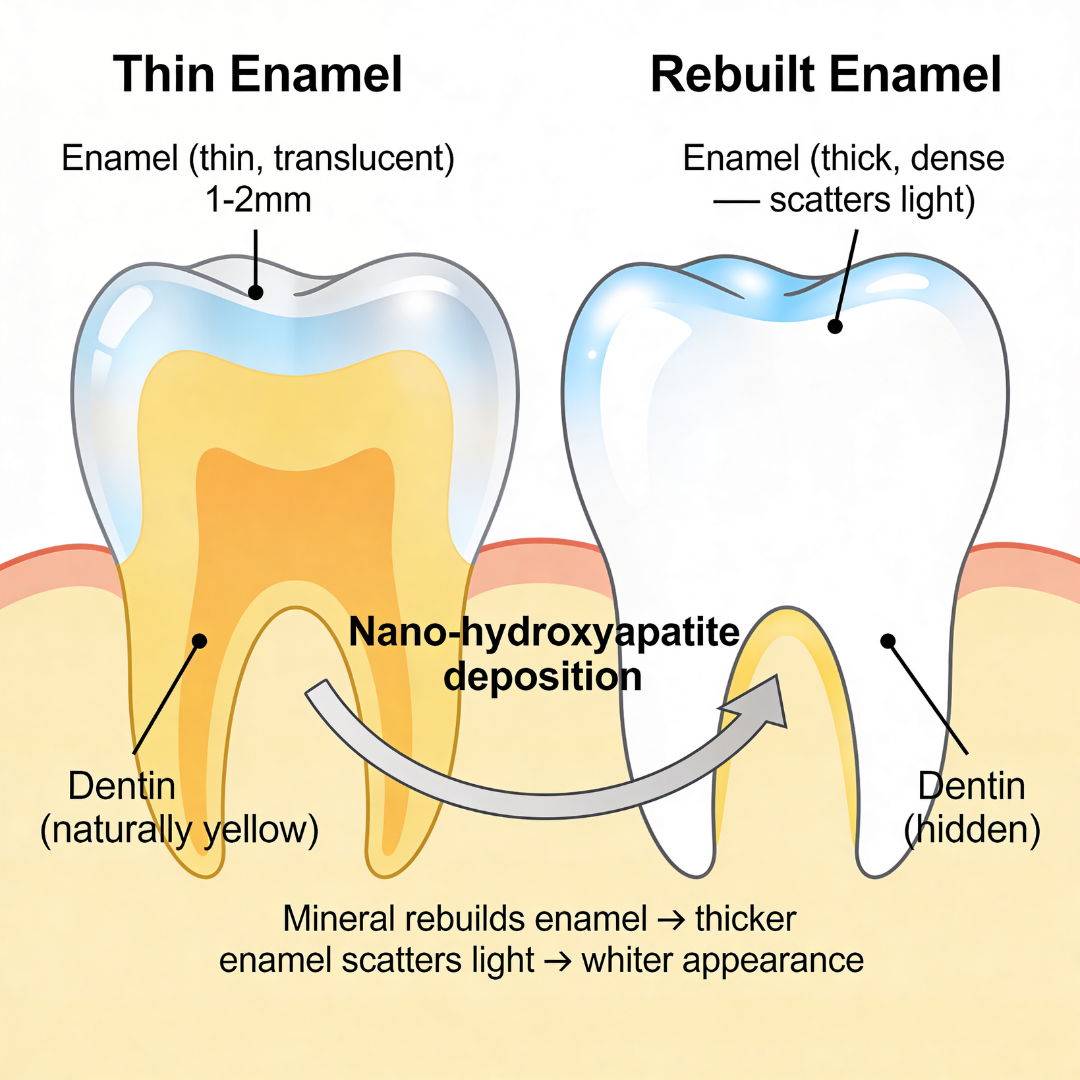
A dentist explained something to me that changed how I think about tooth color permanently. I want to share it because I think it will change how you think about it too. Look at the diagram above. It shows two cross-sections of the same tooth. The difference between them is a single variable: enamel thickness. On the left: thin enamel. On the right: thick, rebuilt enamel. Same tooth. Same dentin. Dramatically different appearance. Here’s what most people — including me, until recently — don’t understand about tooth color: Your teeth are not white. Tooth enamel is not white. It’s translucent. It’s a semi-transparent crystalline mineral layer made of hydroxyapatite — the same mineral that makes up bone. When light hits enamel, the crystalline structure scatters some of the light and transmits some of it through. Underneath the enamel is dentin. Dentin is naturally yellow. In every human being. This is not a defect. It’s not from coffee or wine or poor hygiene. It’s the inherent color of the tissue. Your dentin is yellow. My dentin is yellow. Everyone’s dentin is yellow. When enamel is thick and dense — as on the right side of the diagram — it scatters a large percentage of incoming light. The scattered light reflects back toward your eye, and the thick enamel layer obscures the yellow dentin beneath. The effect is similar to frosted glass: you can’t see the color behind it because the glass itself scatters the light. The tooth appears white. When enamel is thin — as on the left side of the diagram — it scatters less light. More light passes through the translucent enamel and reaches the yellow dentin, then reflects back through the enamel carrying the yellow color with it. The tooth appears yellow. The yellowness you see is not ON the tooth. It’s INSIDE the tooth, showing through thin enamel. This single fact reframes the entire tooth whitening conversation. If yellowness comes from thin enamel letting dentin show through, then there are only two approaches to making teeth look whiter: Approach 1: Bleach. Use peroxide to chemically destroy pigment molecules in the enamel and on the surface. This produces a temporary whitening effect. But peroxide also degrades the enamel matrix — published research documents surface roughening, mineral loss, increased porosity, and microstructural damage. The enamel gets thinner. Thinner enamel shows MORE yellow dentin. The temporary whitening masks the structural damage until it fades. Then the yellow is worse than before. Whitening strips. Whitening trays. In-office bleaching. All variations of Approach 1. All peroxide-based. All thin enamel. Approach 2: Rebuild. Instead of removing material from the tooth, add material back. Deposit mineral into the enamel. Increase its thickness. Increase its density. Restore its light-scattering capacity. The yellow dentin becomes less visible because the enamel barrier is thicker. The tooth appears whiter through structural health. Whitening toothpastes present a variation on Approach 1 that’s worth addressing separately. Most whitening toothpastes don’t use peroxide — they use abrasives. Physical particles that scrub the tooth surface. The abrasives remove surface stains (from coffee, wine, tea), which does produce a temporary whitening effect. But aggressive abrasives also remove enamel material. They literally sand down the tooth surface. Each brushing removes a microscopic layer. Over time, the enamel thins. The same mechanism as peroxide, different pathway to the same outcome: thinner enamel, more visible dentin, yellower teeth. Both approaches — bleaching and abrasion — treat enamel as something to be stripped. The structural problem gets worse while the cosmetic symptom is temporarily masked. Approach 2 — rebuilding — is what Japan has been doing since 1993. Japan’s approach was never about cosmetics. It was about dental health. But the cosmetic benefit follows directly from the health benefit. Rebuild enamel thickness for structural integrity, and you get whiter-looking teeth as a natural consequence. The optical physics guarantee it. It’s not an aesthetic treatment with health side effects. It’s a health treatment with aesthetic side effects. Nano-hydroxyapatite is the mineral that constitutes 97% of tooth enamel. In nano-sized particles at 10% concentration, it deposits into the enamel surface. It fills microscopic defects. It increases mineral density. It rebuilds enamel thickness. The crystals integrate into the existing mineral lattice and become part of the tooth structure. An 18-month randomized controlled trial (PMC10393266) confirmed nano-HAP matches fluoride for remineralization and cavity prevention. Double-blind studies (PubMed 28361171) documented sensitivity reduction in two weeks. Over 40 years of clinical use in Japan. But here’s where it gets interesting for the optical question: A tooth powder I found adds theobromine at 3% to the 10% nano-HAP. Theobromine — a compound from cocoa beans — promotes the formation of larger, more organized hydroxyapatite crystals during remineralization (PMC9355873). A 2024 meta-analysis (PubMed 38987932) confirmed it matches fluoride for enamel microhardness. Why does crystal size matter for appearance? Larger, more organized crystals scatter light more effectively than smaller, irregular crystals. Better light scattering means more of the incoming light is reflected back from the enamel surface and less reaches the yellow dentin underneath. The rebuilt enamel isn’t just thicker — it’s optically superior. Each unit of rebuilt enamel does a better job of hiding the dentin than standard remineralization would produce. The formula includes kaolin clay for ultra-low abrasivity polishing (no enamel thinning), zinc citrate (plaque reduction — less acid means less enamel erosion), dual sugar alcohols (bacterial control), and concentrated powder format (no water dilution). No peroxide. No bleaching agents. No aggressive abrasives. Nothing that thins enamel. Everything that rebuilds it. This is not the dramatic overnight transformation that whitening strip marketing promises. It’s slower. It’s gradual. And it’s permanent in a way that bleaching never is, because the mineral is physically integrated into the tooth. You’re not masking the yellow. You’re rebuilding the structure that hides it. And here’s what makes this approach fundamentally different from the experience of whitening: zero sensitivity. Not reduced sensitivity. Zero. Because you are adding mineral to the tooth, not stripping it away. Sensitivity comes from exposed dentinal tubules — exposed because enamel has been eroded or degraded. Depositing nano-hydroxyapatite into those tubules is the opposite of the process that causes sensitivity. It’s actually the TREATMENT for sensitivity. You’re getting whiter-looking teeth through the same mechanism that eliminates sensitivity. One process. Two benefits. Users consistently report the same timeline: week 2-3, teeth feel noticeably smoother and more polished after every brushing. The mineral coating is tangible. Week 4-6, comparison photos show the first visible brightness improvement. Week 8-12, other people notice. Look at the diagram one more time. Left: thin enamel, yellow visible. Right: thick enamel, yellow hidden. The arrow between them is the entire pitch. You don’t need whiter teeth. You need thicker enamel. Rebuild the enamel and the whiteness follows. Approach 1 strips it away. Approach 2 builds it back. Your teeth are not the enemy. Your enamel just needs reinforcement.
Where the ad sends people
Solviva.com
This could be affecting your teeth
Atriva
Learn more: shopatriva.com(opens in a new tab)