Lymphedema Support Center
Lymphedema Support Center Facebook ad: “What your legs have forgotten”
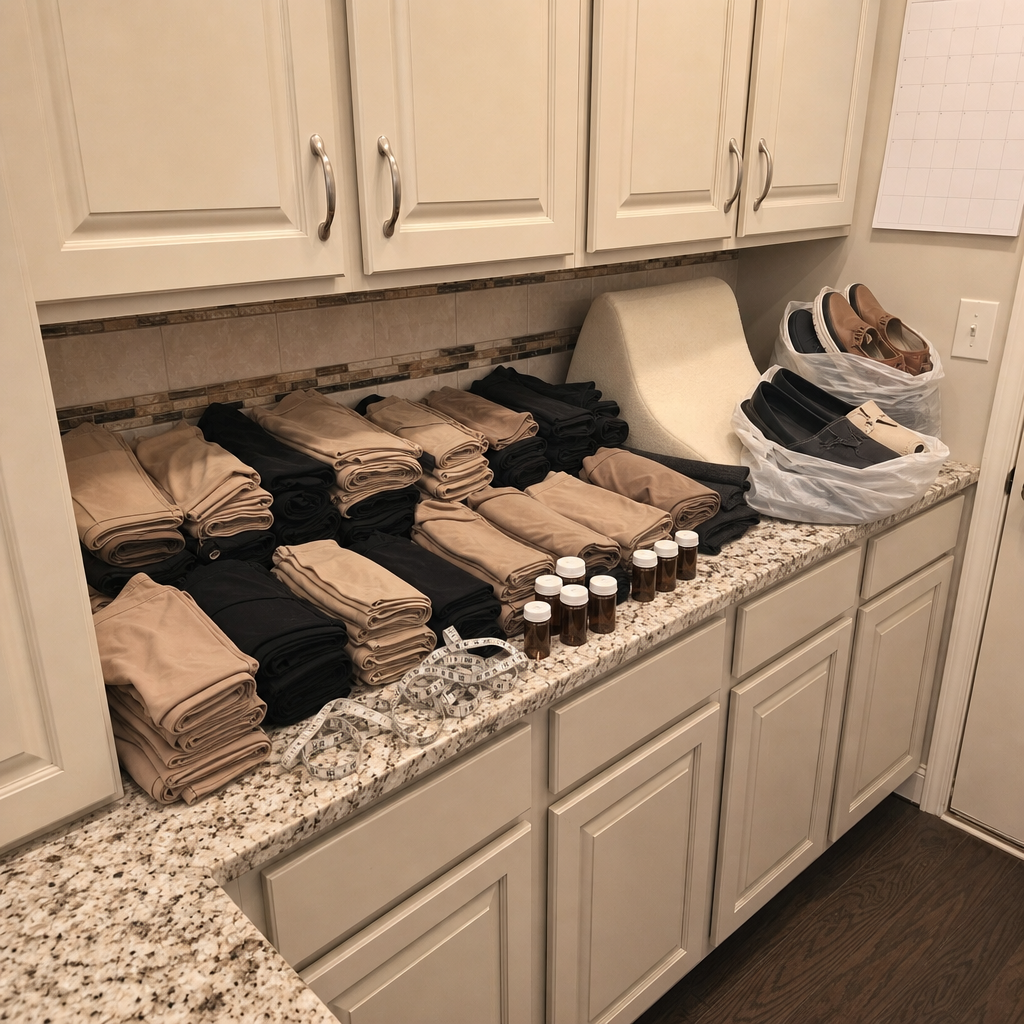
Ran for 55 days, from June 19 to August 13, 2026, the last day Crush saw it.
Run by Lymphedema Support Center on Facebook. Crush is not the advertiser and does not verify its claims. See this ad in Meta's Ad Library(opens in a new tab)
Want an ad like this for your product?
Crush makes new ad images for your product from this ad: your logo, your product photo, your offer.
Trials from $19.95 USD, then $79.95 USD a month. Cancel anytime.
About this ad
- Meta Ad Library ID
- 2271827143620957
- Platforms
- Facebook, Instagram, Audience Network, Messenger and Threads
- Relaunches
- 0
Ad text
I am going to say something that nobody with swollen legs wants to hear and I don't give a f*k if it upsets you. My sister Margaret started compression stockings in July, 2024. Threw out every pair of regular shoes. Went on the low-salt diet. Walked the mall loop every morning. Started elevating her legs on three pillows every night, of all things. She did everything the doctor told her. Her swelling never went down and her legs got worse until the day she fell on October 19th at 4:17 AM. She was 61 years old. Started the stockings on July 8th. Ate nothing with salt in it. Lost 22 pounds. Walked the mall loop, rain or shine. The hospital bill was $63,000. The rehab was $11,200. Her favorite pair of leather boots is still on the rack by the door. I can't move them. If I move them, she's really gone. I need to tell you what happened to Margaret. Because I'm seeing the same posts on Facebook that I was making just months before she fell, "my sister's doctor told her her ankles are too swollen, any tips?", and it makes me physically ill. If you're over 50 and your legs swell, or someone you love's do, please read this entire thing. I know it's long. I know you're scrolling. I know you have things to do. Fifteen months ago I would have given anything, everything, for someone to tell me what I'm about to tell you. Margaret went in for a routine physical on June 28th, 2024. She felt fine. Better than fine. She'd just turned 60. She still tended her own garden. She still walked the dog every weekend. She thought she was indestructible and honestly so did I. Two days later her doctor called. Ankle circumference 16 inches. Pitting that held a thumb-dent for 11 seconds. "Your legs are very swollen, Margaret. We need to talk about the fluid." Margaret was quiet on the call. I was in the kitchen pretending not to listen. "How long have they been like this?" "Couple hours a day at first. All day now. Tight by lunch. My shoes don't fit by three." "That's enough to worry about. You need compression. Daily. No exceptions. We'll retest in three months." Margaret hung up the phone and sat at the kitchen table for forty minutes without saying anything. Then she stood up, walked to the closet, and took everything out. I watched her bag up a $180 pair of heeled boots. A $90 pair of loafers. A $40 pair of flats. Two boxes of normal shoes into the donation pile. The whole shoe shelf, gone in under an hour. "That's it," she said. "I'm done with all of it." And she was. For 103 days, she didn't skip a single morning. No regular shoes. No salt. No standing. Not at her niece's wedding in August. Not at the fall festival in September. Not at her own 61st birthday dinner in October where her best friend ordered the salted caramel right in front of her and Margaret had the plain fruit cup. She stopped going to her Tuesday night card game because she couldn't sit there with her legs throbbing while everyone else relaxed. She lost her friend Mike's wife, who told her "you never come anymore" and stopped inviting her. She lost the Friday lunch at the club. She lost a piece of herself she'd been carrying for 35 years. And she did it anyway. Because the doctor said to. She lost 22 pounds in those three months. She bought a wedge pillow, Margaret, with the wedge pillow, I still can't picture it. She started walking the mall loop every morning before the heat. She took the dandelion root her doctor "wasn't against." She took a water pill. She ate unsalted everything, the woman who used to call it "hospital food." She did everything right. The follow-up came back on October 7th. Ankle circumference: 15 inches. Pitting: 10 seconds. She'd worn the stockings entirely for 90 days and the numbers had barely moved. The doctor said "give it more time. Swelling goes down slowly. We'll retest in 6 months. Keep doing what you're doing." Margaret came home that night and sat at the kitchen table again. The same table she'd sat at after the first call. She didn't say anything for a long time. Then she said: "Carol, I gave up everything. Everything. And it didn't work." I told her to give it time. I told her the doctor said six months. I told her to trust the process. She nodded. She kept walking. She kept elevating. She kept wrestling the stockings on. Five days later, five days, she stood up at 2 AM to use the bathroom and her legs gave out from under her. I drove her to the ER. By the time they admitted her at 4:30 AM, her shins were weeping. Not "a little damp." Weeping. Like a faucet. Like the skin had finally given up holding it all in. The ER doctor, a young woman, couldn't have been 35, looked at Margaret's legs and her face did this thing. "Mrs. Hale, the fluid has pooled so long the skin is breaking down. This is venous stasis with cellulitis. We're admitting you." "But I've worn the stockings three months," Margaret said. The doctor just looked at her. "I know, Mrs. Hale. I'm sorry." Margaret spent 11 days in that hospital. I learned things about the legs I never wanted to know. I learned that when the fluid sits in the lower legs long enough, the skin starts to ulcerate, and the infection that gets in, cellulitis, mostly, can spread into the blood. They call it sepsis. It means your sister stops being your sister. She looks at you with a fever burning behind her eyes. She says things that don't connect. On day 6, Margaret asked me three times in twenty minutes if I'd watered the ferns. We don't have ferns. We haven't had ferns since 2009. I learned that they kept squeezing her calves with these inflating sleeves that pumped up and down, day and night. The nurse told me it was the only way to physically move the fluid out, because Margaret's own legs had stopped doing it. She said the calf muscles are supposed to be a pump, and Margaret's had basically gone to sleep. She said the machine was doing the job her body had quit doing, and at this stage they were hoping it could buy her time. It bought her 11 days. Day 8, the infection spread up her thigh. The doctors talked about debriding the wounds. Then they talked about her not being strong enough for surgery because of how fast she was declining. Then they stopped talking about surgery altogether. Day 10, her legs swelled up so tight the skin split. They wrapped 4 layers of dressing around each one. Four layers. The nurse called it lymphorrhea. I called my daughter. Day 11, October 19th, I was in the family room down the hall. They'd asked me to step out while they worked on her. At 4:09 AM I heard the long beep. At 4:17 AM, a doctor I'd never seen walked into the family room. I knew. "I'm so sorry. We did everything we could." I drove home at 6 AM. The wedge pillow was still on the bed. The walking shoes were by the back door. The dandelion root was on the windowsill above the sink, next to the water pills. Her favorite leather boots, the ones she left because they were her favorite, were still on the rack by the door. Where they sit today. I sat in her chair. I didn't move for six hours. The house was so quiet I could hear the refrigerator hum. 38 years we'd lived two doors apart. And now the only sound in my house was the refrigerator. The service was January 19th. Margaret's daughter flew in from Arizona. Our cousin drove up from Bloomington. The grandkids wore dresses that were too big for them. My five-year-old great-niece asked me: "Auntie, when is Grammy Mar coming home?" I told her Grammy Mar was in heaven now. She said: "Can we call her there?" I had to walk out of the room. After the service, I tried to go back to normal. I couldn't. Because every time I opened my phone I saw women my age, women Margaret's age, posting things like "doctor said my ankles are a little swollen, anyone tried compression?" or "annual physical, slightly puffy feet, no big deal." And I knew, I KNEW, some of them were doing exactly what Margaret did. Compression. Low salt. Walking. Elevating. Taking the water pills. And getting worse anyway. I couldn't just sit there and watch it happen. So I started researching. Not because I wanted to. Because I had to. Because if Margaret gave up everything for nothing, if I can't save even one woman from what happened to her, then I can't live with that. I read for weeks. Medical journals I barely understood. Circulation forums. Studies out of Japan and Germany. And one thing kept coming up, over and over, that no doctor ever told us: The reason Margaret's swelling didn't come down is that compression only squeezes from the outside. It doesn't restart what's already stopped working. Specifically: the calf-muscle pump. The calf-muscle pump is the engine your body uses to push blood and fluid back up out of your legs, against gravity, every time you take a step. Every walk to the mailbox, every trip up the stairs, every step depends on it. And here's what no one told us. After age 40, the motor nerves that fire that pump start going quiet, a little more every year. Modern life, sitting all day, standing all day, burns through what's left even faster. By 55 most women have lost nearly half of that pumping action without knowing it. And here's the part that made me sit up straight: When your calf pump goes dormant, the fluid that's supposed to be pushed back up harmlessly, now starts pooling in your ankles. Margaret's legs weren't swollen because of salt. They were swollen because she didn't have enough pump left to move the fluid she had. Read that again. Her legs weren't swollen by the salt. They were swollen by the dead pump the fluid was sitting on top of. And here's why compression alone didn't save her: squeezing from the outside contains the fluid. It doesn't move it. Her pump was already dormant by the time the doctor told her to wear the stockings. The pooling was already cascading. Eating clean, walking, elevating those legs, those things slow how fast it pools. They don't restart the engine that pushes it up. That's why her numbers wouldn't move. She gave up everything she loved to squeeze a wound that was already inside her. I sat with that for three days. And then I started looking at what I'd been doing. I'd thrown out Margaret's stockings the week after the service. But I bought a new pair for myself. Because I'm 59. Because my ankles were "borderline" at my last physical. Because I was scared. I wore them for three weeks. My doctor, a different one to Margaret's, who I called because I trusted her, sighed when I told her. "Carol, compression squeezes the leg you've still got. But you can't squeeze life back into a pump that's gone to sleep. It works on the surface. It doesn't restart anything." Then she said something I'll never forget: "If Margaret had been on something that actually reactivated her calf pump, the picture might have been very different." I stopped breathing for a second. "Why didn't her doctor recommend that?" She was quiet for a long time. "Because we don't recommend devices. And the thing that works isn't a prescription." I went to the pharmacy the next day. I stood in that aisle for forty minutes. Compression socks. Foot soak salts. Dandelion capsules. "Leg detox" 30-day program. Multivitamins with "circulation support." A generic vibrating foot massager, $14.99, the cheap stuff. I bought the cheap massager. Used it for two weeks. No change to my ankles. I started Googling and what I found made me throw the thing in the trash. A dormant calf pump can't be reached by skin vibration. The buzzing massager just rattles the surface of the foot, it never reaches the motor nerves that actually fire the muscle. Most of what you're paying for never gets where it needs to go. You're wasting $14.99. Direct electrical stimulation bypasses this entirely. The pulse reaches the motor nerve directly. I had been doing the right thing in the wrong form. I was furious. I'm still furious. About a week later I was reading a thread on Facebook, one of those leg health groups, full of women like Margaret was, "swollen ankle" women, "borderline edema" women, and a woman posted something that stopped me cold. She said her sister had been told to wear compression at 58. She wore it. Her swelling barely moved for six months, sound familiar?, and then she found a foot-plate device that sent gentle pulses straight to the calf muscles, reawakening the pump, plus it drained the pooled fluid up and out. Her ankle circumference went from 17 inches to 13 in ten weeks. Without giving up anything else. Without doing anything else different. I read that post six times. I started looking into the device she mentioned. And what I learned is that there are five things a serious leg treatment has to do at the same time, or it's a waste of your money: It has to reactivate the calf-muscle pump from the inside out. That's the EMS pulse, the same kind of muscle stimulation the hospital sleeves were doing on Margaret's legs at the end. Not a sock. The actual electrical signal to the motor nerve. It has to physically move the fluid that's already pooled, directly, while the pump wakes up. That's the rhythmic squeeze-release of the contractions themselves. EMS restarts the engine. The contractions push the fluid up at the same time. It has to reach the soleus and gastrocnemius, the two deep calf muscles that do the actual pumping. Without reaching those, the fluid just sits there hardening the skin into scar tissue, no matter how much weight you lose. It has to drive the fluid up and out so what pools in the ankle actually leaves instead of recirculating. That's the squeeze of the deep veins, contracting in sequence. One pulse opens the vein. The next pushes the fluid through. And it has to be a device you can use sitting still. Because a dormant pump cannot be restarted by socks or pills. Five things. All five. At the same time. In one device. I went through every product I'd looked at in the pharmacy. Not one of them did all five. Most did one. The expensive ones did two. None of them reached the pump. That's when I found Ornexis. It was the only thing I could find that hit all five. EMS pulses. Calf-pump reactivation. Soleus and gastrocnemius. Deep-vein drainage. A foot plate you rest your bare feet on, 15 minutes in the evening. Made in the US. 100-day money-back guarantee tied to your actual ankles, if your swelling doesn't improve, you get every penny back, no questions asked. I almost didn't order it. After the pharmacy aisle. After the compression. After Margaret. After everything. But I had a cousin who was still standing on her feet all day like Margaret used to. I had a niece with "borderline" puffy ankles. I had myself. I ordered it. My cousin. Came back from a routine appointment with an ankle circumference of 17 inches. Didn't know what to do. I sent her one. I didn't ask. I just sent it. Wrote a note that said "If you don't rest your feet on this every evening I will never speak to you again, Frances, I mean it." She used it. She kept standing all day, she wouldn't quit her shifts, she's stubborn the way Margaret was stubborn, but she used it every evening. She went back to her doctor four weeks ago for a follow-up. Ankle circumference: 13 inches. Down from 17. In ten weeks. She hadn't quit standing. She hadn't changed her diet. She hadn't started anything else. The only thing she changed was the 15 minutes on the plate in the evening. She called me crying. My cousin. 57 years old. Crying on the phone like a kid. She said: "Carol, I think Margaret got that bad because nobody told her about this." I had to hang up. Then there's my niece. 44, two kids, "borderline puffy ankles" at her last physical. Started resting her feet on it six weeks ago. She says her evening heaviness is gone. She says the dull tight ache she'd been feeling in her shins for two years, the one her doctor said was "probably nothing," is gone. My neighbor Karen. Her sister died of complications from leg ulcers four months before Margaret. Two of us grieving on the same street. She started using one two days after I told her. She says it's the first time since then that she doesn't feel like she's waiting for a phone call. I told my daughter. I told Margaret's daughter. I told the women in my book club. I told the ladies at Margaret's old card game when I went to drop off a casserole. I'm not a doctor. I'm not a scientist. I'm not selling anything and I don't get a penny from any of this. I'm a 59-year-old woman sitting in my late sister's chair at 2 in the morning because I can't sleep and I can't stop thinking about my cousin and whether she's going to end up where Margaret ended up. Here's what I know because I lived it: Compression stops nothing. It doesn't move what's pooled. It doesn't restart the pump. A foot massager rattles the surface. It doesn't reach the nerves that fire the muscle. A dormant pump cannot be restarted by socks or pills. Direct stimulation reaches it. Margaret gave up everything she loved for 103 days and it didn't save her because nobody told her what was actually broken. I wish someone had told us before June 28th, 2024. Before the routine physical. Before the shoes in the donation pile. Before the 103 days of the plain fruit cup. Before October 19th at 4:17 AM. I can't go back. Margaret can't come back. Her boots are still on the rack and they're going to stay there. But you can still go forward. Your sister can. Your cousin can. You can. The page that explains all of this, the calf-pump mechanism, why the swelling won't move when you wear the socks, what your doctor doesn't know about direct stimulation, and what Ornexis actually does, it's the page I found at 3 AM. Not containing. Reactivating. That's the line that finally made it click for me. I want you to read it. Not for me. For whoever you'd leave behind. 👇 https://ornexis.com/pages/ems-edema Margaret used to say: "You can't unring the bell, but you can stop ringing it." You can stop ringing it. Carol Baker, age 59 Springfield, IL P.S. The boots are still on the rack. I still can't move them. Every morning I walk past them and for one second I forget. For one second I think she's about to come over and tell me she's going for a walk before the heat. She's not. $63,000 in hospital bills. $11,200 for rehab. 103 days of her giving up everything she loved for nothing. And a device that costs less than her Tuesday night card buy-in for the month, a device her own doctor told me could have changed everything if we'd known. Please. Don't end up here. Don't let someone you love end up here. 👇 https://ornexis.com/pages/ems-edema P.P.S. I don't work for Ornexis. I don't get a penny from this. I'm writing this at 2:14 AM because I can't sleep and Margaret's house two doors down is dark and my cousin is 57 and stubborn and I'm scared every time the phone rings. Share this with anyone you love whose legs swell. Even a little. Even "just by evening." Even if they already wear the socks. Please.
Where the ad sends people
ornexis.com
What your legs have forgotten
Try Ornexis for 100 days. If you don't see real changes in your ankles, your evenings, or how your legs feel overall, we'll refund every cent. Just an email. That's it.
Learn more: ornexis.com(opens in a new tab)