Donna Reed
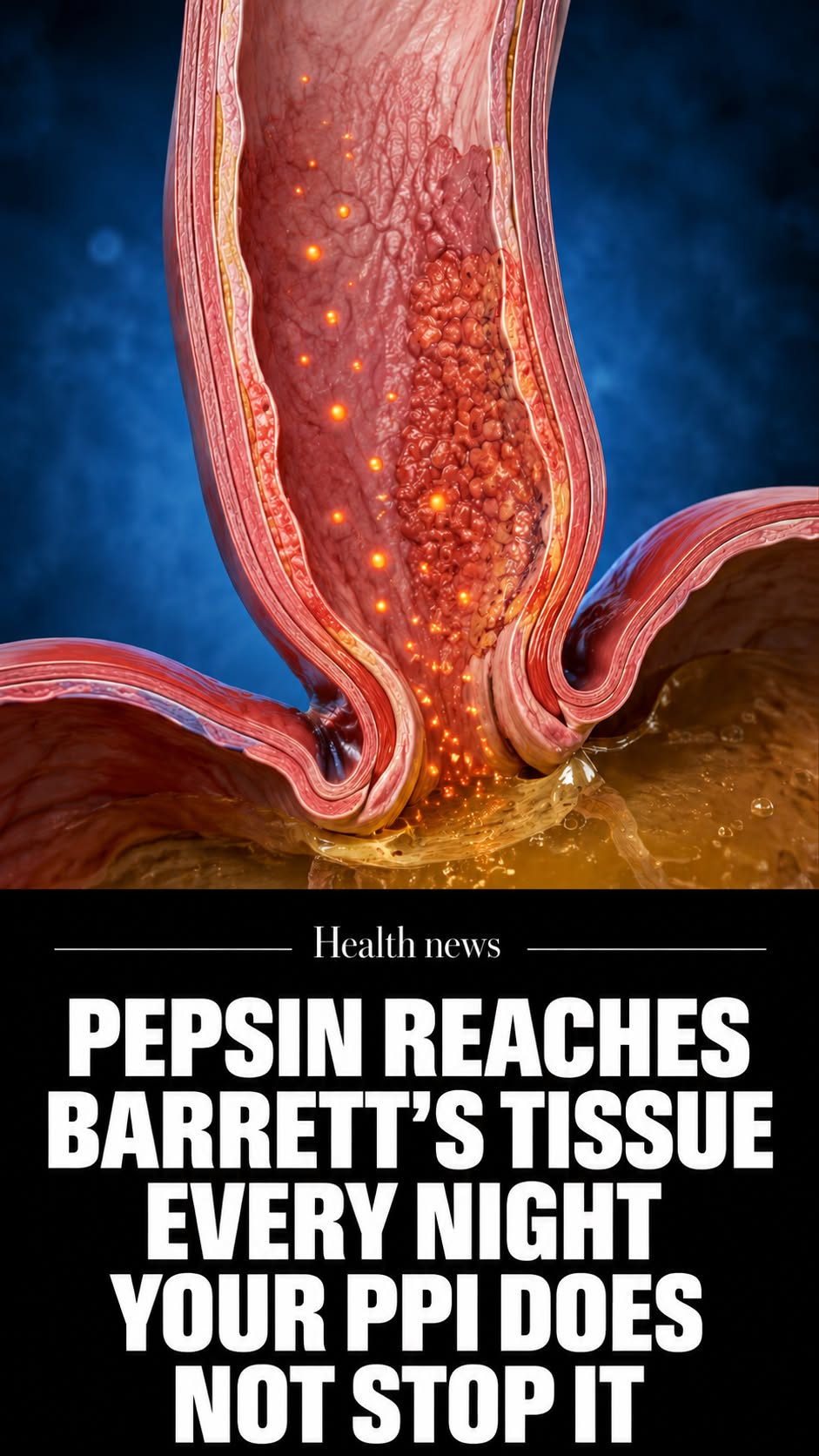
Donna Reed Facebook ad: “Barrett's Progressing Despite PPIs? Read This.”
Ran for 51 days, from July 1 to August 21, 2026, the last day Crush saw it.
Run by Donna Reed on Facebook. Crush is not the advertiser and does not verify its claims. See this ad in Meta's Ad Library(opens in a new tab)
Want an ad like this for your product?
Crush makes new ad images for your product from this ad: your logo, your product photo, your offer.
Trials from $19.95 USD, then $79.95 USD a month. Cancel anytime.
About this ad
- Meta Ad Library ID
- 2446718322422527
- Platforms
- Facebook, Instagram, Audience Network, Messenger and Threads
- Relaunches
- 0
Ad text
My mother followed her gastroenterologist's Barrett's esophagus protocol perfectly for eight years. It still killed her. I want to tell you why. My name is Donna. I am 61 years old. I live in a brick house on a quiet street in Nashville with my husband Martin, a vegetable garden that has gotten away from me since I retired, and a medical file I have been adding to for three years that has started to look a lot like my mother's. I was a school principal for 29 years. I know how to gather information. I know how to sit across from someone telling me something difficult and hold my face steady while my mind is already three steps ahead. None of that prepared me for the scope report. My mother was diagnosed with Barrett's esophagus at 63. That was 2007. She did everything right. She took every prescription her gastroenterologist gave her. She elevated the head of her bed with wooden risers my father installed on a Sunday afternoon. She cut out the wine, the coffee, the tomato sauce she had made for forty years from her own garden. She showed up to every surveillance scope on the exact schedule her doctor gave her. Four months apart. For eight years. Every scope showed progression. Mild dysplasia became moderate. Moderate became something that required intervention. She died at 71. Not from something that ambushed her. From the exact thing she had been watching for eight years and could not stop. Her gastroenterologist sent a sympathy card. That card is in a box in my closet and I think about it sometimes. My own diagnosis came three years ago. My gastroenterologist sat down, pulled up my chart, and used the same words my mother's doctor had used twenty years before. Barrett's esophagus. Low-grade dysplasia. High-dose PPI therapy. Surveillance scope in six months. I sat in that office and nodded. I shook her hand. I walked to my car and sat in the parking lot for a long time without turning the key. The whole drive home I kept thinking about the day I drove my mother home from her diagnosis. She had held the printout in her lap the entire ride and looked out the window and I had not known what to say to her. I had not known then what I was driving her toward. I took the long way home. Past the street where her house used to be. I don't know exactly why. I told Martin over dinner that everything was going to be fine. He looked at me the way he looks at me when he doesn't believe something I'm saying but knows better than to push. That night I stared at the ceiling fan until the clock said 1:22. Then 3:09. Then I gave up, went downstairs, and opened my laptop. I have my mother's scope reports. She kept all forty-one of them in a manila envelope in her desk drawer. When we cleaned out her house the summer after she died, I took that envelope home. I could not tell you exactly why. I think I needed to hold the evidence of what had happened to her. The night of my own diagnosis I laid them out on the kitchen table in order. Watched the language change across two decades of appointments. Mild. Moderate. Concerning. The final report that led to the intervention that did not work. Forty-one appointments. Eight years. Progression documented at every one. At 3:09 in the morning, alone in my kitchen with those reports spread in front of me, I started reading. The word pepsin does not appear in any of my mother's reports. It does not appear in mine either. I found it at 4:47 AM in a clinical journal about Barrett's metaplasia. The study was arguing that pepsin, not acid, was the primary driver of cellular damage in Barrett's tissue. That PPIs reduce acid but leave pepsin completely active at near-neutral pH. That pepsin keeps reaching the compromised esophageal cells. Keeps accelerating the injury. While the scope reports keep showing progression and the prescription keeps getting refilled. I printed the paper. I put it on top of my mother's envelope. I sat there until daylight came through the kitchen window and Martin came downstairs in his socks and saw my face and didn't ask. Three weeks later I was at a small integrative medicine conference a colleague had mentioned in passing. I almost did not go. A presenter spoke for forty minutes on Barrett's, LPR, and something he called alginate raft therapy. He was a retired ENT surgeon. His name was Dr. Gerald Ramos. He had spent twenty years at Johns Hopkins before retiring to Tennessee, He spoke without notes, slowly, like someone who has known something long enough that the urgency has left it. Near the end of his talk he said something that made me raise my hand. "Every Barrett's patient I placed on high-dose PPIs was still experiencing pepsin damage. The acid was lower. The pepsin did not care. Because nothing was physically preventing it from reaching the tissue." I raised my hand. "What physically prevents it?" He said: an alginate raft. A gel derived from specific species of brown seaweed that forms a buoyant physical barrier on top of stomach contents and remains there for four hours. When the lower esophageal sphincter relaxes at night, which it always does and especially in Barrett's patients, the gel is already sitting at the junction. The pepsin reaches the gel. Not the tissue. I asked him why my gastroenterologist had never mentioned this. He paused. Then he said: "Alginate therapy has been standard of care in Europe since the 1970s. In America we trained on proton pump inhibitors. There is no patent on seaweed. There is no pharmaceutical company with a reason to change the protocol." I ordered it on my phone before I left the building. The first dose was thirty minutes before bed. A gel I sipped slowly. I could feel it settling as it went down, coating in a way that nothing I had taken before had done. Day four: The burning I had been waking with every morning, the one three different doctors had noted in my chart and moved past in the same appointment, was noticeably less. Week two: I slept through the night. Three nights straight. Martin noticed before I said anything. He watched me come downstairs one morning and just stood there quietly. He said: "You're different." Week three: A hoarseness I had blamed on seasonal allergies for two years started to ease. Not gone. Easing. Six weeks after I started, I had my surveillance scope. I sat in the parking lot of the endoscopy center and opened the patient portal on my phone. No progression of dysplasia. Barrett's segment stable. Continue current regimen. I called Martin from the parking lot. "Stable," I said. A long exhale on his end that took time to resolve into something else. "Donna. Thank God." My mother never had a stable scope after her diagnosis. Not one. In eight years. Forty-one appointments. Every one showing something had moved. She took every pill. Followed every instruction. Trusted the system completely. Nobody told her about pepsin. Nobody told her there was something that could physically sit at the junction and stop the refluxate from reaching the tissue that had already changed. In January I told a woman in my Barrett's support group about alginate therapy. She had been diagnosed two years before me. Her last three scopes had all shown progression. She was quiet for a long time after I finished explaining. Three years of progressive scopes will do that. You stop expecting the conversation to go anywhere new. She called me eight weeks later. "My scope came back stable," she said. "My first stable scope in three years." I did not have words for a moment. Neither did she. We sat on the phone together in silence for a little while. If you are reading this, I do not need to explain what it is to have those words in your chart. You already know. You have already searched at 3 AM. You may have already watched someone you loved walk this road in front of you. Here is what I want to tell you. The PPI addresses the acid. It does not stop pepsin. It does not physically prevent refluxate from reaching esophageal tissue when the sphincter relaxes at night. Nothing your pharmacist carries does that. Alginate therapy does the thing the PPI cannot do. It sits at the junction. When reflux occurs, the gel travels instead of what is underneath it. Not chemistry. Physics. My mother's gastroenterologist never mentioned this. Mine never mentioned it. Forty-one scope reports showing progression across eight years, and not one appointment where anyone said there is something that can physically block what is getting through at night. Try it for 30 days. If your nighttime symptoms, your morning throat, your sleep have not changed, you will receive a full refund. No questions asked. When my mother was on her PPI protocol for eight years, nobody offered her a refund. When her gastroenterologist documented the progression scope by scope and called it appropriate surveillance, nobody offered to give back what she lost watching and waiting. The guarantee is the least this company can do. It is also the most the medical system never offered her. Do not wait for the next scope to show you what unprotected nights cost. Donna Reed, 61, Nashville, Tennessee
Where the ad sends people
get-zylo.com
Barrett's Progressing Despite PPIs? Read This.
Zylo
Learn more: get-zylo.com(opens in a new tab)