
Inactive· since May 28, 2026
- 53
- days it ran
- 0
- relaunches
Ad copy
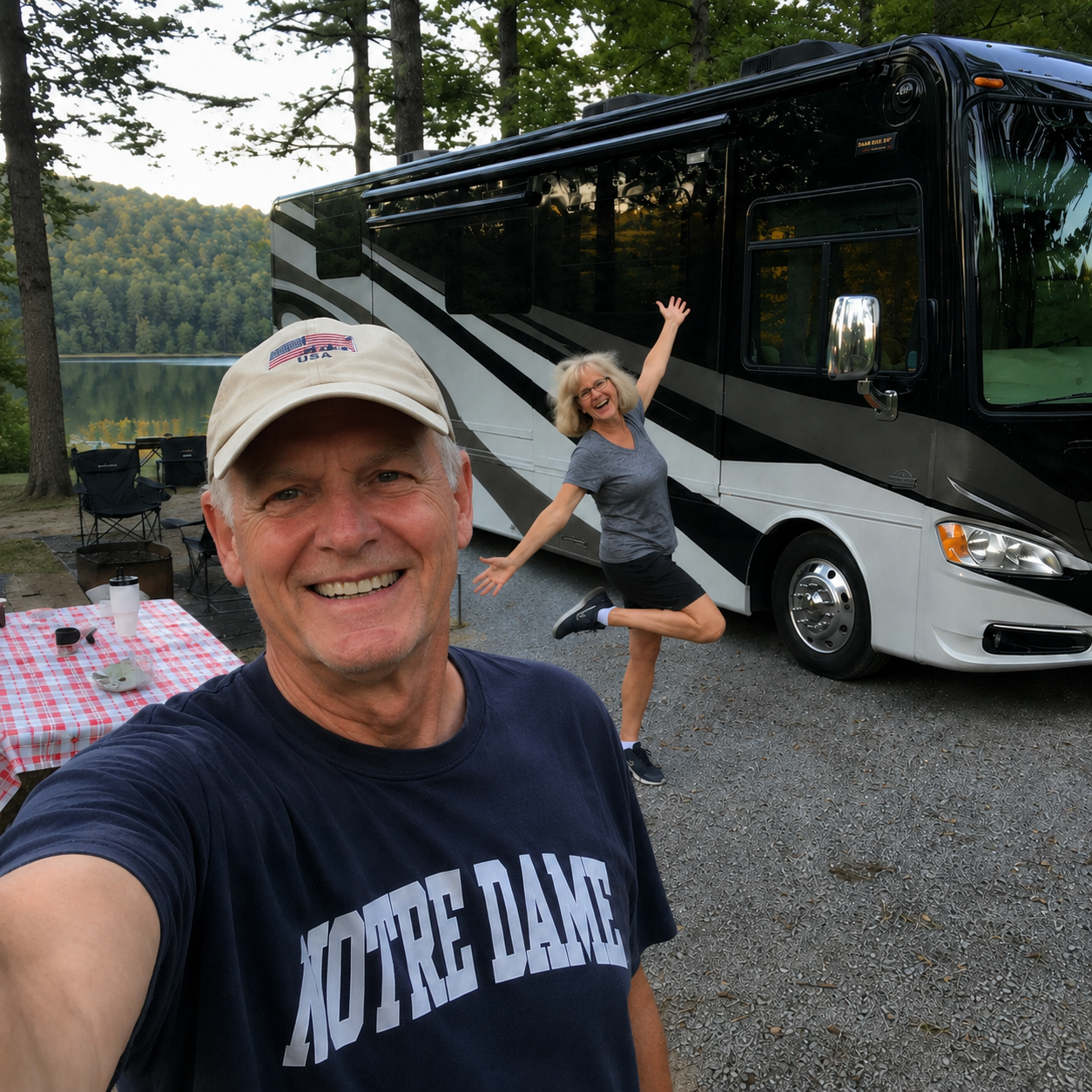
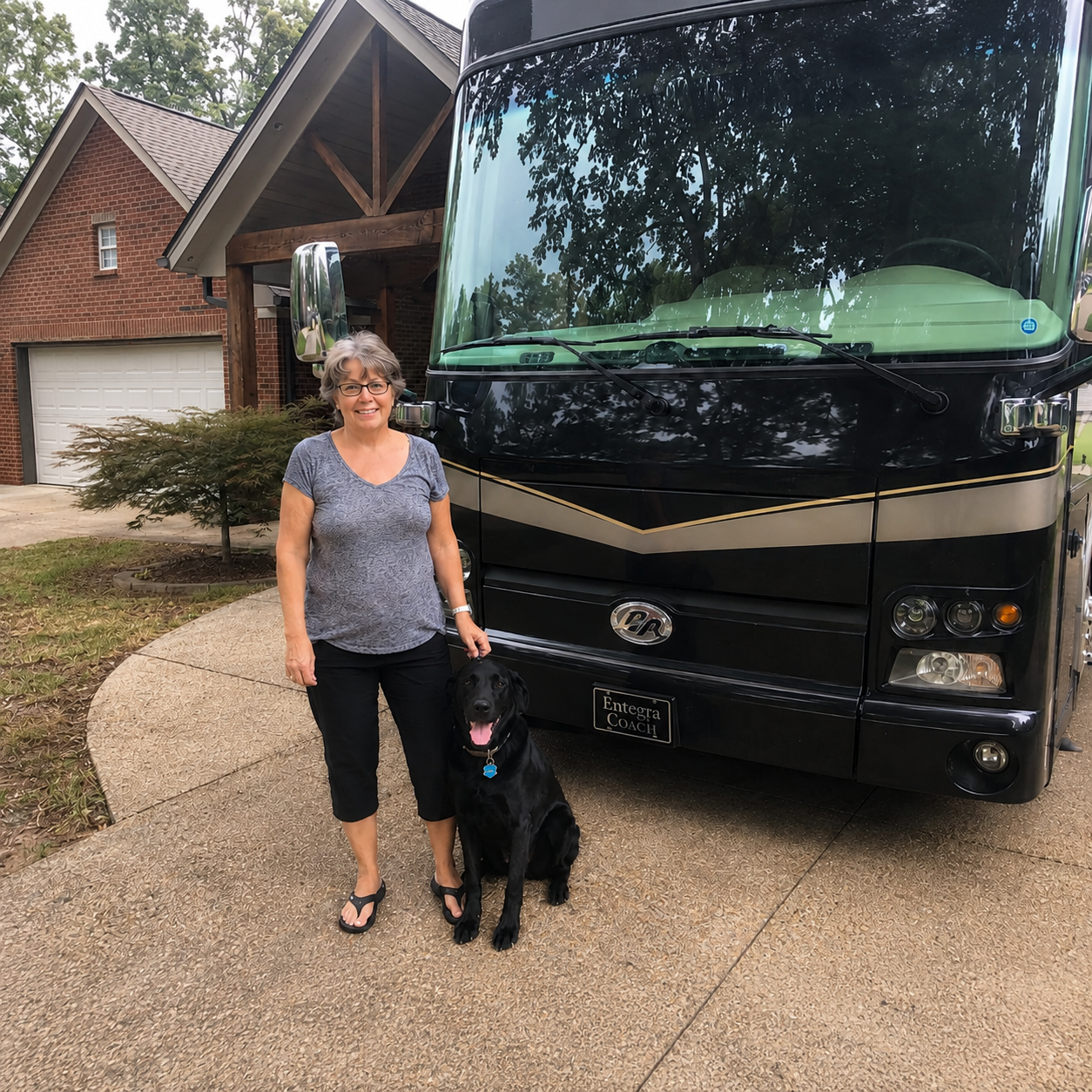
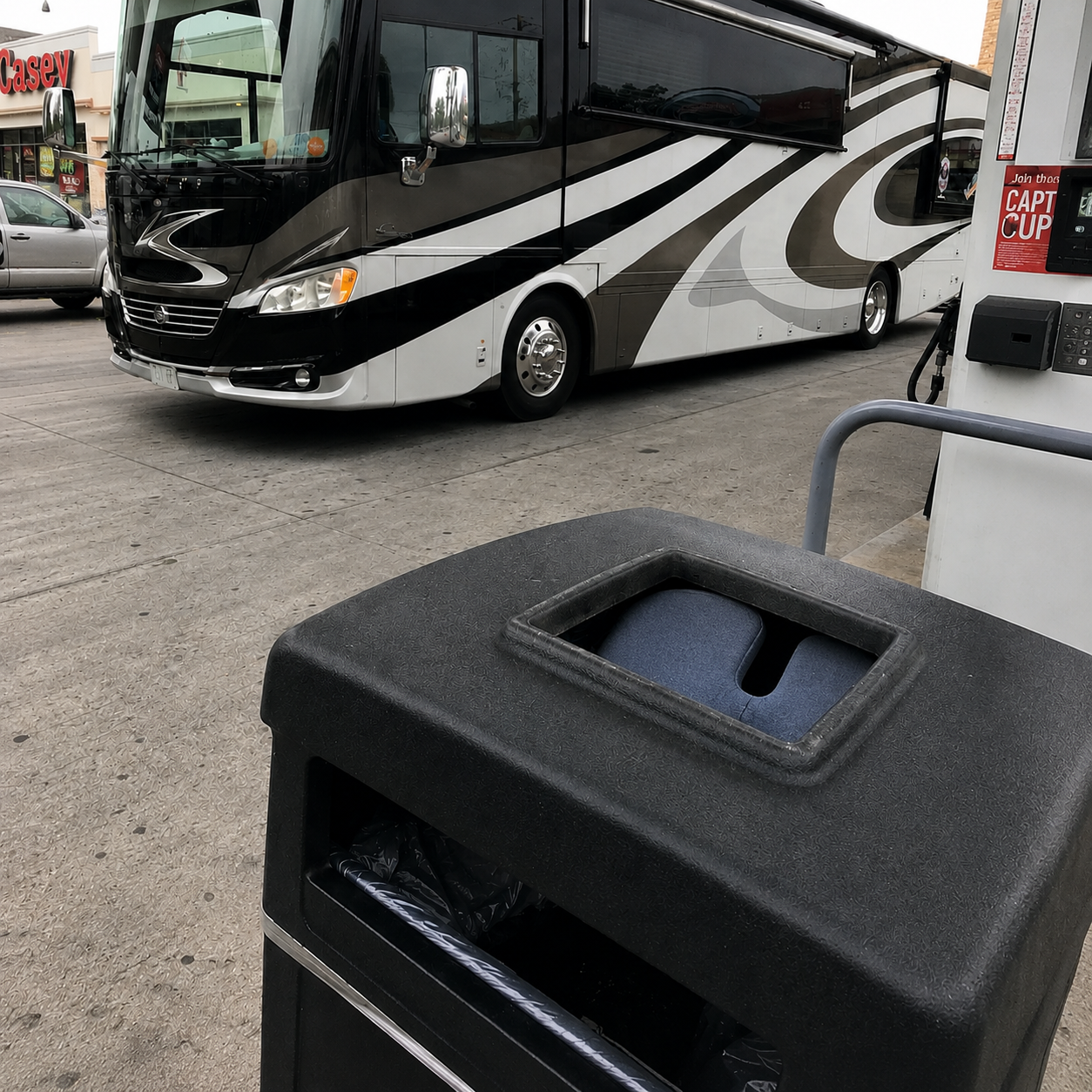
My husband doesn't know I'm writing this. He's outside right now hooking up the water line at site 14. If he reads this over my shoulder later, he'll shake his head and say "Diane, why'd you have to go and tell people our business." Because maybe one more wife reading this will recognize her husband in what I'm describing. And maybe she won't wait as long as I did. Don is 68. Retired general contractor. Built houses for 43 years with the same hands that planned our retirement trip by trip on a paper Atlas he's had since 1997. The margins are full of his handwriting. Campgrounds circled. Routes mapped in red pen. Notes like "avoid I-80 in August" and "Crater Lake — go early for the rim road." He bought our Class A motorhome nine years ago. Thirty-eight feet of rolling ambition. He spent six months researching it, drove four hours each way to the dealer twice before he signed anything. The day we drove it off the lot he looked over at me in the co-pilot seat and said, "Honey, we're going to drive this thing to every state in the lower 48." We've made it to 31. That was the plan at 59. Now he's 68 and the drives are getting shorter. Not because we changed the plan. Because his body started changing it for him. It started quietly. I'm his co-pilot — always have been. I do the navigation, the campground reservations, the campsite reviews on the iPad. He drives. That's been our arrangement for nine years. And on a travel day I'd talk. I'd read him little facts about whatever state we were crossing, read the funny one-star campground reviews out loud, tell him what I'd heard about the next rally. Around year seven, I noticed I was doing most of the talking. By hour three he'd stopped responding. Not rudely — just one-word answers. His jaw would get tight. His left hand would leave the wheel and come down to his hip. He'd shift in the seat, forward, then back, like he was trying to find a position that didn't exist. By hour four he'd be scanning for exit signs. "I need to stretch my legs," he'd say. We'd pull off. He'd open the cab door, swing his legs out, and when his feet hit the pavement there was this pause — one, two seconds — before he'd stand. And in that pause I could see him bracing. Every time. We used to do 450 miles in a day without a second thought. I have trip logs going back to 2016. Last October we did 210 miles and he pulled over at a rest stop outside Amarillo, put the rig in park, leaned his head back against the headrest, and said, "I think that's it for today." 210 miles. 3:15 in the afternoon. I asked if he was okay. He said "just tired." I knew it wasn't tired. Tired is what happens at the end of a full day. What was happening to Don had started before we even pulled out of the campsite that morning. He stopped wanting to drive. That's the thing I couldn't say out loud for six months, because saying it felt like saying it was over. The man who drove through a Texas thunderstorm at midnight because "we made a reservation, Diane" — that man started suggesting we stay an extra day at the current site instead of moving on. "The site is nice. We don't have to rush." We weren't rushing. We had three months and nowhere to be. He just didn't want to get back in that seat. I started watching him at campgrounds. After a long drive day he'd ease down into his folding chair outside, and there was this thing he did — a slow, controlled descent, the way you lower something fragile. He'd sit there for an hour not really talking. Not because he was relaxing. Because he was recovering. Our friends from the rally — Tom and Bev — they're 73 and 71. Still doing 350-mile days without a conversation. I watched Tom hop down from his cab at our meetup in Albuquerque and walk straight to the grill without grabbing anything for support. I watched Don notice it too. He never said a word. But I saw him watching. We tried everything. We paid $4,700 to have both captain chairs re-upholstered. The guy at the shop in Phoenix said the original foam had "collapsed" and new high-density foam would be "like sitting in a brand new coach." Don came home from the test drive and said it felt better. Two weeks later — Fort Davis to Carlsbad — we stopped twice before lunch. He tried three different cushions off Amazon. Memory foam. Gel-top. One that looked like it belonged in a wheelchair, which he threw in the truck bed after one drive because it pushed him forward and made everything worse. He bought a $200 lumbar air cushion from an ergonomics site. Used it for six weeks. His exact words: "It's not the lumbar. It's the sitting." His doctor told him it was "normal for 68." Suggested ibuprofen before long drives. Suggested physical therapy. He did eight sessions. The therapist told him he had "good range of motion for his age." He stopped going after the fourth session because driving to the PT appointments was the worst part of his week. I started reading RV forums at night while he slept. Up at 11, midnight, 1 AM, reading threads from guys his age. And what I kept seeing was this: "As I grow older trips are getting shorter." "The days of driving all day are behind us." "300-mile day was a killer for us. But we're on the old side." And I'd read those and feel this quiet grief I couldn't explain. Because it wasn't describing a medical problem. It was describing the resignation of capable men who had decided this was just what happens now. They were grieving the dream in forum posts and calling it aging. Then came March. We were at a state park in the Texas Hill Country, three days into a two-week trip we'd been planning since November. Day three he drove 170 miles and we stopped at noon. He went into the rig, lay down on the bed, and didn't come out for two hours. I sat in the co-pilot chair and made myself a promise. I said: I am not done. This trip is not done. We are not done. I went back to the forums. I went back to the Facebook groups. And I started looking at this differently — not "what is wrong with Don" but "what is everyone getting wrong about why this happens at all." Here's what I found at 2 AM with my laptop on the dinette table. I want to be specific, because I'm not a medical person — but I do have a biology degree I stopped using 35 years ago, and apparently I never fully forgot it. This is the thing nobody has explained to the men suffering in their captain chairs. You have two bones in your pelvis — sit bones, the two you can feel if you press on the underside of your thighs when seated. When you sit down, those two bones take on roughly 60% of your body weight. Cornell's ergonomics lab measured this: on a hard or poorly-designed seat, that works out to 85 to 100 pounds per square inch, concentrated on about 4 square inches of bone. Now here's the part that nobody connects. After 40, the fat pad directly under those sit bones starts thinning. This is normal anatomy — not a disease, not something you did wrong. By 60, that natural cushioning is significantly reduced for most people. And when you sit, the large muscle in your backside slides up and away from the sit bone rather than cushioning underneath it. So by 60, your body's natural shock absorption has been compromised in two ways simultaneously: less fat pad, less muscle coverage. The bone is closer to whatever surface you're sitting on than it's ever been in your life. That pressure doesn't just stay in your bottom. It travels. Upward, through the base of your spine, into the 23 discs between your vertebrae. Each disc is a gel-filled structure that's roughly 80% water — it's what keeps your spine from grinding bone on bone. Sitting compresses those discs through the day like slowly squeezing a sponge. Hour one, you don't notice. Hour seven — they've lost fluid, lost height, lost their ability to cushion anything. Now add an RV on highway asphalt. Research on occupational drivers has counted more than 80,000 road vibrations per 8-hour drive day. Every single one sends a small shock wave up through the seat, through the pelvis, into those already-compressed discs. Standard captain chair foam absorbs a fraction of each impact and passes the rest directly through. Memory foam is arguably worse — it compresses on impact and holds for a moment before recovering, which means the shock still transfers, it just arrives half a second late. The re-upholstery didn't fix it because re-upholstery replaces the foam above the surface. It cannot change what is happening inside his body — the way the bones are loading the tissue, the way the discs are slowly losing their capacity through the hours. It's like putting a new mattress topper on a board and being surprised you can still feel the board. Drive-day exhaustion isn't tiredness. It's a body absorbing 80,000 compressive hits a day to a spine that has been quietly running out of its own shock absorbers for years. He's not getting old. He's been sitting on the wrong surface. I found a cushion built on a completely different principle than anything we'd tried. Not foam. Not gel coating sprayed onto foam — I want to make that distinction because there are a lot of those, and the coating washes out in a few months. This is medical-grade TPE — a thermoplastic elastomer — formed into 570 individual open cells, each one acting like an independent spring. When a bump comes, each cell catches it and springs back in milliseconds. Not compress-and-hold. Catch and release. The pressure from the sit bones spreads across all 570 cells — distributing what should land on 4 square inches across more than 200 square inches. The discs take a fraction of the impact they normally would, every bump, all day. The brand is Easewell. The cushion is $59. They offer a full 30-day trial — if it doesn't work, you send it back. I found it in a forum thread from another RV wife. I ordered it without telling Don. I put it on his captain chair the night before our next drive day. Said nothing. He climbed up in the morning, started the engine, looked down and said, "Diane. What is this thing on my seat." I said, "Just drive." He drove 7 hours and 40 minutes. Stopped once, for fuel and a sandwich, not for his hip. Pulled into the campsite in Fredericksburg, Texas, swung the cab door open, stepped down — and did not pause. He walked straight to the hookup panel. I was still in the co-pilot seat. I didn't move for a minute. I just sat there. When he came back inside he said, "Whatever that thing is, don't touch it." Week two of that trip: 340 miles in a single day. First time in over a year. He pulled into the campsite, got out, struck up a conversation with the couple next door about their fifth wheel, and pointed our rig out the way he used to when we first got it — proud, easy, no pain written anywhere on his face. That night he spread the Atlas out on the dinette table. The one with his handwriting in the margins. He was circling again. Wyoming. Montana. Eventually Alaska. I watched him from across the table and I thought: there he is. There's the man I married. We are at 36 states now. If your husband has stopped suggesting the longer route. If he picks the closer campground without explaining why. If he's in his folding chair after a drive day not because he's relaxing but because he has to be. If you've watched him brace — that one-or-two-second pause before his feet hit the ground — please read what I wrote again. It is not age. It is not the end of the dream. It is the surface he has been sitting on for six and eight and ten hours a day, working against the body he's in, and he will never say that out loud because men who planned their retirement around a 38-foot motorhome do not say things like that out loud. Easewell has a 30-day trial. Order it. Put it on his seat the night before the next drive day. Don't explain it. Let him drive. If nothing changes, send it back. No argument from me. If it does — and I believe it will — you'll find him at the dinette table with a pen and a map, circling things again. https://tryeasewell.com/products/ew-restore-seat-cushion P.S. — Don read this. His exact response: "You told strangers about the thing in Amarillo." Yes. I did. He grumbled. Then he told me to make sure the link was in there so people could actually find it. P.P.S. — Several people have asked about fit. They come in two thickness options — 1 inch and 1.6 inches — just choose based on your preference. We went with the 1.6 inch and Don hasn't looked back. It fits every captain chair we've tried across Class A, B, and C configurations. Don now uses the original on his seat and I ordered a second one for the co-pilot chair on the long travel days when my back starts talking. P.P.P.S. — The thing to know about the knockoffs: there are "honeycomb gel" cushions all over Amazon that use foam with a thin gel layer sprayed on top. That coating washes out within a few months and you're left with regular foam. The Easewell is TPE cells that are structural to the cushion — they don't wash out, they don't compress permanently, they don't degrade. That's the distinction that matters. Real link here: https://tryeasewell.com/products/ew-restore-seat-cushion P.P.P.P.S. — Don wants you to know we're doing Idaho in August. The Sawtooths. He's already circled three campgrounds. I told him I'd put it in the post. Consider it done.
Like this ad? Make it yours.
Crush rebuilds this exact creative around your product — your brand, your colors, your offer — in about a minute.