
Inactive· since Apr 8, 2026
- 6
- days it ran
- 1
- relaunches
- 37
- EU reach
Ad copy
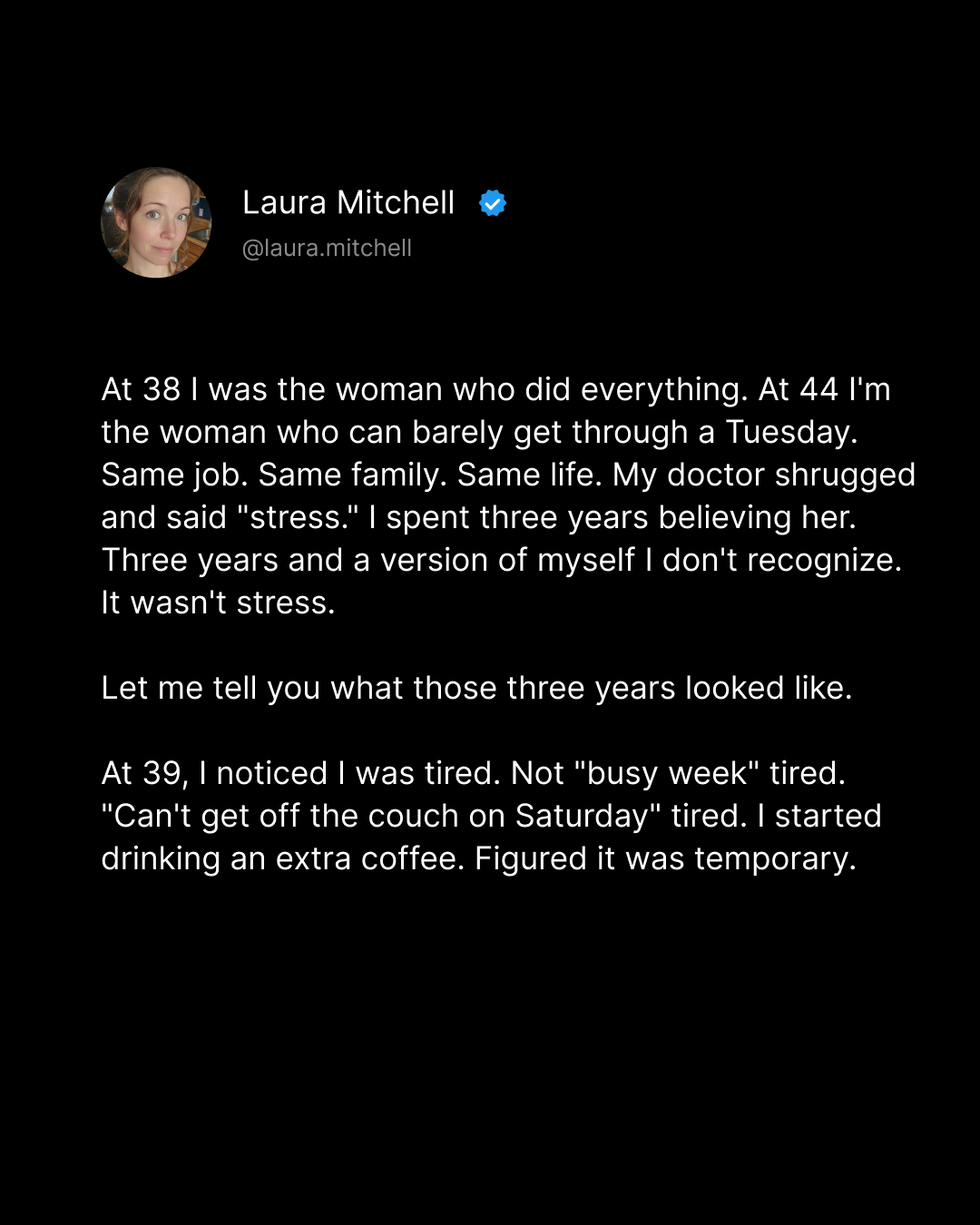
At 30 I was a person with interests, friends, opinions, a body that belonged to me. At 36 I'm a to-do list with a wedding ring. Nobody did this to me. I just... disappeared into the logistics of everyone else's life, one small surrender at a time. Let me tell you how it happened, because it wasn't obvious from the inside. At 31, I stopped reading. Not deliberately. I just kept picking up a book at night and my brain would drift to what I needed to do the next day, and I'd read the same paragraph four times, and eventually I'd put the book down and open my phone and plan the morning instead. The book sat on my nightstand for nine months before I returned it to the shelf unfinished. At 32, I stopped calling my college friends. Not because I was mad at them. Because calling required having something to say, and everything I had to say was about the baby, and I was tired of being the woman who only talked about her baby. So I stopped calling. They stopped calling. It wasn't anyone's fault. It just happened. At 33, I stopped having opinions on things that weren't household decisions. Movies, music, books, news, politics — I'd lost the thread. My husband would ask what I thought about something and I'd realize I hadn't thought about it at all. I didn't have the bandwidth to form opinions on things that didn't directly require a decision from me. "I don't know" became my answer to everything that wasn't logistical. At 34, I stopped knowing what I actually liked. What kind of music I used to listen to. What my favorite food was. What I wanted to do on a Saturday afternoon. I could tell you what every person in my family liked. What my husband's coffee order was. What my daughter's favorite snack was. What my mother-in-law preferred for lunch. But if you asked me what I wanted? Blank. At 35, I stopped being able to answer the question "what do you want to do this weekend?" Not because I didn't want to do anything. Because I couldn't access wanting. That part of me had been reassigned to "what does everyone else want" for so long that asking "what do I want" felt like asking in a foreign language. My husband stopped asking. It wasn't that he didn't care. It was that "whatever you want" became my default answer, and eventually he started just picking things, and eventually I was a person whose weekends got decided for her by the people around her who still knew how to want things. Let me tell you what it was like to live in this body. Every day felt the same. Not because the days were the same — they weren't, my kids kept growing, my husband kept changing, the seasons kept happening — but because I was experiencing all of it from behind glass. Present, technically. Functional, technically. But not actually in my own life. More like managing it from the control room. I tried everything. I swear I did. I tried "self-care." I got a pedicure. I sat in a massage chair. I spent sixty dollars on a book about "finding yourself after motherhood" and didn't finish it. I tried yoga. I tried journaling prompts that asked me what I wanted and I stared at the page. I tried "date night." Twice a month my husband and I would pay a babysitter and go to a restaurant and try to be a couple. I'd order the same thing I always ordered. He'd ask what I was thinking. I'd say "nothing much." He'd look a little sad about it and change the subject. I tried signing up for a painting class because I "used to like art." I went to two sessions. I felt like I was performing enthusiasm for an activity I couldn't actually feel. I didn't go back. I got everything checked. Hormones. Thyroid. Iron. All "within normal range for a woman your age who just had kids." The friend I talked to said, "Oh honey, this is every mom. Welcome to your thirties." She meant it kindly. I wanted to believe her. Some part of me did. And that was the part of me that was keeping me stuck. Then one Sunday afternoon, my sister came over for lunch. We sat on my back porch and drank coffee and she asked me, casually: "So what do you want for your birthday this year?" I opened my mouth. Nothing came out. She waited. I waited. I was sure the answer was going to arrive. It didn't. I genuinely could not name a single thing I wanted. Not something for the house. Not something for the kids. Something for me. A single item. I couldn't think of one. I said, "Surprise me." She looked at me for a long second and said, "You used to have such strong opinions." That was the sentence that cracked me open. Not in a dramatic way. I didn't cry right there. I just sat on the porch after she left and thought about what she'd said. You used to have such strong opinions. Past tense. And the thing that scared me wasn't her saying it. It was that I couldn't even argue with her. I knew she was right. I'd known for a while. I just hadn't let myself look at it directly because looking at it directly was its own exhausting task. The flat feeling about it — the fact that I was sitting on my own back porch thinking about having been erased and I couldn't even muster sadness about it — that was the moment I understood something was actually wrong. That night I couldn't sleep. Not because I was thinking about what my sister said. Because I was thinking about whether I'd signed the permission slip for my daughter's field trip, and what we needed at the grocery store, and whether my mother-in-law's follow-up appointment was this Thursday or next. Even in the middle of realizing I'd disappeared, my brain was still running the logistics of everyone else. I picked up my phone. Scrolled past the usual things. Landed on a post in a group I'd joined in early pregnancy and hadn't engaged with in over a year. A woman wrote: "My sister asked me what I wanted for my birthday and I couldn't answer. That was the moment I knew something was really wrong. I thought I'd just gotten older. Turns out my nervous system had been in caretaker mode for so long it couldn't remember what it felt like to want things for itself." I put the phone down for a second and picked it back up. She said that when you've spent years in a role where your attention is fully allocated to other people's needs — anticipating them, tracking them, meeting them — your body starts to lose the signal for your own. Not metaphorically. Literally. The neural pathways for "what do I want" don't just go quiet. They get rerouted. Your wanting becomes about them. Your identity becomes their logistics. And the terrifying part, she said, is that this pattern doesn't feel like a crisis. It feels like maturity. It feels like being a good mother, a good wife, a good woman. The cost is invisible until one day someone asks you a simple question and you can't answer it. She said the pattern her body had learned wasn't fixed by "reconnecting to herself" the way the self-help books described. That framing assumed there was still a separate self to reconnect to. She had to first let her system understand it was allowed to have a self at all. She mentioned a program called Liven. Not a journaling app. Not a parenting course. Something that worked with the pattern underneath — the nervous system wiring that had locked her into caretaker mode. I took the quiz at 1 AM. It didn't ask me about my husband or my kids or my schedule. It asked what it felt like to be alone in a room with myself. It asked if I remembered the last time I'd wanted something without guilt. It asked if "I don't know" had become my answer to questions about myself. I said yes to everything. I started the plan. The first few days, I slept a little better. Not dramatically. Just a little. About a week and a half in, I was making dinner and I noticed I was humming a song. I hadn't hummed anything in years. I tried to remember the song. It was something I used to listen to in college. I couldn't remember the title. But I'd hummed it. That was the first sign. Around two weeks in, I was at the grocery store and I stopped in the book section. I hadn't looked at books in months. I picked one up — nothing important, a novel with a blue cover — and read the back. I bought it. I didn't tell myself it was for anything. I just bought it because I wanted to read it. That felt like a small miracle. About three weeks in, my husband asked what we should do on Saturday. I said, "I want to go for a walk. Just the two of us." He blinked. I don't think he'd heard me ask for something specific in a long time. We went for a walk. I picked the route. I hadn't picked a route in years. About a month in, I finished the book. I'd forgotten what it felt like to finish a book. I cried a little at the ending. Not because it was sad. Because I was reading something and feeling something about it. A couple months in, my sister came over again and asked what I wanted for my birthday. I told her. A specific thing. She laughed and said, "Oh thank God. I thought you were gone for a while there." So did I. It's been three months. I'm still a mom. I'm still a wife. I'm still the person who knows where everyone's things are and what everyone needs. That part of me isn't gone. But it's not the only part anymore. There's a me behind the logistics now. A me with opinions and preferences and a book I'm in the middle of reading and a song I remember the words to. My body isn't running on pure caretaker mode anymore. There's space in me for me. If you've stopped being able to answer "what do you want?"... If you've been functional and invisible at the same time for years... If someone you love has looked at you and said "you used to" followed by anything... It might not be that you've just gotten older. It might be that your body has been in a pattern so long it's forgotten you're allowed to exist inside yourself. Liven has a free quiz that identifies what's going on. Takes a few minutes. Costs nothing. I wish I'd found it before my sister had to tell me I'd disappeared. Link is right below.
Liven
LEARN MORELike this ad? Make it yours.
Crush rebuilds this exact creative around your product — your brand, your colors, your offer — in about a minute.