Linda Jones
Linda Jones Facebook ad: “Read this if you want to pass down faith to your grandkids”

Ran for 1 day, from February 25 to February 26, 2026, the last day Crush saw it.
Run by Linda Jones on Facebook. Crush is not the advertiser and does not verify its claims. See this ad in Meta's Ad Library(opens in a new tab)
Want an ad like this for your product?
Crush makes new ad images for your product from this ad: your logo, your product photo, your offer.
Trials from $19.95 USD, then $79.95 USD a month. Cancel anytime.
About this ad
- Meta Ad Library ID
- 26327105336922227
- Platforms
- Facebook, Instagram, Messenger and Threads
- Relaunches
- 0
- Niche
- Parenting & Kids
Ad text
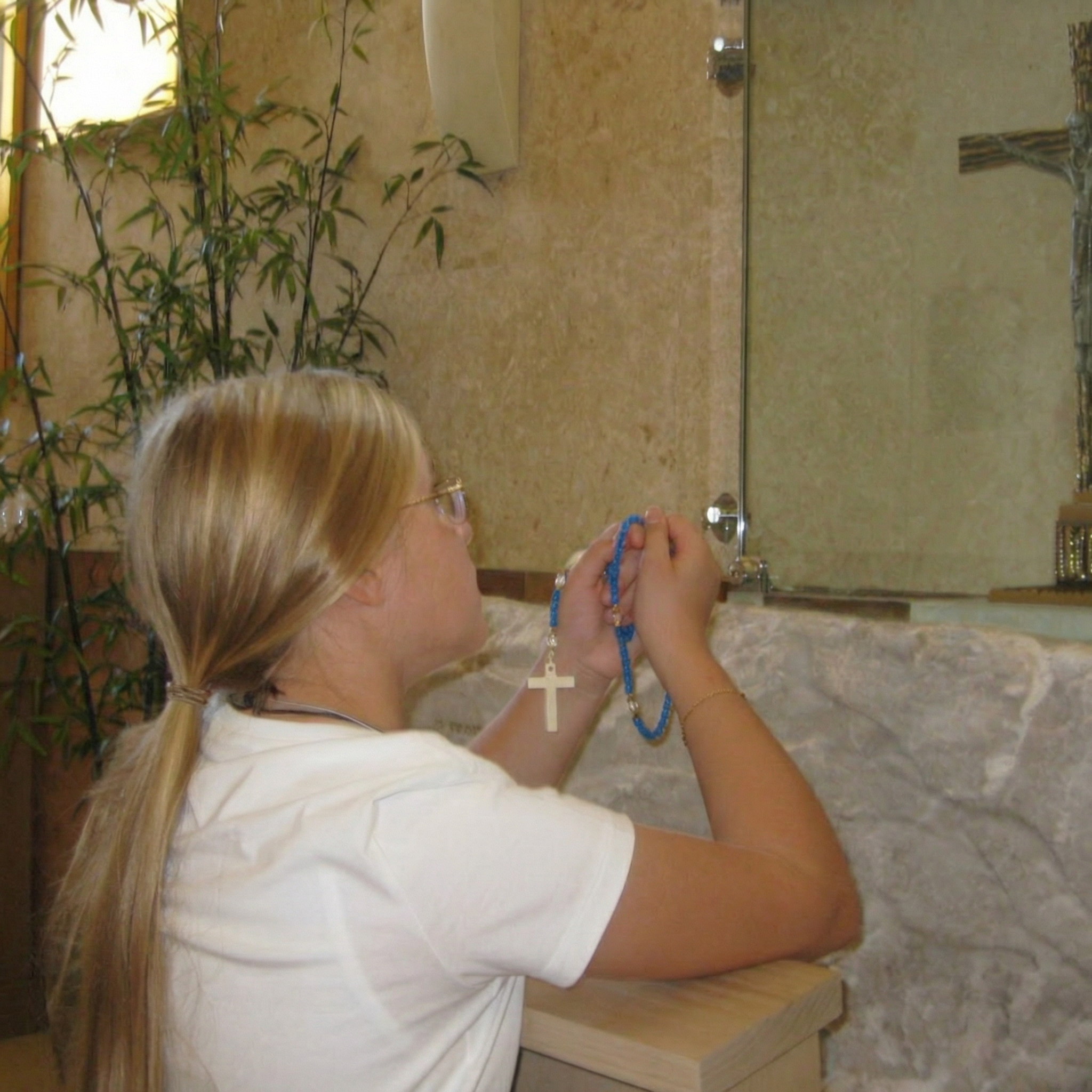
I teach Sunday school at our local Catholic church. Last week I asked my class to bring their rosaries in. Twenty-two kids. Three remembered. I asked the rest where theirs were. Drawer. Broken. Lost. Don't have one. These are kids whose grandmothers pray for them every single morning. I've been teaching Sunday school for twelve years. Same classroom. Same faces every September. And every year, the same thing. "Did you bring your rosary today?" Four hands. Out of twenty-two. "Where is yours?" "At home, I think." "Mine broke." "I lost it." "I don't really have one." These aren't kids without faith. Most of them have grandmothers praying for them every single morning. I know because the grandmothers tell me after church. "I pray for my Emma every day. Never miss." But Emma can't find her rosary. I started asking grandmothers a harder question. "Does Emma know you pray for her?" "Of course she does." "Does she feel it?" Silence. That word started haunting me. Feel. Because knowing and feeling are two completely different things. Year after year, I watched grandchildren drift from the faith. Not because their grandmothers stopped praying. But because those prayers were invisible. A grandmother on her knees every morning. A grandchild who couldn't find her rosary. I knew it was a real problem when I started asking around. I asked parents: what religious gifts have you given her in the last two years? A rosary from the church gift shop. A prayer card. A little saint medal. "Did she keep them?" Most shrugged. One mum said it for all of them: "She loved it for a week. Now I have no idea where it is." I tried solving it myself. I started giving out nicer rosaries in class. Not the cheap plastic ones — proper ones, still affordable, but nicer. Same result. Gone by Christmas. One Sunday after Mass I stopped to talk to a grandmother named Margaret. Three grandchildren. Praying for all of them every single morning for eighteen years. "Margaret, does Lily know how much you pray for her?" "I tell her." "But does she have something to hold? Something that connects your prayer to her hands?" She looked at me. "I gave her a rosary when she made her First Communion." "Where is it now?" She didn't know. I stood there thinking: this woman has given eighteen years of daily prayer to a grandchild who has nothing in her hands to feel it. That is not a small problem. That is a generation of grandmothers praying with everything they have — and grandchildren drifting anyway. Not because they were unloved. Because the love was never made real. The rosary was in a drawer. The prayers were invisible. That was three months before I noticed something different about one of my students. Her name is Clare. Twelve years old. Quiet, but certain in a way the others aren't. She had her rosary every single week. Not buried in her bag. In her hand when she walked in. It wasn't like the others. It was wooden. Beautiful, actually. The kind of thing you'd notice. After class one Tuesday I asked her about it. "My Nana gave it to me. She said it has real soil from Jerusalem inside. From where Jesus walked." She held it up. There was a glass capsule behind the centre medallion. You could actually see the soil inside. "She told me: every time you hold this, I am praying for you. Now you can feel it." I found Clare's grandmother at a church event the following week. Her name was Ruth. She told me she had spent years giving religious gifts. "Every one ended up in a drawer. Or broken within a month." Then a friend from her prayer group told her about Wood of Grace. Handcrafted rosaries made in Bethlehem. Olive wood. Real soil from Jerusalem, sealed inside by Christian families who have been making rosaries for generations. "I gave Clare this one and told her: this is from the Holy Land. This is from where Jesus was born and walked and prayed. I chose it for you." "And she kept it?" Ruth smiled. "She sleeps with it on her nightstand. She asked me to teach her how to pray the full rosary." "Can you send me the link?" She typed it into my phone right there. That night I couldn't stop thinking about why Clare's rosary was different. It came down to one thing: story. A rosary without a story is just an object. Children — and honestly, all of us — don't form attachments to objects. We form attachments to the stories attached to objects. Without a story, no object survives contact with a teenager's bedroom. The church gift shop rosary says: here is a religious item. The drawer swallows it within weeks. The prayer card says: here is a nice thought. It gets tucked away and forgotten. That's why neither of them worked. There was nothing to hold onto. No origin. No meaning. No reason to keep it close. We hadn't given those children a story. We'd just given them objects. When I looked into Wood of Grace, it immediately made sense. Each rosary is handcrafted from olive wood by Christian families in Bethlehem. Real people. A real place. A real tradition of faith passed down through generations. But here's what convinced me: the real Jerusalem soil sealed behind the centre medallion. It gives the rosary a story the child can actually tell. "This is from where Jesus walked." That one sentence turns an object into something sacred — something worth keeping, worth showing, worth carrying. Unlike a gift shop rosary — made in a factory, no story, no meaning — Wood of Grace has a real origin. Unlike a prayer card — thin, easy to lose, easy to forget — this rosary is held, felt, worn. It isn't a trinket. It's a gift weighty enough to be taken seriously. It wasn't just another religious item. It was the first rosary with something real to say. I ordered one that night. Then three more — one for each of my grandchildren. When the first one arrived I sat with it for a long time before I gave it away. The wood was warm. Solid. The kind of thing that feels like it was made to be held. I gave the first one to my granddaughter Sophie. She's fourteen. I sat with her and said: "This is from Bethlehem. The soil inside came from the Holy Land. I chose it for you because I pray for you every single morning. Now you have something to hold when you pray for me." She didn't say much. She just looked at it for a long time. Week one: it was on her nightstand. Week two: she brought it to Mass. Without me asking. Week three: she asked me to teach her how to pray the full rosary. I could have cried. At Christmas, her mum called me. "What did you give Sophie? She carries that rosary everywhere. She's showing her friends." Four months later, Sophie still has it. Still prays with it. Back in my Sunday school class, I started seeing more rosaries on the desks. Word had spread through the parish. Ruth had quietly told other grandmothers. Three more had ordered Wood of Grace rosaries. Their grandchildren were carrying them. Not because they were told to. Because they had something worth carrying. If this is your life right now — you pray for your grandchildren every morning, you've bought religious gifts that disappeared into drawers, and some part of you wonders if any of it is reaching them — you need to understand something. This isn't just about finding a better rosary. Your grandchild can't feel invisible prayers. She needs something in her hands that makes your love real — an object with a story, from a real place, chosen specifically for her. Without that, the most faithful grandmother in the world can pray for fifty years and her grandchild will still drift. Not because the prayer failed. Because it was never made tangible. I'm telling you: this is fixable. Most grandmothers find their grandchild starts asking questions within the first few weeks — about Jerusalem, about prayer, about faith. Watch it yourself. Notice whether she keeps it close. See whether she reaches for it on her own. You've prayed for her every single morning. She deserves something worthy of those prayers. The mission you started the first time you got on your knees for her? When you decided you would never stop, no matter what? This is how you make it real.
Where the ad sends people
woodofgrace.com
Read this if you want to pass down faith to your grandkids☝️
4 in 10 Catholic children leave the faith. Here's what grandparents are doing now to pass down their faith before the window closes. Read their stories.
Shop now: woodofgrace.com(opens in a new tab)