Mitra Occults
Mitra Occults Facebook ad: “Reaveti Nakhshatra part 1”
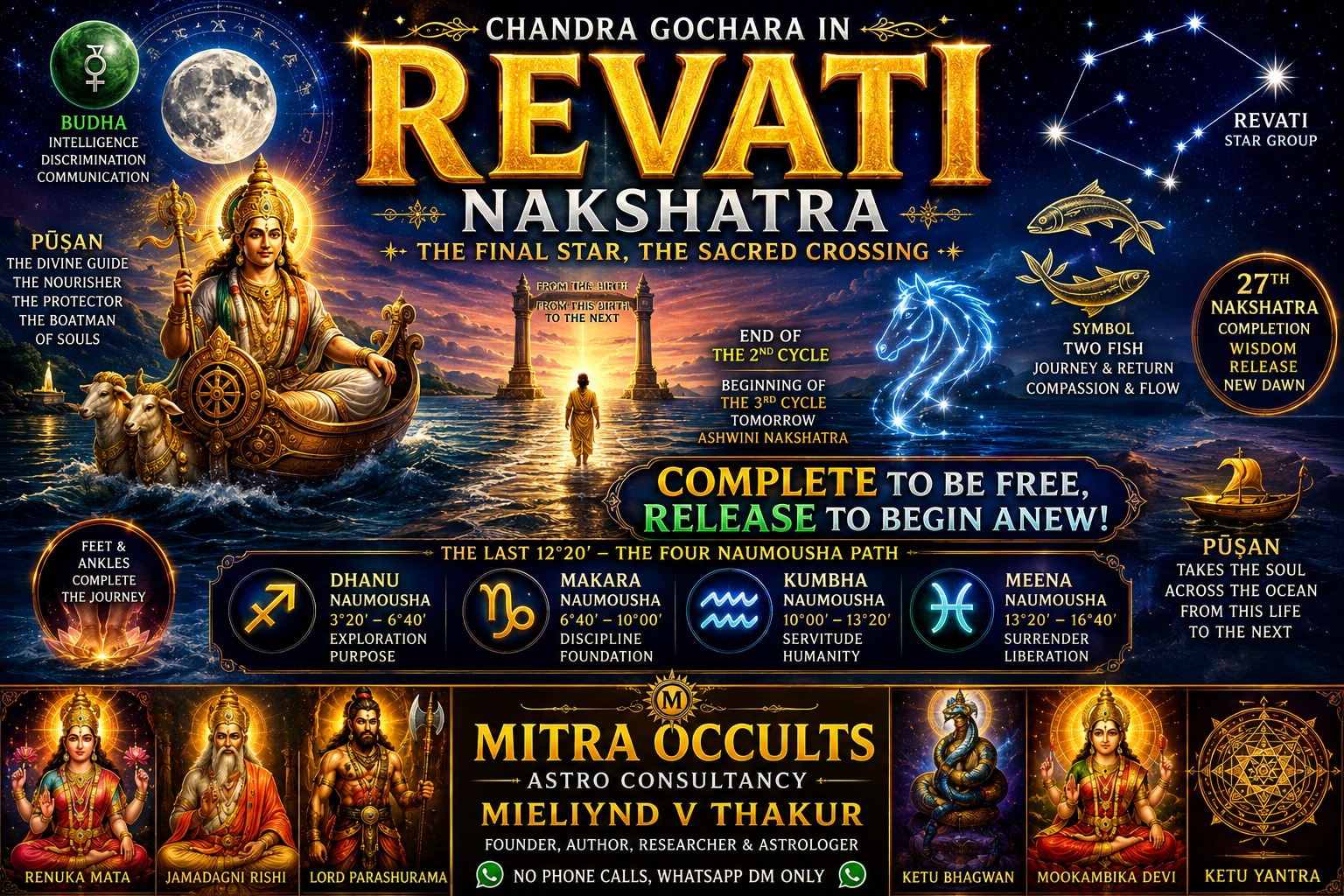
Ran for 6 days, from August 31 to September 6, 2026, the last day Crush saw it.
Run by Mitra Occults on Facebook. Crush is not the advertiser and does not verify its claims. See this ad in Meta's Ad Library(opens in a new tab)
Want an ad like this for your product?
Crush makes new ad images for your product from this ad: your logo, your product photo, your offer.
Trials from $19.95 USD, then $79.95 USD a month. Cancel anytime.
About this ad
- Meta Ad Library ID
- 27737454619290875
- Platforms
- Facebook, Instagram and Messenger
- Relaunches
- 0
Ad text
Reaveti Nakhshatra part 1 EVATI PART 1 Revati stands at the final position among the twenty-seven Nakshatras. She occupies the concluding portion of Meena Rashi, Pisces, and therefore carries the symbolism of completion, transition and preparation for a new beginning. Revati is the twenty-seventh Nakshatra. It is the final celestial mansion of the cycle. It is the point at which the traveller looks backward at the road already travelled and forward toward the road that has not yet begun. And therefore the first sentence with which we should approach Revati is not that Revati represents death. It represents completion. There is a profound difference between completion and destruction. Ashwini is the first movement. Revati is the last movement. Ashwini is the spark. Revati is the flame that has completed its journey. Ashwini says, “Begin.” Revati says, “Complete.” Ashwini says, “Move.” Revati says, “Understand where you have travelled.” Ashwini represents the opening of the door. Revati represents standing at the threshold before crossing it. And then the cycle begins again. Again birth. Again journey. Again the movement of life. The river enters the ocean, becomes cloud, and returns as rain to nourish the Earth again. This is not merely poetry. This is the deepest metaphor of Revati. The river does not become meaningless when it reaches the ocean. It changes its form. The traveller does not become meaningless when one journey ends. The traveller prepares for another journey. The human being spends an entire lifetime thinking that every ending is a loss. Revati teaches another possibility. An ending can be an accomplishment. An ending can be a release. An ending can be a purification. An ending can be a doorway. An ending can be the preparation for a completely new beginning. This is why Revati is so important in the study of life transitions. A student finishes education. A professional completes a career. A person leaves one city and moves to another. A person enters marriage. A family watches children become independent. A person retires. A person turns toward spiritual life. A person moves from Grihastha consciousness toward Vanaprastha. Every one of these is a Revati moment. रेवती नक्षत्रस्य स्वरूपं पूर्णत्वस्य रहस्यं च May Pushan show the path. May Pushan protect the path. May Pushan nourish us. May Pushan reveal the destination toward which we should travel safely. This brings us to Pushan. Pushan is the presiding deity of Revati. The name Pushan is associated with nourishment, prosperity, protection, guidance and the safe movement of travellers. Pushan is not simply a deity who stands at a destination. He is the deity who accompanies the traveller. That distinction is essential. There are teachers who give instructions and disappear. There are guides who walk beside you. Pushan represents the second. He knows the road. He knows the difficulties. He knows where the traveller may become lost. He knows where nourishment is required. He knows when the traveller must continue. He knows when the traveller must stop. This is the shepherd consciousness. And therefore Revati has a very unusual psychological quality. There is a difference between guidance and control. Pushan teaches this distinction. The teacher guides the student. The teacher does not own the student. The parent protects the child. The parent does not own the child's destiny. The astrologer interprets possibilities. The astrologer does not own another person's future. The healer supports recovery. The healer does not create permanent dependency. This is mature Revati. Mercury is the ruler of Revati. Mercury represents intelligence, communication, language, calculation, interpretation, adaptability and discrimination. But Mercury is placed here in the final sign, Meena. This creates a fascinating philosophical combination. The analytical intelligence of Mercury enters the oceanic field of Pisces. Budha enters the realm of Guru. The mind of analysis enters the field of synthesis. Information seeks meaning. नक्षत्राणां चरमे स्थाने रेवती विराजते। Knowledge is not merely collection. Knowledge must transform life. True learning should produce humility. Humility should produce discrimination. Discrimination should illuminate the path toward liberation. This is why Revati can be extremely significant for occult study. Jyotisha. Mantra. Vedanta. Meditation. Tarot. Ramal Shastra. Symbolic sciences. Spiritual psychology. Mysticism. Scriptural interpretation. Astrology becomes particularly interesting here because Mercury wants to understand patterns while Pisces wants to understand the meaning behind the patterns. The mature Revati seeker therefore does not stop at: What will happen? Jyotisha is not merely fortune-telling. It can become a tool for self-observation. The planets are indicators. The Nakshatras are symbolic guides. One's actions remain the mirror of one's life. This distinction is extremely important for MITRA OCCULTS. One Moon transit does not give the entire destiny. One Nakshatra does not explain the entire horoscope. One planet cannot be isolated from the rest of the chart. But once the seeker understands the principles, the seeker can begin to see the larger design. This is why we want people to learn. We want people to understand the Nakshatras. We want people to understand planetary principles. We want people to understand why a remedy is being suggested. Revati is the Nakshatra of prosperity. But prosperity does not mean money alone. Prosperity can be knowledge. Prosperity can be Dharma. Prosperity can be compassion. Prosperity can be experience. Prosperity can be spiritual maturity. Prosperity can be the ability to give. The wealthiest person is not necessarily the person who possesses the most. The wealthiest person may be the one who has the least inner poverty. This is the distinction between accumulation and abundance. Accumulation says: I need more. Abundance says: I have enough to give. Revati belongs to the second principle. Giving purifies wealth. Giving knowledge is among the highest forms of giving. Giving food protects life. Giving freedom from fear is a supreme expression of compassion. This is why charitable activities can resonate strongly with the Revati principle. But charity must also be intelligent. Giving without discrimination can sometimes create dependency. Therefore: Give. But understand. Help. But empower. Teach. But do not create dependence. Protect. But do not control. This is Pushan. Now let us enter the symbolism of the feet. Revati is associated with the feet and ankles. The symbolism is extremely appropriate. The head thinks. The heart feels. The mind imagines. But the feet carry the traveller. मीने राशौ अन्तिमांशे सा स्थित्वा यात्रायाः पूर्णतां सूचयति। Therefore Revati is not simply a Nakshatra of spiritual imagination. It is a Nakshatra of embodied journey. A person can dream about enlightenment. But somebody still has to walk. A person can study scriptures. But somebody still has to practice. A person can speak about compassion. But somebody still has to help. A person can discuss Dharma. But somebody still has to live it. The elephant is powerful, yet its movement can be gentle. Greatness does not require violence. Greatness can be expressed through stability. This is why the female elephant symbolism is particularly beautiful. The maternal, protective, patient and sheltering quality of the elephant resonates with Revati's nourishing nature. Yet again the shadow must be remembered. Protection can become overprotection. Nourishment can become suffocation. Love can become possession. Guidance can become control. The elephant must know when to walk beside the traveller and when to allow the traveller to walk alone. This is the mature Revati. The immature Revati says: I will solve everything for you. The mature Revati says: I will help you become capable of solving it yourself. This is the difference between rescue and empowerment. And this is where Mercury's intelligence becomes essential. The adaptable person can lose direction. The peaceful person can become passive. Therefore Revati requires one additional principle: direction. Pushan provides that direction. Where are you going? What is the purpose of this journey? What do you actually need? What should you leave behind? These questions form the inner compass of Revati. पूषा देवता तस्याः मार्गदर्शकः पोषकश्च। Revati is not merely the final step. It is the doorway through which the next beginning waits. Beyond Revati stands Ashwini. Beyond the last light comes the first dawn. And this is where the second cycle of our MITRA OCCULTS journey begins to close. But before we reach that dawn, we must enter the great mythology of Pushan. Because without understanding Pushan, Revati remains incomplete. The mythology of Pushan is one of the most important keys to understanding Revati. Pushan is not a decorative Devata placed beside the Nakshatra. Pushan is the philosophical heart of Revati. He represents nourishment. He represents safe passage. He represents roads. He represents travellers. He represents the recovery of what has been lost. He represents the guidance that allows movement between one state and another. And then comes the strange mystery: Why does Pushan lose his teeth? Why should the deity of nourishment become toothless? Why should the deity associated with food lose the instrument of eating? This question opens one of the deepest symbolic doors of Revati. At the sacrifice of Daksha, a great conflict arose. Sati saw the dishonour shown toward Shiva. She could not accept the humiliation of the Divine principle represented by Shiva. Her self-immolation transformed the entire atmosphere. Shiva's grief and fury became cosmic. Virabhadra emerged. The sacrificial arena, which represented organized ritual authority, became the place where pride was broken. And in that fierce event, Pushan's teeth were damaged. The details differ among the textual traditions. The early Vedic material and later epic-Puranic narratives do not present the episode in exactly the same form. बुधः अधिपतिः सूक्ष्मबुद्धेः संचारस्य च दाता। But the central symbol remains. Pushan loses his teeth. And that is enough to ask the question: What do teeth represent? Teeth break. Teeth divide. Teeth chew. Teeth consume. Teeth allow the organism to take something from the external world and transform it into nourishment. Therefore teeth represent consumption. But there is a profound difference between consumption and nourishment. We consume food. But food nourishes us. We consume information. But information does not necessarily make us wise. We consume entertainment. But entertainment does not necessarily enrich us. We consume wealth. But wealth does not necessarily create prosperity. We consume relationships. But possession is not love. Pushan is the nourisher, not the devourer. He is the guide, not the owner. He is the protector, not the imprisoner. This is one of the deepest Revati teachings. The spiritual teacher who wants to own disciples is not acting from mature Pushan. The parent who wants to control every decision of an adult child is not acting from mature Pushan. The partner who says, “I love you, therefore you must obey me,” has confused love with possession. The astrologer who says, “Only I can save you,” has confused guidance with dependency. Pushan guides. Pushan nourishes. Pushan protects. But Pushan does not own. This is why the toothlessness is spiritually significant. The instrument of consumption has been broken. The nourisher remains. The one who gives is blessed. The one who gives without claiming ownership embodies Pushan. The one who protects acts according to Dharma. The one who shows the path becomes part of the sacred chain of teacher and student. Now we can understand why the Daksha story is connected so beautifully with Revati. Daksha represents external order. Everything appears organized. The sacrifice is being performed. Ritual is taking place. But the inner principle has been corrupted by pride. The external form is intact. The internal Dharma has been damaged. And therefore destruction enters. The essence of sacrifice is the inner attitude. The essence of sacrifice is surrender. The essence of sacrifice is the reduction of ego. This is a warning for every spiritual seeker. You can perform rituals and remain unchanged. You can chant mantras and remain dishonest. You can wear sacred symbols and remain arrogant. You can speak about karma and still exploit people. You can speak about compassion and still be cruel. Therefore Revati asks: Has the journey changed you? Not: How many rituals have you performed? Not: How many mantras have you counted? Not: How many books have you purchased? But: Have you become a better human being? मोक्षः पुरुषार्थरूपेण अस्याः अन्तर्निहितः संदेशः। The root of Dharma is truth. The root of truth is a purified mind. The root of a purified mind is compassion. And the root of compassion is knowledge of the Self. This is the inward journey. Now let us turn to the story of Revati associated with King Raivata. The story is remarkable because it deals with time. King Raivata takes his daughter Revati to Brahma seeking a suitable husband. While they are in the presence of Brahma, time passes differently. When they return, the world they knew has changed. Generations have disappeared. The age has changed. The people have changed. The scale of time has changed. Revati eventually becomes associated with Balarama. The story is extraordinary because it tells us that human beings experience time from within their own limited framework. Can I carry everything? The question is: What should I carry? What should I release? This is karmic introspection. Do not imagine that one Nakshatra transit magically erases karma. It does not. The deeper principle is conscious completion. If you have wronged someone, make amends where possible. If you have a responsibility, fulfil it. If you have made a mistake, learn. If you have acquired knowledge, share it. If you have received help, express gratitude. If you have created suffering, stop repeating it. If you have an addiction to anger, work on it. If you have been living dishonestly, return to truth. This is the practical remedy of Revati. This is more powerful than simply repeating words without understanding. Now let us discuss another symbolic story connected with Pushan. Pushan is associated with finding what has been lost. In Vedic symbolism, cattle can represent nourishment, wealth and also rays of knowledge. The lost cattle can therefore be interpreted at another level as lost illumination. The human being loses direction. Pushan restores the path. The seeker loses knowledge. Pushan leads toward it. The traveller loses confidence. Pushan nourishes. The soul becomes uncertain. Pushan accompanies. समाप्तिर्न विनाशाय, पूर्णत्वस्य प्रकाशनम्। Pushan reveals the lost road. Pushan illuminates the lost direction. Pushan nourishes lost courage. This is why Revati is strongly associated with guidance. A person with strong Revati may naturally become a counsellor. A teacher. A mentor. A spiritual guide. A writer. A musician. A therapist. A researcher. An astrologer. An animal welfare worker. A person involved in travel. A person involved in communication. A person helping others navigate difficult transitions. But the same person must learn not to become the permanent rescuer. Because if you rescue everybody, eventually you lose yourself. This is the shadow of Pushan. The mature shepherd does not carry the entire flock on his shoulders. He shows the road. He protects the vulnerable. He keeps watch. And he allows the flock to walk. This is why Revati's greatest lesson is not merely compassion. It is intelligent compassion. Now we enter the symbolism of the fish. The fish lives in water. It does not stand outside the water and philosophize about water. It exists within it. This becomes the Revati metaphor. The human being spends much of life trying to understand the universe as something separate. But the spiritual realization gradually becomes: I am within the universe. The universe is within my experience. The line between the fish and the water becomes difficult to distinguish. This is the dissolving principle of Pisces. Who am I beyond my family role? Who am I beyond my social identity? Who am I beyond my fears? Who am I beyond my successes? This does not mean rejecting life. It means seeing that life is larger than one temporary identity. Now consider the shadow of Pisces. The same water that nourishes can also dissolve boundaries. A Revati person can absorb the emotions of others. They may not know where another person's pain ends and their own begins. This is why boundaries are essential. यत्र एकः मार्गः समाप्तिं याति, तत्र अन्यः पन्थाः प्रादुर्भवति। Without boundaries, compassion can become suffering. With discrimination, compassion becomes strength. Therefore the Revati seeker should learn: I can love you without becoming you. I can help you without carrying your entire karma. I can listen without absorbing everything. I can guide without controlling. I can forgive without returning to an unhealthy situation. This is spiritual maturity. Now let us consider the body symbolism. Feet. Ankles. Movement. The journey. The final stage of physical travel. And traditionally the feet can also symbolize humility. The head is raised. The feet touch the Earth. In Indian sacred culture, touching the feet of elders and teachers expresses reverence. The feet symbolize humility. Touching the Earth can become a reminder that ego must soften. Service to the feet of the Guru symbolizes humility on the path of knowledge. Again, this is why Revati is not simply about the end. It is about arriving with humility. A person who has completed the journey but remains arrogant has not understood Revati. The true traveller arrives and says: I learned. I made mistakes. I received help. I was guided. I am grateful. That is the Revati consciousness. Now we must return to the toothless Pushan one more time. The broken teeth are a warning against endless consumption. Wealth that does not serve Dharma, knowledge that does not create humility, power that does not protect, and life that does not become service can eventually become a burden. This is the Revati test. What did you do with what you received? Now let us discuss the Ghatikas symbolically. The traditional divisions of auspicious and inauspicious periods may be approached as timing traditions rather than universal guarantees. The Amrita period represents nectar. Visha represents poison. रेवती पूर्णतायाः अन्तिमं सोपानं मन्यते। Time witnesses all actions. Activities should be undertaken with awareness of their suitability and timing. But no timing system should become an excuse to avoid responsibility. A person who waits for a perfect Muhurta forever may never act. A person who understands timing acts when the right window appears. This is another Mercury lesson. Discrimination. Now let us consider Revati's sounds. De. Da. Cha. Chi. These sounds connect the Nakshatra to naming traditions and the vibrational identity of the lunar mansion. The sound itself becomes a reminder that language is important. Mercury rules language. Pushan guides communication. Therefore words become significant. Gentle speech nourishes the heart. Harsh speech can tear the mind. Revati should therefore learn the art of healing communication. Not saying everything that comes into the mind. Not every truth needs to be delivered without compassion. Not every criticism needs to be spoken. Not every argument needs to be won. Silence can sometimes be the highest communication. Sometimes silence is greater than speech. This is the mature Mercury. Now we are approaching the final threshold. The final Pada. Pisces Navamsha. Guru. Mercury. Chandra. The symbolic field becomes highly devotional. The analytical mind becomes softer. The intellect turns toward contemplation. The traveller stops calculating distance and begins appreciating the journey. This is the deepest spiritual Revati. The seeker does not ask: How much further? The seeker asks: What have I understood? Meditation is not merely closing the eyes. Meditation is observing the inner instrument. Meditation is releasing the burden of memory. Meditation is recovering one's inner direction. This is why the final portion of Revati can be deeply supportive for contemplative practices. The night becomes quiet. The mind becomes quieter. The traveller stops. Pushan waits. And the question becomes: Where are you going? यत्र यात्रायाः फलम् अन्तःकरणे परिपक्वं भवति। Renunciation is not merely abandoning objects. Renunciation is abandoning the egoic claim over them. Moksha is not running away from the world. Moksha is the reduction of bondage. A person can live in a family and still cultivate freedom. A person can manage wealth and still cultivate detachment. A person can work in business and still cultivate Dharma. A person can be successful and still remain humble. This is the mature Revati. Now let us examine the four Padas. The first Pada is Sagittarius Navamsha. Guru. Knowledge. Philosophy. Higher learning. Travel. Teaching. Dharma. The second Pada is Capricorn Navamsha. Shani. Discipline. Responsibility. Structure. Practical realization. The third Pada is Aquarius Navamsha. Universal concerns. The fourth Pada is Pisces Navamsha. Guru returns. The final dissolution. Devotion. Meditation. Compassion. Surrender. Knowledge is the first movement. Discipline is the second. Service to the larger world is the third. Surrender is the fourth. This is one way to understand the progressive depth of the four Padas. Now let us speak about the physical and psychological health symbolism. Revati's association with feet and ankles reminds us that the body carries the journey. The fluid symbolism of Pisces can also invite reflection upon bodily fluids, sensitivity, sleep and the need for emotional boundaries. But astrology must not be converted into medical diagnosis. A person experiencing persistent pain, swelling, difficulty walking, dental problems or other physical symptoms should seek appropriate medical evaluation. This body is an instrument through which Dharma is lived. The body must therefore be cared for. Health is supported not only by medicine but also by appropriate food, movement, sleep and conduct. The spiritual seeker who neglects the body completely has misunderstood embodiment. Revati teaches care. Care of others. Care of animals. Care of the environment. Care of the body. Care of the mind. Care of knowledge. Care of the lineage. This is nourishment in the broadest sense. Now let us return to the core wound. The core wound of Revati can be quiet exhaustion. The person who says: I have given everything. I have helped everyone. I have listened to everyone. I have supported everyone. But nobody has asked what I need. This is the shadow. न समाप्तिः भयस्य कारणं, किन्तु नूतनमार्गस्य द्वारम्। The nourisher also needs nourishment. This should be remembered by every compassionate person. You do not have to save everyone. You do not have to answer every message. You do not have to solve every family conflict. You do not have to become everyone's therapist. You do not have to carry every person's fear. You can say: I care. I will help where I can. But I cannot walk your entire path for you. That sentence is not selfishness. It is wisdom. Now we come to the professional and creative dimension of Revati. Revati can support symbolic themes associated with music, poetry, writing, acting, visual creativity, counselling, teaching, communication, travel, animal welfare, healing, spiritual studies and guidance. Education allows knowledge to travel through generations. This is why creative expression can be particularly meaningful for Revati. The final Nakshatra has absorbed the experience of the previous twenty-six. It has material from every stage. Therefore its creativity can become synthetic. It can combine. Music and philosophy. Art and spirituality. Story and mythology. Astrology and psychology. Science and symbolism. The best Revati expression is rarely isolated. It connects. This is synthesis. This is the final gift of Mercury in Pisces. Mercury connects. Pisces dissolves. Jupiter gives meaning. Pushan gives direction. Together they produce the fullness of Revati. Now let us consider the most beautiful question: What should a person do during a symbolic Revati period? Complete. Finish pending work. Organize unfinished matters. Resolve where resolution is possible. When action is aligned with Dharma, time itself becomes supportive. This is the deeper Muhurta principle. Now the final question: What is the karma of Revati? The past-life symbolism of Revati can be contemplated as the role of the guide. A person may carry gifts connected with teaching, healing, travel, communication, care, creativity and protection. But every carried gift has a corresponding lesson. If you were a guide, learn humility. If you were a teacher, continue learning. गतस्य अनुभवाः आगामिनः पन्थानं प्रकाशयन्ति। The seed planted through action eventually bears fruit. Past impressions can emerge in the present as talents. Difficulties can arrive as lessons. Gifts can arrive as opportunities for service. This is a constructive way to think about karma. Not: I am being punished. But: What am I being asked to understand? Not: Why is this happening to me? But: What is this experience teaching me? This is the difference between fatalism and spiritual responsibility. Now we come to the Vaitarani symbolism. The Vaitarani is described in sacred traditions as a difficult river associated with the post-mortem journey. But we can also contemplate it symbolically. There is a Vaitarani between every major identity. Between childhood and adulthood. Between education and career. Between marriage and solitude. Between attachment and detachment. Between worldly ambition and spiritual reflection. Between life and death. The river represents transition. Pushan shows the path. Dharma becomes the boat. Knowledge becomes the lamp. Compassion becomes the companion. Detachment removes unnecessary weight. This is how the traveller crosses. Now remember the pair of fish. The fish does not fight the water. It moves through it. The seeker who understands impermanence does not fight every change. The seeker learns to move. This is adaptability. Mercury gives adaptability. Pisces gives fluidity. Pushan gives direction. Together: Move, but do not lose direction. Adapt, but do not lose Dharma. Give, but do not destroy yourself. Love, but do not become possessed. Surrender, but do not become passive. This is mature Revati. Now we arrive at the final day of this second Nakshatra cycle. For twenty-seven days, we have walked from Nakshatra to Nakshatra. We have studied the celestial mansions. We have looked at their Devatas. We have looked at planetary rulership. We have examined their symbols. We have entered their mythology. We have tried to understand their psychological dimensions. And now we arrive at the last gate. Revati. The second cycle is complete. But tomorrow morning, Ashwini returns. A new cycle begins. त्यागेन भारः लघुः भवति, विवेकेन दिशा स्पष्टा भवति। On Tuesday morning, Ashwini returns. Ketu stands at the first gate. The Ashwini Kumaras bring the symbolism of healing and movement. Revati gives rest. Ashwini begins movement again. This is the extraordinary relationship between the last and first Nakshatras. Mars may occupy another. Jupiter may occupy another. Saturn may occupy another. The Ascendant may be somewhere else. The horoscope becomes a living network. This is why one Nakshatra never tells the whole story. The seeker must learn the system. Now let us give the final Revati meditation. Sit quietly. Close your eyes. Imagine a long road behind you. Twenty-seven doors stand along that road. You have crossed them. At the end of the road stands Pushan. He does not speak loudly. He simply waits. Then he asks: What will you give? This is the final question. Because life is not only about what you receive. What will you leave? What knowledge? What kindness? What service? What protection? What legacy? What blessing? This is the wealth of Revati. Now we come to the declaration of MITRA OCCULTS. This knowledge does not belong to us. The Vedas do not belong to us. The Nakshatras do not belong to us. The Devatas do not belong to us. The Rishis do not belong to us. The mantras do not belong to us. The Vedas are the illumination preserved through the Rishis. Jyotisha is a precious knowledge of the Rishi tradition. The Nakshatras are the celestial markers of the timeless cycle of Kala. The Devatas are not objects of our ownership. They are objects of reverence. The mantras have been protected and transmitted through Guru Parampara. We are merely humble seekers, interpreters and messengers of that knowledge. Whatever is valuable in this work belongs to the wisdom of the tradition. Whatever is profound belongs to the Rishis. Whatever is spiritually illuminating belongs to the Devatas and Guru Parampara. Whatever is mistaken, incomplete or imperfect belongs to our own limitations as interpreters. पूषा पन्थानं दर्शयतु, बुधः प्रज्ञां प्रकाशयतु। Whatever knowledge we have received is offered with reverence to the Gurus. Whatever illumination is experienced is offered to the Devatas. Whatever error exists is a consequence of our own limitations. This is the spirit with which MITRA OCCULTS presents the Nakshatra series. We want seekers to learn. We want seekers to study. We want seekers to question. We want seekers to understand. We want people to become capable of reading their own astrological framework. We do not want blind dependence. We do not want fear-based astrology. We do not want unnecessary expenditure created by panic. We do not want one remedy to be presented as a universal solution for everyone. A remedy that may be meaningful for one person may not be meaningful for another. The purpose is not to discourage anyone from seeking a competent astrologer. If a person has a genuine problem and trusts a competent practitioner, seeking guidance is completely reasonable. But the seeker should also learn. Ask: Why this remedy? Why this planet? Why this mantra? Why this gemstone? Why this timing? What is the astrological logic? What is the expected purpose? Can I understand it? Knowledge protects. May Pushan make every path safe. May Revati nourish every journey. May Mercury grant intelligence. May Jupiter grant wisdom and discrimination. May Ketu grant inner vision. May Ganesha remove obstacles. May the Ashwini Kumaras grant health and renewed vitality. To every seeker who has travelled with us through these twenty-seven days: This journey now reaches its final gate. Twenty-seven Nakshatras. Twenty-seven doors. Twenty-seven symbolic landscapes. From Ashwini to Revati. From the first movement to the final completion. From action to surrender. From individuality toward universality. From the first spark to the final light. But tonight, do not think that everything is finished. A new dawn. A new journey. A new intention. A new Ashwini. A new beginning with renewed consciousness. Let us welcome the new sunrise. Let us welcome the new cycle. Let us welcome the new learning. Let us welcome the responsibility that comes with knowledge. Let us welcome the road. And before we step into Ashwini, let us bow once more to Revati. पुनरपि जन्म, पुनरपि यात्रा, पुनरपि जीवनस्य प्रवाहः। Salutations to Revati. Salutations to Pushan. Salutations to Mercury. Salutations to Guru. Salutations to the Rishis. Salutations to the Devatas. Salutations to the Guru Parampara. The river has reached the ocean. The ocean has not destroyed the river. The river has become something else. One day the clouds will form. One day the rain will fall. One day another river will begin. And perhaps another traveller will stand beside that river and ask: Where does this road go? Pushan will be there. The road will be there. The light will be there. And the journey will begin again. The final step is therefore also the first step. The last Nakshatra is also the preparation for the first Nakshatra. Revati is the final light before Ashwini's dawn. And this is where we close the second cycle of the MITRA OCCULTS Nakshatra series. Not with an ending. With gratitude. Not with a conclusion. With preparation. Not with fear. With knowledge. Not with possession. With offering. Not with the claim: “This belongs to us.” But with the humble statement: “This knowledge has travelled through the Rishis, through the Guru Parampara, through the sacred texts and through generations of seekers. We have only attempted to understand it, interpret it and present it to the seekers of the present age.” May every seeker find the right path. May every traveller reach the right destination. May every teacher remain humble. May every student remain curious. May every family receive peace. May every child receive protection. May every animal receive nourishment. May every lost person find direction. May every human being discover the wealth hidden within knowledge. And may the blessings of Revati remain with us as we step toward the new dawn of Ashwini. From Revati to Ashwini. From completion to beginning. From the last step to the first step. From the final light to the new sunrise. नदी समुद्रे लीयते, मेघत्वं गच्छति, पुनः वर्षारूपेण पृथिवीं पूरयति। Revati is complete. The journey is complete. The cycle is complete. The doorway to the new dawn is open. Welcome, Ashwini. Welcome, new cycle. Welcome, new dawn. Below is the next section, continuing the Revati Nakshatra article in the same long-form MITRA OCCULTS style. I have deliberately made the Sanskrit passages independent, substantial sections rather than isolated Sanskrit words, so the article reads as a genuine Sanskrit–English Vedic exposition. Revati is not merely the twenty-seventh Nakshatra because it happens to occupy the final portion of the zodiac. Its position carries a profound symbolic responsibility. It stands at the edge of completion. Everything that has been experienced through Ashwini, Bharani, Krittika, Rohini, Mrigashira, Ardra, Punarvasu, Pushya, Ashlesha, Magha, Purva Phalguni, Uttara Phalguni, Hasta, Chitra, Swati, Vishakha, Anuradha, Jyeshtha, Moola, Purva Ashadha, Uttara Ashadha, Shravana, Dhanishtha, Shatabhisha, Purva Bhadrapada and Uttara Bhadrapada finally reaches Revati. Therefore Revati cannot be understood independently of the twenty-six Nakshatras that precede it. It is the great absorber. It is the great nourisher. It is the great guide. It is the final road. It is the place where the traveller looks behind and sees the entire journey. And then, after understanding the journey, the traveller looks forward and sees nothing familiar. That is the mystery of Revati. This is why Revati has such a powerful relationship with completion, transition and continuity. Completion does not mean destruction. Completion means that a particular form of experience has reached its natural limit. A seed completes its existence as a seed when it becomes a tree. A river completes its journey when it reaches the ocean. But the river does not disappear from existence. It becomes part of the ocean. The ocean becomes cloud. The cloud becomes rain. The rain returns to the mountain. The mountain gives birth to the stream. The stream becomes the river again. This is the Revati principle. नक्षत्रचक्रं पुनः पुनः प्रवर्तते, किन्तु चेतना उन्नीयते। The deity associated with Revati is Pushan. Pushan is one of the most beautiful and deeply symbolic Vedic deities for understanding the final Nakshatra. The name Pushan is connected with nourishment, growth, protection and the power that causes beings to thrive. He does not need to defeat the world in order to establish his authority. He guides. He nourishes. He protects. He accompanies. And this is exactly why Revati is so different from many other Nakshatras. A warrior asks: How can I win? A ruler asks: How can I command? A merchant asks: How can I gain? A scholar asks: How can I understand? But Pushan asks: Where are you going? What do you need for the journey? Who needs protection? What must be carried forward? What must be left behind? This is the consciousness of Revati. One of the most extraordinary mythological associations connected with Pushan is the story of his broken teeth. This story is extremely important for understanding Revati. Different textual traditions preserve different versions and details of the Daksha Yajna episode, and the accounts do not always describe the injuries to the participating deities in exactly the same manner. But the larger mythological pattern is unmistakable. Daksha Prajapati conducted a great sacrifice. Sati, the daughter of Daksha and consort of Shiva, entered the sacrificial arena after being deeply humiliated by the absence of honour shown toward Shiva. She could not accept the insult directed toward her husband. The fire of the sacrifice became, symbolically, the fire of separation. She relinquished her physical body. The universe responded. Shiva's grief became cosmic fury. The sacrificial order that had been constructed through pride and exclusion could not remain untouched. अश्विनी आरम्भस्य शक्तिं वहति, रेवती पूर्णत्वस्य। The important point here is not merely the violence of the story. The important point is the symbolism. Daksha represents an order that has forgotten humility. The sacrifice represents ritual without inner surrender. Sati represents devotion that cannot tolerate the desecration of its deepest truth. Shiva represents the destructive power that appears when spiritual reality is separated from ritual pride. And Pushan becomes part of the lesson. In traditional accounts, Pushan is described among those who suffered injury during the destruction of Daksha's sacrifice. His teeth were broken. Why is this so significant for Revati? Because Pushan is the nourisher. The nourisher consumes. The nourisher feeds.