
Inactive· since Aug 6, 2026
- 3
- days it ran
- 0
- relaunches
Ad copy
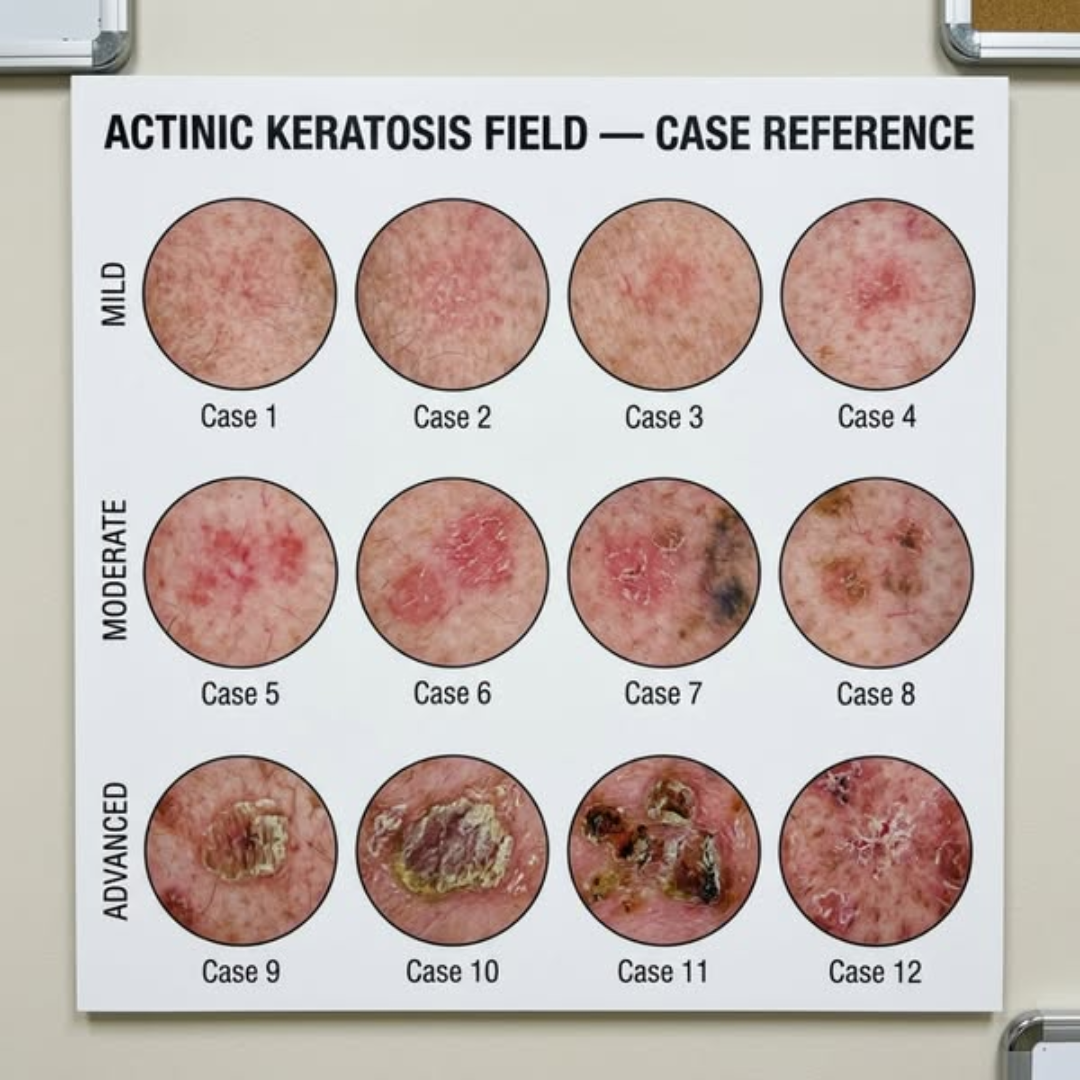
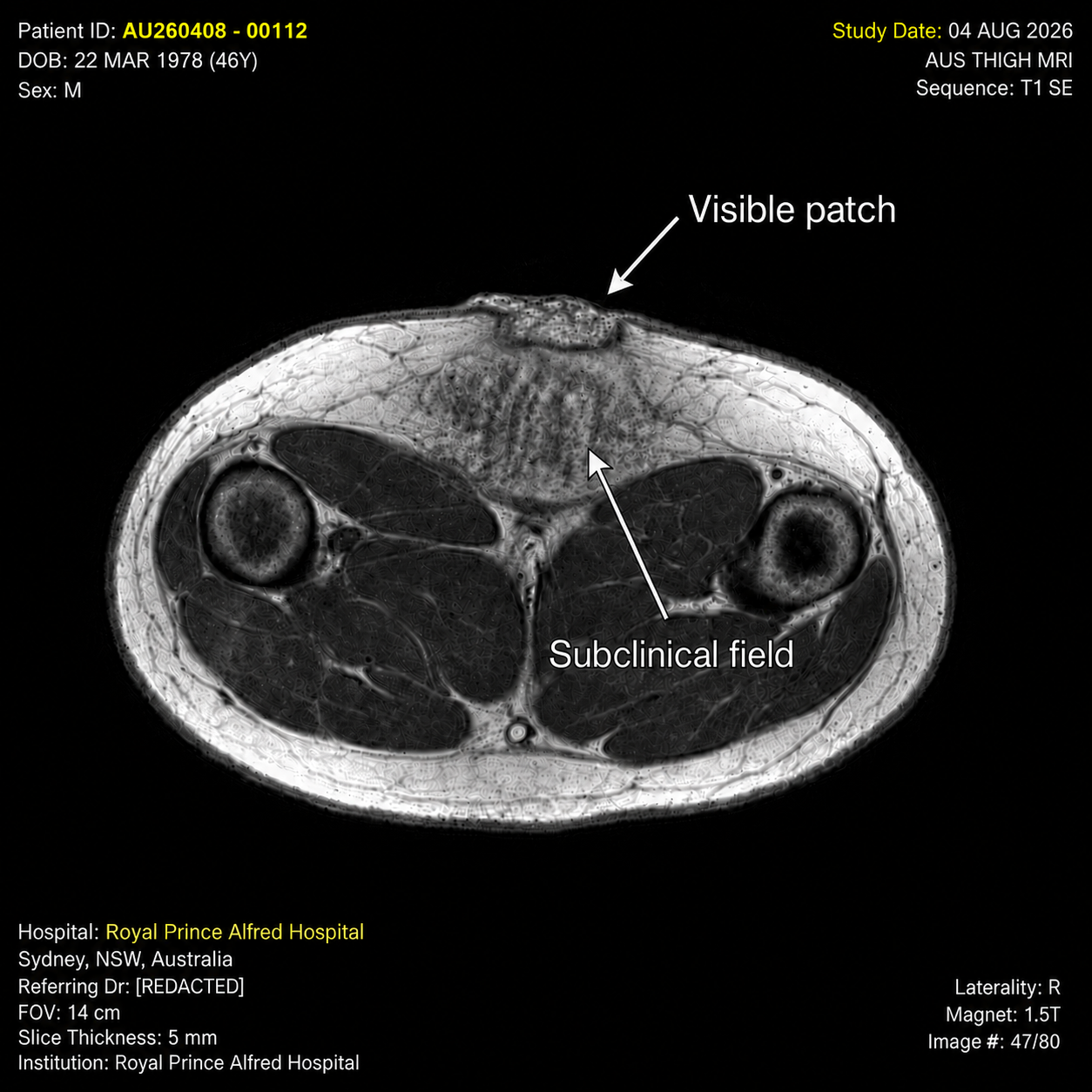
I saw a statistic that made me sick. Women with actinic keratosis who stay on the quarterly freeze schedule are 3 times more likely to watch it spread to new body parts every year than women who address the subclinical field directly. I didn't believe it when I read it. I'd had actinic keratosis for almost 18 years and not one dermatologist had ever told me why nothing worked. But here's the truth. Your dermatologist freezes the patch. Your family doctor hands you a diclofenac gel. The real problem sits underneath the skin that looks clear... and nobody is paid to look there. That's why most of us never heard this. That's why my mother never heard it either. My mother was part of that statistic. Twenty-one years of freeze sessions and diclofenac on her arms. The patches spread to both forearms, both hands, her upper arms, and her chest before she died at 71. I'm 64. Last month my dermatologist told me to start 5-fluorouracil field therapy and warned me about six weeks of weeping skin. I refused. And what I found instead... at a farmers' market on a Saturday morning in September... took me from fourteen rough spreading patches I hid under long sleeves... to smooth flat skin and short sleeves again. No field chemotherapy. No six weeks of crusting skin. But to understand why I was desperate enough to drive forty minutes to a farmers' market at 7 AM looking for answers, you have to know what I watched those patches do to my mother. And what I didn't know they were quietly doing to me too. --- For 21 YEARS... over two decades... my mother was trapped fighting those patches. Started with one rough spot on her left forearm. Her dermatologist called the freeze schedule "the gold standard." Said she'd come back every three months, but that was fine because it would keep things "under control." It stayed under control. Everything else fell apart. Within the first year it spread to the forearm beside it without warning. Doctor said it was just the way UV damage progresses with age. By year three she had eight rough patches across both forearms and couldn't wear a short-sleeved blouse without people asking questions. Her confidence? Gone. This was a woman who gardened every weekend, proud of her arms, always reaching for people when she talked. By year five she wore long sleeves in February. Her patches got thicker. The edges stayed raised no matter how many sessions she had. We'd run our fingers across her forearms and the sandpaper texture never fully went away. Thirty-eight years she'd kept her skin. And every time we brought it up, her dermatologist said the same thing. "It's manageable, Margaret. The freeze sessions are doing their job. Come back in three months and we'll treat any new ones." She kept coming back. She applied the diclofenac. Patience wasn't the problem. My sister said it was like watching her hide one patch at a time. They had her coming back for freeze sessions for TWENTY-ONE YEARS. Twenty-one years of the patches spreading. Twenty-one years of feeling like her arms weren't her own. Twenty-one years of appointments where they'd freeze the visible patch or hand her another tube of diclofenac... but never once... not ONE TIME... did anyone say, "Maybe something is wrong that the freeze session can't reach." And then the patches spread to her chest anyway. 71 years old. Seventy-one. She passed with patches across seven body parts she spent two decades trying to hide. At the funeral my aunt grabbed my hand and said something I'll never forget. "For 21 years they told her it was just sun damage, Linda. They were wrong the whole time." --- So fast forward to eighteen months ago. I'm 64. Diagnosed with actinic keratosis at 46. I've been a good patient. Come back every three months. Apply the diclofenac between visits. Never miss a freeze session. Wore SPF 50 every morning without fail. I still have fourteen rough spreading patches, worse than the day I started. I go to my annual skin check. The nurse looks at my forearms. Frowns. The dermatologist pulls up my chart. Looks at me. "Linda, the diclofenac isn't holding the field. The patches have spread to your chest and upper arms now. We should start 5-fluorouracil field therapy. Twice daily for six weeks. Your skin will weep and crust. You won't be able to go outside." My chest tightened. Field therapy. Twenty-one years of watching my mother come back every three months. Twenty-one years of her covering her arms at family dinners. Twenty-one years of her pulling her sleeves down every time someone looked at her forearms. And then it spread to her chest anyway. "No," I said. She blinked. "Excuse me?" "I'm not doing it. My mother did freeze sessions for 21 years. I watched what it did to her. And the patches spread to her chest anyway." She gave me that look. "Linda, field therapy is the next step when the freeze schedule stops being sufficient. The diclofenac just sits on top—" "What's the point of six weeks of weeping skin if the field keeps generating underneath?" She didn't have an answer. I told her to give me three months. She wasn't happy. Wrote something in my chart. I didn't care. For three months I did everything right. Applied the diclofenac twice daily without missing a morning. Added a vitamin C serum. Bought an expensive brightening body oil from the health food store. Started a retinol routine. Three months later I went back. Two patches looked slightly less raised. The other twelve were the same or worse. A new one had appeared on my right hand between visits. The dermatologist pulled out the field therapy paperwork again. "Linda, it's time." "Give me three more months." "Linda—" "Three more months." She sighed. I didn't care what she wrote. That night I couldn't sleep. I kept thinking about my mother. Same patches. Same freeze sessions. Same field spreading right up until the day she died. At 2 AM I gave up. Went downstairs. Opened my laptop. I started searching. What actually causes actinic keratosis to keep spreading. Why the topicals never touch it. Why some women get worse and worse even when they do everything right. Every site said the same thing. Come back every three months. Apply the diclofenac. Freeze every new patch. Be patient. I'd done all of it. So I kept digging. Looking for women who'd actually stopped the field from generating. Not managed it. Stopped it. That's when I found the thread. A forum post with over 2,000 comments. The title: "Why do my patches keep coming back even after perfect treatment?" I read every comment. Women like me. Eight years on the freeze schedule. Twelve years. Twenty. Perfect compliance. Patches spreading to new areas every single quarter. Dermatologists saying "keep coming back." Watch lists that kept growing. And buried in the comments — one woman. She'd been on the freeze schedule for fourteen years. Patches on six body parts. Then she stopped. Not the freeze sessions — those she kept. But she started something else at the same time. Something she'd found from a retired dermatologist she'd met at a Saturday morning market. Her patches went from rough and spreading to smooth and flat in six weeks. I read that comment six times. I looked up the market she mentioned. Forty minutes from my house. Open every Saturday at 7 AM. I looked at the clock. 2:47 AM. By 7 AM I was there. --- I didn't have a name. Just walked the stalls until I spotted a woman selling botanical skincare products at the end of the row. Had to be pushing 75. Small. Sharp eyes behind wire-rimmed glasses. White hair pulled back. She was explaining something to a customer with her hands, gesturing at the layers of her own forearm. Bare arms in September. Smooth skin. No rough patches. No raised edges. No sandpaper texture. Just even, calm skin on a woman sixteen years older than me. I waited until the customer left. Walked up. "Excuse me," I said. "I don't want to bother you. But how old are you?" She looked up. "Seventy-nine." I stood there. 64 years old. Hiding fourteen patches under a cardigan in September. And this woman fifteen years older had arms I hadn't seen on anyone since before my mother's diagnosis. "I'm 64," I said. "I have actinic keratosis. My dermatologist wants me on field chemotherapy — six weeks of weeping skin. My mother did freeze sessions for 21 years. It spread to seven body parts before she passed at 71." She set down what she was holding. Looked at me for a long moment. "You came here for a reason," she said. "Let me show you something." She pulled two folding chairs out from behind the stall. Poured two cups of coffee from a thermos. Sat down like she had all morning. "I practised dermatology for 38 years," she said. "Retired six years ago. And the thing that bothered me most in 38 years wasn't the patients who wouldn't comply. It was the ones who did everything right and watched their skin get worse anyway." I stared at her. "Your freeze session," she said. "It reaches the visible patch. Destroys what's above the surface. That's what it was designed to do. And it does it well." She folded her hands. "But beneath every patch you can see — and beneath the skin that looks completely clear around it — there's a field. Thousands of UV-damaged keratinocytes spreading invisibly across the dermis. They look normal to the eye. Feel almost normal to the touch. But they're already misfiring. Already generating the next visible lesion before the current one has even been frozen." She tapped the inside of her forearm. "The freeze session destroys the endpoint. It doesn't touch the source. And every water-based compound you've been applying — diclofenac, vitamin C serum, retinol, any of it — hits the stratum corneum and stops. The skin's outermost layer is a lipid barrier. Oil-based by design. Water bounces off it. Less than four percent of any water-based compound reaches the dermis." I stared at her. "So nothing I've been applying has ever actually reached the field." "Not even close. You've been painting the surface of a fire that lives in the basement." She looked me straight in the eye. "And here's the part that will make you angry. Every dermatologist who told you to apply the diclofenac more consistently knew this. We all know water-based compounds don't cross the stratum corneum to the dermis. It's in the textbooks. But the protocol doesn't change because the protocol is what we're trained to prescribe." My eyes started to burn. "That's why your field keeps generating. That's why new patches appear in skin that looked clear last visit. That's why your mother's patches spread for 21 years despite perfect compliance. And no vitamin C serum fixes it. No diclofenac fixes it. No brightening oil from the health food store fixes it. Because none of those things have the right carrier to reach the dermis." She leaned back. "That is what happened to your mother. Not bad luck. Not poor compliance. A field they could never reach... and a subclinical layer that kept generating new lesions year after year... because nothing they prescribed could get there." I asked her what could. She smiled. A small smile. "Cold-pressed botanical oils. Specifically camellia oil and sea buckthorn oil as the lipid carrier. Those are the two oils with the molecular structure to actually penetrate all seven skin layers and carry oil-soluble actives to the dermis." I'd seen botanical body oils. They hadn't worked. She must have read my face. "That's not what you think it is," she said. "What's in the health food store is surface moisturiser." She reached under the table. Pulled out a bottle. "Real lipid-based dermal penetration requires the right carrier. Camellia and sea buckthorn — not sunflower, not jojoba. Those sit on the surface. And the vitamin C has to be oil-soluble. Ascorbyl tetraisopalmitate. Not ascorbic acid — that's water-soluble. It bounces off the stratum corneum exactly like the diclofenac does." She held up the bottle. "Oil-soluble vitamin C carried by camellia and sea buckthorn through all seven skin layers to the dermis. Directly inhibiting the UV-induced oxidative cascade driving abnormal keratinocyte proliferation. Not on the surface. In the dermis. Where the field actually lives." She set the bottle down. "And bakuchiol at clinical concentration for natural cellular turnover. Replacing the abnormal proliferation pattern with healthy keratinocyte cycling from the dermis out. Without the rebound irritation retinol causes in UV-damaged skin." She looked at me. "Zero water in the formula. Because every drop of water dilutes penetration. Water-based compounds sit at the surface. Everything has to be oil-soluble and lipid-delivered or it bounces off the same way the diclofenac does." I asked her if anyone made this the way she was describing. She nodded. "One brand that formulates it correctly. Took me two years of retirement to find it. Wild-harvested botanicals. Cold-pressed. Oil-soluble actives at clinical concentration. Zero water. Zero filler. Applied morning and evening — because the field doesn't rest." She wrote the name on the back of a market receipt and handed it to me. Solvèra™. I ordered it from the market stall. Bottle arrived two days later. I applied it that evening and the next morning. Didn't expect much. I'd been burned by three generic botanical oils already. And fourteen freeze sessions before that. --- Checked my skin the next morning. Rough patches still there. Too early to tell. Week one. Nothing dramatic. Still rough. Maybe slightly less raised at the edges on two patches. Small change. Could be nothing. I wasn't trusting it yet. Week two. Smoother. I ran my fingers across my left forearm three mornings in a row to make sure I wasn't imagining it. Smoother. Smoother. Smoother again. Consistent. Less rough than I'd felt in years. Less rough than after any of the fourteen freeze sessions. Now I'm paying attention. My husband noticed I wasn't pulling my sleeves down automatically at dinner. "Something's different," he said one night. "You seem less... aware of them." Week three. I ran my fingers across the largest patch on my left forearm. The one that had been raised and rough for six years. It felt flat. I pressed again. Flat. I did it five times. I walked outside. Stood in the morning sun with my arms out. Just stood there. Fourteen freeze sessions in eighteen months never let me do that without immediately checking for new patches afterward. I sat on the porch steps and put my head in my hands. Not from stress. From relief. Week four. The day before my appointment with my dermatologist. Smooth forearms. Flat where the patches had been raised. The rough sandpaper texture I'd carried for eighteen years — gone. My husband ran his hand across my forearm before I did. At the appointment, the nurse examined my forearms. Looked. Paused. Looked again. She photographed them for the file. Routine for her. For me? Everything. My dermatologist walked in. Pulled up my chart. Stopped. "Your forearms are smooth. The texture on the sites we've been monitoring — flat. The edges that were raised at your last visit — no elevation." "Yes." She looked at the previous visit photos. Rough, raised, spreading across both forearms and hands. Then today's. Smooth. Flat. No new lesions. "You started the 5-fluorouracil?" "No." Her head came up. "No?" "I found something else. A botanical body oil. Cold-pressed camellia and sea buckthorn as the lipid carrier — the two oils that actually penetrate all seven skin layers to the dermis. Oil-soluble vitamin C at clinical concentration. Bakuchiol for cellular turnover. It reaches the subclinical field where the UV-damaged keratinocytes are generating. Where the freeze sessions and the diclofenac never got." Her jaw tightened. "Linda, a cosmetic oil isn't a medical—" "My patches went from rough, raised, and spreading to smooth and flat in four weeks. No new lesions at sites that were actively generating. That's on your screen right now. Fourteen freeze sessions in eighteen months never gave me a single visit with no new additions to the watch list." She stared at me. Then at the chart. Then back at me. Long silence. "What's it called?" "Solvèra™." She typed it in. Read the site. Looked at the ingredient list. Cold-pressed camellia and sea buckthorn. Oil-soluble vitamin C. Bakuchiol. Zero water. Another silence. "Continue what you're doing. I want to see you back in eight weeks. If it holds, we'll adjust the monitoring schedule." If it holds, we'll adjust the monitoring schedule. No field chemotherapy. No six weeks of weeping skin. No $2,740 today. No $1,100 every quarter. I walked out of that office. Sat in my car. Called my daughter. "Fourteen active sites of rough, spreading actinic keratosis down to smooth and flat. No new lesions. She cancelled the field therapy." I heard her exhale. Then a sob. "Mum. I was so scared you'd end up like Gran." "I know. Me too." That was four months ago. My skin this morning at my quarterly check? Stable. Smooth across the board. No new lesions. No rough patches reforming. My dermatologist photographs the sites every visit. Nothing new to freeze. Normal. Smooth. No field chemotherapy. No quarterly freeze schedule. I'm not following my mother's path. Last weekend I took my granddaughter to the lake. I wore a short-sleeved blouse. Walked right to the water's edge with my arms out. She grabbed my arm and said "Grandma, your arms feel so soft now." I didn't tell her I was crying behind my sunglasses. I called my sister that night. Told her about my arms. Long silence. "Mum would have wanted to know about this, Linda." I know. --- If you're reading this, you probably see yourself in my story. Your patches are rough and spreading and nothing touches them. They keep appearing every quarter and your dermatologist has mentioned field therapy, or photodynamic treatment, or just told you to keep coming back. You've tried diclofenac. You've tried vitamin C serums. You've tried brightening body oils. You've tried retinol. Maybe two of them. Maybe all of them. They didn't work. But now you know why. You weren't using a lipid-based carrier that actually crosses the stratum corneum. You were applying water-based compounds to the surface of a lipid barrier that physically blocks them. The actives never got through. The field kept generating underneath. And your arms have been hidden under long sleeves this whole time... just like my mother's were... waiting for a summer that never came. Solvèra™ is different. Cold-pressed camellia and sea buckthorn as the lipid carrier — not sunflower, not jojoba. The two oils that actually penetrate all seven skin layers to the dermis. Oil-soluble vitamin C — ascorbyl tetraisopalmitate, not ascorbic acid — at clinical concentration. The oil-soluble form that crosses the stratum corneum and reaches the field. Bakuchiol at clinical concentration for natural cellular turnover. Sixteen botanicals. Zero water. Zero filler. Applied morning and evening. Third-party tested. Try Solvèra™ for 60 days. Run your fingers across the patches every morning. Watch for the rough texture to smooth. Take a photo at day 30 and compare it. If the patches aren't calmer, if the edges aren't flattening, if new lesions are still appearing on schedule — full refund. No questions asked. --- You're at a crossroads. One path: Keep applying the diclofenac. Watch it spread to the next area. Do the field therapy when the freeze schedule finally fails. Six weeks of weeping skin. Watch new lesions appear at the edges of the treated area. Spend the next 20 years hiding your arms while the real problem never gets touched. End up where my mother did. Another path: Try what I tried. Reach the field from the inside out. Let the lipid carrier take oil-soluble actives to where the diclofenac and serums never could. Watch your skin every morning. See what changes in 60 days. I chose the second path. It gave me my arms back. And my summers back. The system isn't coming to save you. Your dermatologist is freezing the surface. Your diclofenac is sitting on the stratum corneum. Nobody is reaching the field. Every quarter you wait is another new patch the field generates. Another summer in long sleeves. Another year closer to becoming the statistic I refuse to be. My mother didn't have this information. You do. 👉 https://go.shopavyrom.com/solvera/adv — Chloe Dawson, age 64, Byron Bay NSW P.S. The rough texture was gone within the first two weeks of morning and evening application. Flat patches by week three. No new lesions at my four-week appointment. Avoided the field therapy at month two. Smooth arms by month four. Your timeline might be different. But you won't know until you try. P.P.S. My older sister Janet started Solvèra™ eight weeks after I did. She's 67. Five patches smooth and flat already. The raised edges gone. Last Sunday she called me crying. "I'm going to wear short sleeves this summer." So am I. So should you.
If You Have Actinic Keratosis, You'll Want To Read This ☝️
LEARN MORELike this ad? Make it yours.
Crush rebuilds this exact creative around your product — your brand, your colors, your offer — in about a minute.