

Neel Majumder
Active· since May 21, 2026
- 122
- days running
- 0
- relaunches
Ad copy
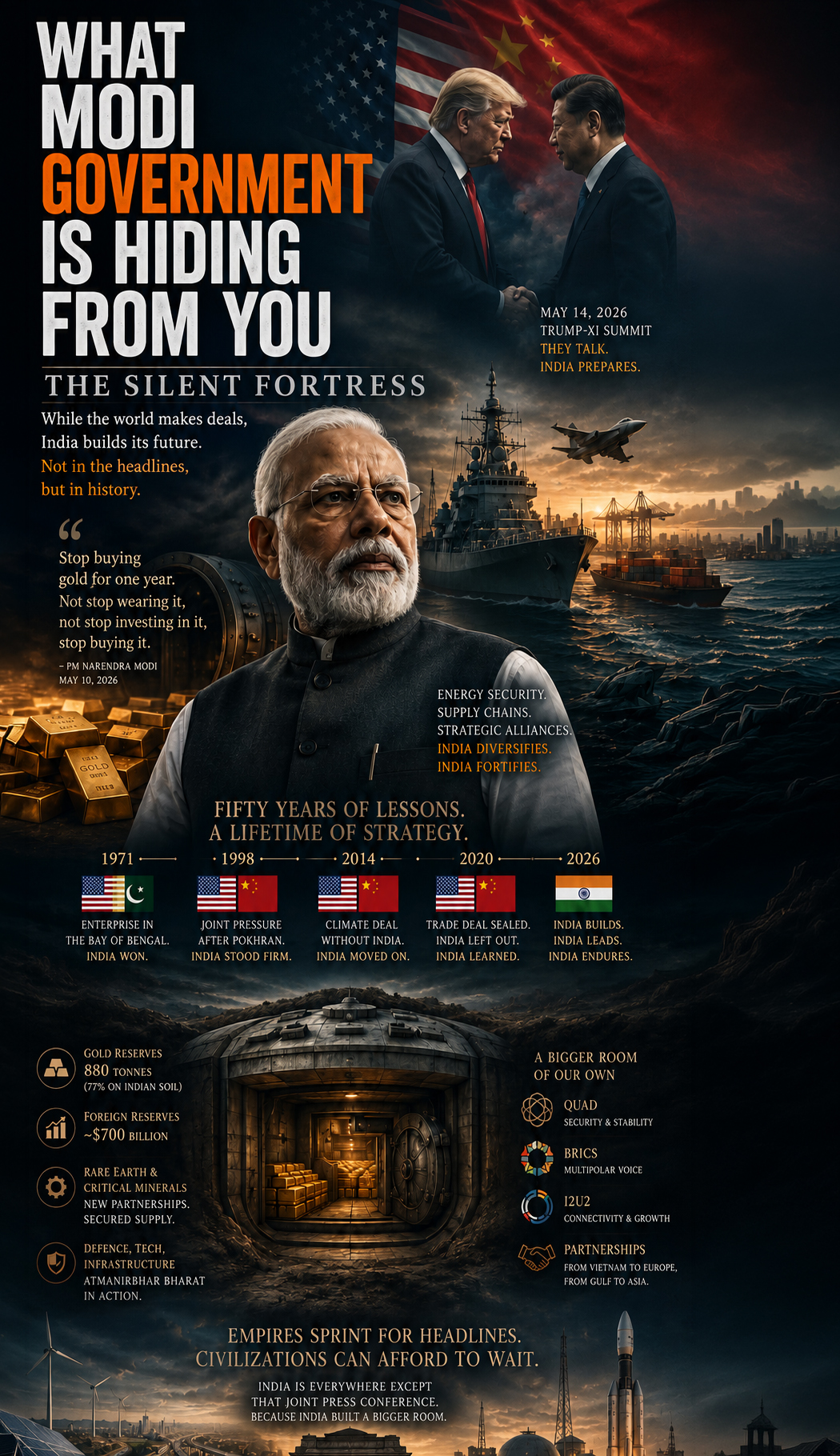
WHAT MODI GOVT IS HIDING FROM YOU – The Silent Fortress On May 10, 2026, Prime Minister Narendra Modi shocked the country with a blunt appeal - He stood on a stage in Hyderabad and told 1.4 billion people to stop buying gold, not stop wearing it, not stop investing in it, stop buying it for one year regardless of which wedding, regardless of which festival, regardless of which function at home. This was no publicity stunt but a strategic emergency measure. Indians had poured $71-72 billion into the yellow metal in the prior year. Modi wanted that figure near zero. It is not just India but many tighter rules and regulations imposed by most of the countries due to USA -IRAN war and the energy crisis is real. But for India the stakes are really high. Old Power Games The timing was no accident. Delhi had been bracing for this moment for months. In recent history, whenever Washington and Beijing “spoke in one voice,” India was invariably on the Target side. Nine months earlier, long before any missile arced over Tehran or Air Force One lifted for Beijing, the bunker rose. While the world fixated on Donald Trump shaking hands with Xi Jinping, Delhi moved with the quiet precision of a civilization that has outlasted empires. • 1971 (Bangladesh War) – U.S. leaders privately insulted India’s leadership (Nixon called Mrs. Gandhi an “old witch” and a "b--ch," while Kissinger muttered “those damn Indians, bastards”) while dispatching the nuclear carrier Enterprise into the Bay of Bengal to back Pakistan’s genocide [whose army was killing three million Bengals. That summer.] India responded by allying with the USSR, signing a security treaty, and ending the war in just days. • 1998 (Nuclear Tests) – Six weeks after India’s Pokhran tests, President Clinton and China’s Jiang Zemin stood side by side in Beijing, issuing a joint communiqué demanding India halt its tests and immediately sign the nuclear-test-ban treaty. • 2014 (Climate Summit) – President Obama and China’s Xi Jinping announced a joint climate framework aimed at the Paris 2015 conference – notably, without India’s participation in those talks. • 2020 (Trade Deal) – In January 2020 Trump finalized a $200 billion “Phase One” trade deal with China, even as his administration a year earlier had stripped India of its U.S. trade-preference (GSP) status. In every case, India was the object of others’ diplomacy, not a partner. It learned to expect that great powers will “trade” India when convenient, and that alliances of Washington+Beijing often spell trouble for Delhi’s interests. Hard-Won Lessons - Over 50 years of this pattern, Indian policymakers have internalized key maxims: • Never rely on a single great power. Hedge by diversifying alliances (e.g. BRICS, Quad, Moscow or Tokyo, etc.). • Suspicion is prudent: When Washington and Beijing join hands, it’s a trap, not a forum. They can always trade something for India behind closed doors. • If you’re left out of the room, build another room. India helped spawn BRICS and Quad precisely to counterbalance being sidelined. • Hard capability is the ultimate ticket. Nuclear weapons, a blue-water navy, advanced missiles – these force India into the conversation (as Delhi proved in 1998 and 1971). • Above all: don’t panic, don’t overreact. Let the summit happen; then move. A cool, long-term strategy beats knee-jerk headlines. These are not platitudes but strategy – quietly practiced while media attention is elsewhere. Stakes on the Table - Energy & Trade: India imports ~4.5 million barrels of crude per day, roughly half from Russia. If Trump offers China Indian discount oil (or swaps Russian barrels for Chinese soy), New Delhi’s current account could blow out. Critical Supply Chains: China essentially dominates the world’s rare-earth magnet industry and supplies most antibiotic/API ingredients. These go into Indian electric cars, smartphones, vaccines and medicines. If Beijing weaponizes export licenses, India literally cannot make phones, missiles or drugs without permission. Financial Flows: The rupee has plunged to record lows (crossing ₹95 to the dollar) as oil shocks swell import bills. Foreign investors have already pulled out over $20 billion from Indian stocks in early 2026. Building the Invisible Bunker - Meanwhile, as the world watched U.S.–China summits and Middle East flashpoints, Delhi was constructing something far more dangerous than a headline — an invisible bunker. What began in Modi’s August 2025 Independence Day address as an economic doctrine rapidly evolved into a calculated national restructuring. Sweeping tax reforms, zero-tax thresholds, and cuts on essential duties quietly injected liquidity into the Indian middle class, while by February 2026 million found themselves effectively liberated from income tax altogether. In parallel, Delhi moved with cold strategic pragmatism — selectively reopening critical Chinese imports such as rare-earth magnets under the “automatic route,” not out of dependence, but out of recognition that nations preparing for industrial war cannot afford ideological purity in supply chains. Then came the geopolitical layering. In May, the BJP’s historic breakthrough in West Bengal effectively sealed India’s vulnerable eastern corridor from decades of foreign-engineered political instability and insurgent infiltration. Days later, Vietnam’s President Tô Lâm arrived in Delhi, where 13 agreements spanning defence technology, infrastructure, and critical minerals quietly reshaped India’s Indo-Pacific architecture. With Vietnam holding one of the world’s largest rare-earth reserves, Delhi was not signing trade deals — it was securing the raw bloodstream of future warfare and semiconductor manufacturing. At the same time, as sections of foreign AI capital began cautiously withdrawing from Indian markets amid global uncertainty and regulatory recalibration, Delhi responded not with panic, but with escalation. The emerging ASML–India semiconductor partnership with the Netherlands signalled the opening move of a much larger technological counteroffensive. By embedding itself into the global chip supply chain through lithography access, fabrication infrastructure, and semiconductor ecosystem development, India began laying the foundation for strategic technological sovereignty — reducing long-term dependence on East Asian choke points dominated by Taiwan and South Korea. The message was unmistakable: if speculative capital exits, India will replace borrowed innovation with industrial self-reliance. To force foreign capital back on its own terms, policymakers simultaneously moved to slash the steep 20% withholding tax on government bonds to attract stable long-term debt, while SEBI aggressively dismantled compliance barriers for overseas investors. Domestically, the government fortified reserves by raising gold import duties and pushing civilian austerity to suppress fuel consumption and external spending. Behind the curtain, the RBI tightened its grip on speculative currency trading while holding specialized FCNR swap mechanisms in reserve as a final defensive wall. India was no longer merely surviving capital flight — it was redesigning the battlefield itself, ensuring that the next phase of global investment enters India on Indian terms alone. By the very week Modi told Indians to halt gold buying, the Reserve Bank was tallying India’s vaults. Domestic gold holdings leapt from ~576 tonnes in Sept 2025 to 680 tonnes by March 2026 (an influx of 104 tonnes in six months). Total RBI reserves reached ~880 tonnes (≈$115B), about 77% of which was on Indian soil. In other words, one India was curbing demand, while another India was quietly stockpiling. Same metal, different decade. In 1991, India airlifted gold abroad in humiliation to avoid default. In 2026, India recalls it home, fortifies reserves near $700 billion, and tells its people: We endure. Patience as Power - Remarkably, on May 14 – the day of the Trump–Xi summit – India’s official reaction was silence. No grand press conference or walkout. The Prime Minister was opening a highway in a far-flung state; the External Affairs Minister was busy at a book launch. But don’t mistake inertia for weakness. In the following weeks, Delhi will let its new posture speak in deeds: re-scheduled Quadrilateral meetings, defence pacts, alternative oil shipments, new factories springing up, quietly undone deals with China, etc. None will be advertised as direct “responses” – they are simply what a confident India does when playing its own long game. The bunker Modi has built is not built of fear – it is built of patience and preparation. Empires sprint for headlines; civilizations can afford to wait. India has seen this movie before (1971, 1998, 2008, 2020, etc.). On the screen in Beijing, the leaders of America and China are taking their bows. Meanwhile India has quietly slipped into every other theatre: Quad, I2U2, AUKUS, energy deals with the Gulf, partnerships in Europe and Asia. India is everywhere except that joint press conference. And that is exactly where a great power should be – because in the end, India is not in the room only because it built a bigger room of its own. #BreakingNews #NarendraModi #Geopolitics #GlobalTrade #GlobalEconomy #IndianPolitics #bharat #IndiaNews
Like this ad? Make it yours.
Crush rebuilds this exact creative around your product — your brand, your colors, your offer — in about a minute.