
Inactive· since Jan 28, 2026
- 12
- days it ran
- 4
- relaunches
Ad copy
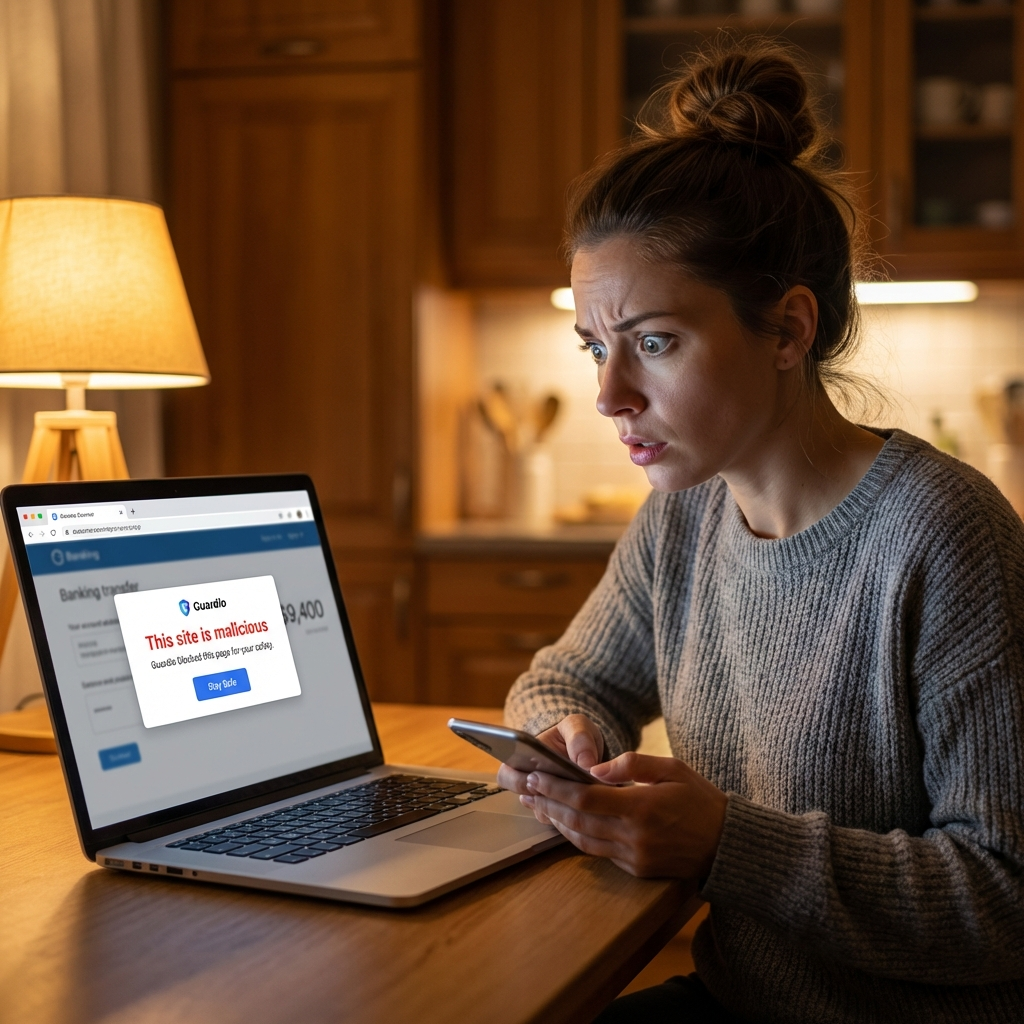
But when I replay our messages, I can pinpoint the second I stopped being careful and started being loyal. My fingers were already on the trackpad. The transfer window had opened in a new tab. The page looked clean, modern, almost calming - the kind of interface you expect from a bank or an investment platform that wants to feel "premium." And then, before I could even read the first line of the form, a warning covered everything. Dark overlay. Bold text. Red and urgent: "This site is malicious." A button at the bottom: "Stay Safe." I stared at it so long my eyes started to blur. Like if I stared hard enough, the warning would turn into a joke, or a glitch, or an overreaction. But it didn't. The form was gone. I couldn't access it anymore. My heart was doing something ugly in my chest - not just racing, but thudding like it was trying to escape. Because a second ago, I had been ready to send almost ten thousand dollars to a person I'd never met. And I need to tell you how that happened. So let me back up. Three weeks earlier, I was still trying to convince myself I liked being alone. That sounds pathetic written out, but it was my reality. I was thirty-five, recently divorced, living in an apartment that still felt temporary even after I'd put my name on the lease. I had unpacked the kitchen first, like a responsible adult. I had a drawer of mismatched utensils and a new set of wine glasses I bought because I didn't want to drink out of the same ones my ex and I had picked together. Everything in my life had that faint, awkward echo - like I was walking around in a house that used to be full and now I could hear my own footsteps. I kept busy. I did the things people tell you to do after a divorce. I went to the gym. I ate salads. I said yes to plans even when I wanted to say no. I stopped checking my ex's social media after I caught myself doing it at 1:00 a.m., thumb scrolling like it was an involuntary reflex. And then, on a Tuesday night, when I was half-watching a show I didn't care about and folding laundry that would probably sit in a basket for two days, a message came through. It was on a dating app I had downloaded and deleted twice. Her profile photo wasn't the usual. No fish. No sunglasses. No group shot where you have to play detective. It was just a person in a soft gray sweater, standing in front of a building that looked like it belonged on the cover of a design magazine. Clean lines. Glass. Light. Her name was Samara Rodriguez. Her first message was simple. "Hi Laura. I hope this doesn't come off as strange, but you seem like someone who values honesty. How has your week been?" I should've rolled my eyes. I should've thought, Who talks like that? Instead, I felt something I hadn't felt in a while. Seen. I told myself it was harmless to answer. I told myself I deserved a pleasant conversation with a stranger. I told myself I could always stop. "It's been a week," I typed. "Divorce paperwork week. So... not glamorous. How about you?" She responded fast, but not desperately. "I'm sorry. That's a heavy thing to carry. I'm not divorced, but I lost my wife three years ago. Sometimes it feels like life splits into "before" and "after" and you spend a long time pretending the "after" is normal." I stared at that line. Before and after. I hadn't said those exact words to anyone, but I had thought them. We messaged for an hour. Then two. She didn't try to steer it into anything sexual. She didn't push. She asked questions. She answered mine. She told me she was a widowed architect who split her time between projects, travel, and taking care of her mother. That part felt almost too perfect, like a character in a novel - but I wasn't suspicious. I was hungry for a version of romance that didn't feel like a performance. And Samara Rodriguez felt calm. In the days that followed, she kept showing up. Not in a suffocating way. Not with the frantic "good morning beautiful" messages every hour. Just... consistently. "Did you eat today?" "How did the meeting go?" "I saw a building today that reminded me of what you said about my dream kitchen. I wish I could show you." She suggested moving to WhatsApp "because the app notifications can be weird" and because she traveled and sometimes the dating app would log her out. Text only. Always text. I didn't question it, because it made sense. People move off the apps. That's normal. And I liked hearing from her. I liked the way her messages made my apartment feel less quiet. Over the next week, she became part of my day. I drank coffee with my phone on the table, waiting for her first message. I told myself it was ridiculous. Then I did it anyway. I should've known better. I've read the warnings. I've heard the stories. I've seen the headlines. But warnings feel abstract until a person learns your favorite takeout order and asks how your mother is doing. I didn't tell my friends right away. Not because I was hiding anything, but because I didn't want their opinions. I didn't want the jokes. I didn't want the protective interrogation. I wanted to keep the feeling intact, just for a little while. There were details, little things, that made it feel real. She sent me photos of sketches. Not fancy ones. Messy ones. Pencil lines and smudges. A corner of a desk in the background with a coffee stain. She asked me what kind of music I listened to when I needed to calm down. She told me, in a long message one night, about the moment she came home to an empty house after the funeral and realized she didn't know how to make dinner for one. I remember reading that message in bed, under a yellow lamp, feeling my throat tighten. Because grief is universal. Loneliness is universal. We speak the same language when it comes to that. And I trusted her. That trust felt like a muscle waking up again. The second week, she started using my name more. "Laura, you deserve softness after what you've been through." "Laura, I can tell you're the kind of woman who loves deeply." It sounds embarrassing now, but at the time it felt like someone handing me back a part of myself. There were a few moments where something didn't line up. She would mention "a project in Chicago" and then later talk about "being at the site" without saying where. She'd send a photo of a city skyline that could've been anywhere. I noticed. I did. But I explained it away because that was easier than admitting the alternative. And then, in the third week, the temperature changed. Not dramatically. Not a sudden demand. Just a shift. One evening she was quieter than usual. Her responses were shorter. "Long day?" I asked. "Complicated," she wrote. Then she waited. Like she wanted me to ask. So I did. "What's going on?" She sent a longer message that read like someone trying to sound composed while failing. "I'm embarrassed to even talk about it. My mother had a health scare and I had to move some funds around quickly. It's not about needing money. It's about timing. My bank is holding a transfer and it puts me in a position I hate - feeling helpless." Helpless. That word got me. Because I knew what it felt like to be at the mercy of paperwork, of systems, of someone else's decisions. I typed: "Are you okay?" "I will be. I just hate that I can't fix it immediately. I hate asking for patience when all I want is control." It was so carefully written. Not manipulative on the surface. Not a sob story with obvious hooks. Just a person admitting vulnerability. She didn't ask me for anything that night. And that made me trust her more. The next day she sent me a screenshot. It was a bank transfer page. A transaction marked "pending" with a note about verification. I remember zooming in on it, checking if it looked like something I'd seen before. It did. Not perfectly, but enough. "It should clear soon," she wrote. "I just need to cover a medical deposit today, and then the rest is fine. I have the funds. The timing is the issue." I should've put my phone down. I should've said, "I'm sorry, I can't help." Instead, I asked, "How much?" Even now, that question makes my stomach turn. Because it wasn't just curiosity. It was me opening a door. She didn't pounce. She didn't say, "Send it now." She wrote, "Laura, I don't want to put you in that position." She waited again. And then: "But if you can help me bridge it, just for a day, it would mean everything. It's $9,400. I can return it the second the transfer clears." Nine thousand four hundred. Specific. Odd. Not a clean number. It sounded like a real deposit. My savings account had a little over eleven thousand in it - the sad, stubborn emergency fund I had built after the divorce like a life raft. I stared at my banking app. I stared at her message. I felt shame. Then I felt anger at myself for feeling shame. Because I'm not reckless. I'm not naive. I don't wire strangers money. But Samara Rodriguez wasn't a stranger in my mind anymore. She was the person who asked if I'd eaten. She was the person who remembered the story about my father teaching me to drive. She was the person who said, "Before and after." That's how it works, I learned. They don't steal your money first. They steal your sense of reality. I told her I needed a minute. She replied, "Of course. Take your time. And if it's no, it's no. I won't be angry." That line was the hook. I won't be angry. It made me feel safe. It made me feel like I was choosing, not being pushed. I sat at my kitchen counter, the one I bought secondhand because I didn't want to keep the dining table my ex and I had chosen together. The overhead light was too bright. My laptop was open, but I wasn't working. I was doing something worse. I was calculating how much I could lose and still survive. I should've known better. That was the moment, right there, where I stepped out of logic and into loyalty. I typed, "How would I even do this?" She answered quickly. "My bank has a verification portal. It's secure. I can send you the link and you can initiate the transfer to my account. It's like a direct deposit. You'll see everything." She included a little smiley face. A tiny symbol of gentleness. She sent the link. It looked like a normal URL at first glance. It had words like "secure" and "verify" in it, plus a string of numbers. I felt a small flicker of hesitation. Because I knew - somewhere in my brain - that links are where people get hurt. But I had already asked how. I had already moved from "should I" to "how do I." And she was waiting. "Laura, I hate that I'm even asking," she wrote. "But I won't forget it." I can still see the typing bubble in my mind, like a pulse. I glanced at my savings account again. $11,237.18. I imagined it dropping. I imagined being at zero. I imagined calling my bank, trying to explain without sounding stupid. And then I imagined Samara Rodriguez's mother in a hospital bed, and her sitting in a waiting room with her head in her hands, alone. That image - whether it was real or not - made my chest ache. I clicked the link. The page started to load - white screen, a logo appearing - then a warning flashed. A popup covered everything. Dark background. Bold text at the center, red and urgent: "This site is malicious." I stared at it, confused. Below the warning, more text explaining the threat. A button at the bottom: "Stay Safe." The form was gone. I couldn't access it anymore. The popup had blocked everything. I clicked "Stay Safe," hands shaking. What just happened? For a beat, I couldn't breathe. Then my phone buzzed. Samara Rodriguez. "Did it work?" I didn't answer right away. My brain was trying to reconcile two realities at once. Reality one: Samara Rodriguez is who she says she is, and the site is fine, and this is a weird false alarm. Reality two: The person I've been trusting for weeks is not Samara Rodriguez, and I almost sent her $9,400. The warning had been so blunt. So absolute. Malicious. I typed back carefully. "It blocked the page. It says the site is malicious." Her response came fast. Too fast. "Sometimes those warnings are wrong. It happens. Try again from a different browser. Or use your phone. The portal is safe." My mouth went dry. Because if it was truly safe, she would have said, "Don't worry, let's do something else." She would have suggested calling her bank. She would have offered another method that didn't require me clicking a link. Instead, she wanted me to get around the warning. That's when I felt the first clean crack in the story. And once you see the crack, everything starts to crumble. I wrote, "Can you send me your bank's phone number? I'll call and verify." She didn't answer for a minute. Then: "Laura, I told you I hate asking. Please don't make this harder. I'm already humiliated." Humiliated. A new hook. I stared at that word and felt my own guilt flare - the old instinct to soothe, to fix, to not be the reason someone feels bad. And I hated that I could feel her tugging on that instinct. I put my phone face-down on the counter. I walked to the bathroom. I looked at myself in the mirror like I was trying to recognize the person who almost did this. I should've known better. Not because I'm careless. Because I was lonely. Because I wanted to be chosen. Because I wanted someone to tell me I was worth the tenderness. When I picked up my phone again, there were more messages. "Laura?" "I'm not trying to hurt you." "Please." Then a final one that made my skin go cold. "If you can't help, I understand. But don't accuse me of being someone I'm not." Accuse. She was flipping it. I felt my hands start to shake again, but this time it was anger joining the fear. I opened my banking app and checked my savings account like it might have changed just because I thought about it. $11,237.18. Still there. I sat back down and forced myself to do the thing I hadn't done once in three weeks. I searched her name. Samara Rodriguez, architect, widowed. Nothing solid. I searched the image she used as her profile photo. My heart thudded harder with every second the results loaded. And there it was. The same photo, attached to a random blog post from years ago, featuring an entirely different name. My throat tightened so fast it felt like swallowing a stone. I stared at the screen and felt humiliation wash over me, hot and bright. And then, underneath that, a darker feeling. Grief. Because it wasn't just money. It was the loss of the person I thought I'd been talking to. The loss of the version of myself that believed in her. I went back to WhatsApp. "Who are you?" I typed. The typing bubble appeared. Then disappeared. Then nothing. Finally: "Laura, you're spiraling. I'm in the middle of a crisis and you're making it about you." That sentence was so wrong - so cold - that it snapped something in me. The person who had written about "before and after" wouldn't talk like that. Or maybe she would, if she were real and panicked. That was the trap, right there. The constant possibility that I was wrong, that I was being unfair, that I was ruining something good. But the warning on my laptop had been real. And my money was real. And my life was real. I blocked her. My finger hovered over the button longer than I want to admit. Then I pressed it. The silence afterward was immediate. No more messages. No more typing bubble. It should have felt like relief. Instead it felt like standing at the edge of a cliff and realizing how close I'd been to stepping off. That night, I didn't sleep. I kept replaying the moment I clicked. The little white loading screen. The way my body had leaned forward like I was already committed. The way my brain had tried to justify it. I got up at 2:00 a.m. and opened my laptop again, like I could rewind time if I stared at it hard enough. I checked my accounts again. I should've known better. I should've told a friend. I should've listened to the tiny voice that said, "Why does she need this exact amount, this exact way?" But the worst part was this: It had felt real. Not because I'm foolish. Because it was designed to feel real. The next day, I told my best friend, Mia. She listened in that quiet way she has, the kind that makes you feel both exposed and safe. When I finished, she didn't say, "How could you?" She said, "They study people, Laura. They don't just guess." I swallowed hard. "I almost sent her $9,400," I whispered. Saying it out loud made it heavier. Mia reached across the table and squeezed my hand. "I'm glad something stopped it," she said. Something. That word hung there. Because I still didn't understand what had happened on my screen. I knew a warning had blocked the site. But why then? Why that moment? Why had it appeared so quickly? Was it my browser? Was it some built-in thing? Was it luck? I spent the weekend doing what I should have done sooner - reading. Romance scams. Widowed professionals. Slow-burn messages. Financial "timing" emergencies. Links to "verification portals." It was all there, laid out like a script. And I had followed it. I want to be careful here, because I know how this sounds. It's easy to read a story like mine and think, "I would never." I used to think that, too. But I'm not telling you this to scare you. I'm telling you because the part that almost got me wasn't greed. It wasn't desperation. It was trust. It was the way a person can make you feel understood, and then use that understanding like a key. Two weeks after I blocked her, I got another message on a different platform. Different name. Different photo. Same rhythm. "Hi Laura. Your smile looks honest. How is your week going?" My stomach dropped. Because it meant Samara Rodriguez wasn't a single person. It was a method. I didn't respond. I deleted it. Then another came. Then another. And every time, the same small thought followed. What if the next one is better? What if the next one doesn't send a link that triggers a warning? What if the next one waits longer, builds deeper, asks for a smaller amount first? I started flinching at my phone. I started reading messages twice. I started wondering how many other people were walking around with the same invisible bruise. One night, I was scrolling through an email thread from my bank - just normal notifications - when I saw a subject line I didn't recognize. "Security Tip: Protect yourself from phishing sites." It looked like one of those generic informational emails you ignore. But I clicked it anyway. It mentioned a browser extension and an app called Guardio. I had heard the name before, vaguely, like background noise in the world of "things people install when they're trying to be responsible." I sat there, thinking about that dark overlay. The red warning. The words: "This site is malicious." And I wondered if it was connected. I installed it. Not because I wanted to feel invincible. I didn't. I just wanted to feel like I wasn't alone with my own judgment. A few days later, I got another message. This time it was on WhatsApp again. A new number, a new name, but the same patient tone. "Laura, I know you don't know me, but I was moved by your profile. I don't often reach out like this." She waited for me to respond. I didn't. Then came the hook. "I can show you something private, but I only share it on a secure link." My pulse kicked up even though I knew exactly what it was. A link arrived. I stared at it. And then - because part of me needed proof, needed to see it happen with my own eyes - I clicked. The page started to load - then the screen darkened. A familiar overlay. Bold red warning: "This site is malicious." The Guardio logo sat at the top like a stamp I hadn't earned but desperately needed. A blue button waited at the bottom: "Stay Safe." I clicked it, hands steady this time. And I sat back, staring at my laptop, letting the reality settle into my bones. That first night - the night Samara Rodriguez asked for $9,400 - I thought I'd been saved by luck. Now I knew it wasn't luck. It was a line I didn't even know existed until I almost crossed it. Over 2 million people have stopped being easy targets. The next "perfect" message from someone who seems to understand you, the next link sent with just enough tenderness to lower your guard - will you catch it in time? Click below to see if dangerous sites get blocked before they load, before your next click turns into a loss you can't take back.
Like this ad? Make it yours.
Crush rebuilds this exact creative around your product — your brand, your colors, your offer — in about a minute.