
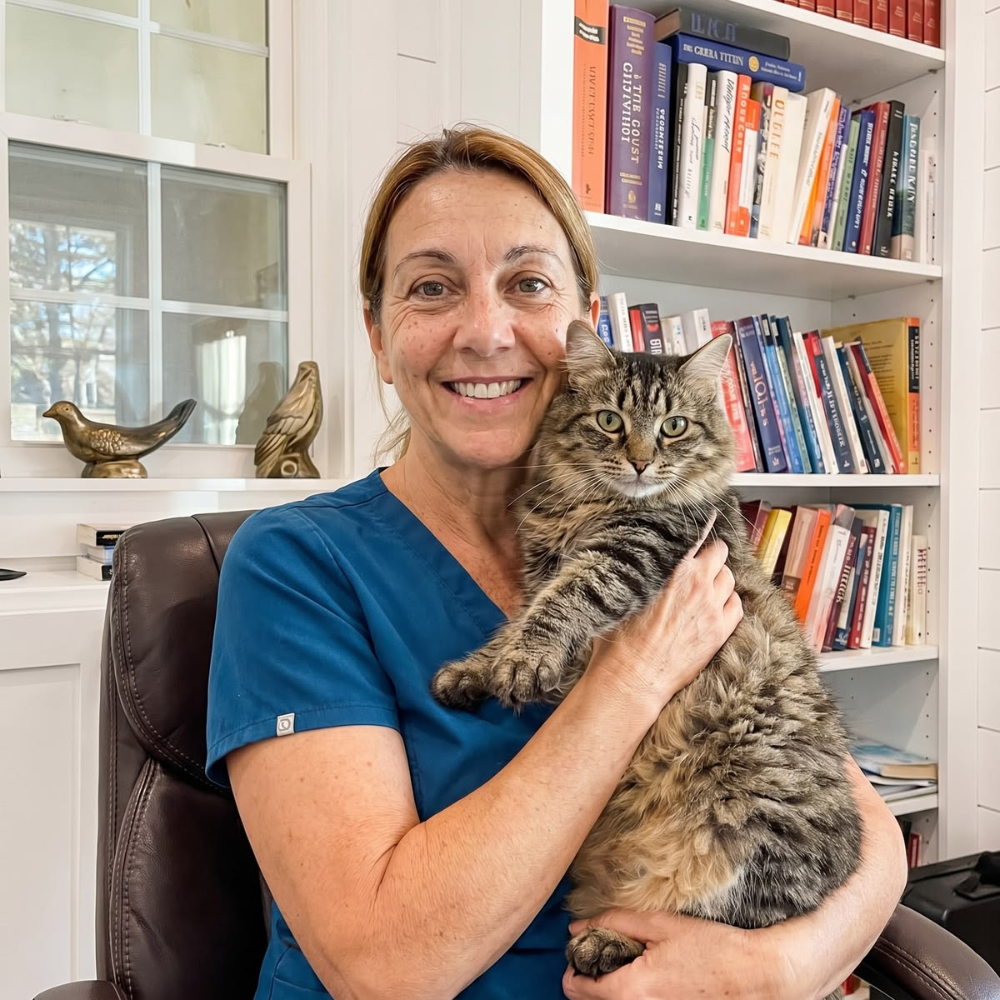

Sarah Callahan, DVM
Active· since May 30, 2026
- 116
- days running
- 1
- relaunches
Ad copy
I'm a veterinarian. I've practiced small-animal medicine for nineteen years, and in that time I've had one particular conversation more often than almost any other. It usually happens quietly, near the end of an appointment, when an owner lowers their voice and says some version of: “Doctor… can I ask you something a little embarrassing?” Then it comes out. Their house smells like cat urine. They've tried everything. It always comes back. They're ashamed to have anyone over. And — this is the part that breaks my heart — a lot of them are quietly working up to asking whether it's time to give up their cat. So let me say this as plainly as I can, before anything else: in the large majority of these cases, you do not need to rehome your cat. You are not dirty. And your cat is not broken, spiteful, or “getting back at you.” Nearly everyone has this story wrong — because nearly no one explains what is actually happening. So today I will. First — a word as your vet. If your cat has suddenly started urinating outside the litter box, or its habits have changed, please get it examined. Urinary tract infections, bladder crystals, kidney disease, and even stress can all cause this, and some are serious. Rule out a medical cause first. That part is genuinely my job, and no product on earth replaces it. What I'm about to explain is for the odor and the behavior that remain once a medical problem has been ruled out. Why you can't smell it, but everyone who walks in can. Your nose is built to stop noticing a constant smell. The technical term is olfactory fatigue — “nose-blind,” in plain English. After enough exposure, your brain simply filters the odor out so it can pay attention to new things. It is not a character flaw; it's basic biology. The cruel part is that anyone arriving with a fresh nose smells it the instant they walk in, while you've had no warning at all. So please let go of the idea that this means you keep a dirty home. It doesn't. It means your nose is doing exactly what it was designed to do. Why your cat keeps returning to the exact same spot. Here is the part owners almost never hear. Cats do not urinate out of spite — I promise you, they are not plotting. A cat returns to a spot for one simple reason: it can still smell a scent marker there. To a cat, urine isn't just waste; it's a signal that says “this is a bathroom.” And here is what changes everything: your cat's sense of smell is many times more sensitive than yours. So when you have cleaned a spot until it smells perfectly fine to you, it can still smell exactly like a toilet to your cat. You're telling them “this is clean.” Their nose is telling them “this is the spot.” Their nose wins. Every time. So they go again. And you clean again. And the cycle never ends — not because anyone is doing anything wrong, but because you and your cat are working from completely different information. What cat urine actually does once it lands. To understand why both the smell and the marker are so stubborn, you have to know what cat urine does the moment it lands. It does not sit on the surface like a spilled glass of water. It soaks down — through carpet fibers, into the padding underneath, into couch foam, into the seams of fabric, sometimes all the way into the subfloor. And as it dries, it leaves behind uric acid crystals. Those crystals are the real problem. They do not dissolve in water, which means ordinary cleaning slides right over them. They sit there — dry, dormant, invisible — until they meet moisture or warmth. A humid day. The heater switching on. Even a steam cleaner. The instant that happens, the crystals reactivate and release that sharp ammonia smell all over again, as strong as the day it happened. That is why it “comes back.” It never actually left. It was sitting an inch or two below the surface the entire time. To your fading nose, it eventually disappears. To your cat's nose, it never disappears at all — which is precisely why they keep returning to it. Why nothing you've tried has worked. Once you understand that, it becomes painfully obvious why the usual fixes fail. Vinegar and baking soda treat the surface. Candles and plug-ins just lay a second smell on top of the first. Carpet shampoo cleans the fibers you can see. And enzyme cleaners — which are actually the right idea, because enzymes can break those crystals down — still fail for most people, because they spray a light mist across the top while the source is soaked deep underneath. I want to be clear about this, because it matters: the enzyme is not the problem. The delivery is. It's the right tool applied at the wrong depth. What actually fixes it. So what I tell my clients now is simple. You have to get the bio-enzymes down to where the urine actually went — not just onto the surface above it. That means a treatment fine enough to penetrate, rather than a spray that beads on top and runs off. The option I've seen work best for this is a device called PetMizer. Instead of a coarse spray, it turns a bio-enzyme solution into an ultra-fine nano-mist that settles down into the carpet, padding, and cushions, rather than sitting on the surface. It uses no artificial fragrance — and as a vet, I genuinely prefer that, because the goal was never to make the spot smell like flowers. The goal is to leave nothing behind for any nose to find. Yours. Your guests'. Or your cat's. And that last part is what I most want you to hear. When the marker is truly gone — not masked, but neutralized at the source — two things happen at once. Your home stops smelling. And your cat, no longer reading “bathroom” in that corner, finally stops returning to it. You solve the odor and the behavior together, because they were always the same problem. I have watched this turn situations completely around. Owners who were a week away from surrendering a cat they loved. Owners who hadn't had a guest over in years. Owners who had genuinely convinced themselves that they were the problem. None of them were. They had simply never been told what was happening beneath the surface. So if you're sitting there ashamed of your home, or quietly wondering whether you have to give up your cat — please do not make that decision over a problem you haven't actually solved yet. Rule out the medical causes with your vet. Then stop treating the surface, and reach the source. You almost certainly do not have to lose your cat. And you absolutely do not have to live like this. 👉 https://petmizer.com/products/petmizer%E2%84%A2-blue-light-enzyme-deodorizer P.S. — The hardest part of my job is watching a family surrender a cat over something that was never the cat's fault and was never unfixable. If you take one thing from this, take this: the smell coming back is not proof that you've failed. It's proof that the source was never reached. P.P.S. — And the sooner you handle it, the better. The longer those crystals sit, the more firmly they bond into the material — and every day the marker remains, your cat keeps returning to that same spot and adding to it. Time quietly makes both problems worse.
Like this ad? Make it yours.
Crush rebuilds this exact creative around your product — your brand, your colors, your offer — in about a minute.