
Inactive· since May 26, 2026
- 8
- days it ran
- 0
- relaunches
- 17
- EU reach
Ad copy
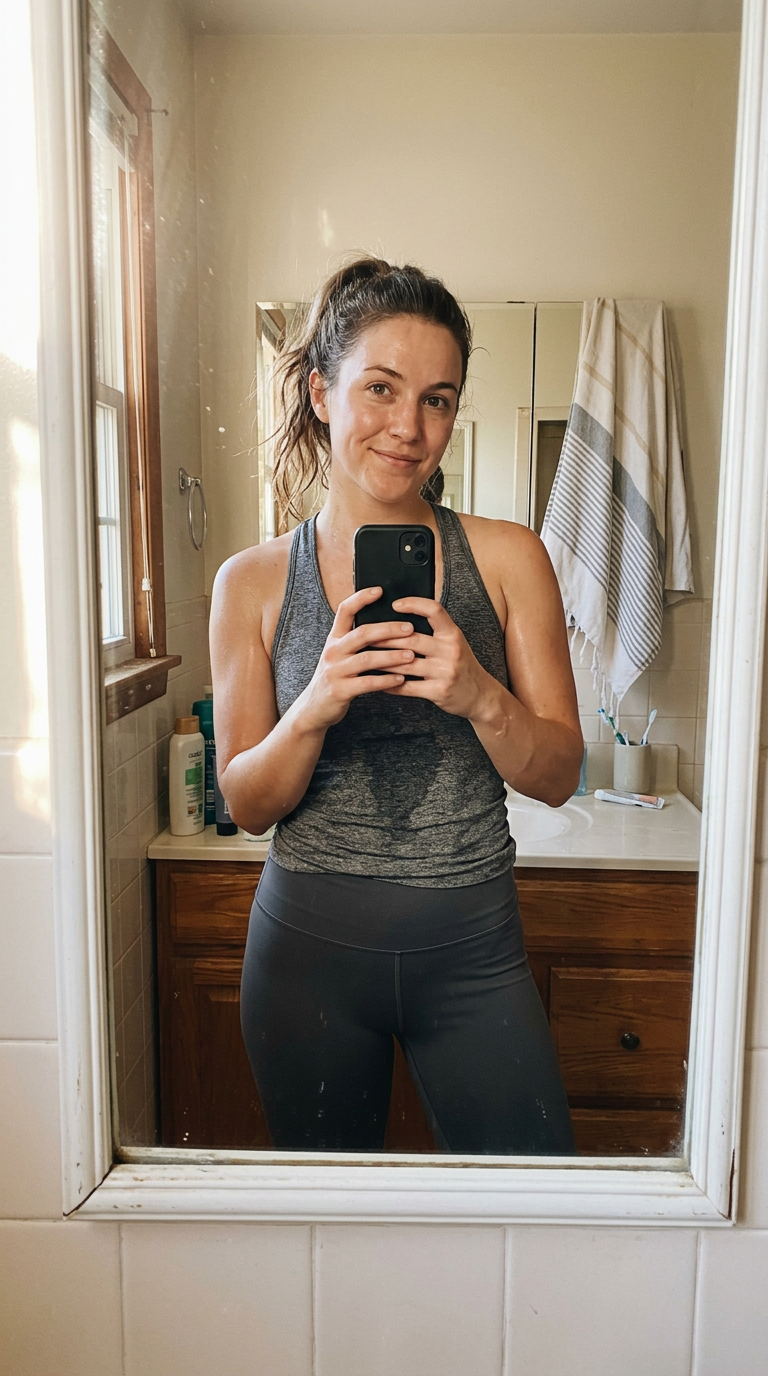
I watched my sister start hiding in every photo. The woman who used to grab me by the arm and say "selfie!" started positioning herself behind people, behind furniture, behind anything that would crop her body from the frame. My sister and I are two years apart. We have thousands of photos together — twenty years of them. Birthday photos. Beach photos. The random Tuesday photos that exist because one of us said "we look cute" and the other one agreed and the phone came out and the record was made. At 39, she agreed. At 43, she stopped agreeing. And the stopping changed the way we document our life together. "No photos." The new sentence. Not said once — said every time. At family gatherings where the cousins line up. At brunches where the light is good and someone reaches for a phone. At my daughter's sixth birthday where everyone crowded together for the group shot and my sister stood to the side and said "I'll hold the bags." She wasn't holding bags. She was holding the line between herself and a camera that would document a body she didn't recognize. My sister was a size 8 at 39. She's a 16 at 43. Four years and eight sizes while doing everything the system told her to do. The gym — four times a week, never missing, the discipline that should produce results and didn't. The diets — low carb, then keto, then calorie counting, then intermittent fasting, each one lasting three months, each one producing zero change or change in the wrong direction. The trainer — $180 a month she couldn't really afford, for a year, who pushed her harder and the harder produced nothing except exhaustion and a credit card bill. Her doctor said "perimenopause." Said "your metabolism is adjusting." Said the sentence that every woman over 40 hears from the medical system: "this is normal for your age." Normal. A size 8 to a size 16 while training four times a week and eating 1,400 calories. If that's normal, normal is a word that has lost all meaning. The photo-hiding was the part I could see. Underneath was the infrastructure of shame she'd built so carefully that most people didn't notice. The mirror avoidance — turning the bedroom dresser mirror so it faced the wall. She told her husband she preferred the dresser that way. The dresser preferred whatever angle didn't show her body. The changing with the door locked — even when nobody was home. The private ritual of putting on clothes in a locked room because the dressing required a vulnerability she wouldn't risk even in an empty house. The online ordering — every piece of clothing bought from a screen because the dressing room was a fluorescent courtroom where the mirror was the judge and the verdict was always guilty. She'd order five things. Return four. Keep the one that hid the most. The shrinking. Not of her body — her body was expanding. The shrinking of the woman inside the body. The confidence contracting as the waist expanded. The presence withdrawing from rooms she used to fill. The woman who grabbed my arm for selfies becoming the woman who holds bags during group shots. I almost said something a dozen times. At the birthday where she positioned herself behind the kids. At the beach where she wore a cover-up the entire day — in the water, out of the water, at lunch, the cover-up never coming off because the cover-up was the portable hiding she carried everywhere. At the holiday dinner where the family photo was taken and she stood in the back row behind our brother who is six inches taller and wide enough to block her entirely. Each time I opened my mouth. Each time the moment passed. Because what do you say to your sister about her body? The sentence doesn't exist in the sister-vocabulary. Every version sounds like judgment. Every version sounds like "I noticed you're bigger" disguised as concern. The disguise isn't good enough. She'd see through it. She'd hear "I noticed" and the "I noticed" would be another camera she's hiding from. The day I actually said something: Her birthday. Forty-three. Just us. A restaurant we've been going to since our twenties. The waiter offered to take our photo. She said "no thank you" and I watched her say it — the practiced no, the smooth deflection, the smile that covers the refusal with politeness. After the waiter left: "I miss taking pictures with you," I said. "I don't photograph well anymore." "You don't photograph. Period. You hide." She looked at her plate. The looking-at-the-plate that means: you said the true thing and I need somewhere to put my eyes while I process the truth. "I don't want to remember looking like this," she said. Quietly. The sentence underneath all the hiding. Not vanity — grief. The grief of a woman who remembers looking different and can't reconcile the memory with the mirror and the camera is the permanent version of the mirror and she won't volunteer for permanence. "What if 'like this' isn't permanent?" I said. "What if nobody checked the actual thing?" I showed her the article that night. In the restaurant parking lot. Both of us in her car. The way sisters have important conversations — in parked cars where the world can't hear. The article was about the nervous system. About survival mode. About bodies that hold weight regardless of effort because the chronic stress response overrides the gym and the diet and the discipline. Not because the effort is wrong — because the body is running a program that makes the effort invisible. The program says: hold. And the body holds. And the gym can't override the hold. And the calories can't override the hold. And the trainer can't override the hold. Because the hold lives underneath everything. The article mentioned Liven. Micro-Cycle Method. Five minutes a day. Not a diet. Not a training program. Something for the program underneath. For the nervous system that's telling the body to hold while the woman is telling the body to release. She read it in the car with the engine off and the parking lot lights coming through the windshield. She started crying — not the sad kind. The recognition kind. The tears that come when someone describes the room you've been locked in and you realize the door was never locked. "Every article for three years has been about food," she said. "Every doctor, every trainer, every program — food, food, food. This is the first thing about why the food doesn't work." She took the quiz in the parking lot. Dysregulation Score: high. She started Liven before she started the car. Here's what I watched from the sister's seat. Week 1: she texted me. "Did the five minutes. Haven't noticed anything. But I slept better. Like, actually slept. First time in months." Week 2: "The 3 PM thing is gone. The craving at 3 PM that I always gave in to — I didn't even think about it today. I walked past the vending machine and kept walking." Week 3: she sent me a photo. Of herself. Not a selfie for the world — a selfie for me. In the bathroom mirror. The mirror she'd turned to face the wall. She'd turned it back. The photo was her — in workout clothes, sweaty, after the gym — looking at herself without the looking being a war. The caption: "First photo in 8 months." I stared at that photo for a long time. Week 4: "Seven pounds," she texted. The scale she'd brought back from wherever she'd hidden it. Seven pounds from the combination — Liven plus moderate gym plus normal eating. Not the punishment gym. Not the starvation eating. The normal version of both, with the nervous system being addressed alongside. Week 6: brunch. Our restaurant. The waiter offered to take our photo. She didn't say "no thank you." She didn't hold bags. She sat next to me and put her arm around me and the waiter took the photo and she looked at it on my phone. "Not bad," she said. Looking at herself in the image. The first time she'd looked at a photo of herself and not flinched in over two years. Not "I look great" — "not bad." But "not bad" from a woman who's been hiding is a revolution. Week 8: my daughter's birthday. The group shot. Everyone lined up. And my sister stood in the front row. Next to me. Not behind our brother. Not behind the kids. Not holding bags. In the front. Visible. Arm around my waist. The arm that used to grab me for selfies reaching for me again. "There I am," she said. Looking at the group photo afterward. Pointing at herself in the frame. The way people point at themselves when they're surprised to see someone they recognize. It's been five months. She's down twenty-one pounds. Not at her size 8 yet — but she talks about it like she'll get there. And I believe her because I've watched her body respond to the effort for the first time in three years. But here's what matters more than the size: She takes photos again. Not constantly — carefully. With the awareness of a woman who knows what hiding felt like and chooses visibility instead. The mirror faces the room. The dresser is correct. The dressing room door isn't locked. The online returns went from four-out-of-five to one-out-of-three. She's in the photos. Our photos. The shared record of two sisters who have twenty years of pictures together and almost lost the twenty-first. It wasn't perimenopause. It wasn't metabolism. It was a nervous system in survival mode running a program that made four years of effort invisible. Five minutes a day for the program. Combined with moderate gym and normal eating. And the hiding stopped because the body started changing and the changing gave her permission to be seen. If your sister hides in every photo. If "I'll hold the bags" replaced the selfies. If the camera became the enemy and the enemy is winning. If the hiding is quiet and practiced and covered with a polite smile. The camera isn't the problem. The body isn't the problem. The program running underneath might be the problem. And the program can be addressed. Liven has a quiz. A few minutes. Doesn't cost anything. Show it to her. Not as "I noticed you're bigger." As: "I think there's something blocking everything you've been doing. And I want you back in the photos." Link is below. 💙 P.S. — She knows I'm posting this. She said: "Tell them I missed two years of photos with my niece because I couldn't stand being in the frame. Tell them the frame has room for all of us. Tell them to get in the picture. Even if it's hard. Especially if it's hard." I'm telling you. 💙
THIS IS what you need to do
LEARN MORELike this ad? Make it yours.
Crush rebuilds this exact creative around your product — your brand, your colors, your offer — in about a minute.