
Inactive· since Jun 17, 2026
- 87
- days it ran
- 0
- relaunches
Ad copy
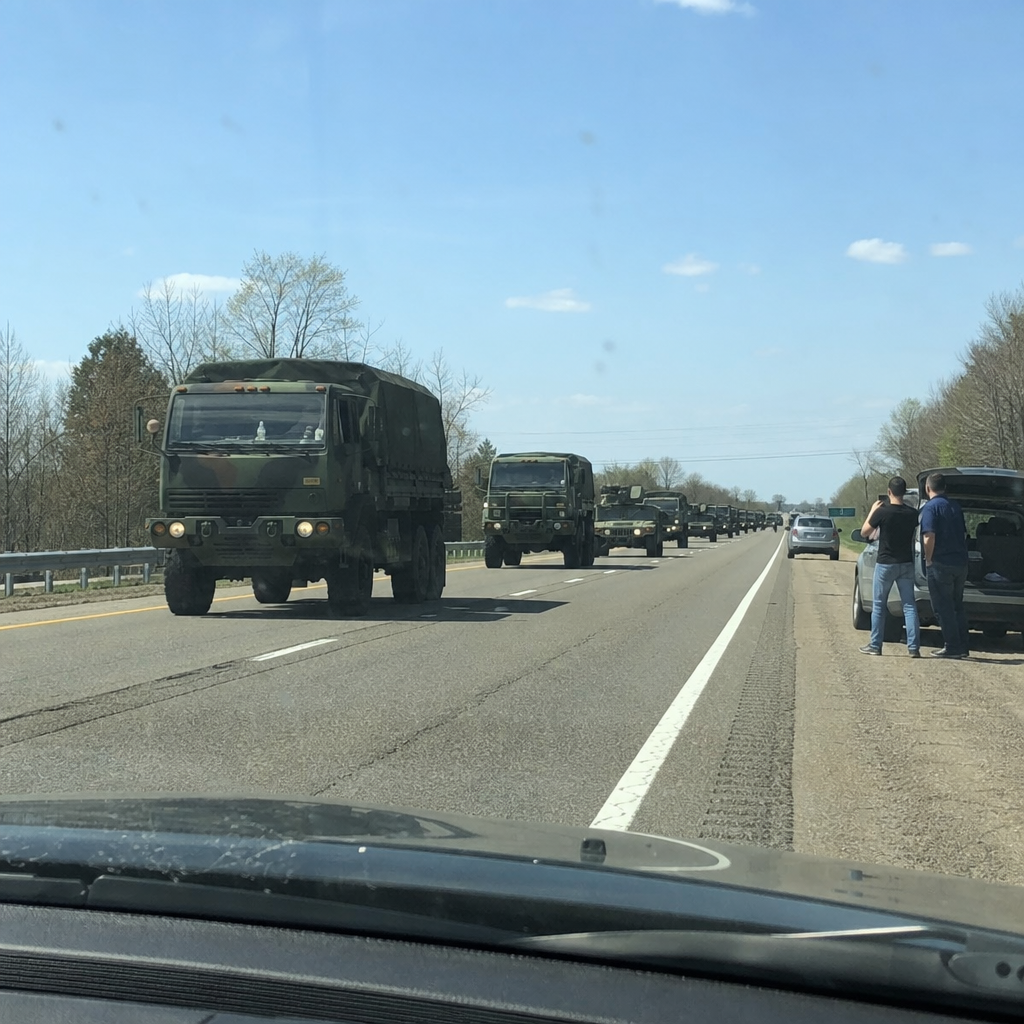
I was driving home on I-77 last Tuesday afternoon when I counted forty-two military vehicles heading south. In a civilian lane. On a weekday. That's when I called my buddy Marcus. I served eight years in the Marine Corps. Infantry. Two deployments. I know what a logistics convoy looks like. I know the difference between a training movement and a deployment movement. Training convoys are scheduled, announced, and usually on weekends when traffic is light. They're marked. They're expected. This was a Tuesday at 2 PM on a major interstate. Unmarked. No announcement. No escort. Just vehicle after vehicle after vehicle — trucks, humvees, fuel tankers, communications vehicles — rolling south like they had somewhere to be. I pulled over and watched them pass. Took me almost four minutes. I called Marcus. He's still active duty. Can't say much. Never can. But he's the kind of guy who'll tell you what he can without telling you what he can't. You learn to read between the lines. I said: "Hey. I just watched a convoy roll through Charlotte on I-77. Full logistics package. Comms vehicles. Fuel trucks. You know anything about this?" Long pause. "I can't talk about specific movements." "I know. I'm not asking about specifics. I'm asking if I should be concerned." Another pause. "I'll say this. Make sure your family has a plan. A real plan. Not a 'we'll figure it out' plan. Assume communications could get spotty." My stomach dropped. "Spotty like — cell service?" "Spotty like everything. Just be ready. Have a way to get information that doesn't depend on the grid." He hung up. I sat in my truck on the shoulder of I-77 and watched the last few vehicles in the convoy disappear south. Then I drove home and had a conversation with my wife that I'd been putting off for months. "We need to talk about what happens if the power goes out and doesn't come back quickly." She looked at me. She knows me well enough to know when I'm not being dramatic. "How long are we talking?" "I don't know. Days. Maybe longer." We sat at the kitchen table and went through our situation. We had food — enough for a week, maybe ten days if we stretched it. Water — three cases of bottles. First aid kit. Flashlights with batteries that were probably half dead. Then I asked the question that changed everything. "If the cell towers go down — how do we know what's happening? How do we know if it's safe to leave the house? How do we know where to go? How do we know when the power's coming back?" She didn't have an answer. Neither did I. In eight years of military service — two deployments, countless field exercises, months in environments where nothing worked the way it was supposed to — the one thing that was always there was communications. Radio. Always radio. You could lose power. You could lose vehicles. You could lose GPS. But you never lost radio because radio doesn't depend on any infrastructure. It just broadcasts. And as long as you have a receiver, you can hear it. In the civilian world, that receiver is a NOAA weather radio. The National Oceanic and Atmospheric Administration runs a network of transmitters across the entire country that broadcast continuously — weather alerts, emergency notifications, civil danger warnings, evacuation orders. It's been running since the 1960s. It doesn't need cell towers. It doesn't need the internet. It doesn't need the grid. It runs on its own dedicated infrastructure. And almost nobody owns a receiver. That's what hit me sitting at that kitchen table. We had food and water and flashlights — but we had zero ability to receive information if the grid went down. Zero. We'd be sitting in the dark guessing. Just like everybody else on our street. I went online that night and found a solar hand-crank emergency radio with a built-in NOAA receiver. AM/FM too. LED flashlight. SOS alarm. And a 10,000 milliamp-hour battery that charges your phone. Solar panel on top charges it during the day. Hand crank on the side gives you power anytime — day or night, indoors or out. USB-C port charges it from the wall when power's available. And the whole thing fits in your hand. No batteries. No outlet. No fuel. No grid. It just works. I ordered three. Nightstand. My truck. My wife's car. That weekend I sat on the back porch and tested it. Tuned to 162.550 — the NOAA frequency for our area. Clear as a bell. Automated voice reading alerts, forecasts, and emergency updates. Broadcasting right now. Right this second. To anyone with a receiver. I scanned the AM/FM bands. Local stations. National news. All coming through crisp. Then I turned off my phone, unplugged the WiFi, and sat there for twenty minutes with just the radio. Imagining what it would be like if the grid actually went down. No phone. No internet. No TV. Just this. It was the most prepared I'd felt since I left the Corps. My wife came out and listened for a few minutes. She didn't say anything. Then she went inside and I heard her call her sister. "Do you and Brian have an emergency radio? No — not the weather app on your phone. A real radio. One that works when the phone doesn't." Her sister didn't have one. Her parents didn't have one. My brother didn't have one. Not a single person in our family — including me, a Marine with two deployments — had a way to receive emergency information without the grid. We fixed that the next day. I don't know what that convoy was for. Marcus couldn't tell me and I stopped asking. But I know what a logistics movement looks like. And I know that the guys who know what's coming are already preparing. Marcus has one. His wife has one. His parents have one. If you've been watching what's happening — the convoys, the infrastructure warnings, the grid attacks, the military movements that nobody's explaining — and you've had that feeling in your gut that something's coming — trust your gut. Here's the link to the exact one I bought: https://guardsurvival.com/products/solar-powered-radio They've been going in and out of stock since the grid situation started escalating. If they're available, get them now. If you wait until you need one, you'll be standing in line with everyone else — except there's no line for these. They'll just be gone. The Marines taught me a lot. But the most important thing was this: you don't prepare when the emergency starts. You prepare before it starts. Because once it starts — it's too late. P.S. — Since that convoy on I-77, I've seen two more. Different highways. Different days. All headed south. My neighbor, a state trooper, told me he's been briefed to prepare for potential extended power disruptions this summer. He wouldn't say more than that. I'm not writing this to scare you. I'm writing this because nobody official is going to tell you to go buy an emergency radio. That's not how it works. By the time they tell you, it'll already be too late. Check the link above while they still have units.
I Served 8 Years. What I Saw on the Highway Changed Everything.
Congressional Report Warns: 9 in 10 Americans Won't Survive a Year Without the Grid — And Most Families Are Missing the One Thing That Gets Them Through It Congressional Report Warns: 9 in 10 Americans Won't Survive a Year Without the Grid — And Most Families Are Missing the One Thing That Gets ...
SHOP NOWLike this ad? Make it yours.
Crush rebuilds this exact creative around your product — your brand, your colors, your offer — in about a minute.