

Elizabeth Westberg
Active· since May 6, 2026
- 137
- days running
- 0
- relaunches
Ad copy
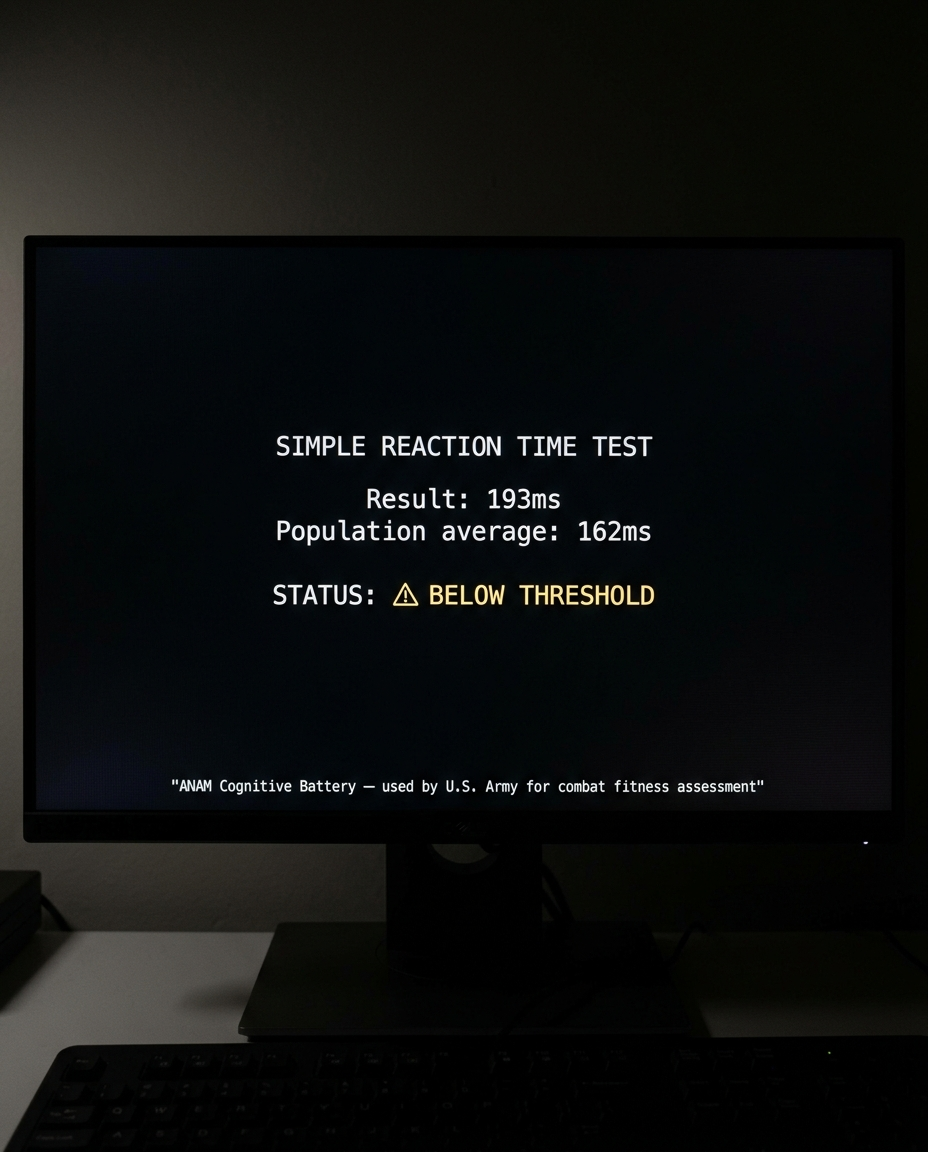
THE U.S. ARMY USES A COMPUTERIZED COGNITIVE TEST TO DETERMINE IF A SOLDIER IS MENTALLY FIT FOR COMBAT. People with chronic sinus inflammation fail it. Not "score slightly lower." Fail. Measurably, statistically, significantly — with a 19% slower reaction time than healthy controls, confirmed in a peer-reviewed study of 100 subjects using the same neuropsychological battery the military uses to assess combat readiness. And here's the part that stopped me cold when I read the study: The cognitive impairment persisted after the researchers controlled for age, sex, education level, sleep apnea, asthma — and depression. It persisted after controlling for antihistamine use. Meaning: this is not stress. This is not anxiety. This is not getting older. This is not something in your head. It's something in your nose. And it's been slowing your brain down every single day. I want to talk to a specific person right now. Not someone who woke up one morning with a stuffy nose and called it an allergy. I'm talking to the person who has been quietly watching their mind change over months or years. The person who used to be fast — genuinely fast, the one people came to — and now sits in conversations searching for words that should be automatic. "My memory sucks. Mainly names — and sometimes I have trouble finding the right words mid-conversation. It could be the most famous person in the world and I'll be talking and won't be able to think of their name. It should be automatic." "I feel like I have mild dementia almost every day." "It feels like my IQ dropped 20 points. I hate it so much." If you've said any version of those things to yourself — or typed them into Google at midnight, quietly, hoping nobody would see — what I'm about to explain is probably the most important thing you'll read this year. Because you've been looking in the wrong place. What the research actually shows Chronic rhinosinusitis — persistent inflammation of the nasal cavity and sinus lining — affects an estimated 12% of the adult population. Most of those people don't think of themselves as "allergy sufferers." They have a nose that runs sometimes. A little congestion. Maybe occasional headaches. Nothing dramatic. What they don't know is that inflammation doesn't stay where it starts. The nasal cavity is anatomically a direct pathway to the central nervous system. The olfactory nerves enter the skull through the cribriform plate — millimeters from brain tissue. When there is chronic inflammation in the nasal lining, the inflammatory cytokines produced there migrate upward into neural tissue and trigger neuroinflammation: sustained, repeated inflammatory events inside the skull, every day, for years. This is why the cognitive impairment shows up in objective tests. It's not subjective. It's not the person catastrophizing. It's measurable neural tissue under sustained inflammatory pressure from a source most doctors never examine — because most doctors, when they see brain fog, depression, or cognitive complaints, never look at the nose. The peer-reviewed study I referenced used the ANAM battery — Automated Neuropsychological Assessment Metrics — the same platform used by the U.S. Army to evaluate soldiers' cognitive fitness before deployment. CRS patients scored significantly worse on simple reaction time tests: 162 milliseconds versus 193 milliseconds for healthy controls. A 19% difference in reaction time. In practical terms: if you drive, you react to hazards 19% slower. In a meeting, you process information 19% slower than the person across the table. In a conversation, the lag between hearing a word and retrieving its answer is 19% longer. And the researchers confirmed: this difference persisted even after accounting for antihistamine use. That last detail matters more than people realize. The thing the antihistamine doesn't fix Millions of people with chronic nasal inflammation take daily antihistamines — Zyrtec, Claritin, Allegra — often without even connecting them to a formal allergy diagnosis. They just help with the nose. They're easy to get. They become a daily habit so embedded it barely registers as medication. What almost nobody knows: first and second-generation antihistamines cross the blood-brain barrier. Once inside the brain, they block the histamine receptors responsible for alertness, memory consolidation, and word retrieval. They suppress acetylcholine — the neurotransmitter the prefrontal cortex uses for working memory and executive function. For the mechanism that lets you hold a thought long enough to finish a sentence. The study controlled for antihistamine use and the cognitive gap remained. Which means: the antihistamine isn't causing all of it. But it's also not fixing it. You have nasal inflammation creating neuroinflammation from one side — and a drug suppressing the cognitive circuits already under attack from the other. "I found out this year that antihistamines cause brain function degradation. I've been on them every day for six years. Six years. What has that actually done to me?" That's not a fringe concern. That's a pharmacological reality that most prescribers don't flag because they're looking at the nose, not the brain. Why it gets worse every year The mechanism compounds. Every cell in the nasal lining — and in the neural pathways anatomically connected to it — contains mitochondria. After years of chronic low-grade inflammation, those mitochondria collapse. Cells enter a complete energy blackout. Without ATP production, they can't complete the immune response, can't repair tissue between exposures, can't clear the neuroinflammatory signals they keep generating toward the brain. Your cells aren't failing to heal because they're broken. They're failing to heal because they've run out of the energy required to heal. And every treatment that demands more from those cells — antihistamines requiring the immune system to suppress, steroids requiring tissue to respond, immunotherapy requiring tolerance to build — is asking for output from a system that's already in blackout. This is why every year feels harder than the last. Not because the allergy is getting worse. Because the cellular infrastructure required to recover from it has been depleted by years of inflammatory cycles with no real repair window. What actually restores the system In 1967, a Hungarian researcher named Endre Mester discovered by accident that a precise wavelength of light — 660 nanometers — was absorbed directly by the enzyme inside mitochondria responsible for producing ATP. Not systemically. Not through the bloodstream. At the cellular level, exactly where the collapse is. Dr. Michael Hamblin at Harvard Medical School has since published more than 400 papers on this phenomenon. Over 7,000 peer-reviewed studies confirm it. NASA used it for astronaut wound healing in zero-gravity environments where normal cellular repair breaks down completely — the same environment where the ANAM cognitive battery was developed to measure the effects of that breakdown. When 660nm red light reaches collapsed mitochondria in nasal tissue, ATP production restarts. Cells that have been in blackout for years regain the energy to complete what they've been trying to complete. The inflammation that couldn't resolve starts resolving. And because the nasal cavity is that direct pathway to the brain, the restoration doesn't stop at the sinuses — the connected neural tissue responds. The fog clears. Not because something is suppressed. Because the cells generating the neuroinflammatory signals finally have the energy to stop. Dr. Michael Anderson, a board-certified ENT surgeon with 27 years of clinical practice, spent years watching this mechanism play out in his most chronic patients before understanding it fully. He built a device that delivers this wavelength precisely into the nasal cavity — the NoMore Device, powered by Mito-Wave™ Technology. Six minutes a day. At home. Nothing entering your bloodstream. What the people who used it described "Within a few hours, my brain fog completely cleared — which was as incredible and shocking as it sounds. I literally felt better than I had been in any of my recent years, at least from what I remember." "I had depression, fatigue, anxiety, brain fog — and now I wake up full of energy, jump out of bed and start singing and dancing on a weekday. Almost all my symptoms are gone or reduced by about 80%." One person titled their post about it: "I solved my brain fog. It was allergies." They hadn't known. Their doctor hadn't told them. Nobody had looked at the nose. What I need you to sit with The cognitive test used to determine military combat readiness shows that chronic nasal inflammation produces measurable, objective cognitive impairment that persists regardless of antihistamine use. The research shows that the antihistamine you may have been taking for years suppresses the brain circuits already under neuroinflammatory attack — without fixing the underlying mechanism. And the underlying mechanism — the cellular energy blackout in the nasal tissue connected directly to your brain — has a solution that doesn't require anything entering your bloodstream, doesn't suppress anything, and doesn't demand more from cells that are already depleted. You are not getting less intelligent. You are not depressed. You are not aging badly or handling stress poorly or failing at discipline. Your cells are in blackout. And blackouts can be recharged. The full explanation of the mechanism — and the clinical data behind it — is here: www.get-nomore.com/allergy-article Read it. Particularly the section on why the standard treatment protocol has never addressed the cellular energy deficit. That section answers the question you've probably been asking for years. Try it for 120 days. If nothing shifts — if the fog doesn't lift, if the words don't come back, if the mornings don't change — send it back. Full refund. Return shipping covered. No questions. Because the only thing worse than spending years wondering what's wrong with your brain is spending one more year wondering — when the answer has been sitting two inches above your mouth this whole time. 👇 www.get-nomore.com/allergy-article
Brain Fog? Read This✌️
Home›Health›Allergy & Sinus Health ENT Former Reveals ‘Antihistamines, Nasal Steroids, and Allergy Shots Are Treating The Wrong Problem Entirely’ ENT Former Reveals: ‘Antihistamines, Nasal Steroids, and Allergy Shots Are Treating The Wrong Problem Entirely’ (And There’s One Drug-Free S...
LEARN MORELike this ad? Make it yours.
Crush rebuilds this exact creative around your product — your brand, your colors, your offer — in about a minute.