

Patricia Wells
Active· since Jul 19, 2026
- 62
- days running
- 0
- relaunches
Ad copy
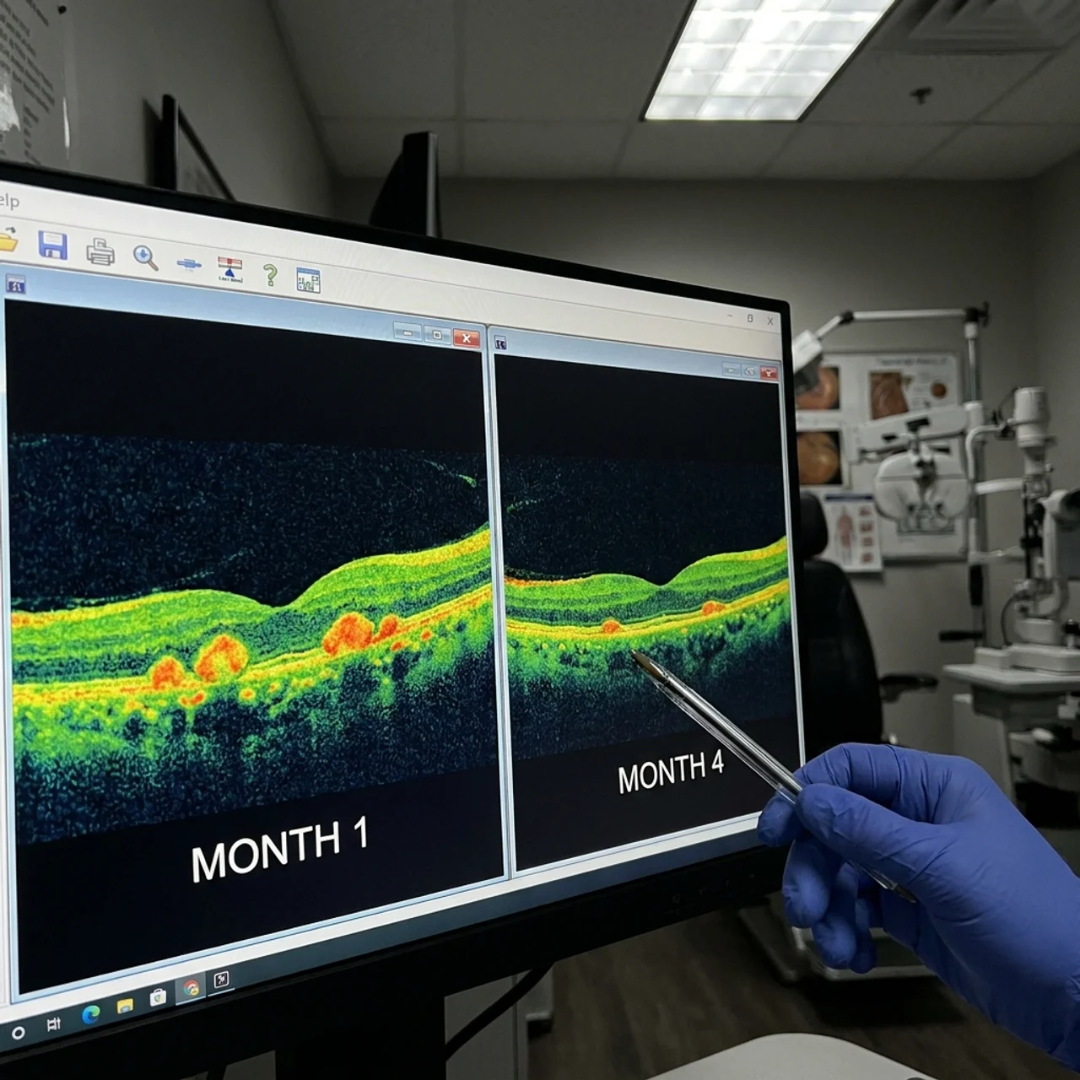
I've been getting eye injections for eight years. Never missed one. And a few months ago my friend told me what a specialist had said to her — that the injections are only doing one job, and there's a second job nobody's doing. I'd never heard anything like it in eight years of appointments. So I went to find out for myself. ⠀ And what that doctor showed me changed everything. ⠀ I'm 74. I can read my granddaughter's birthday cards again. I can see her face across the room. Three months ago I couldn't do either — and I'd resigned myself to never doing them again. ⠀ Let me tell you exactly what happened, because if you're getting these injections and still losing your sight, you need to hear all of it. ⠀ For eight years, every six weeks, I've sat in that chair. They put the drops in. They fix the little clamp that holds your eye open. And a needle goes into my eye while I stare at a spot on the ceiling and try not to think about it. ⠀ Over seventy needles now. Perfect attendance. And I did everything else they asked too — the AREDS2 supplements, the greens, the sunglasses, every single thing on the list. ⠀ And I was still going blind. Slowly. Every year, a little more. ⠀ Six months ago I understood just how far it had gone. I was sitting at my kitchen table holding a birthday card from my granddaughter — pink pen, her careful little handwriting. I could see there were words on it. I could see the colour of the ink. But the centre of the card, where the message actually was, was just a grey smudge. ⠀ I held it closer. Then further away. Then up to the window, in the light. ⠀ Nothing. ⠀ My daughter had to read it to me. "It says: I love you Nana, you're my best friend." ⠀ I smiled. I said thank you. And I waited until she'd left before I let myself cry. ⠀ Eight years of injections. Over seventy needles in my eye. And I couldn't read four words from a seven-year-old. ⠀ And here's the thing that still makes me angry when I think about it. Every six weeks, my consultant looked at my scans and said the same thing. ⠀ "You're stable. You're doing well. See you in six weeks." ⠀ Stable. ⠀ I couldn't read a card from my grandchild, and he called that stable. I wanted to scream at him. Stable compared to what? Compared to being completely blind? Is that the bar now? ⠀ But I didn't say anything. I'd stopped asking questions years ago. I'd stopped hoping. I'd just accepted it — the injections, the blur, the slow disappearing of everything I used to be able to do. I gave up the car in year four. I stopped reading books in year five. I stopped going to my reading group in year seven, because sitting in a room full of women discussing a book I couldn't read made me feel like I was pretending to be someone I wasn't anymore. ⠀ That's who I was when Margaret rang me in February. ⠀ We've been friends since our children were small. She has dry AMD — not as far along as mine — and she'd gone for a second opinion. A macular specialist at a research hospital. And this specialist told her something none of her doctors had ever said in all those years. ⠀ "Margaret," she'd said, "your injections are doing one job. But there's a second job that nobody's doing. And that second job is the whole reason people like you keep declining, even on treatment." ⠀ A second job. Nobody's doing. ⠀ I'd been getting injections for eight years and no one — not one doctor in all that time — had ever said the words "second job" to me. ⠀ I almost let it go. I'd been disappointed too many times to get my hopes up. But I couldn't stop hearing it. A second job. So I rang the hospital myself. ⠀ Three weeks later I was sitting in a different chair, in a different room, across from a doctor I'd never met. She pulled up my scans. She read my history — eight years of injections, steady decline despite treatment. Then she looked at me and said something I'll never forget. ⠀ "Can I explain something that might change how you understand what's been happening to you?" ⠀ I nodded. ⠀ "Your injections are doing exactly what they're designed to do. They block the abnormal vessels leaking fluid into your retina. That's real, and it matters — it's stopping things from getting far worse, far faster. You must never stop them." ⠀ I'd heard all of that before. ⠀ "But here's what they don't do." She paused. "They don't rebuild the protection your macula has lost." ⠀ She pointed at the centre of my scan. ⠀ "This tiny area, right here — your macula — is meant to be covered by a layer of protective pigment. It's yellow. It filters out damaging light. It neutralises the toxic waste your retina makes every single day. It shields the cells that let you read, recognise faces, see detail." ⠀ She looked at me. ⠀ "On your scans, that pigment is severely depleted. Almost gone at the centre." ⠀ I felt something shift inside me. ⠀ "Your injections deal with the leaking vessels. But they do nothing for this pigment. Nothing. And without it, the cells underneath are completely exposed. They keep getting damaged. Every day. Even with the injections working perfectly." ⠀ And that was it. That was the second job. The thing nobody had been doing for eight years. The reason I kept fading while my scans looked "stable." ⠀ I asked her the question I'd stopped letting myself ask. ⠀ "Is there something I can do about it?" ⠀ "Your body can't make macular pigment on its own," she said. "It can only come from three specific nutrients. Three carotenoids." She held up three fingers. ⠀ "Lutein. Zeaxanthin. And meso-zeaxanthin. Each one settles in a different part of your macula. Lutein on the outer area. Zeaxanthin in the middle. And meso-zeaxanthin — this is the critical one — sits right at the very centre. The fovea. Where your sharpest vision is processed." ⠀ She tapped the centre of my scan. ⠀ "Right here. The exact spot where you've lost the most." ⠀ My throat tightened. "I take supplements," I said. "I've taken AREDS2 for years." ⠀ She nodded, like she'd heard it a hundred times. ⠀ "AREDS2 has lutein and zeaxanthin. Two of the three. It was a landmark study and those nutrients matter. But it has no meso-zeaxanthin at all." ⠀ She paused. ⠀ "And meso-zeaxanthin is the one that sits right at the centre of your macula. The exact spot you need it most." ⠀ I just sat there. ⠀ "So for eight years," I said slowly, "I've been taking a supplement... that was missing the one thing my macula needed most... in the exact place I've gone blind?" ⠀ "That's correct." ⠀ I didn't know whether to cry or throw something. ⠀ And then she told me the part I still think about every day. ⠀ "I trained in Germany," she said. "Twenty-two years, at a university eye clinic in Munich. And where I trained, we would never treat the leak and stop there. Never. We rebuild that pigment at the same time — as standard, in every single patient. It isn't experimental. It's simply how we were taught this disease has to be treated. Two problems. Two treatments." ⠀ She let that sit. ⠀ "When I came to work here, I found doctors doing only the first half — the injection — and calling it the whole treatment. The research that proves the second half came out of Europe and Ireland. It just never made it into the training here. So patients like you get one half, faithfully, for years — and are told it's everything." ⠀ "So my own doctor isn't a bad doctor?" ⠀ "Not at all. He's doing his half correctly. He simply was never taught the second half existed. He can't give you something that was never in his training. That isn't his fault. But it has been costing you the centre of your sight, every single day, for eight years." ⠀ "Think of it as a target," she said, and drew three rings on a slip of paper. "Lutein covers the outer ring. Zeaxanthin the middle. But with no meso-zeaxanthin, the bullseye — the very centre — has no protection at all." She coloured the outer two rings and left the middle blank. "That's what most supplements give you. Two out of three. The centre left bare." ⠀ I looked at that little blank centre. Then at my scan. And I asked the question I'd carried, unspoken, for years. ⠀ "Is it too late?" ⠀ She didn't hesitate. ⠀ "It is not too late to rebuild macular pigment. The research is very clear. Give the eye all three carotenoids at the right doses, and pigment density can rise again — even in people who've been depleted for years." ⠀ She showed me the studies. The Nutrition Research Centre in Waterford, Ireland. Nolan and Beatty. Decades of peer-reviewed work. Patients whose macular pigment measurably rebuilt once they got all three at clinical doses. ⠀ "I've watched it happen in my own patients," she said. "Not every case. But many. The pigment comes back. The contrast sharpens. The blur steadies — and often lifts. Colours come back." ⠀ Colours come back. ⠀ I hadn't realised how grey everything had become until she said it. ⠀ "The doses matter," she added. "The research uses twenty milligrams of lutein, two of zeaxanthin, two of meso-zeaxanthin. Most shop-bought formulas that even include meso-zeaxanthin use a fraction of that. If the doses are wrong, the effect isn't there." ⠀ I asked what she'd recommend. She opened her desk drawer and took out a bottle. ⠀ "I've been recommending this to my patients for over a year now. It's the same complete formula, at the same doses, we used in Germany. It's called NeuroView." ⠀ She put it in my hand. ⠀ "All three carotenoids at the exact clinical doses from the research. Plus saffron — good evidence it improves retinal cell function. Astaxanthin. Bilberry for retinal blood flow. Everything your macula needs, in one formula. Two capsules a day, with a meal. Alongside your injections — never instead of them. Give it three months." ⠀ "I've been let down before," I said. "Many times." ⠀ "I know. That's why I'm telling you this face to face. I wouldn't recommend something I didn't believe in. I take it myself. So does my mother." ⠀ I left carrying something I hadn't felt in years. Not quite hope — I'd been burned too often for hope. More like a question mark where a full stop used to be. ⠀ I ordered a bottle that evening. ⠀ The first two weeks, nothing. I nearly stopped. Nearly rang Margaret to tell her it was another dead end. But the specialist had said three months. So I kept going. ⠀ Week three, something small. The morning glare through the kitchen window wasn't biting the way it usually did. I always squint when the sun comes in. One morning, I realised I hadn't. I told myself it was nothing. ⠀ Week four, the colours on the television looked different. Not dramatically. Just... richer. Like someone had cleaned a window I hadn't known was dirty. I still told myself it was nothing. ⠀ Week six, I picked up one of my granddaughter's picture books off the coffee table. Big print. I opened it expecting the usual smear in the centre. ⠀ The words were there. ⠀ Not perfectly. Not like twenty years ago. But there. I could make out letters I hadn't been able to before. I closed the book and opened it again. Still there. I sat on the sofa holding a children's book, and I cried — but this time not the way I'd cried over the birthday card. ⠀ Week eight, I went in for my injection. Same consultant I'd seen for eight years. He looked at my scans. Then he looked again. ⠀ "Your macular pigment density has improved," he said. ⠀ He said it casually. Like a footnote. But I heard it. For the first time in eight years, something was moving the right way. ⠀ He asked if I'd changed anything. I told him about the NeuroView. He didn't say much. But he wrote it down. ⠀ I'm three months in now. I'll be honest — the blur isn't gone. Eight years of damage doesn't vanish in twelve weeks. But it has lifted. Noticeably. Measurably. ⠀ And I want to tell you what that actually means, day to day, because "improved contrast" doesn't capture it. ⠀ It means I read my granddaughter's next birthday card myself. Out loud. To her. And watched her face while I did it. ⠀ It means I know which grandchild is coming through the door from across the room, before they say a word. ⠀ It means I've started a book again. Large print, and slow — but a book. The first in five years. There's a stack of them by my chair now instead of gathering dust on the shelf. ⠀ It means colours. The garden. The red of the roses my husband planted. I hadn't seen that red properly in years and didn't even know it had faded until it came back. ⠀ My daughter said last week, "You seem different, Mum. More... here." I didn't know how to explain it. So I just said, "I think I've stopped disappearing." She didn't understand. But I did. ⠀ I'm still getting my injections. I'm not stopping those, and neither should you — the specialist was clear. NeuroView works alongside the injections, not instead of them. The injections handle the leaking vessels. The NeuroView rebuilds the pigment they were never designed to touch. Two different jobs. Both necessary. It's just that for eight years, only one of them was ever being done for me. ⠀ I need to say something to you now. Whoever you are, reading this. ⠀ If you've been getting injections for years and your sight is still fading. If you sit in that chair every few weeks and hear "you're stable" while knowing full well you're not. If you've taken your AREDS2 and your Macushield and eaten your greens and none of it made a real difference. If you stopped asking whether it could get better because you've been let down too many times — ⠀ I understand. I was you. For eight years, I was exactly where you are. ⠀ And I need you to hear this. You're not stable. You're depleted. Your macula has been starving for the one nutrient none of your supplements gave you — the most important one, the one that guards the very centre of your sight. And nobody told you, because nobody treating you was ever taught the second job. In Germany, they'd have started you on it eight years ago. ⠀ Every month you go without it, more pigment is lost. More cells exposed. More damage that gets harder to undo. ⠀ I waited eight years. I wish to God I hadn't. ⠀ NeuroView has a 90-day money-back guarantee — that's what finally made me try it. Three months, and if nothing changes, you get every penny back. Even if the bottle's empty. So the only thing you're risking is another few months of "stable." ⠀ I'm not promising you miracles. I'm not telling you your sight will be what it was at forty. I'm telling you that after eight years of accepting decline, something is finally going the other way. My pigment is rebuilding. My scans are improving. My own consultant wrote it down. And for the first time since my diagnosis, I don't feel like I'm disappearing. ⠀ Don't wait eight years like I did. Don't sit in that chair and accept "stable" when you know you're not. Your macula has been waiting to be fed. The centre — the part that matters most — has been bare this whole time. ⠀ You can fill it. Keep your injections. Do the second job too. The one they never told you about. ⠀ Three months. That's all I'm asking you to give it. ⠀ I wish someone had told me this eight years ago. Nobody did. So I'm telling you now. ⠀ 👉 https://tryneuroview.com/products/neuroview-15-in-1-advanced-eye-formula-1
Like this ad? Make it yours.
Crush rebuilds this exact creative around your product — your brand, your colors, your offer — in about a minute.