Ruth Williams
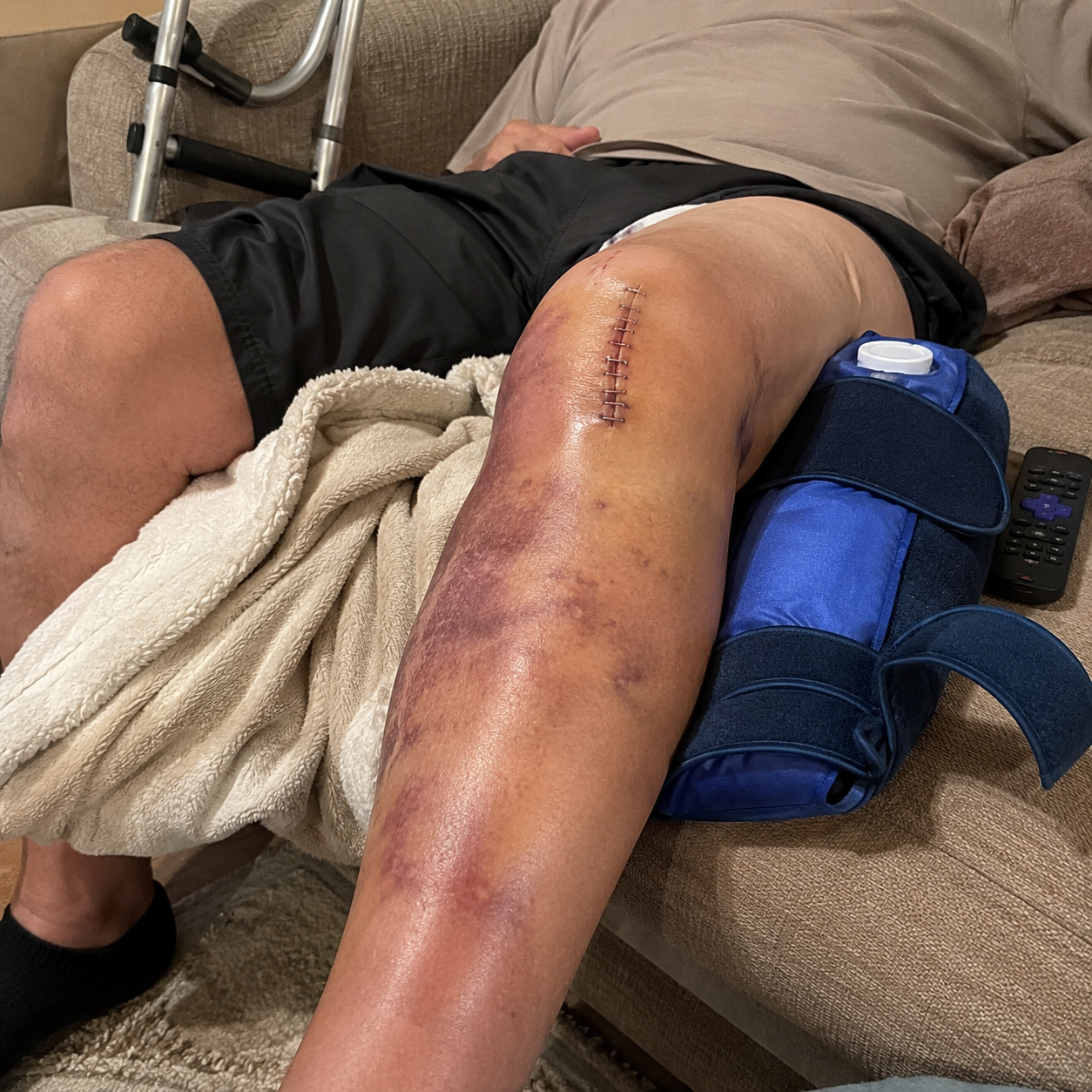
Ruth Williams Facebook ad: “12 years of knee pain gone in 2 days?”
Ran for 15 days, from August 8 to August 23, 2026, the last day Crush saw it.
Run by Ruth Williams on Facebook. Crush is not the advertiser and does not verify its claims. See this ad in Meta's Ad Library(opens in a new tab)
Want an ad like this for your product?
Crush makes new ad images for your product from this ad: your logo, your product photo, your offer.
Trials from $19.95 USD, then $79.95 USD a month. Cancel anytime.
About this ad
- Meta Ad Library ID
- 884693148052873
- Platforms
- Facebook, Instagram, Audience Network, Messenger, WhatsApp and Threads
- Relaunches
- 0
Ad text
Week four after my knee replacement, my physiotherapist stopped mid-session and asked what I was doing differently — my range of motion was ahead of where she expected. I pulled a photo up on my phone and showed her. "That explains it," she said. "The tissue environment is finally cooperating. I can see it in how the joint is responding." Let me back up, because four weeks earlier I wouldn't have understood that sentence either. I'm 63. I spent 30 years as a ward nurse on 12-hour shifts. Hard floors, lifting patients, doubles when we were short. My knees paid for every year of it — the left one most of all. When it finally gave out — bone on bone — my surgeon said it was one of the worst she'd seen. I've discharged hundreds of joint replacement patients in my career. So when my own surgery date landed, I did what I'd coached every one of those patients to do. I built the list. Walker — ordered. Shower chair — ordered. Ice compression unit — ordered. Raised toilet seat — ordered. I wasn't going to be the nurse who didn't prepare. Then I posted in a knee replacement support group to make sure I wasn't missing anything, and someone wrote: "Have help. Have a good walker. Ice machine. Shower chair with handles. But the thing nobody puts on the list — something to address the cellular healing environment inside the joint itself from day one. Not just the surface. The tissue underneath." I had the walker. I had the ice machine. I did not have what they were describing. Here's the part that stings. I'd reviewed discharge instructions with knee replacement patients for decades. And somewhere in the gap between "don't twist on it" and "attend twice-weekly physio," nobody had ever explained it clearly: every time you take your anti-inflammatory and ice your knee, you're addressing the alarm signal — the pain you can feel. But underneath that alarm, the cellular environment inside the joint is running a completely different process that no ice pack, no paracetamol, and no elevation was ever designed to touch. That's how people end up stuck at week six, eight, ten — doing everything right on the surface while the tissue underneath keeps being blocked from healing properly. I've been in the room when it happens. I just never understood the mechanism until I became the patient. My surgeon confirmed something at my pre-op appointment that I've been thinking about ever since. "The patients who struggle longest after replacement aren't the ones who skip their exercises. They're the ones whose tissue environment was never addressed. After surgery, the joint is flooded with damaged senescent cells — zombie cells — that accumulate in response to both the trauma of the procedure and the years of inflammation that came before it. These cells sit in the tissue releasing enzymes that block the repair signals. They keep the inflammation running even when the implant is in perfect position. And every anti-inflammatory taken before and after surgery depletes the magnesium those repair cells desperately need." She didn't have to finish that thought. I'd taken care of those patients. The ones still swollen at week twelve with X-rays that looked perfect. Now I understood why. "So what goes on the list?" "Something that addresses the zombie cell environment directly. Transdermally — through the skin into the tissue — so it actually reaches the cartilage cells at the concentration they need. Not through the gut where most supplements are lost. Into the joint itself." That night I went back to the support group and searched for what people actually used. One name kept coming up, over and over: Magnesium Freeze from Radiance Labs. Post after post, people who'd been stuck in that same cellular stalling pattern and found this. "The swelling finally started moving." "My physio said my range of motion jumped more in one week than the previous month." "The only thing that felt like it was actually reaching the tissue." I was sceptical. I'm a nurse. I read everything. I've seen enough products promise deep tissue relief and deliver a few minutes of surface cooling that fades completely before anything underneath is touched. But I read the mechanism. And as a nurse who'd spent thirty years watching what happens to joint tissue, it made complete sense. The zombie cells accumulate because the cells responsible for clearing them have run out of fuel. That fuel is NAD+. After surgery — after years of anti-inflammatories, after cortisone shots that depleted magnesium — the cellular cleanup system is running on empty. The niacinamide in Magnesium Freeze from Radiance Labs supports NAD+ production directly in the local tissue. Transdermally — bypassing the gut entirely — so it arrives at the cartilage cells and surrounding tissue at the concentration they actually need. When NAD+ comes back, the cells responsible for clearing zombie cells finally have the power to do it. The repair signals that have been blocked start getting through. The inflammatory cascade that's been stuck on finally starts switching off — not because something masked it, but because the cells doing the job can finally finish it. The pharmaceutical-grade magnesium absorbs through the skin directly into the joint tissue, giving the repair cells the cofactor they need for collagen synthesis, tissue regeneration, and cellular energy production right at the source. Without it, even cells that have had their zombie cell burden reduced cannot carry out the rebuild. Then a cool-to-warm wave — menthol, Coolact 10, camphor, Hotact VBE — opens the blood vessels and floods the starved tissue with oxygen-rich blood that post-surgical inflammation has been restricting. Most topical creams fade in four minutes. This keeps working for up to two hours. And a layer of botanicals — arnica, frankincense, aloe vera, vitamin E — calms the remaining inflammation and protects the tissue while the deeper repair work takes hold. Three layers. Twelve ingredients. One application. Directly at the joint. Not sitting on the surface. Going after the zombie cells and the depleted cellular environment the surgery left behind. I ordered a jar before I came home from hospital. I checked the ingredient list twice — once as a patient and once as a nurse. Both times I was satisfied. First application that evening, I noticed the deep cooling settle into the joint in a way the chemist gel I'd tried had never managed. Not surface cold. Something that felt like it was reaching the right place. The warmth that followed was steady. It didn't fade in minutes. Week three post-op, my incision was clean and closed. My physio commented on the tissue quality around the joint — "less reactive than most patients at this stage." I showed her the jar. She photographed the label. Week four was the conversation you already heard — the photo I showed my physio was the jar of Magnesium Freeze. Week six, I was walking without a limp. Week eight, cleared for normal activity. My husband started applying it to his own knee — his has been grinding for two years, hasn't committed to surgery yet, but says getting up in the morning is half the production it used to be. And a colleague's husband has his knee scheduled for September. She asked me what to order. Magnesium Freeze went on the list before the ice machine did. The knee replacement community maintains the list together — what worked, what didn't, what nobody told you before you went in. This is on that list now. It has been for a while. I just hadn't found it until I became the patient instead of the nurse. If a knee replacement is anywhere in your future — yours, your husband's, your mother's — or you know someone still swollen at week eight wondering why progress feels like two steps forward, one step back: look at the list. Check what's missing. This cream won't fix your knee. Surgery does that. But it addresses the zombie cell environment the surgery left behind — so the tissue surrounding the implant gets the cellular support it needs to actually repair, the NAD+ depletion gets corrected, and the magnesium the repair crew was starved of finally arrives at the concentration it needs. The sooner the cellular environment is addressed, the sooner real healing can happen underneath everything else you're doing right. Magnesium Freeze from Radiance Labs comes with a 180-day money-back guarantee. You can send it back if it doesn't help. Every penny refunded. No forms. No questions asked. I don't think you will. I'll put the link below 👇
Where the ad sends people
radiancelabs.shop
"12 years of knee pain gone in 2 days?"
After seeing her describe waking up at 2:47 AM, unable to move because her knees were so swollen
See details: radiancelabs.shop(opens in a new tab)