
Inactive· since Jul 17, 2026
- 36
- days it ran
- 0
- relaunches
Ad copy
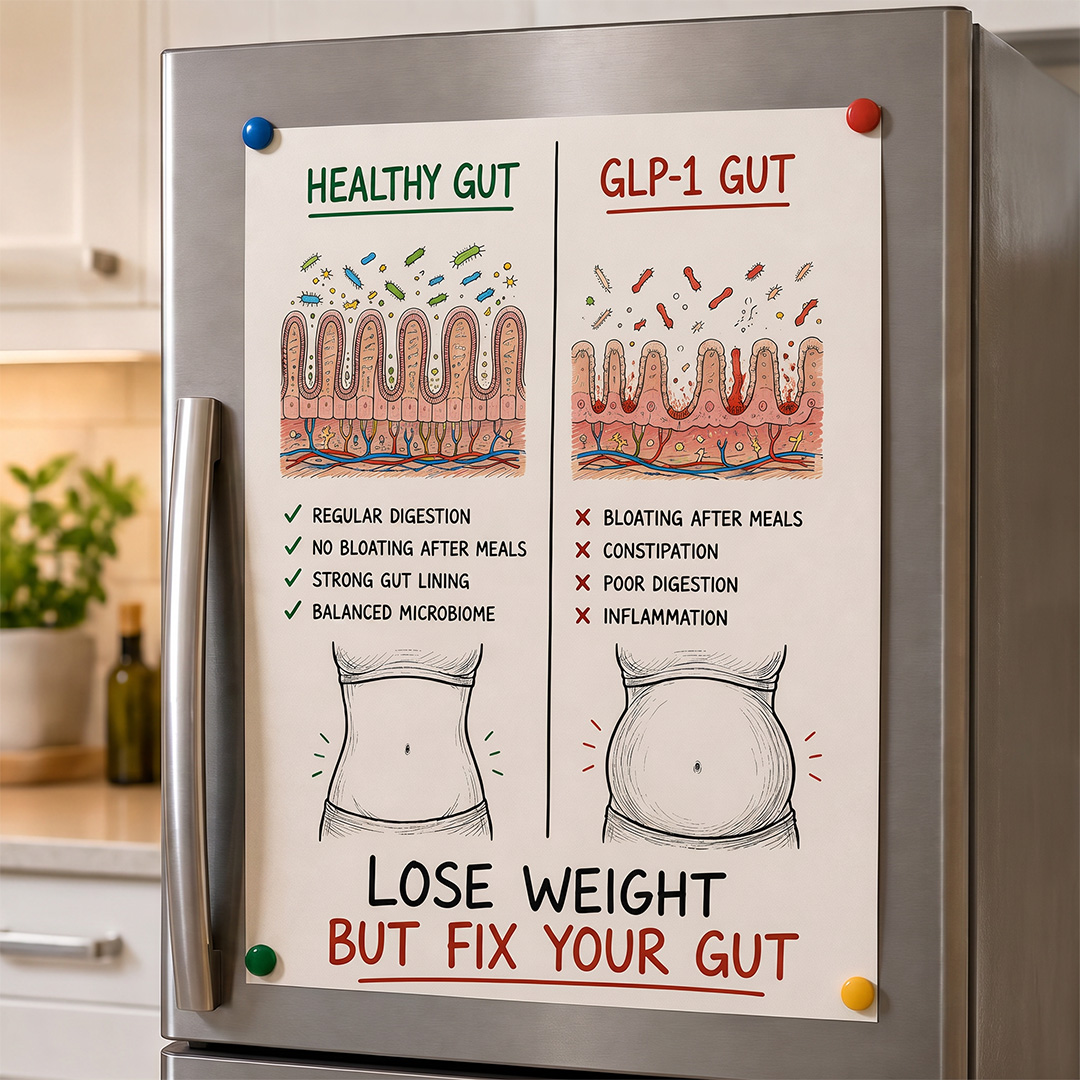
Please STOP trying to fix your digestion on GLP-1 medications with fiber and laxatives. I know that sounds crazy, but every time you take Miralax, force down another glass of Metamucil, or pop a fiber gummy, you might be feeding the exact problem that's destroying your gut. I used to be just like you. Standing in the pharmacy aisle at CVS, reading every label on every laxative bottle, desperately hoping the stool softeners would be different from the stimulant laxatives I'd already tried. Ordering that $32 tub of Metamucil from Amazon, mixing it into a full glass of water every single morning even though it made me feel like I'd swallowed wet cement, because everyone in the GLP-1 groups kept saying that's what I needed to do. Tracking my water intake obsessively, forcing myself to drink 100 ounces every single day even when my stomach already felt like it was going to explode, because everyone said hydration was the answer. Spending $45 on some influencer's probiotic gummies because surely something "specifically formulated for gut health" had to work. Watching my bathroom shelf fill up with bottles while my gut got worse. I tried everything. I mean everything. Every supplement the GLP-1 forums recommended. Every "miracle" remedy someone swore finally got them regular. I did exactly what I was told to do. And my digestion got worse. Not better. Worse. The bloating got more extreme. My stomach went from looking slightly puffy by evening to looking six months pregnant by dinner — in clothes that had fit perfectly that morning. The sulfur burps got more frequent, erupting hours after meals with a taste so foul I'd gag. And the constipation went from uncomfortable to terrifying. Five days became six. Six became eight. Eight became "I need to go to urgent care." I lost almost 45 pounds on my GLP-1 medication. My A1C dropped to the best range I'd seen in a decade. My doctor kept calling my progress "remarkable." But none of that mattered at 11:30 PM on a Tuesday when I was locked in my bathroom, sweating, trying not to cry, because it had been seven days since my last bowel movement and nothing in my body would move. I was finally getting the health wins I'd worked so hard for. My family kept telling me how incredible I looked. I felt like I'd finally gotten my life back. But the truth was, I had a shelf of Miralax, Metamucil, Gas-X, fiber gummies, Tums, and magnesium citrate in my bathroom that I rotated through like a chemist. Every shower I dreaded the bloating. Every dinner started with silent math — "if I take one more bite, will I pay for it at 10 PM?" Every morning I stood in front of the mirror watching the body I'd worked so hard for disappear behind a wall of distension by the time I left for work. I started wearing loose tops all the time, even to events where I used to dress up. Strategically declining dinner invitations because I couldn't predict which version of my stomach would show up. Mapping every bathroom between my house and the office because I never knew when the laxative roulette would finally hit — three days of nothing, then everything at once with zero warning. The worst part? I felt ungrateful. Here I was, healthier than I'd been in years, and all I could focus on was the bloating, the burps, and the fact that I hadn't gone in a week. My husband would say, "You look amazing," and I'd think, "You can't see what's happening inside me." But it wasn't vanity. It was misery. I was trapped in a body that was shrinking on the outside and filling up with concrete on the inside, and I didn't know how to stop it. Four months in, I got desperate enough to drop my GLP-1 dose. I thought maybe if I just went down to the lowest amount, the bloating would stop. Maybe everyone was right — maybe my body just needed to "adjust." For three weeks, I took a half dose. I watched my stomach like a hawk. Counted the days between bowel movements. Checked my belly in the mirror every morning and every night. The bloating didn't get better. Not even a little. But the food noise came roaring back. The cravings. The constant thoughts about eating. And the scale started creeping up. Four pounds in three weeks. Four pounds I'd fought for months to lose. I went back to full dose. What choice did I have? My gut was a disaster either way, but at least on the full medication I could hold on to everything I'd built. I felt trapped. Like I was being forced to choose between a body that worked on the outside and a body that worked on the inside. Between staying on a medication that was saving my health and having a digestive system I could actually live with. I made an appointment with my doctor. Told him everything — the bloating, the sulfur burps, the eight-day stretches, the Miralax dependency, the fear of eating. He looked at me and said the sentence I'd already heard fifty times: "Eat more fiber. Drink more water. It should level out." I wanted to scream. I was eating fiber. I was drinking water. I was doing everything he told me to do and it was making everything worse. I posted about it on Reddit, desperate for answers. The responses were the same as always: "It's just your body adjusting, give it time." "You're probably not drinking enough water." "Try magnesium citrate before bed." "GLP-1 constipation is normal, it goes away for most people." But here's what kept bothering me: if it was just an "adjustment," why was it getting worse at month four, not better? If water was the answer, why was I drinking 100 ounces a day and still backed up? Why did lowering my dose for three weeks make zero difference to my gut? Nothing added up. And I was running out of hope. Then one night — 2:17 AM, I remember because I'd been lying awake for hours with the brick feeling sitting behind my sternum — I couldn't take it anymore. I grabbed my phone and started searching. Not the same generic searches I'd done a hundred times. This time I typed something different: "Why doesn't fiber work for GLP-1 constipation" That's when I found an article that changed everything. It was written by a GLP-1 prescribing physician, and it was about something I'd never heard anyone explain: Digestive Shutdown. The article explained that GLP-1 medications work, in part, by deliberately slowing your stomach's ability to empty. That's the mechanism — it delays gastric emptying so you stay full longer and eat less. But in a meaningful percentage of patients — especially women over 40, whose gut motility is already declining from dropping estrogen — that "delay" tips over into something much more severe: a digestive system that has effectively stopped moving. When food stops moving, everything I was experiencing follows with mechanical inevitability. Food sits in the stomach and ferments — that's the sulfur burps. Gas builds behind the stalled contents — that's the evening bloat. The colon keeps extracting water from waste that isn't going anywhere — that's how stool turns to concrete. And adding bulk-forming fiber to a pipeline that isn't moving doesn't push things through. It packs the jam tighter. I'd never heard anyone explain it like that before. I had to keep reading. And suddenly everything made sense. That's why fiber didn't work. Fiber needs muscular contractions to push it through. In a paralyzed gut, it just expands and sits — like pouring wet concrete into a stalled traffic jam. That's why Miralax didn't work. Miralax acts at the very end of the pipe — the colon — while the backup begins at the very start, in a stomach that won't empty. It can't prevent the jam. It can only blast it out after days of accumulation, which is exactly the "roulette" I'd been living. That's why Tums made the burps worse. Stomach acid is one of the body's natural triggers for emptying contents downstream. By suppressing acid, I was slowing my emptying even further — quietly extending the exact stagnation causing the burps in the first place. That's why lowering my dose didn't help. The gastric slowing was already established. The cascade was in motion. Nothing I was doing touched the place where the problem actually started. I wasn't crazy. I wasn't doing something wrong. My gut was in Digestive Shutdown — mechanically paralyzed by the medication doing exactly what it was designed to do — and every remedy I tried was designed for a completely different problem. For the first time in months, I could breathe. Because if the problem was mechanical — food stalling at the top of the pipeline — that meant there might be a solution I hadn't tried yet. Something that actually addressed where the breakdown started, not just the symptoms it produced at the end. I spent the rest of that night reading. Not about laxatives or fiber. About what actually moves food through a pharmacologically slowed stomach. The specific mechanisms that could do the digestive work my gut had been told to stop doing. The article called it the Metabolic Motility Reset. Four things, working in sequence, that address the shutdown from the top of the pipeline to the bottom. First: full-spectrum digestive enzymes — the "chemical scissors" that break food down into liquid form while it's still in the stomach, so it physically can't sit there and rot. This was the part that hit me hardest. No other supplement I'd tried — not one — did anything about the food stalling in my stomach. They all worked downstream, at the colon, after the damage was already done. Second: apple cider vinegar to restore the acidic environment the stomach needs to trigger its natural emptying signal. The opposite of the Tums I'd been popping. Counterintuitive — and that's exactly why I'd never tried it. Third: targeted prebiotics that feed the beneficial bacteria in the lower gut without expanding like fiber. Because you need transit lubrication, not more bulk in a stalled pipeline. Fourth: live probiotic strains to rebalance the ecosystem that stagnation had wrecked — outcompeting the gas-producing bacteria that thrive in a slow, stalled gut. The article kept emphasizing one thing: the order matters. The sequence matters. You can't fix the bottom of the pipeline if you haven't addressed the top. And that's exactly why a probiotic alone didn't work, why enzymes alone wouldn't have been enough, and why everything in my bathroom cabinet failed — each product was one quarter of the answer, used in isolation, with no understanding of where the actual breakdown began. That's when I found a formula that put all four steps in one protocol. Not a generic "gut health" supplement. Something specifically built around the Metabolic Motility Reset for people on GLP-1 medications. I was skeptical. I'd spent hundreds of dollars already on supplements that didn't work. But I was also desperate. And for the first time, what I was reading actually matched what was happening in my body. Not "your body is adjusting." Not "drink more water." An actual mechanical explanation for every single symptom I had, and a sequential approach that made logical sense. It wasn't a prescription drug — just a supplement with ingredients that support your body's natural digestive processes. I could take it alongside my GLP-1 medication. It didn't interfere with anything my doctor had prescribed. I ordered it. Told myself not to get my hopes up. I'd been disappointed too many times. It arrived a few days later. Simple capsules — two before my biggest meal, easy to add to my morning routine alongside everything else. The instructions said to be patient. Easy enough. The first four days, honestly? Not much. Same brick feeling after dinner. Same bloating by evening. I started thinking this was just another expensive mistake. But I'd already bought them, so I kept taking them. What did I have to lose at this point? Day five is when I noticed the first change. It was subtle — so subtle I almost dismissed it. I ate dinner, a normal portion of chicken and rice, and realized at 9 PM that I didn't have the usual "sitting on a rock" feeling behind my sternum. I wasn't burping. The food felt like it had... moved. I told myself I was imagining it. That I wanted it to work so badly I was feeling things that weren't there. But the next day, same thing. And the day after. By the end of the first week, the sulfur burps were noticeably fading. Not gone entirely, but the intensity was dialed way down. I could sit through a work meeting without that rising panic of swallowing back rotten-egg gas. I could eat dinner without spending the rest of the evening doing math about whether I'd regret it at bedtime. Week two is when my husband noticed. We were at dinner — at a restaurant, which I'd been avoiding for months — and he looked at me and said, "You seem... relaxed." I realized I was. I'd ordered food without the usual dread. I hadn't unbuttoned my jeans under the napkin. I wasn't tracking the nearest bathroom. I was just eating dinner. Like a normal person. That's when I started believing this might actually work. By week three, I went to the bathroom. On my own. Without Miralax. Without any laxative. For the first time in five months, my body did what it was supposed to do, on its own, without chemical intervention. I sat there afterward and cried. Not from pain — from relief. I'd forgotten what this felt like. I'd forgotten what normal felt like. Week four, my evening bloat started visibly deflating. The jeans that I'd been unbuttoning by 7 PM were still comfortable at 9. My stomach at dinner looked like my stomach at breakfast. My husband said, "Did you lose more weight?" I hadn't. I was the same weight. I just wasn't carrying a day's worth of backed-up, fermenting food and trapped gas anymore. For the first time, I could actually see what I'd lost. The body I'd earned was finally the body I could see. By week six, my hairstylist — of all people — noticed. She said, "You look different. Like, lighter." I wasn't lighter. I was just finally not in pain. It's been three months now. I still take the capsules every morning. My digestion isn't perfect — I still have the occasional slow day, especially around dose adjustments — but it's so dramatically better that some mornings I forget I ever had a problem. The sulfur burps are gone. The evening bloat is gone. The laxative roulette is gone. The fear of eating is gone. I have a boring, predictable, normal routine. And "boring" has never felt so good. But more than that, I feel like myself again. I'm not declining dinner invitations. I'm not mapping bathrooms. I'm not standing in front of the mirror at 7 PM watching my body inflate. I'm not lying awake at 2 AM wondering if I should go to urgent care. I can be happy about my weight loss and my health improvements without feeling like I'm trading one victory for a different kind of suffering. And I'm still on my GLP-1 medication. Full dose. I don't have to choose between losing weight and having a gut that works anymore. If you're reading this and you see yourself in my story — if you're on a GLP-1 medication and everyone keeps telling you to eat more fiber, drink more water, and just wait for your body to adjust, but nothing you try actually works — I need you to understand something. It might not be a fiber problem at all. It might be mechanical. Your stomach might be in Digestive Shutdown — food stalling at the top, fermenting, compacting — and everything you're taking for it was designed for a digestive system that's actually moving. And if that's what's happening, all the Miralax and Metamucil and fiber gummies in the world won't fix it. Because they can't restart a stalled pipeline. They're answering a question your gut isn't asking. I wasted four months trying to fix a fiber problem I didn't have. Four months of choking down Metamucil that made me more bloated, taking laxatives that either did nothing or struck violently, popping Tums that were quietly making the stagnation worse, watching my body inflate every single evening while everyone told me to "be patient." But the moment I addressed the Digestive Shutdown — the actual root cause, at the actual starting point, in the actual sequence — everything changed. I'm not a doctor. I can't tell you what's happening in your specific body. But I can tell you what happened in mine. And I can tell you that if you've tried fiber, laxatives, water, and probiotics and your gut is still a disaster, maybe it's time to ask a different question. Not "am I eating enough fiber?" but "is the food in my stomach actually moving?" The supplement I found is called Vital Gut Health. It's specifically formulated for people on GLP-1 medications dealing with Digestive Shutdown — built around the Metabolic Motility Reset: digestive enzymes to break food down before it can stall and rot, apple cider vinegar to prime your stomach to empty, targeted prebiotics to fuel transit, and live probiotic strains to rebalance everything stagnation destroyed. Four steps, in sequence, in one daily protocol. It's not a laxative — it's a formula that does the digestive work your slowed gut can no longer do on schedule, without requiring you to stop your medication. It comes with a 60-day money-back guarantee, so if it doesn't work for you, you're not stuck with it like I was with all those bottles of Metamucil and Miralax that made everything worse. I'm sharing this because I spent so many nights lying awake at 2 AM, hand pressed against the brick in my stomach, desperately searching for answers, feeling like I was the only person whose constipation didn't respond to the normal fixes. And I don't want anyone else to waste months like I did, making a mechanical problem worse with remedies built for a completely different situation. Your fiber intake might be fine. Your water intake might be fine. Your gut might just need help doing the digestive work that your medication told it to stop doing — in the right order, starting at the right place. And there's something that may actually help with that. Click below to read the full article from a GLP-1 prescribing physician on the five warning signs your gut has gone into Digestive Shutdown — and whether Vital Gut Health is right for you. You don't have to choose between your weight loss and a digestive system you can live with. You just have to address what's actually causing the problem. And for me, that changed everything.
Digestive Shutdown Due to GLP-1
— And why the standard advice (more fiber, more water, more Miralax) is quietly making it worse. A GLP-1 prescribing physician explains the hidden mechanics behind the bloating, the sulfur burps, and the days-long backups — and what your gut actually needs instead.
LEARN MORELike this ad? Make it yours.
Crush rebuilds this exact creative around your product — your brand, your colors, your offer — in about a minute.