Fungus Health Tips
Fungus Health Tips Facebook ad: “I investigated every option for nail fungus”
Ran for 13 days, from June 17 to June 30, 2026, the last day Crush saw it.
Run by Fungus Health Tips on Facebook. Crush is not the advertiser and does not verify its claims. See this ad in Meta's Ad Library(opens in a new tab)
Want an ad like this for your product?
Crush makes new ad images for your product from this ad: your logo, your product photo, your offer.
Trials from $19.95 USD, then $79.95 USD a month. Cancel anytime.
About this ad
- Meta Ad Library ID
- 905090452618837
- Platforms
- Facebook, Instagram, Audience Network, Messenger and Threads
- Relaunches
- 1
Ad text
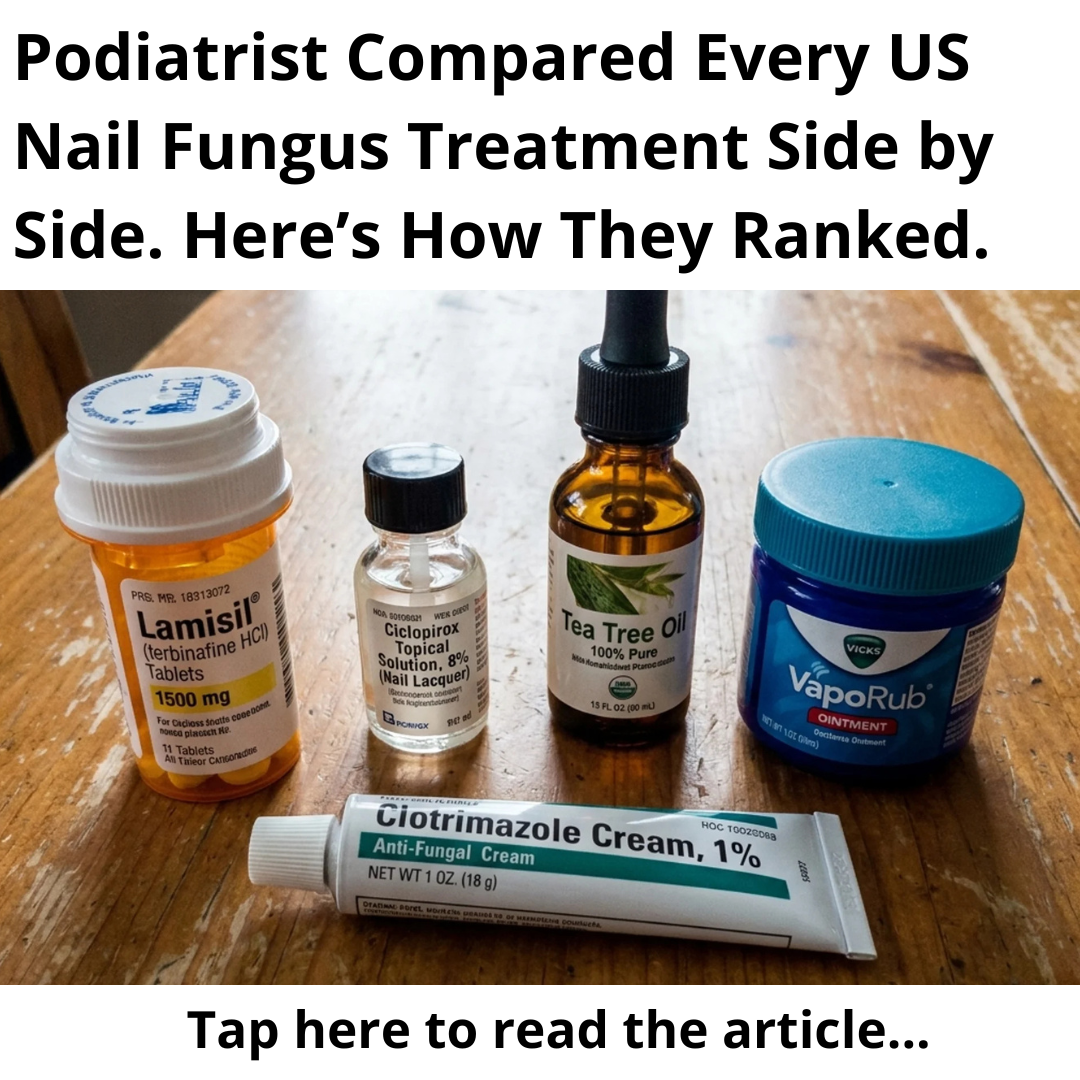
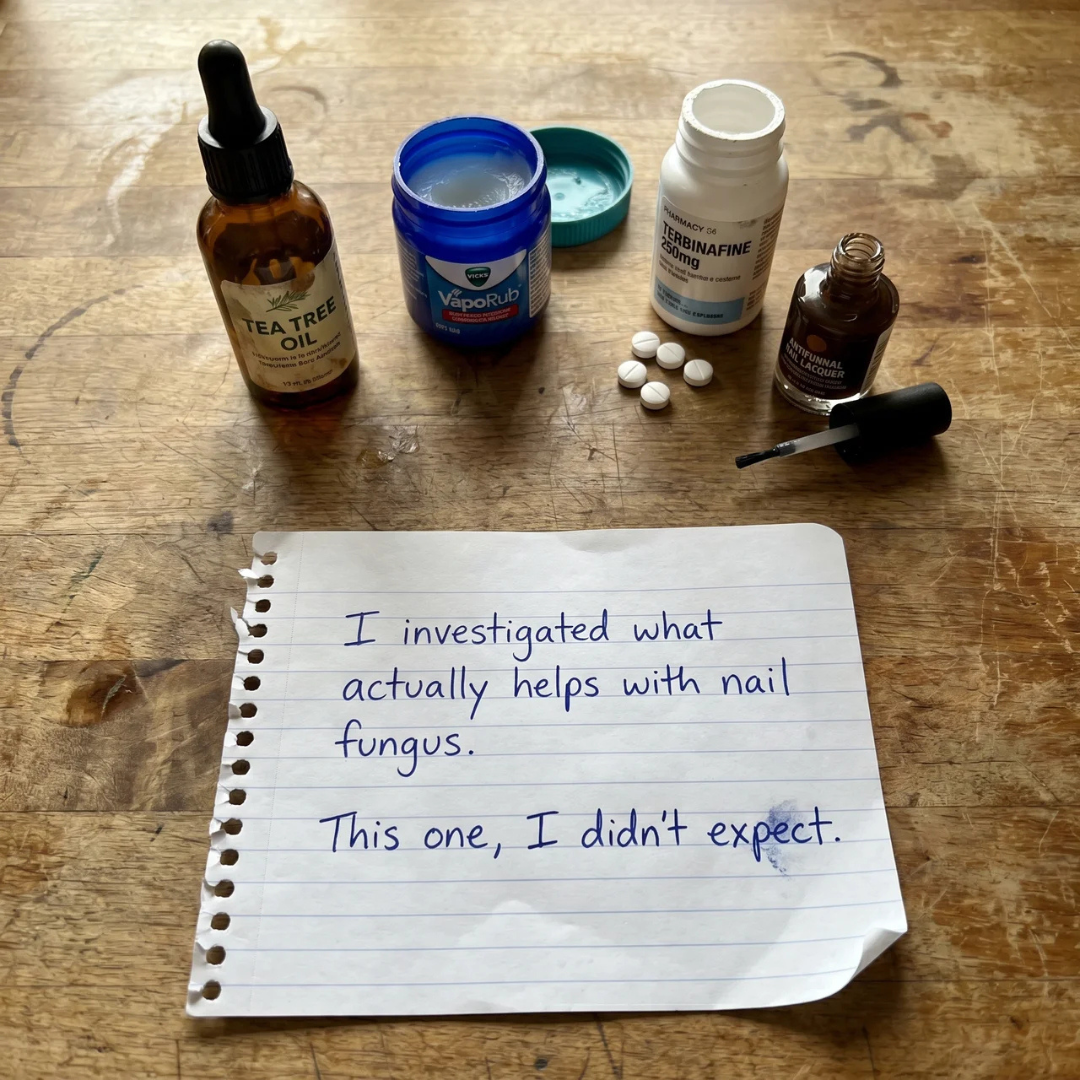
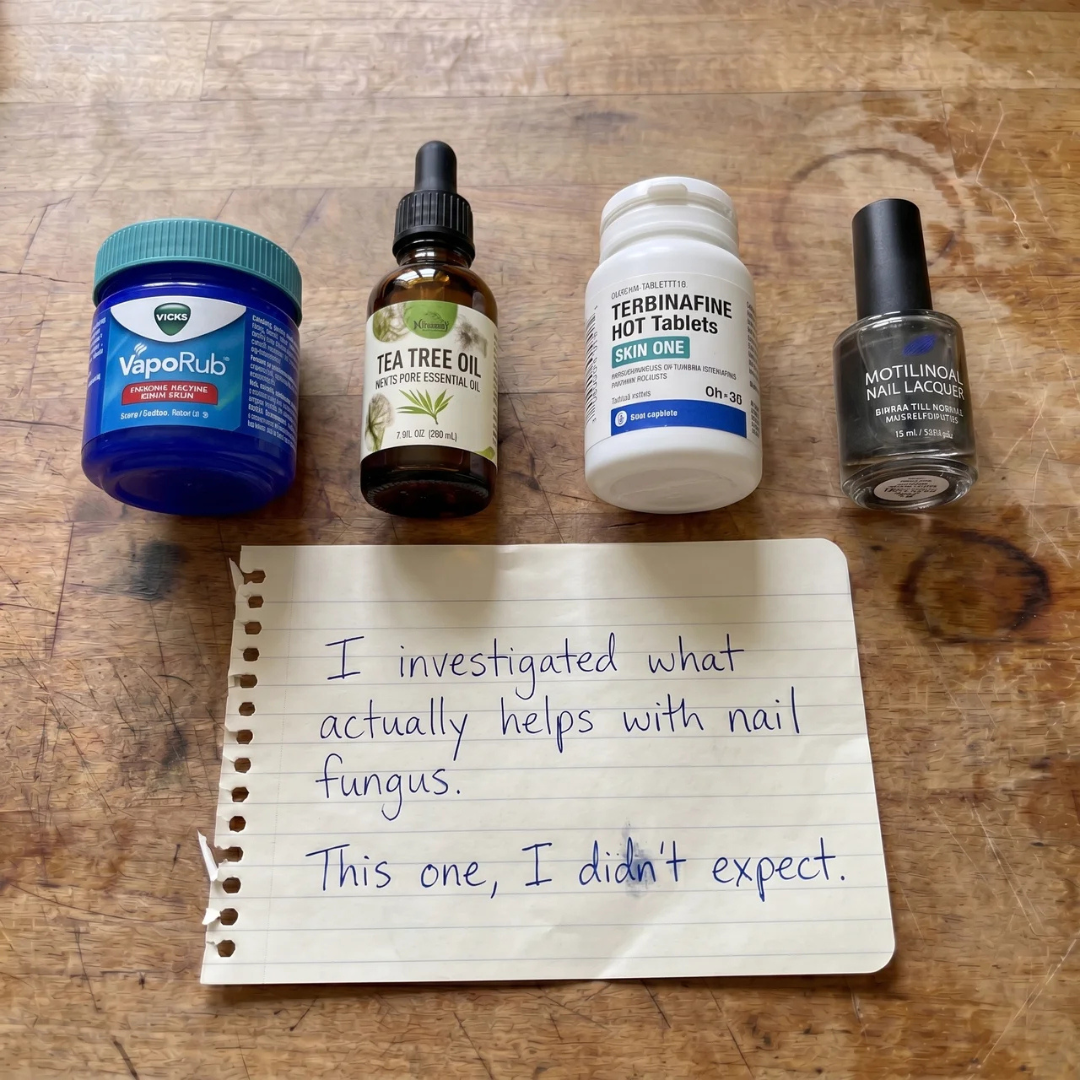
I sat at my kitchen counter staring at an antifungal lacquer, a bottle of tea tree oil, a jar of Vicks, and a blister pack of terbinafine I stopped taking three months in. Three years of trying everything available. Every product the pharmacy carried. Every recommendation my doctor gave me. My name is Dorothy. I'm 64. Retired school librarian from Clearwater, Florida. I have read enough fine print in my life to know when a label is making a promise the ingredients cannot keep. So I didn't keep reaching for the next box on the shelf. I investigated instead. Three weeks. Every toenail fungus solution available without a prescription. Every price point. Every ingredient label. What each product actually does once it touches the nail — and what it doesn't. Here is what I found. Option 1: Antifungal Lacquer — $12 to $20, pharmacy shelf The first thing most women try. The one the pharmacist points to without hesitation. I used mine for four months. Every morning, same nail, same routine. I kept a small chart on the inside of the cabinet door. I was not careless about it. Nothing changed. When I went looking for why, I started with the label. The active ingredient listed needs to reach the nail bed — the tissue underneath the nail — to do anything meaningful. The label does not explain how it gets there. So I kept reading. The nail plate is what you can see. It is made of keratin, the same protein as hair, compressed into a hard dense layer. Its biological job — the reason the body builds it — is to keep things out. Bacteria. Water. Chemicals. Everything. When you paint a lacquer onto that surface, it dries. And then it's gone. The solvent evaporates. What remains on the nail surface has, at most, a few minutes of wet contact before it hardens into a film sitting on top of the keratin, not inside it. I found this confirmed in a paper from the Journal of the American Academy of Dermatology. Nail plate penetration by topical agents requires sustained contact time — the studies that show positive results hold the active ingredients against the nail for hours under controlled conditions. A lacquer applied once daily and left to dry is not that. I had been painting the outside of a wall for four months and wondering why the inside wasn't changing. Verdict: Not a formula problem. A contact time problem. The lacquer dries in minutes. The nail bed is hours away. Four months of daily application and I was never getting through. Option 2: Tea Tree Oil — $8 to $15 Recommended everywhere. I had three separate people tell me it worked for them. I used it twice a day for twelve weeks. Morning and night, directly on the nail, let it sit. At week eight I went looking for the research behind it. I found a 2016 study published in the Journal of Nurses in AIDS Care that confirmed antifungal activity. I read it carefully. The study conditions involved sustained topical application held in contact with the affected tissue. Not a drop applied to a nail and left to air dry. Sustained contact. The kind that doesn't happen when you apply a liquid to a surface that evaporates in open air. I also found that most OTC tea tree oil products do not disclose concentration. The therapeutic concentrations used in studies range from 25% to 100% depending on the application. The bottle I was using listed tea tree oil as an ingredient. No percentage. No concentration. No way to know if what I had was anywhere near what the studies used. Twelve weeks. Twice a day. I had no way of knowing whether what I was applying was even at therapeutic concentration, and no way of knowing how long it was staying in contact with the nail once applied. The forums I read told the same story. Dozens of women. Same product. Same timeline. Same result. Verdict: Real antifungal activity in the right conditions. The conditions I was creating — a drop on a nail, twice a day, open air — were not the right conditions. Twelve weeks and the same contact time problem. Gone before it could work. Option 3: Vicks VapoRub — $6 to $10 I want to be clear that I approached this seriously. I found a peer-reviewed study from 2011, published in the Journal of the American Board of Family Medicine, that tested Vicks VapoRub on toenail fungus. It showed positive results in a portion of participants. The researchers attributed it to thymol and camphor, both of which have documented antifungal properties. I read the full study. Then I read the methodology. The participants applied Vicks daily and were assessed at 48 weeks. The study noted that Vicks is more occlusive than standard liquids — it sits on the skin longer because of its petroleum base. That is why it showed results where straight liquids hadn't. The occlusion was extending the contact time. I taped mine on overnight for three weeks. More occlusion than just dabbing it on. I thought I was replicating the conditions. I wasn't. Petroleum jelly on skin is one thing. Petroleum jelly on a nail plate is another. Skin absorbs. Nail plate is a barrier. The study participants who improved were likely seeing surface-level softening, not deep penetration. The researchers themselves noted that complete cure rates were low and that the mechanism was not fully understood. Three weeks of nightly application. The nail looked the same. Verdict: The most scientifically interesting home remedy in the category. The occlusion logic is real. But petroleum jelly on a nail plate is not the same occlusion as petroleum jelly on skin. Contact time was longer than a liquid, but still nowhere near what penetration requires. Three weeks and nothing moved. Option 4: Terbinafine pills — prescription, approximately $10 to $30 for a course This is the one that actually solves the penetration problem. Oral medication bypasses the nail surface entirely. It travels through the bloodstream and reaches the nail bed from underneath. No contact time issue. No keratin barrier. It gets where it needs to go. I filled the prescription. I started the course. Then I read the patient information leaflet. Liver enzyme monitoring required. Regular blood tests for the duration of the course. The listed side effects included taste disturbance, hair thinning, and in rare cases serious liver complications. I went to the forums. What I found was not a fringe reaction. Thread after thread. Women describing elevated liver enzymes at the three month mark. Women describing hair coming out in the shower. Women describing a metallic taste that lasted months after stopping. One woman wrote: I had to decide which problem I was more willing to live with. I stopped at three months. I want to say again that terbinafine works for many people. The clinical cure rates are the highest in the category. But the course is six to twelve months. The monitoring is real. And a significant number of women I read about stopped early, the way I did, for the same reason. The pill gets through. At a cost I wasn't willing to pay. Verdict: Solves the contact time problem completely. Creates a different set of problems in exchange. Stopped at three months due to liver monitoring requirements and the side effect patterns I found across multiple forums. The most effective option clinically. Not an option I could finish. That was three weeks of investigation. Four options. Three of them stopped by the same wall — a nail plate that evaporates everything before it can get through. One of them that gets through but asks something of your body that not everyone can give. I closed my notebook. I had been treating my nails for three years and I had just confirmed, in writing, that nothing I had tried was ever going to work. Not because I was doing it wrong. Because the format was wrong. Because 60 to 90 seconds of contact time cannot do what hours of contact time can do, and every liquid I had ever applied was gone from my nail surface before I had put the cap back on the bottle. I sat with that for a while. Then I went back to the forum thread I had been reading earlier that week. There was a woman who had posted a twelve-week update. Five years of trying things. She listed the same sequence I had just documented — lacquer, oils, soaks, a prescription she stopped early. Then she wrote: "Week three I saw the nail base changing. I still don't completely believe it." Someone asked what she was using. She named something I had never come across in three weeks of research. Not a liquid. Not a cream. Not a pill. A patch. My first reaction was that this was not a serious answer. I had just spent three weeks understanding a penetration problem and a patch did not sound like a solution to a penetration problem. But I read how it worked. And for the first time in three weeks, what I was reading matched the problem I had just finished documenting. The patch goes directly onto the nail before bed and stays there for eight hours. Not 60 seconds. Not two minutes. Eight hours of continuous contact with the nail surface. I had read enough by then to understand why that number matters. Nail plate permeability is not fixed. Under sustained occlusive contact, the keratin softens. The surface becomes more permeable over time. The studies that show topical penetration work because they hold the actives in contact long enough for that threshold to be crossed. Four to six hours minimum. Most topicals don't come close. The patch crosses it every night. Glovoro uses urea and glycerin as the primary delivery agents, alongside tea tree oil held at the nail surface for the full eight hours. Urea has a specific function here that I had not encountered in any of the products I tested. It softens and thins the nail plate with repeated application. The nail that has been hardened and thickened by years of fungal damage becomes gradually more permeable. Each night, the barrier gets a little easier to cross. Glycerin draws moisture into the nail bed and holds it there. The discoloration and brittleness that fungal damage leaves behind — the part that stays even after the infection is addressed — responds to sustained moisture restoration. Not a surface coat. Eight hours of it, every night. Tea tree oil at the nail bed. Not at the nail surface where it evaporates in two minutes. At the nail bed, because the patch has kept it in contact long enough to actually get there. No prescription. No liver monitoring. No solvent that evaporates in 90 seconds. I ordered them the same night. Here is what happened. Day four: I pressed my thumb against the edge of the nail. It felt different. Softer. Less like pressing against something rigid. I noted it and told myself it was too early to mean anything. Week two: a thin line at the base of the nail where the new growth was coming in. Lighter than the rest. Almost the color a nail is supposed to be. I had not seen anything like that in three years. I took a photograph. I compared it to one I had taken the week before. It was not my imagination. Week three: my neighbor Gloria asked if I had done something different with my feet. She had not been told I was trying anything new. I showed her the before photograph on my phone. She looked at it for a long time. Week four: I booked a pedicure. First one in three years. I sat in the chair. I did not apologize. I did not angle my foot away. I just sat there. I want to be precise: four nails do not clear in four weeks. The nails are not clear. But the change was visible enough that I did not feel the thing I had felt every summer for three years when I opened my closet and looked at my shoes. I went back to the forum and posted what had happened. Within two days, six women had ordered. By the end of the week, four had written back. Patricia, 61: "Week two and I can see the healthy nail coming in at the base. Four things before this. Nothing moved until now." Lorraine, 58: "Six months on the lacquer and nothing. Three weeks on these and something is actually changing. I don't know what else to say." Connie, 63: "I was skeptical. I'm still a little skeptical. But the nail looks different and I haven't changed anything else." Margot, 67: "My podiatrist asked what I had been doing at my last appointment. I showed her the box. She wrote the name down." These are not miracles. This is what happens when active ingredients stay in contact with the nail surface long enough to cross the barrier that every liquid I tested evaporated against in under two minutes. 88% of customers report visible improvement at the nail base within the first three weeks. 83% say their nails look and feel noticeably different by the end of the first month. Before I ordered I did what I suspect most people reading this will do. I searched Amazon for nail patches. There are dozens of them. Some of them are a third of the price. I looked at several carefully. The ones I found used thin adhesive strips with no meaningful occlusive layer. The contact they create is incidental, not engineered. A few listed no active ingredients at all. Several had reviews describing patches that lifted off overnight, which means the eight hours of contact that make this work becomes two hours, or one, or none. The contact time is the entire mechanism. A patch that falls off at 3am is a liquid that evaporated at 3am. Same result. I ordered Glovoro specifically because the occlusive seal held through the night. That is not a feature you can verify from an Amazon listing thumbnail. It is the thing I looked for after three weeks of understanding why contact time is the only variable that matters. I'm not a doctor. I'm a retired librarian who got tired of reading labels that didn't explain anything. So before you take my word for any of this, I want you to read something written by someone who actually is qualified to say it. A retired podiatrist with 20 years of experience. She lays out the contact time problem in more clinical detail than I can, and she reaches the same conclusion, from 20 years of patients instead of 3 weeks of research. Read her full breakdown here: theperfectnailmagazine.com/nail-health/nail-fungus-option-overview If you already know what your nails need and you're just here for the product, here it is directly: glovoro.com/products/patches $39 for a month's supply. 60-day money-back guarantee. If nothing changes, you contact them and you get your money back. No questions asked. Every night you spend applying something that's gone from your nail in seconds is another night the nail bed goes untreated. The contact time problem does not fix itself, no matter which label you're reading it from. Dorothy Whitfield Retired Librarian, Clearwater, Florida Three weeks of research. One honest conclusion. P.S. I read the podiatrist's article after I'd already placed my own order, which is a strange feeling. Reading someone with actual experience confirms, piece by piece, the same thing I'd spent three weeks figuring out alone at my kitchen table. If I'd found her article first, it would have saved me about two and a half weeks.
Where the ad sends people
theperfectnailmagazine.com
I investigated every option for nail fungus
In that time I have watched thousands of patients spend months — sometimes years — on nail fungus treatments that had no realistic chance of working. Not because the products were fraudulent. It's something entirely different.
Learn more: theperfectnailmagazine.com(opens in a new tab)