Dr. Elliot Johnson
 Facebook ad: “Read this if you have TMJ”
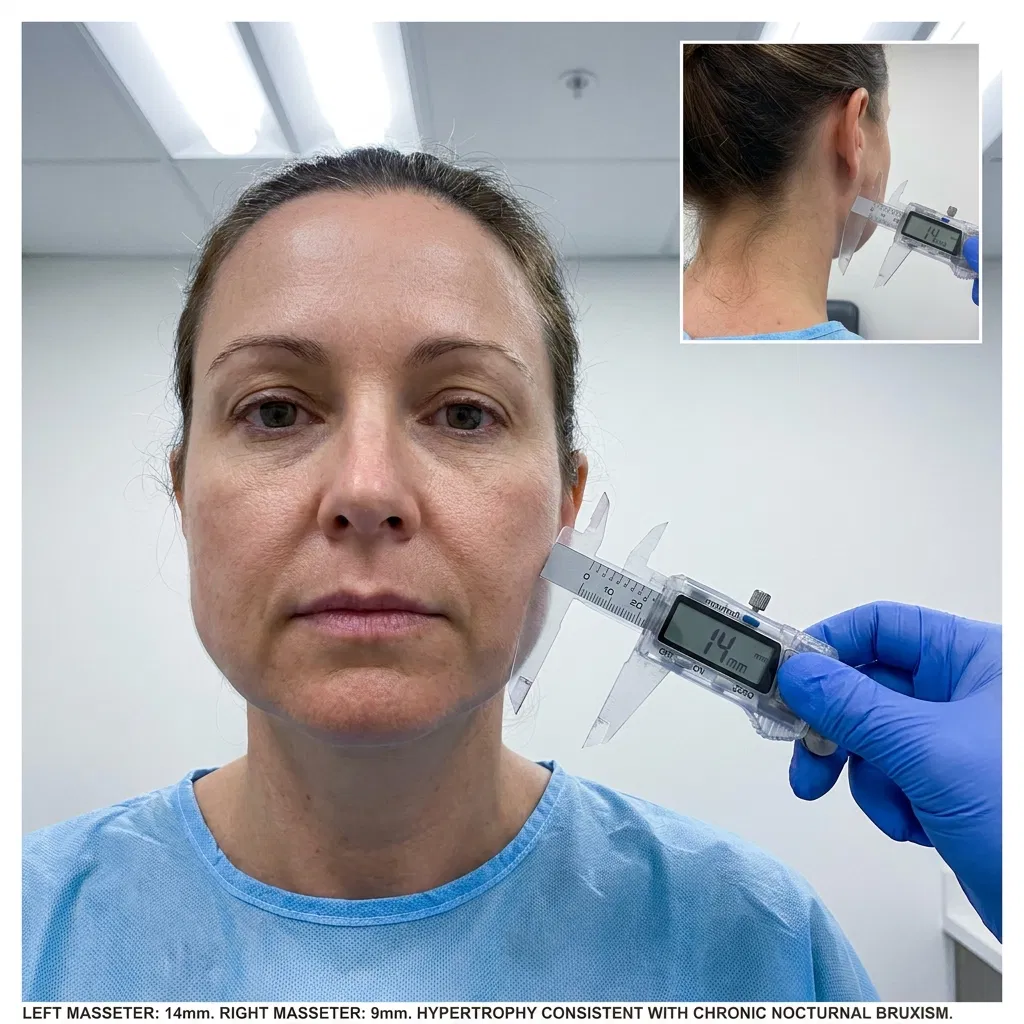
Ran for 17 days, from October 6 to October 23, 2026, the last day Crush saw it.
Run by Dr. Elliot Johnson on Facebook. Crush is not the advertiser and does not verify its claims. See this ad in Meta's Ad Library(opens in a new tab)
Make your own version of this ad
Crush makes it, launches it in your own Meta ad account, scales the winners and pauses the losers.
About this ad
- Meta Ad Library ID
- 917300997912048
- Platforms
- Facebook, Instagram, Audience Network, WhatsApp and Threads
- Relaunches
- 0
Ad text
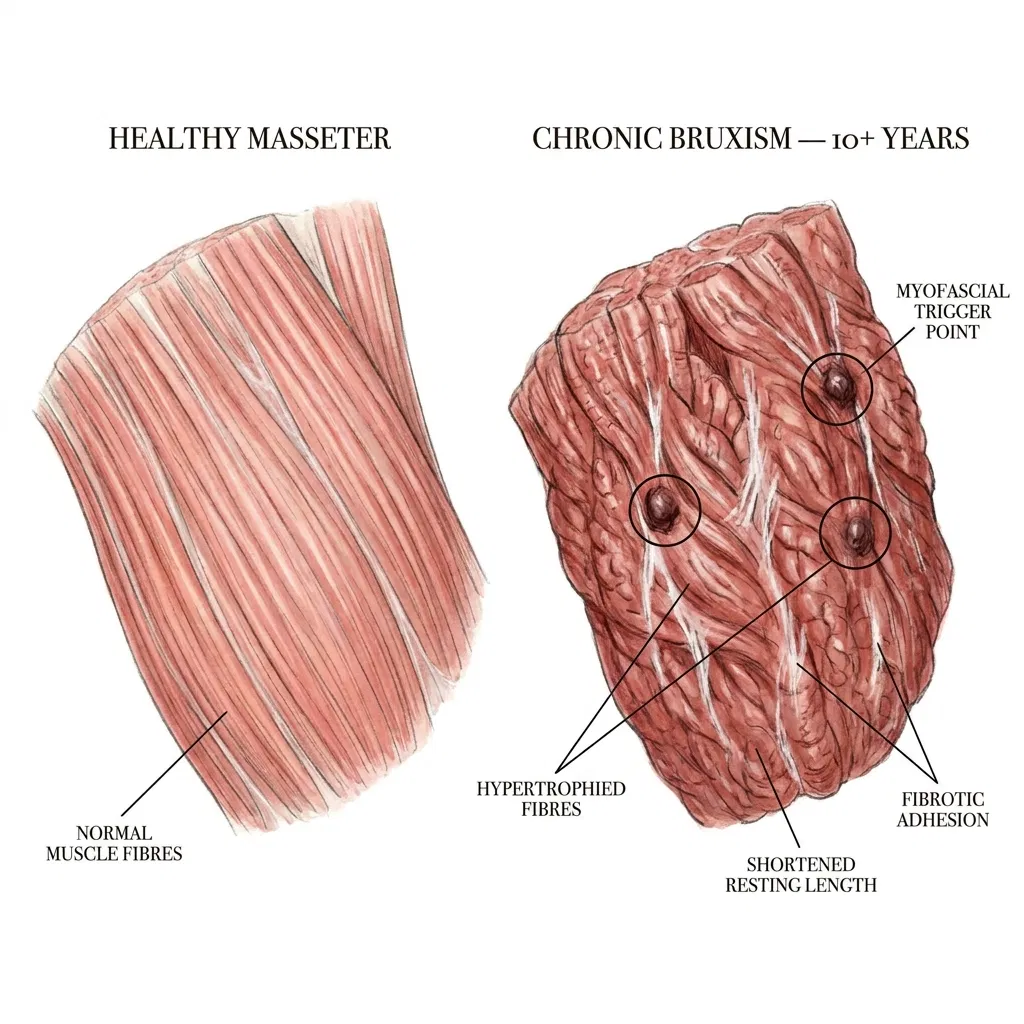
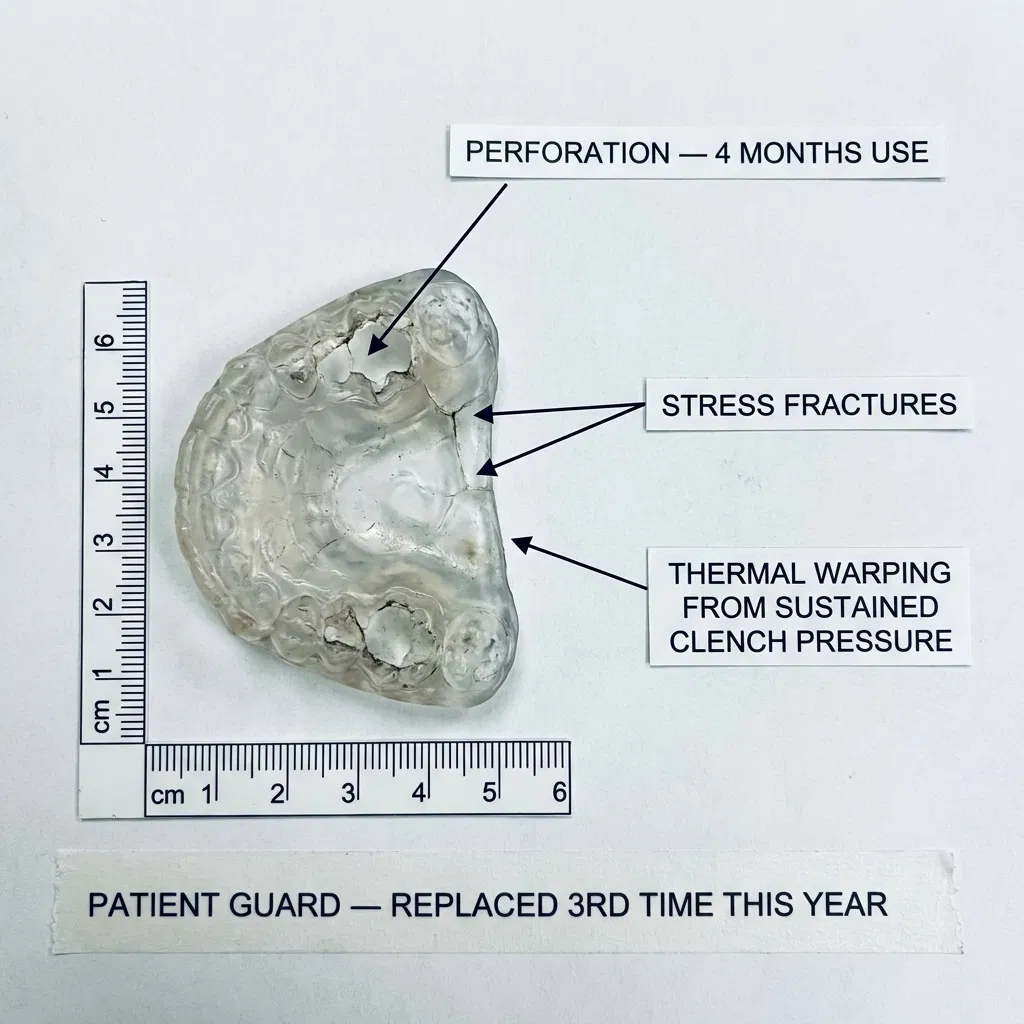
I have treated 1,400 patients with jaw tension. I referred every one of them back to their dentist for a night guard if they didn't already have one. I said "the guard will protect the joint" approximately four hundred times. Then I spent thirteen months doing exactly what I had been telling them to do. My masseter was measurably denser at the end of those thirteen months than when I started. Not the same. Worse. The protocol I had built my practice on had made my own jaw worse. I am a physiotherapist who specializes in craniofacial and temporomandibular rehabilitation. Jaw pain is the only thing I treat. I trained in it specifically. I am not a dentist who picked it up on the side. I am the person your dentist sends you to when the guard isn't working. And I need to tell you what I found on the other side of thirteen months of failing on my own protocol — because what I found changes everything I thought I knew about what is actually happening in your jaw. --- My name is Sandra Okafor. I am 48 years old. Physiotherapist, registered, seventeen years of clinical practice. I specialize in craniofacial and temporomandibular rehabilitation — which means jaw pain, headaches, neck dysfunction. It is the only thing I treat. I trained in it specifically. I am not a dentist who picked it up on the side. I am the person your dentist sends you to when the guard isn't working. I chose this specialty because of my sister. Amara is five years older than me. She started clenching in her late twenties — the kind that wakes you up at 3 AM with your back teeth locked together so hard you can feel the force in your neck. Her dentist fitted her with a guard at 31. Soft material first, hard acrylic six months later when the soft one cracked in half. She has been wearing that guard, or a replacement of it, for fifteen years. I have been treating jaw pain professionally for twelve of those fifteen years. I have never once told her what I now know about what her guard is actually doing. Her masseters — the muscles at the angle of her jaw — are visibly thick. Hypertrophied in a way that changed the shape of her face over a decade. You can see it in photos from her wedding at 32 and photos from last Christmas. The jaw is squarer. The temples more pronounced. The headaches that were occasional at 32 are three times a week at 46. She still wears the guard. Her dentist still says "the guard is doing its job." I referred twelve patients to her dentist. I trusted him. I believed the protocol. Then eighteen months ago my own jaw started. --- I should have seen it coming. The stress of a practice sale and a difficult year had settled somewhere in my body and I did not notice it had settled in my jaw until one morning I could not bite into a piece of toast without a bolt of pain shooting to my left ear. I sat in my car in my driveway for four minutes, pressing my fingers into my left masseter. It was like pressing into a clenched fist. I knew immediately what I was feeling. I had palpated this in a thousand patients. I was palpating it in myself. I did exactly what I tell my patients to do. I booked a dentist. Got a guard. Committed to it fully — I am a physiotherapist and I know compliance matters. I wore it every single night for thirteen months. My enamel was perfect at every cleaning. My symptoms got progressively worse. The morning ache spread from the left side to both sides. The bolt of pain eating extended from my ear into my temple. By month seven I had headaches four mornings a week that did not lift until mid-afternoon. By month ten I had a low hum in my left ear that no one could explain. My neck was so tight by 5 PM that I would drive home with my whole torso turning to check mirrors because my cervical spine couldn't rotate independently. I was the clinician who treats this condition. I had seventeen years of training and a practice built on addressing exactly what was happening to me. And I was getting worse. Month thirteen: I woke up at 3:17 AM with my jaw locked so far closed I could not fit a finger between my back teeth. Not just tightly closed. Seized. I sat on the edge of my bed for seven minutes with both hands on my jaw trying to remember every mobilization technique I have taught patients, applying each one, until the joint finally gave about half a centimetre and then a centimetre more. I sat there in the dark and I understood what my patients mean when they say they are afraid of their own jaw. That morning I called a colleague — Marcus, a dentist who has been referring to me for six years, someone whose clinical judgment I respect — and I asked him to examine me as a patient, not as a peer. He examined me for forty minutes. Thorough, careful, the kind of exam you give someone you take seriously. He checked my occlusion, palpated both masseters, measured my opening, took notes in the careful longhand I recognized from the referral letters he sends me. When he was done he sat back and was quiet for a moment. Looking at his notes. I could see him working through the options. "Sandra." He said it the way you say someone's name when what you're about to say isn't going to be enough. "I want to be honest with you. The enamel is holding. The joint space looks acceptable on the imaging. But the muscle —" he paused. "The muscle is significantly hypertrophied on both sides. You can feel it. I can feel it." "I know," I said. "I've been palpating it myself every week for four months." He nodded slowly. Looked at his notes again. "I think the guard you have may be too soft for the force you're generating. I want to refit you with a harder acrylic. Sometimes that makes a difference with the morning symptoms." I looked at him. He met my eyes. He is a good dentist. He is thorough and he is kind and he has sent me patients for six years who needed exactly what I could give them. He was sitting across from me with genuine concern and the full weight of his training and his seventeen years of practice and everything his profession had given him to offer. And he had nothing. Not because he wasn't trying. Because the next move his profession gave him was a harder piece of acrylic for a muscle that had already been clenching against acrylic for thirteen months and getting stronger. "That's the standard of care for this presentation," he said quietly. Almost to himself. "The guard is the intervention." He said it the way you say something you know isn't enough. He knew it wasn't enough. He said it anyway because it was the only thing there was to say. I drove home and sat in my office and understood something with a clarity I had been avoiding for seventeen years. The guard is the intervention. Not the only intervention. Not the correct intervention for what I was experiencing. The only intervention anyone offers. That evening I stood in my bathroom and examined myself the way I should have been examining myself every week since I started. Not the joint. Not the occlusion. The muscle. I placed both thumbs on my masseters — one on each side, right at the angle of the jaw — and pressed. Then I found the file on my phone where I had been noting my self-assessments. A habit from training: baseline, then comparison. The baseline was from week two of wearing the guard. Thirteen months ago. *"Dense, bilateral. Left slightly worse. Estimate 7/10 guarding."* I pressed both thumbs in again. Slowly. Carefully. The tissue was harder than the baseline. Not the same. Harder. Denser. More resistant to pressure. The left side — the side I had been self-massaging, the side I had been trying to release for over a year — was worse than the side I had ignored. Thirteen months of wearing a guard every night. Thirteen months in which the protocol had been working exactly as designed. And I had made myself worse. I sat on the edge of the bathtub and I thought about the 1,400 patients I had treated and referred and discharged with the same recommendation I had been following for thirteen months. I thought about the ones who had come back — not because the protocol failed, but because the protocol had run out of moves. The ones I had sent back to Marcus, or to their own dentist, or to a specialist, because I had nothing more to offer. The ones whose charts said "compliant, continued guard use, ongoing symptoms" and who I had noted as complex presentation, consider Botox. I did not know how many of them were sitting right now with a muscle denser than when they started. I knew that the number was not zero. I had seventeen years of clinical training and absolutely no next step. And I had given that same nothing to 1,400 people who came to me because I was the specialist. --- That night I did something I had not done since graduate school. I searched for the mechanism. Not the treatment guidelines. Not the physiotherapy protocols I had been following. The mechanism. What is actually happening in the muscle of a chronic clencher, at the cellular level, and what would it actually take to change it. I read until 2:30 AM. What I found was not hidden. It was in Cephalalgia, in the Journal of Oral Rehabilitation, in CRANIO — journals I have subscribed to and read selectively for seventeen years, reading the treatment studies without reading the mechanism papers underneath them. The masseter in a chronic clencher does not simply contract during sleep. It develops something called central sensitization — a state in which the nervous system has been sending the clench signal so repetitively, for so long, that the muscle stops receiving a genuine "rest" instruction. The gap between "clench" and "not clench" narrows. The resting baseline of the muscle rises. Eventually the muscle cannot reach true rest at all. Not because it is damaged. Because the nervous system has normalized the elevated tone as the new baseline. The night guard — every night guard, soft or hard, cheap or custom — does one thing to this system. It gives the muscle something better to clench against. The acrylic between the teeth does not signal the nervous system to stand down. It signals the brain: there is a barrier between your teeth. The jaw responds by engaging. The masseter contracts against the guard with the same or greater force than it would against bare teeth. The nervous system's clench signal is not interrupted. It is received, acted upon, and reinforced. Night after night. For years. The protocol that has been the standard of care for this condition for sixty years does not address the muscle. It manages the teeth while the muscle systematically deteriorates. I sat at my desk at 1:15 AM with this in front of me and I thought about Amara's face in the Christmas photos. The squareness that had arrived so gradually we had stopped seeing it as a change. The guard on her nightstand. The headaches she has learned to manage and the dentist who writes "guard fitting well" in her chart. I kept reading. Three months before that night — through a referral chain I had dismissed when it came to me as a handwritten note tucked under my office door — I had been given a name. Elena Rodrigues. Seventy-one years old. Retired physiotherapist. She had trained in São Paulo in the 1970s under a clinician named Augusto Ferreira, who had spent his career studying craniofacial myofascial pain at a time when the dental world was just beginning to develop the night guard protocol. Ferreira's approach was different from what became the standard. He did not begin treatment with a device. He began with tissue. The note said she worked out of a small house in the west end of the city. Tuesday and Thursday mornings, by appointment only. No clinic. No website. A waiting list of six months that existed entirely by word of mouth from former patients. I had set the note aside. At 2 AM I found the note in my desk drawer and called the number. She answered on the third ring. At 2 AM, on a Tuesday. I later learned she answers her phone at all hours because the people who call at 2 AM are the ones who are ready. She said, "Come Thursday morning." --- The house had a small front garden. Geraniums in terracotta pots. A worn path from the sidewalk to the door, the concrete slightly sunken where generations of feet had taken the same line to the same step. Inside smelled like camphor and warm cedar. There was a kettle on the stove and a single mug on the counter with a tea bag already in it — she had been in the middle of making tea when I knocked. On the kitchen table: a half-finished crossword in Portuguese, a pencil, a pair of reading glasses folded beside it. The ordinariness of it stopped me for a second. I had been expecting something else. A treatment room. Equipment. Something that announced itself as clinical. This was just a kitchen where someone had been doing a crossword before a stranger rang the bell. She was smaller than I expected. Seventy-one. White hair pulled back. Hands that moved with the absolute precision of someone who has spent fifty years locating pain in tissue. She finished pouring her tea without hurrying — set the mug down, turned, looked at me. She looked at my jaw for approximately four seconds before she spoke. "Sit down. I want to show you something." She placed both hands on the sides of my jaw. Not a clinical grip. A patient one. "Open." I opened. "Now close slowly." I closed. She held her hands still for several seconds. Then she stepped back. "Your muscle does not know how to finish letting go," she said. "It starts to open and something stops it and pulls it back. You feel that?" I felt it every day. I had not been able to name it. "The guard gives it something to hold onto at night," she said. "So it holds. All night it holds. And when you take the guard out in the morning the holding habit is more ingrained than the night before. Thirteen months of this — the muscle has been practicing the clench, not resting from it." She sat across from me and folded her hands on the table. Then she said the thing that stopped me completely. "You did not come here because you didn't know what was wrong. You came here because you knew exactly what was wrong and had nowhere to put the knowing inside your profession. You already understood this. You understood it when you palpated your sister's jaw and said nothing. You understood it every time a patient came back with a denser muscle than the visit before and you wrote 'complex presentation' in their chart. You did not need me to teach you the mechanism. You needed someone outside the system to give you permission to say it." I could not speak. She was right. I had known. Not with language — I did not have the language. But in the way you know something when you press your thumbs into tissue week after week and the number keeps going the wrong direction and you keep writing it down because what else do you do with a number that has nowhere to go. I had known for years. I had been writing it in charts and sending patients back to dentists and calling it complex presentation because the alternative was saying out loud that I had nothing. "Let me tell you what Augusto taught me and what I have been doing for fifty years. And then you tell me, as a physiotherapist with seventeen years of practice, why this is not the standard of care." She said: you cannot address a muscle that is holding unless you first convince it that letting go is safe. You cannot convince a muscle with pressure. Cold pressure on a guarded muscle does not release it — it triggers a protective contraction. The tissue guards against the tool. The muscle clamps around the intrusion instead of yielding to it. Heat is the only signal a contracted muscle accepts without resistance. Not surface warmth. Sustained warmth — deep enough and long enough that the thermoreceptors in the muscle fibers receive the signal and the tissue actually changes state. The blood vessels widen. The metabolic waste from chronic contraction begins to move. The muscle receives the warmth the way it receives a trusted hand — it softens. "Then," she said, "and only then, can you work the tissue." On soft, warmed tissue, the adhesions that form from months or years of chronic contraction — the knots, the hardened bands, the coin-sized nodules that feel like cartilage when you press them cold — yield. The fibers separate. The knots break apart. Not from force. From the correct sequence: warm the tissue, then work it while it is warm. "And then," she said, "while the tissue is open and the blood is moving — before it cools, before the nervous system reasserts the old pattern — you settle the nerve. You signal the brain that the muscle has released. Not with vibration. With the lightest possible current. A frequency the nervous system reads as permission: the emergency is over. You can rest now." She looked at me. "Three steps. Warm. Release. Settle. In that order. This is what Augusto was doing in 1974. The research came later. The research confirmed everything. And nobody changed the standard of care." I said, "Because you can't bill for warmth." She nodded once. "And you cannot patent a sequence." She said the published data on heat-plus-manual-therapy versus manual therapy alone showed a 2.4x greater reduction in measured masseter tension. The red light literature — photobiomodulation applied directly to the muscle, not diffused from a distance — shows 60 to 70 percent pain reduction in jaw patients across 44 studies. Microcurrent at the correct frequency has been shown to reduce the resting EMG activity of the masseter — the electrical signal of involuntary contraction — when applied after manual release. Warm muscle, worked, then settled. She said: the reason none of the tools available commercially do this correctly is the sequence problem. A heat pad warms but does not roll. A gua sha rolls but does not warm. A TENS unit signals but does not warm or release. A red light mask illuminates from a distance but does not press against the muscle. And none of them — none — address both sides of the jaw simultaneously. "Your jaw has two masseters," she said. "They fire together. If you address one side, the other compensates. It clamps harder. You have been self-massaging your left side for months. Your right side is worse than when you started." She was right. I had been doing exactly that. "You need both sides warming together. Both sides rolling together. Both sides settling together. And your hands are not built for that. They tire. They cool. The sequence breaks." She reached into a cabinet and set something on the table between us. V-shaped. Two arms reaching outward — one for each side of the jaw. Eight rotating heads. A warming element that sustained heat throughout the session, not just at the start. Red light built into the heads, pressed directly against the muscle rather than diffused across the face. Microcurrent at the end of each cycle. "One of my former patients sent this to me eight months ago," she said. "She found it herself. She had been on the waiting list for two years and when she finally came to me she brought this with her and showed me the mechanism. I looked at it for twenty minutes and I called Augusto." "He's still alive?" "He is ninety-one. In São Paulo. I called him and described what this device does in sequence and he said —" she paused, "— he said: *finally someone built the thing.*" I sat with that for a moment. A man who had spent his career trying to teach a sequence that nobody adopted, who was ninety-one years old in São Paulo, hearing it described in a phone call and saying that. Finally. Not pleased. Not surprised. Finally. Warm → Roll → Release. Both sides. Ten minutes. Runwell Thaw. She said: "Use it every night before bed. The way I would treat you, except you can do it yourself, in your own home, for ten minutes instead of sixty, without a waiting list and without a billing cycle. The sequence is the same. The principle is the same. Augusto's whole career in a device someone finally had the sense to build." I drove home and ordered it from my phone at a red light. --- It arrived four days later. I want to be precise about what the first session felt like, because I am a physiotherapist and I know what tissue feels like before and after, and I will not overstate what happened. I placed it on my jaw. Both sides at once. The warmth started immediately — before the rollers engaged — which told me the designers understood the sequence. Heat first. The roller heads were metal, textured, rotating in a motion that felt like the base of my thumbs moving along the fiber direction of the masseter, except eight of them, simultaneously, on both sides, without tiring. Two minutes in, the tissue on my right side — the side I had stopped addressing because it had been compensating and was harder to the touch than the left — began to soften. Not because of pressure. Because of heat followed by rolling on warm tissue. The sequence Elena had described. The sequence I had read about in the papers at 1:15 AM. Occurring under my own hands, on my own jaw, in my kitchen, on a Thursday night. At four minutes, a nodule in my left masseter — a dense formation I had been pressing with my thumb for months without moving — changed density. I will use the exact words: it went from clenched to resting. Not dissolved. Not gone. The same tissue, different state. Because it had finally been warm enough, long enough, that the fibers were willing to separate. Ten minutes. I turned it off. I opened my mouth. Wide. The widest I had been able to open in eighteen months. Not because I pushed it. Because the muscle that had been limiting the opening had, for the first time in eighteen months, actually let go. I stood in my kitchen at 10:22 PM and I held my jaw open for several seconds because I was waiting for the pull that would snap it back. It did not come. The muscle was not recruiting. The jaw was simply open. I put my fingers on both masseters. I have palpated jaw muscles for seventeen years. I know what healthy tissue feels like. I know what chronic contraction feels like. I know exactly what I was touching and exactly what the difference means. I stopped being a physiotherapist for about thirty seconds. I just stood there with both hands on my face. Then I cried. I will not pretend otherwise. --- I slept without my guard that night. First time in thirteen months. I woke at 5:50 AM. Lay still. Waiting for the morning ache — the bilateral pressure that greeted me every single day, before I moved, before I spoke, before I did anything. It was not there. Not reduced. Not present at lower intensity. Absent. I ran my fingers along both masseters. Soft. The same softness from the night before. **Week one.** By day three the 10 AM headache that had been my daily companion for fourteen months did not arrive. I was between patients on a Thursday afternoon and I realized I had not pressed my temple once since noon. My assistant had been keeping ibuprofen in my desk drawer without being asked. She forgot on day four. I did not remind her. Day five: I bit into a pear. On the left side — the side that had been sending a bolt of pain to my ear for over a year. No bolt. No flinch. I stood in my kitchen and ate an entire pear on the side that had been broken and then stood there for an additional minute because I didn't know what to do with the absence of something I had been bracing for every meal for months. **Week two.** The hum in my left ear quieted. I noticed it on a Tuesday driving to work in silence. Not gone. Quieter. Like a fan that has been running in the next room for so long you stopped hearing it as a sound — and then one morning it drops a register and you realize you'd been tracking it the whole time. I pulled over and sat in the car for a minute. I checked a blind spot by turning my head. Not rotating my whole torso. Turning my head. A motion I had been compensating around for so many months I had stopped knowing I was compensating. **Week three.** Amara called on a Sunday. We talked for an hour. She described a bad week — headaches four days, her jaw had locked Tuesday morning, she had been icing. I asked her about her guard. "Same as always," she said. "Dentist says it's doing its job." I told her what I had found. All of it. The sensitization mechanism. The sequence. The device. I had not told her for three weeks because I did not want to say anything until I was certain. She was quiet for a long time. "Why did no one tell us this?" she said. I did not have a good answer. **Week four.** I brought the Thaw to Amara's flat on a Saturday. She made tea while I set it up. She has a specific way of making tea — loose leaf, a particular pot she has had since university, she steeps it for exactly four minutes and she has a small timer on the counter for this. A ritual she has done every Saturday morning for twenty years. I placed the Thaw on her jaw. She sat still for ten minutes with her eyes closed — not sleeping, the expression of someone in the middle of something they had been waiting for without knowing they were waiting. When she opened her eyes she moved her jaw side to side. She had not been able to do that without pain since before her daughter was born. We sat with our tea. She lifted her mug and took a long sip the way she always does, holding it in both hands, face down over the steam. Then she set it down and looked at me. "I've been sipping from the left side of the mug for three years," she said. "Because the right side hurts. I never told you that." She hadn't. I hadn't known. She picked the mug back up and sipped from the right side. Slowly. Waiting for the bolt. It did not come. She set the mug down. Said nothing for a moment. "That's what the guard was supposed to do." Yes. That is exactly what the guard was supposed to do. And she had been sipping tea from one side of a mug for three years while her dentist wrote "guard fitting well" in her chart, and her physiotherapist sister had been treating jaw pain professionally for twelve of those years, and neither of us had a next move. **Week five.** Amara's daughter is nine. Her name is Priya and she has been asking me to take her swimming since the summer — I used to take her every few weeks, just the two of us, Saturday mornings, the leisure centre ten minutes from Amara's flat. I had stopped going in February. I told Amara it was my schedule. It was not my schedule. It was that an hour in a loud, echoey pool with a nine-year-old who likes to splash and shout across the lane sent a specific kind of reverberation into my left ear that I had learned to avoid. I had stopped going without explaining why. Priya had stopped asking. Week five Saturday I texted Amara and asked if Priya still wanted to go. We went. An hour in the pool. Priya shouted my name across the lane approximately fourteen times. She jumped in from the side and splashed water directly into both my ears and laughed at herself for it. I drove home afterward. The next morning I woke up and the morning ache was the same as it had been all week. Not worse. The same. I had spent six months quietly rearranging my life around what I could not do anymore and I had stopped noticing I was doing it. A nine-year-old stopped asking to go swimming and I had not said anything about why. That is what this condition does when it runs long enough. It does not announce itself as loss. It just becomes the shape of your week. **Week six.** A patient came in — a woman I have been treating for three months, jaw clencher, guard wearer for six years. She sat in my chair and I palpated her masseter before I started. Then I palpated it again. "What are you doing?" she said. "I'm checking something. Your masseter is different." "I found a device," she said. "I've been using it before bed." She hadn't told me. She'd found it herself and started it alongside everything I was doing with her. And what I was feeling in her masseter — a muscle I have been palpating weekly for three months — was something I had not felt in a long-term clencher since I treated a patient who had just completed a six-week course of intensive manual therapy. She was doing ten minutes a night in her kitchen before bed. **Week eight.** I referred three patients to Elena. Not to go on her waiting list. To tell her what I had been seeing. She listened to all three patient reports over the phone on a Friday evening. When I finished she was quiet for a moment. Then she said the thing I have been turning over since. "Sandra. Augusto spent forty years trying to teach this protocol to physiotherapists and dentists and nobody changed anything because nobody had a way to do it at home, every night, both sides, in the sequence, without a practitioner in the room. This is what changes it. Not the clinic. The kitchen. Ten minutes before bed. That is where this works." She said: "Call me when you have ten patients. I want to hear." I am at seven. --- You are at a point I recognize. You have been told the guard is doing its job. You have been told your bite is protected. You have been told to wear it faithfully and come back in six months and the chart will say what it always says. And the muscle underneath keeps clenching. Keeps thickening. Keeps spreading tension upward into your temples, inward toward your ears, down into your neck, forward into the muscles behind your eyes. Slowly. Steadily. Every night. While every record says you are doing everything right. The headaches get worse each year. You blame stress. The jaw gets tighter each morning. You blame sleep position. You develop a hum in one ear that no specialist can explain. Your neck locks by afternoon. You begin avoiding foods not because a doctor told you to but because you have quietly learned which things don't cause the bolt of pain. The apple. The crusty bread. The chewy things you used to eat without thinking. You stop noticing you're avoiding them. And one morning — maybe next month, maybe in three years, maybe next winter — you wake up and your jaw is locked. And the guard is in its case on your nightstand, doing its job. Protecting your enamel. While your muscle has been practicing the clench, every night, for years. I am a physiotherapist who treated 1,400 jaw patients with the standard protocol and then spent thirteen months failing on that same protocol with my own jaw. The guard protects the surface. Nothing in the standard of care addresses the muscle doing the damage. One sequence does: warm the tissue, roll it while warm, settle the nerve while open. Both sides simultaneously. Every night. In a ten-minute session that your hands cannot maintain but a device built for this can. That is what the Runwell Thaw is. A V-shaped warming jaw release device. Eight rotating roller heads. Three heat levels. Red light and microcurrent built directly into the heads, pressed against the muscle, not diffused from a distance. Both masseters at once. Ten minutes. Warm → Roll → Release. The 60-day money-back guarantee removes every dollar of risk. Use it every night for a month — the honest minimum for a muscle to begin to change. If you are not waking up with less tension, you pay nothing. Everything back. Your guard did not come with a guarantee. The exercises your physiotherapist gave you did not come with a guarantee. I am a physiotherapist. I treat this condition professionally. I am telling you from seventeen years of practice and thirteen months of personal failure that the sequence Elena Rodrigues has been using for fifty years — that Augusto Ferreira was teaching in São Paulo in 1974 — is what actually changes the muscle. Runwell Thaw. One session. Every night. Ten minutes. Both sides. 👉 https://tryrunwell.com/products/thaw --- **P.S.** — My sister has been wearing a night guard every night for fifteen years. I have been a physiotherapist specializing in jaw pain for twelve of those years. I never once told her what her guard was actually doing to her muscle because I did not know. I sent 1,400 patients back to dentists. I said "the guard will protect the joint" approximately four hundred times. I watched Amara's face change shape in photographs over a decade and I did not understand what I was seeing. Her daughter stopped asking me to take her swimming and I said nothing about why. I sat across from Amara on a Saturday morning and watched her sip tea from the right side of her mug for the first time in three years — she had been sipping from the left side every Saturday morning for three years without telling the jaw specialist sitting across from her. I sat in Elena Rodrigues' kitchen while she finished pouring her tea and heard an explanation a seventy-one-year-old retired physiotherapist gave in ten minutes that my entire profession had failed to give me in seventeen years of clinical practice. I took Priya swimming last Saturday. She shouted across the lane and splashed water in my ears and I drove home and woke up the next morning the same as I had gone to bed. Please do not wait for a locked jaw at 3 AM to go looking for this. The guarantee means you lose nothing by starting now. **P.P.S.** — You will feel something in the first session. Not the cumulative change — that takes weeks and shows up in how you wake up, not in how you feel during the ten minutes. What you will feel is a change in density in the masseter. The difference between a muscle holding and a muscle that has been convinced to let go, even briefly. Some people yawn — a full, unguarded yawn — the kind they have not had in months. Some people feel their ears shift. Some people feel their shoulders drop and only then realize how high they had been carrying them — that the jaw tension was pulling something all the way down to the trapezius. If you have tried a gua sha, a massage gun, a jade roller, or your own thumbs and felt nothing: the reason is that none of those things warmed the muscle before working it, addressed both sides simultaneously, or sustained the treatment long enough for the nervous system to accept the new state. Cold tool on a guarded muscle triggers a protective contraction. This is not that. You will know the first time. **P.P.P.S.** — About your night guard. Do not throw it away. If your dentist recommends it for enamel protection, keep wearing it. Use the Thaw before bed, then put the guard in. That is exactly what I do now. The guard addresses the surface. The Thaw addresses the muscle doing the damage. They solve different problems. Neither replaces the other unless your jaw begins to show your dentist something different — which may happen, and which should be a conversation you have with your dentist based on what your jaw is showing, not based on what you read here. **P.P.P.P.S.** — For the person reading this whose partner is the one who wakes up with the jaw ache every morning. Who winces when they bite into something without thinking first. Who has stopped ordering certain things at restaurants without explaining why. Who has the ice pack. Who takes the ibuprofen before the day starts. Who has headaches that cancel things. You watch the person. The dentist watches the enamel. You are closer to the truth than the chart is. Share this with them. Or order one and hand it to them without an explanation. Let the first session do the talking. **P.P.P.P.P.S.** — If you have tried heat pads, massagers, TENS devices, or cold facial tools and nothing has changed, there is a specific reason. Each of those addresses one step of a three-step sequence, out of order. Heat without rolling loosens the surface while the deeper knots stay sealed. Rolling without heat pushes against a guarded muscle that contracts against the pressure. A TENS device settles a nerve that has not been released. Red light from a distance does not reach the masseter, which sits under layers of tissue. The sequence matters as much as each step — warm first, then roll while warm, then settle while open. No single tool does all three. No tool on the market does all three on both sides simultaneously. Until this one. **P.P.P.P.P.P.S.** — Runwell Thaw is $79.99. Buy One Get One Free — two for $79.99. If you already know who else in your house carries jaw tension — and it is almost never just one person — the Buy One Get One is the honest choice. Free shipping. 60-day full money-back guarantee on every order. If you have an appointment with your dentist or physiotherapist in the next few weeks, use the Thaw every night until then. Walk in and let your clinician palpate your masseter. You will not need to describe anything. The muscle will describe it. Don't forget the guarantee. Nothing to lose. Sixty days. **P.P.P.P.P.P.P.S.** — I have no financial relationship with Runwell. Nobody pays me anything. I am writing this at my desk on a Sunday evening because a patient sat in my chair last Tuesday with masseters I have been palpating weekly for three months and the tissue was different. Not different like I had done my job. Different like something had changed outside my office. She told me she had started using a device she found herself. I have been a physiotherapist for seventeen years and I have never sent a patient home with something that did what I felt in her tissue on Tuesday. That is why I am still at my desk at 10 PM. If you have been told you are being managed, and your jaw is still waking you up, and the guard is doing its job while the muscle underneath does its job too — you deserve to know the sequence exists. 👉 https://tryrunwell.com/products/thaw *~ Sandra Okafor, PT, MSc, age 48, craniofacial and temporomandibular physiotherapy*
Where the ad sends people
tryrunwell.com
Read this if you have TMJ
TryRunWell
Learn more: tryrunwell.com(opens in a new tab)