
Inactive· since Feb 27, 2026
- 20
- days it ran
- 8
- relaunches
- 16,281
- EU reach
Ad copy
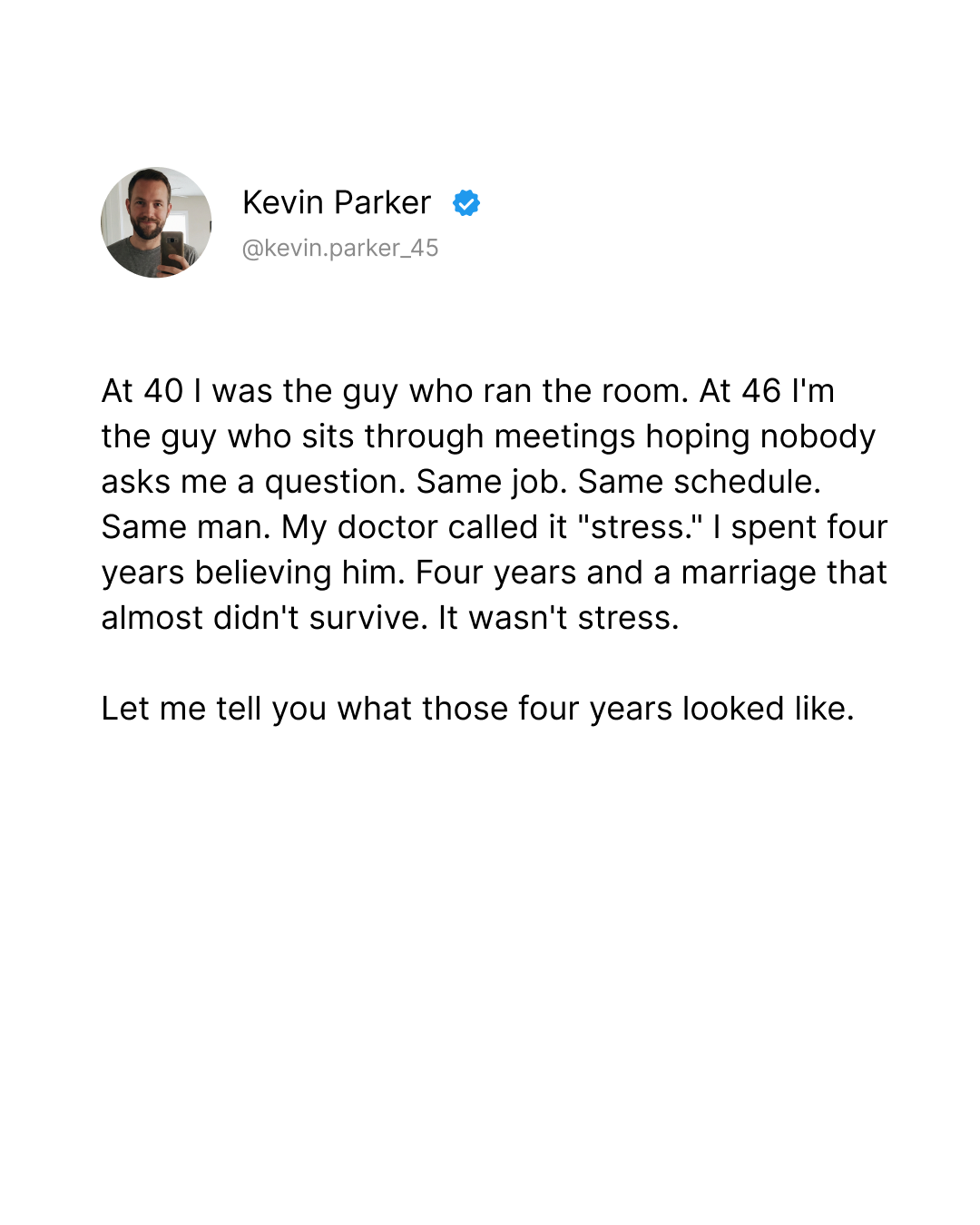
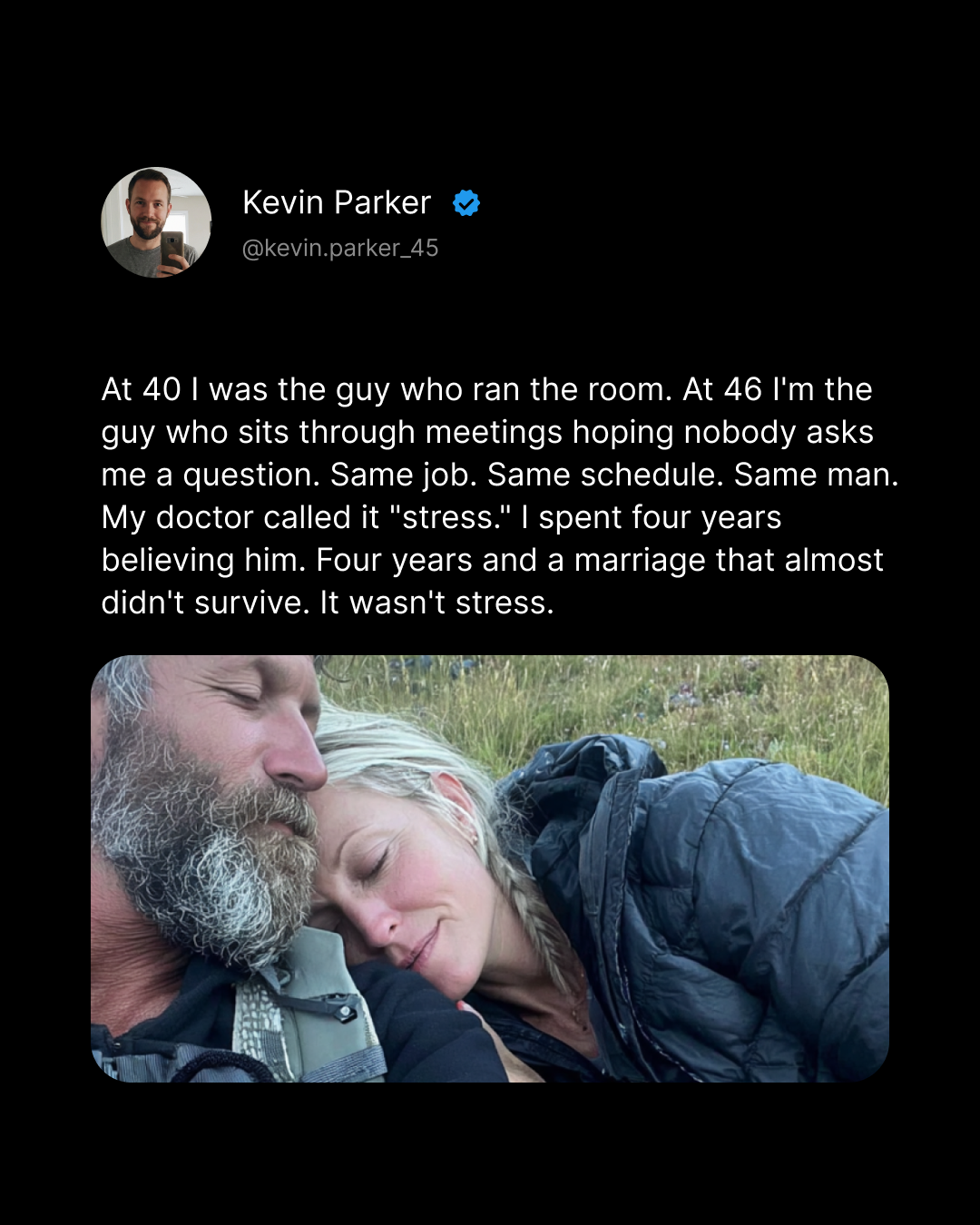
At 40 I was the guy who ran the room. At 46 I'm the guy who sits through meetings hoping nobody asks me a question. Same job. Same schedule. Same man. My doctor called it "stress." I spent four years believing him. Four years and a marriage that almost didn't survive. It wasn't stress. Let me tell you what those four years looked like. At 41, I started forgetting things. Not big things. Small ones. My kid's teacher's name. What I walked into the kitchen for. Whether I'd eaten lunch. I figured it was sleep. I wasn't sleeping well. Who does at this age? At 42, the forgetting turned into something heavier. I couldn't focus in meetings longer than fifteen minutes. Couldn't read a full article. Started re-reading the same email three times before I understood what it said. My performance reviews went from "exceeds expectations" to "meets expectations." That one word — "meets" — felt like a demotion. At 43, I went to my doctor. Told him I was exhausted. That I couldn't think clearly. That I had zero motivation to do anything outside of work — and barely enough to get through work itself. He looked at my chart, looked at my age, and said the words I'd hear a dozen times after: "You're under a lot of stress. That's normal for men your age. Try exercising more." So I did what you do. I tried harder. I started running. Felt worse. I cut alcohol. Still couldn't sleep. I downloaded a meditation app. Used it twice. I started waking up at 5 AM to "get ahead of the day." Burned out faster. Every Monday was a fresh start. Every Friday I was face-down on the couch by 7 PM. Every month, my patience got shorter and my ability to feel anything got smaller. My doctor's advice? "Maybe try therapy." I went. Three sessions. The therapist asked how I was feeling. I said tired. She said, "But how are you feeling?" I didn't know how to answer that. I genuinely didn't know. I was sleeping seven hours and waking up like I'd slept two. I was exercising four times a week and feeling weaker than when I started. I was doing everything the internet and my doctor told me to do. And I was still sinking. Do you know what that does to a man? When you're doing everything right and your body just... won't recover? When you go to bed exhausted, wake up exhausted, push through the day exhausted, and nobody around you seems to understand because you look fine? I started to think something was seriously wrong. Thyroid? Normal. Testosterone? "Low end of normal, but fine for your age." Blood work? Clean. Everything was "normal for your age." I wanted to put my fist through the wall every time I heard that phrase. I didn't. I didn't have the energy. At 44, I stopped trying. Not dramatically. Just quietly. Stopped setting goals. Stopped pretending I was going to "turn it around this month." Started accepting that the sharp, motivated, present version of me was gone and this flat, foggy, going-through-the-motions version was permanent. My wife said she was worried. "You're not yourself." I told her I was fine. She stopped asking after a while. Not because she stopped caring — because she got tired of hearing "I'm fine" from a man who clearly wasn't. She told me later that she'd started wondering if I still wanted to be married. Not because I'd done anything wrong. Because I'd stopped doing anything at all. Stopped laughing. Stopped starting conversations. Stopped reaching for her. She said it was like living with a photograph of the person she married — same face, no pulse behind it. That conversation should have gutted me. It didn't. I heard the words and felt almost nothing. And the fact that I felt nothing about my wife telling me she thought I'd checked out of our marriage — that scared me more than anything else had in four years. Then one night — and this is the part that changed everything — I was awake at 2 AM doing that thing where you stare at the ceiling and your brain runs a highlight reel of every way you're failing. I picked up my phone. Not to do anything useful. Just to stop the reel. I saw a post in a men's health group I'd joined months ago and never read. A guy about my age wrote: "I spent three years thinking I was depressed. Every doctor said it was stress or age. Turns out it wasn't either. It was my nervous system stuck in survival mode." I almost kept scrolling. But something about that phrase — "stuck in survival mode" — landed differently than anything else I'd read. He explained that when you've been running on stress for years — not crisis-level stress, just the constant, low-grade, never-stops kind — your nervous system locks into a state it was never meant to stay in. Fight-or-flight becomes your default. Your body floods with cortisol day and night. And eventually, the system doesn't crash. It flattens. It stops letting you feel things because feeling takes energy it's decided it can't spare. It doesn't matter how much you sleep. It doesn't matter how much you exercise. If your nervous system is stuck in that mode, it will override everything to keep you running on fumes. He said the symptoms look exactly like depression. Fatigue. Brain fog. Emotional numbness. Loss of motivation. Doctors see a man over 40 with these symptoms and they say "stress" or "maybe depression" without ever asking whether your body might be locked in a state it can't exit on its own. He mentioned something called Liven. Not a supplement. Not a productivity system. A program designed to work with your nervous system — to identify the specific patterns keeping it stuck and bring it back out of survival mode. I found the quiz on their site. It didn't ask about my schedule. It asked about my nervous system. About feeling wired but dead. About pushing through every day until I collapsed. About the gap between how I looked on the outside and how hollow everything felt on the inside. I said yes to almost every question. Not because I was being dramatic. Because I'd normalized all of it. This wasn't burnout to me. This was just Wednesday. I started the plan that night. Figured I had nothing to lose. Everything else had failed. Week 1: Nothing dramatic. Fell asleep slightly faster. Woke up once during the night instead of three times. Week 2: I noticed the fog was thinner. Not gone — but thinner. Like someone had cracked a window in a room that had been sealed shut for years. I finished a report at work in one sitting. Hadn't done that in months. Week 3: My wife said something funny at dinner and I laughed. Not the mechanical laugh I'd been performing for years. An actual laugh. She looked at me like she'd seen a ghost. A good ghost. Week 4: I woke up on a Saturday and wanted to do something. Not had to. Wanted to. I drove to the hardware store and spent two hours there. Came home and fixed the shelf I'd been ignoring for seven months. My wife watched me from the doorway and didn't say anything. She didn't have to. Week 6: I slept through the night. Five nights in a row. I didn't know what that felt like anymore. I'd forgotten that waking up could feel like anything other than dread. Week 8: My wife and I sat on the porch after the kids went to bed and talked for an hour. Not about anything important. About nothing. The way we used to. She put her head on my shoulder and I felt it. Not just the weight. The warmth. The meaning. It's been four months now. I'm not the guy I was at 40 — I might never be exactly that version again. But I'm in the room. I'm present. I'm thinking clearly enough to do my job without white-knuckling through every hour. But here's what matters more than the performance: I feel things again. Real things. Not the muffled, distant approximation of emotion I'd been running on. My kid told me a joke last week and I laughed so hard I choked on my water. My wife looked at me and her eyes were wet. Not because the joke was funny. Because I was there. I'm not running on cortisol anymore. My body isn't treating every Tuesday like a threat. It's not in emergency mode. And without that constant alarm in the background, everything — sleep, focus, patience, presence — started coming back. Four years I lost to a wrong explanation. Four years of flatness, fog, and a wife who thought I'd stopped loving her, because every doctor saw a tired man over 40 and said "stress." It wasn't just stress. It was a nervous system stuck in survival mode. And once I addressed that — once I stopped trying to outwork the problem and actually worked with my wiring — my body finally stood down. If you've been exhausted no matter how much you rest... If every doctor blames stress or age... If you're doing everything right and nothing is changing... It might not be what you think. It might be your nervous system locked in a state it was never meant to stay in. Liven has a free quiz that identifies exactly what's going on. Takes a few minutes. Costs nothing. I wish I'd found it at 41. Would've saved me four years and a marriage that almost went silent. Link is right below.
Unstoppable at 40. Empty at 46.
LEARN MORELike this ad? Make it yours.
Crush rebuilds this exact creative around your product — your brand, your colors, your offer — in about a minute.