HandyTool
HandyTool Facebook ad: “Hundreds saved if I'd had this tool earlier”
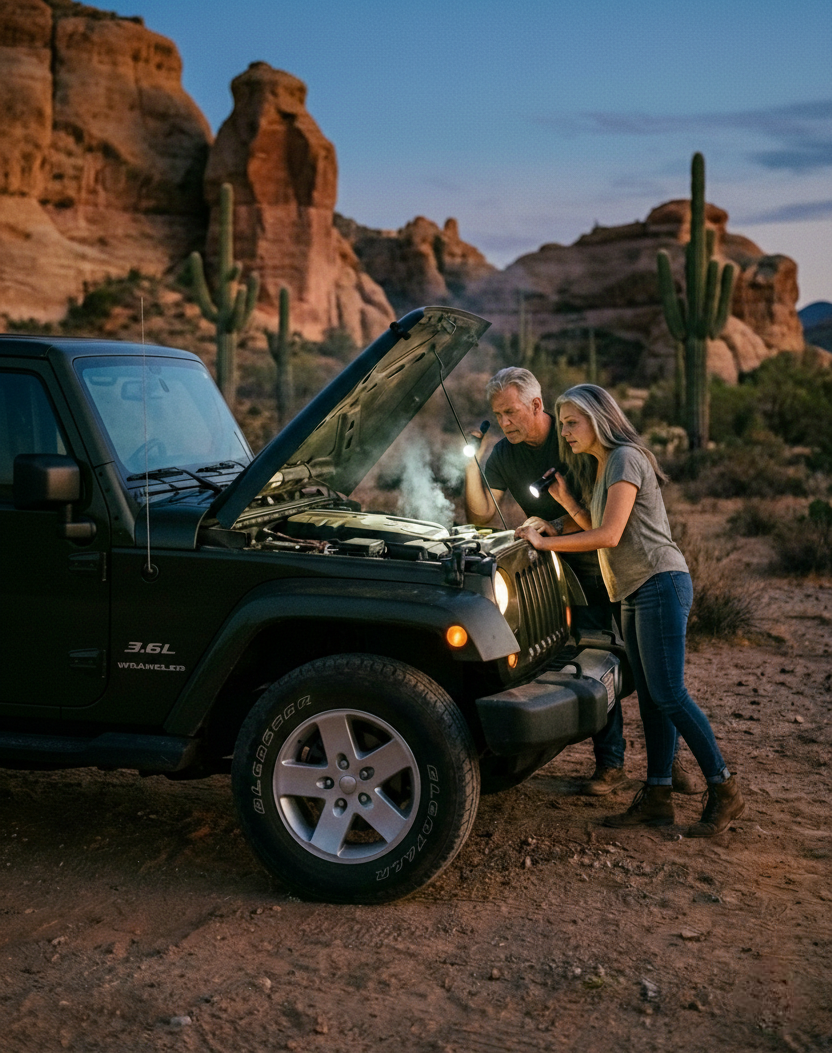
Ran for 36 days, from January 18 to February 23, 2026, the last day Crush saw it.
Run by HandyTool on Facebook. Crush is not the advertiser and does not verify its claims. See this ad in Meta's Ad Library(opens in a new tab)
Want an ad like this for your product?
Crush makes new ad images for your product from this ad: your logo, your product photo, your offer.
Trials from $19.95 USD, then $79.95 USD a month. Cancel anytime.
About this ad
- Meta Ad Library ID
- 935930535532583
- Platforms
- Facebook, Instagram, Audience Network, Messenger and Threads
- Relaunches
- 0
Ad text
A recovery service wanted $2,800 to tow my Jeep so I could replace a $220 alternator. I asked him how that math worked. He didn't even hesitate. "Two mounting bolts you can't see, can't reach, can't turn. Done a dozen Jeeps this season. They're all the same — nobody gets to those without major disassembly." My weekend camping trip with friends was two days away. Then a guy in a dusty 4Runner pulled up and asked what was going on. What he showed me changed how I handle every trail repair now. Let me back up a bit. Sarah and I have been running trails for about six years. Sold our sedan, bought a Wrangler JK — 3.6L engine, lifted suspension. Capable enough to reach anywhere, reliable enough to get us home. The idea was simple. Chase good weather. Desert in winter. Mountains in summer. No more spending weekends in traffic. No more wondering if this is all there is. No more waiting around to actually live our lives. For six years, it worked better than we ever imagined. We hit trails in Utah, Arizona, Colorado. Spent three weeks exploring the Sierras. Last spring we drove through Death Valley, timing it just right before the heat got dangerous. We were deep in the Mojave Preserve — gorgeous spot about 12 miles past Kelso Dunes — when the battery light came on. Wasn't even on a rough section. Just cruising a sandy wash. Idling through a rocky section when I noticed the red battery icon on the dash. Then the voltage gauge started dropping. 12 volts. Then 11.5. Then 11. I knew what that meant. Alternator. Pulled over immediately, popped the hood. Engine was running, but the alternator pulley wasn't spinning smoothly — it was wobbling slightly and making a faint grinding sound. Bearing failure. Alternator was done. Easy fix, I figured. I've done alternators before. Did one on my old Tacoma in my driveway maybe three years ago. Hour and a half job, nothing too complicated. That was before I saw where Jeep decided to mount the alternator on these 3.6L engines. It's tucked low on the passenger side, crammed between the engine block and the frame rail. The mounting bolts face inward — toward the firewall — with maybe an inch of clearance on a good day. I could see the top bolt. Could barely reach down and touch the bottom one with my fingertips. But I couldn't get a wrench on either of them. Tried my regular 3/8" ratchet. Handle hit the frame rail before the socket even touched the bolt. Tried my stubby ratchet. Got it on the top bolt, but I had maybe five degrees of swing. Would've taken three hours just to back that one bolt out. Tried a 13mm wrench. Couldn't fit it in the gap. Just not enough room. Tried my flex-head ratchet. The head bent sideways the second I put any pressure on it, and the socket popped off. Nearly dropped it down into the skid plate. Tried my universal joint extension. Got the socket on once, started to turn, and it popped right off. Same problem. No room to actually swing the ratchet. Ninety minutes I fought those bolts. Ninety minutes in the desert heat, laying on my back in the sand, the engine still radiating heat, sweat dripping into my eyes. Sarah kept bringing me water. Kept saying we should call someone. I didn't want to call someone. I wanted to get this alternator off, get a replacement, and keep driving. We were meeting friends at a campsite 40 miles north. They were coming in from Vegas. We'd been planning this trip since March. Had permits for a backcountry site that took six months to get. The campsite was 40 miles away. Our friends were already en route. And I couldn't get two bolts off an alternator. I finally gave up and pulled out the satellite communicator. Found a recovery service in Baker — about 80 miles east. Told them our situation. They said they could send someone, but it would take time. "We're looking at four, maybe five hours to reach you out there." I asked what it would cost. "Base rate for off-road recovery starts at $2,800. That gets you back to pavement where you can get it properly fixed." Twenty-eight hundred dollars. To tow us so I could replace an alternator. I told them I'd call back. Ended the call. Just sat there in the sand. Sarah was sitting in the shade, looking at our map. "What'd they say?" I told her. She set the map down and stared out at the desert. "We could hike to the road," she finally said. "Try to flag someone down. Get a ride to town." She was right. We could. But that meant leaving the Jeep here. Hoping the battery didn't die completely. Hoping nobody came across it. Coming back with parts and tools and losing the entire weekend. Two stuck bolts were turning into a week of problems. I walked over to a rock and sat down, just watching the sun move across the sky. That's when I heard the engines. Two rigs came around the bend behind us. A built-out 4Runner and a lifted Tacoma. Both covered in trail dust, recovery gear on the roof racks. They saw us stopped with the hood up and pulled over. Driver of the 4Runner got out. Mid-forties, well-worn trail gear. Name was Mike. We'd actually passed each other earlier that morning near the ranger station — given each other the off-road wave. "You guys alright?" I pointed at the battery light still glowing on the dash. He walked over, looked under the hood, listened to the grinding bearing for a few seconds. "Alternator," he said. "Let me guess. Can't get to the mounting bolts." I nodded. "What'd the recovery service quote you?" I told him. He let out a low whistle. "Let me guess. Said it's a four-hour job to reach you, then you're looking at a tow plus shop labor." I nodded again. "You got twenty minutes?" I wasn't sure what he meant. "Come on." He walked back to his 4Runner, opened the rear hatch, and pulled out a tool bag. Came back holding something I'd never seen before. Flat steel bar, maybe 15 inches long. Socket connection on one end. Drive square on the other. Some kind of internal mechanism visible through cutouts in the metal. "Offset extension," he said. " Chain drive built in. Only way to get at those buried bolts without pulling half the front end apart." I told him I'd already tried every extension I owned. The space was just too tight. He just smiled. "Watch." He grabbed a 13mm socket from my tool bag and attached it to one end of that flat bar. Then he slid the whole thing into the gap between the alternator and the frame rail. It went right past the obstruction that had been blocking me all afternoon. The socket clicked onto the top bolt head. He attached his ratchet to the other end — which was now sitting in open space where he had full range of motion. "Give it a turn." He turned it. The bolt moved. Forty seconds later, it was out. Bottom bolt was tighter — seized a bit from heat cycles. But the wrench came at it from a completely different angle, got solid contact, and with some muscle, it finally broke loose. Two minutes later, both bolts were out. He pulled the old alternator free and set it on the ground. I just stood there, trying to process what just happened. Mike was already wiping down his tool. "First time's always like that," he said. "You think it's impossible. Then you get the right tool and realize the only impossible part was what you were using." I asked where he got it. "Online. About eighty bucks. I've got three of them. One in each rig, one in the garage. Won't go on a trail without them." Then he paused. "Actually, hold on a second." Mike walked back to his 4Runner. "What year's your JK?" "2012," I said. He opened a toolbox in the back. "You're not gonna believe this. I just swapped mine out two days ago in Baker. Bearing was starting to whine a bit. Nothing serious yet, but out here you don't wait for things to fail. This one's still got plenty of life left." He held up an alternator. "Same 3.6L engine. Should bolt right on." I couldn't believe what I was hearing. I asked him what he wanted for it. "Parts store gave me a hundred bucks core charge when I bought the new one. Call it even." I pulled out my wallet and handed him five twenties. He tried to wave me off. "Man, you don't need to—" "You just saved me $2,800 and my entire weekend. Take it." He pocketed the cash with a nod. We installed the alternator using Mike's tool. Total time: under fifteen minutes. Started the Jeep. Battery light went off. Voltage gauge climbed back to 14 volts. Perfect. Mike and his buddy headed out. We let the engine run for another twenty minutes, just making sure everything was holding. Then we drove out. Made it to the campsite just after sunset. Our friends were already there, fire going, beers cold. Sarah told them the whole story. They couldn't believe it. That night, I ordered the same tool Mike had used. Offset Extension Wrench from HandyTool. $79. Comes with adapters for 1/4", 3/8", and 1/2" drive. Had it shipped to our house. Showed up three days later. First thing I did was go through the Jeep and identify every other buried fastener I could think of. Found six more spots that would've been impossible with standard tools. Knew exactly how I'd reach them now if I ever needed to. Total cost: $100 for the alternator. $79 for the tool. $0 for labor. $179 The recovery service wanted $2,800. I saved $2,621. And we made the trip. Spent three days in the backcountry with our friends. Watched the stars from a campsite we'd waited half a year to get. Ran trails I'd been dreaming about since we bought the Jeep. None of that happens if I'd waited five hours for that tow truck. Or if I'd paid $2,800 for recovery instead of actually enjoying the weekend we'd been planning for months. Since that day in the Mojave, I've used the tool more times than I can count. Starter motor bolts — tucked behind the exhaust manifold on the driver's side. Shop quoted a friend $380 in labor. I had it done in twenty minutes. Transmission pan bolts for an oil change — half of them blocked by the crossmember. Got them all out in fifteen minutes. Helped a buddy at a trailhead in Colorado — AC compressor bolts buried behind the engine mount on his Tacoma. Would've meant a tow to town. Fixed it in eighteen minutes. Oil filter housing bolts on another friend's Grand Cherokee — completely hidden behind the intake manifold. Dealer wanted $420 just for access. We had it done in twelve minutes. Lower control arm bolts on my own Jeep — mounted in a spot where you can see them but can't reach them with anything standard. Suspension shop quoted me five hours of labor. I did all four corners in an afternoon. Every single one of those would've meant a shop visit. A tow. A labor bill that made no sense for the actual work involved. Now they're just Sunday afternoon projects I handle in the driveway. Here's what I've learned after six years on the trails. These rigs aren't built for owners to work on. They're built to pack maximum capability into minimum space. Every fastener is buried. Every repair is "complicated." Every job needs "special access" that somehow justifies a $400 shop fee. But it's not complicated. It's just hard to reach. And hard to reach is a tool problem, not a skill problem. When you have something that actually fits those spaces — thin enough to slide past obstacles and strong enough to apply real torque — the "four-hour recovery job" becomes twenty minutes at your campsite. Suddenly you're not at the mercy of recovery services charging $2,800. Suddenly you're not missing camping trips and weekends and all the moments you bought this Jeep to go experience. Suddenly you remember why you're out here in the first place. The tool is called the Offset Extension Wrench. $79. Works with whatever socket set you already have. I'm not saying it fixes everything. But I am telling you that someday — probably at the worst possible time, in the worst possible place — some bolts are going to be the only thing standing between you and the life you've been working to build. And when that moment comes, you're either going to reach them or you're not. I couldn't reach them. Now I can. If you're out here doing this — if you're sick of being told basic jobs cost thousands because of "access," if you're done watching your adventure fund disappear into recovery charges — this belongs in your tool kit. Not because I said so. Because a guy named Mike in a 4Runner showed me what I'd been doing wrong for six years. Link's below if you want one. Safe travels out there. And if you see a silver JK with a roof rack and Arizona plates, give us a wave. That's us — still rolling, still doing our own repairs, still making every trip we plan. Sarah says check your alternator bearing before long trips. https://myhandytool.com/products/pro-offset-extension-wrench
Where the ad sends people
myhandytool.com
Hundreds saved if I'd had this tool earlier☝️
FREE Shipping
Shop now: myhandytool.com(opens in a new tab)