
Stopped· since Mar 30, 2026
- 83
- days it ran
- 0
- relaunches
Ad copy
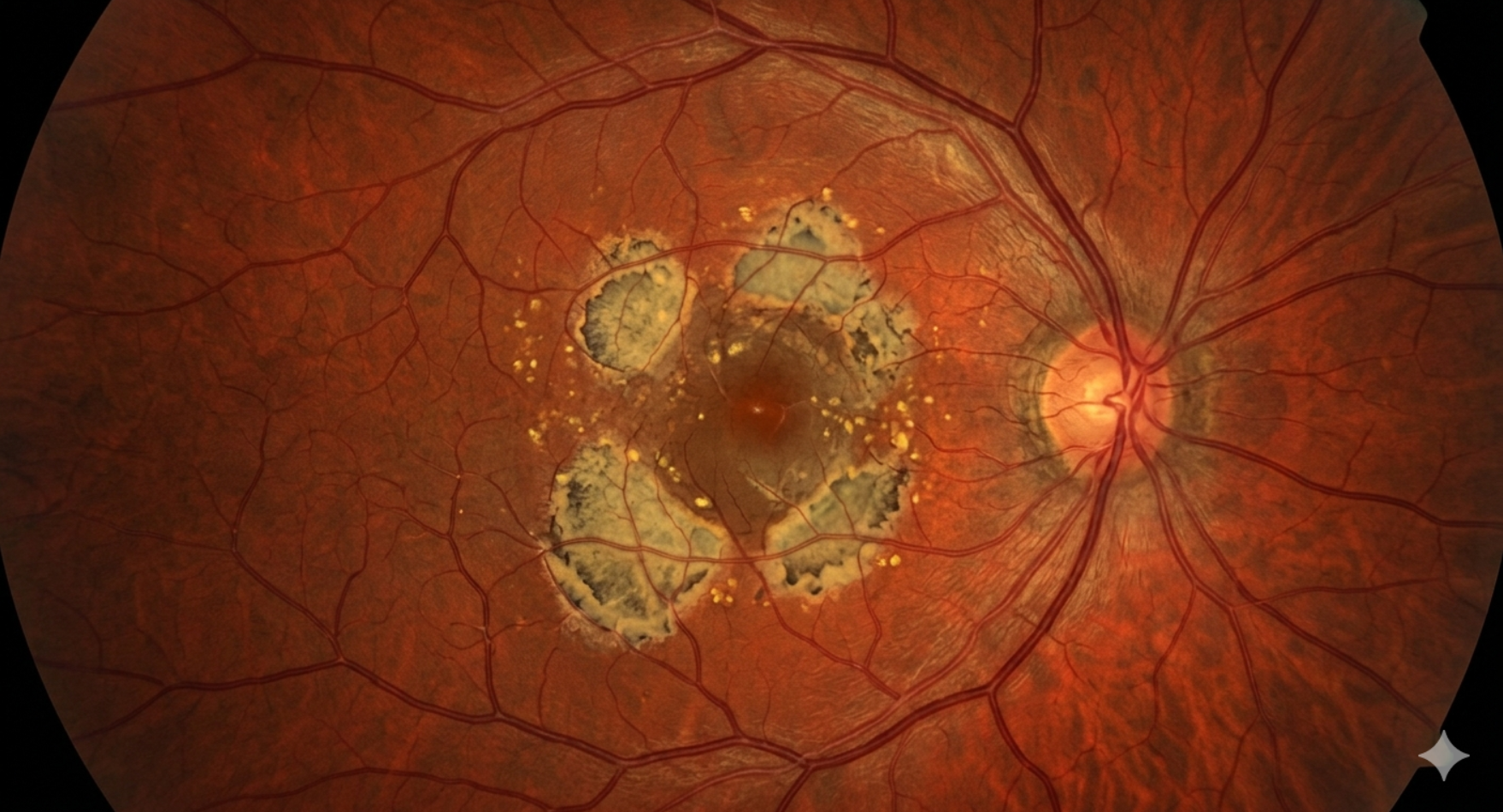
When I got my own macular degeneration diagnosis, I immediately threw away the supplement I'd been recommending to patients for years. Here's what I found on my own retinal scans — and what I take instead. I've read too many retinal scans to not share this with you. If you're dealing with macular degeneration right now, I need to tell you something your eye doctor isn't seeing. I've read 3,800 retinal scans and OCT images in 24 years as a retina specialist. And when a patient walks into their first appointment after diagnosis, I already know what their macular pigment density will look like three years before they ever notice the blur getting significantly worse. Severely depleted central pigment. The same nutritional depletion causing their early symptoms is progressing in the layers they can't feel yet. I'm Dr. Michael Mitchell. I'm a retina specialist with 24 years of experience treating macular degeneration — and specifically studying the relationship between macular pigment density and AMD progression. And when my own early macular changes appeared at 58, I knew something most eye doctors never tell their patients. Your macular degeneration isn't just a vision problem. It's a nutritional emergency happening at the cellular level — and the supplement your doctor recommended is only addressing part of it. I've been reading retinal imaging for 24 years. I've seen thousands of patients with early AMD. Thousands who got prescribed PreserVision and told to come back in six months and thought their condition was being managed. And I've seen the follow-up scans that most patients never understand the full meaning of. Because most eye doctors see you for twelve minutes. Run the standard scans. Renew the supplement recommendation. Send you home. They don't fully explain what is happening to your macular pigment between those six-month appointments. They don't explain why the supplement they handed you is only protecting two of the three zones your macula needs protected. But I see it on every scan. The 67-year-old woman who took PreserVision faithfully for four years. Never missed a dose. Came in for her routine appointment. Her central macular pigment — the fovea, the most critical zone — had continued depleting the entire time. She had been protected on the edges. The center had been completely exposed for four years. She had no idea. Her supplement looked complete. It wasn't. The 71-year-old man. "Just monitoring it, Doc. Doing everything you said." Three years on the standard protocol. His dry AMD converted to wet. Started monthly injections. His macular pigment density at the center had been declining since his first appointment. The supplement his previous doctor recommended contained two carotenoids. His macula needed three. Nobody had told him. I see them at follow-up appointments. They followed every instruction. They are not failures. They were failed. They had years to rebuild their central macular pigment. Years to give their fovea the specific protection it needed. Years to potentially prevent the conversion that put them in the injection chair. Their depleting macular pigment was the warning. The incomplete supplement just slowed the visible part of the decline — while the most critical zone kept starving. My own imaging told a different story than my symptoms suggested. Symptoms still mild. Central vision still functional. Morning reading still manageable. My optometrist colleague looked at my early changes and said what most eye doctors say to every patient at this stage. "Standard protocol. Start PreserVision AREDS2. Come back in six months. We'll monitor it." I knew it would slow some progression. That wasn't the point. I'm a retina specialist. I immediately ordered my own macular pigment optical density testing. Because I know what early AMD actually means — and what it means that almost nobody measures. Depleted central pigment. Macular pigment optical density significantly below protective threshold at the fovea specifically. The outer and middle layers — where Lutein and Zeaxanthin concentrate — showing measurable depletion but still within range. The center — where Meso-Zeaxanthin should concentrate — showing the most severe depletion of all three zones. My early AMD wasn't just a vision problem. It was a nutritional emergency — specifically, a complete absence of the one carotenoid that protects the most critical part of my retina. And PreserVision would have addressed two out of three zones while the most important one kept starving. Here's what most eye doctors don't tell you — because they were never taught to measure macular pigment density the way retina researchers do. Your macula has three distinct zones of protection. The outer ring is protected by Lutein. The middle layer is protected by Zeaxanthin. The center — the fovea — is protected specifically and exclusively by Meso-Zeaxanthin. These three carotenoids are not interchangeable. Each one concentrates in a different anatomical zone. Each one performs a specific protective function in that specific zone. When Meso-Zeaxanthin depletes, nothing else fills its role. Lutein does not migrate to the center. Zeaxanthin does not compensate. The fovea is simply exposed. And the fovea is where macular degeneration strikes first. The blur in your central vision — the difficulty reading fine print — the faces that are slightly soft from across the room — those are foveal symptoms. That is Meso-Zeaxanthin depletion presenting exactly as the research predicts it should. PreserVision contains Lutein and Zeaxanthin. It does not contain Meso-Zeaxanthin. The most prescribed eye supplement in America protects two out of three macular zones and leaves the most critical one — the zone already showing symptoms — completely unprotected. Patients with early AMD who take the standard AREDS2 formula have up to 40% continued decline in central macular pigment density despite full supplement compliance. The standard protocol was never designed to restore complete macular protection. It was designed to slow peripheral depletion. Your macular degeneration isn't failing to respond to treatment. It's responding exactly as expected when the most critical ingredient is missing. It's your macula's early warning system. And the incomplete supplement is silencing part of the alarm while the central zone keeps deteriorating. But most eye doctors don't measure macular pigment optical density at the fovea specifically. They track drusen and visual acuity. They don't see the nutritional depletion that precedes the visible damage by years. So they renew the supplement recommendation and send you home. My next step was clear. Not injections. Not yet. But I knew where the standard protocol was heading. I tried what every compliant patient tries. Dietary improvements. More leafy greens. More eggs. Helped marginally but central pigment density continued declining. Added omega-3s independently. Didn't address the specific depletion. My outer and middle macular zones stabilized slightly. My central pigment continued depleting. Nothing was rebuilding the Meso-Zeaxanthin concentration that was causing my foveal symptoms. But I kept returning to something in the research that made no sense to me clinically. Macular pigment CAN rebuild. The research from the Waterford Eye Institute in Ireland proved it definitively. Meso-Zeaxanthin administered at clinical doses measurably increases foveal pigment optical density in depleted patients. So why weren't patients rebuilding? October 14th. 11:23 PM. I was reviewing ophthalmology journals after a late clinic. Couldn't clear my head. My own central symptoms had been slightly worse that week. I was reading through studies on complete macular carotenoid supplementation. Not looking for anything new specifically. Just reviewing what I thought I already knew. I found a comparison study from Dublin that stopped me completely. Patients receiving Lutein and Zeaxanthin only — the standard two-carotenoid formula — showed modest improvement in peripheral macular pigment but continued central depletion at the fovea over 12 months. Patients receiving all three carotenoids including Meso-Zeaxanthin at 2mg showed statistically significant improvement in foveal pigment optical density over the same period. The difference in outcome between the two groups was not marginal. It was the difference between continued central depletion and measurable central restoration. Not slowed. Restored. I sat there at 11:23 PM staring at the comparison data. PreserVision forces partial protection by giving the outer and middle zones what they need. The fovea gets nothing. Central depletion continues. Symptoms progress. Eventually conversion to wet AMD occurs. Complete three-carotenoid supplementation gives every zone what it specifically needs. The fovea gets Meso-Zeaxanthin directly. Central pigment rebuilds. The shield restores. The foundational cause of the degeneration is addressed rather than partially managed. I had been a retina specialist for 24 years. I had studied macular pigment my entire career. And I had been recommending a formula to my own patients that left their most critical zone unprotected. Because the research on Meso-Zeaxanthin had not been incorporated into standard AREDS recommendations. Because the major supplement brands had not reformulated. Because nobody had told me and I had not independently verified what the complete formula required. At 11:47 PM I searched for a supplement containing all three carotenoids at the doses used in the Dublin research. Most supplements I found contained Lutein only. Or Lutein and trace Zeaxanthin. One contained all three but at doses below the research threshold. Then I found Visiovance. 20mg Lutein. 2mg Zeaxanthin. 2mg Meso-Zeaxanthin. The exact doses used in the clinical research showing foveal pigment restoration. Plus Saffron Extract — shown in separate clinical trials to improve retinal cell function and photoreceptor response in AMD patients. Plus Astaxanthin at a dose sufficient to cross the blood-retina barrier — something most formulas do not achieve — providing direct antioxidant protection at the photoreceptor level. Plus Bilberry and Ginkgo Biloba for retinal microcirculation support. Plus Omega-3s, Zinc, and Copper at the AREDS2 validated ratios. 15 ingredients total. Every one at the dose the research used. Not the token quantities that allow a label claim without achieving a clinical effect. I didn't expect dramatic results. I expected the research to replicate. I started November 3rd. One capsule every morning with breakfast. November 10th — 7 days in. I woke up and the morning glare from the bedroom window did not make me wince the way it had been for months. I lay there testing it. Wondering if it was psychological. Covered one eye then the other. The sensitivity was genuinely reduced. The physiology was beginning to respond. November 17th — 14 days in. Colors looked different. More saturated. More vivid. Like a setting had been adjusted on everything I was looking at. I went outside and stood in the garden and looked at the roses. The reds and yellows were vivid in a way that made me stand there for a full minute. My husband came out and found me. "What are you looking at?" "The garden," I said. "You've been standing there for five minutes." "I know." November 24th — 21 days in. Read the newspaper at the kitchen table. The actual printed newspaper. Without enlarging anything. Without my phone. Without asking my husband to read me the smaller columns. Read the entire front section. Then sat there with my coffee and felt something I had not felt since before my diagnosis. Not relief exactly. Something more specific. The feeling of being exactly who I had always been. December 21st — 7 weeks in. I wanted data. Not just symptoms. I ordered my own repeat macular pigment optical density testing. I positioned myself for the scan. Waited. When the results came, I pulled up the comparison against my baseline. Foveal macular pigment optical density had increased measurably in both eyes. Central zone — the zone PreserVision had never touched — showing the most significant improvement. I pulled up the comparison maps. October baseline versus December follow-up. The foveal pigment density was visibly denser. The central zone that had been the most depleted was showing measurable restoration. My AMD symptoms were resolving because my macular pigment was rebuilding. Not masked. Rebuilt. I printed both maps. Sent them to my colleague Dr. James Patterson who had been seeing similar results anecdotally in his own practice. He called me within the hour. "Michael, what changed? Central pigment doesn't restore this clearly in seven weeks." I explained the complete three-carotenoid mechanism. The Meso-Zeaxanthin specifically. The foveal concentration pathway. The Dublin comparison data. He was quiet for a long moment looking at the maps. "Your endothelial function improved. Drusen stable. And your central pigment..." He paused. "You said your symptoms resolved?" "Completely." Another pause. "I need to start measuring foveal pigment density in every AMD patient I see. Not just overall optical density. Specifically foveal." I changed nothing about my clinical protocol that day. Except I added one thing to every AMD consultation. I'm not sharing this because I'm against PreserVision or the AREDS2 formula. These supplements have genuine research behind them. They slow peripheral macular degeneration. They reduce the risk of conversion to wet AMD in high-risk patients. They work exactly as they were designed to work. But they were not designed to protect the fovea. They were not designed to restore central macular pigment. They were not designed to address Meso-Zeaxanthin depletion — because when the AREDS formula was developed, the research on Meso-Zeaxanthin and foveal-specific protection was not yet incorporated into clinical guidelines. The formula is decades old. The research has moved forward. The formula has not. And I see what happens over years to patients who followed the standard protocol while their central macular pigment kept depleting. Your early AMD isn't failing to respond. It's the warning your macula is sending about a specific nutritional depletion your current supplement was never designed to address. And you have two choices. Take the incomplete formula while your central macular pigment continues depleting. Or complete the formula and give every zone of your macula the specific protection it needs. I think about what I almost did. Not just accepting slow progression. That wasn't the point. I almost spent years on a supplement that protected two zones while the most critical one kept starving. I almost watched my central vision slowly deteriorate while doing everything my colleagues would have told me was correct. I almost became the patient I see at follow-up appointments — the ones who did everything right and still progressed — wishing someone had told them their supplement was incomplete. Because once AMD progresses to advanced geographic atrophy, the photoreceptors that die do not regenerate. Once wet AMD begins, you are managing a condition with monthly injections. Once significant central vision is lost, it does not fully return. You do not get a second window. Early AMD is your window. The only window where the pigment can fully rebuild. I am sharing this because if you have been diagnosed with macular degeneration and you are taking a standard eye supplement — you deserve to know what I know. Not from a pamphlet. From 24 years of reading retinal scans and watching what happens to the patients who had the information and the patients who didn't. Your early AMD is not the problem. It is the warning your macula is sending about a specific nutritional depletion. Your fovea is starving. And every month it goes without Meso-Zeaxanthin is another month the central zone depletes further — toward the permanent damage that no supplement can reverse. Seven weeks. That is how long it took my foveal macular pigment optical density to show measurable improvement. Seven weeks of giving my macula the complete formula. Not the partial one. I'm not saying don't take PreserVision. I'm saying understand what it is not doing. Your progressive central symptoms are your check engine light. The incomplete supplement is partial tape over a warning indicator that is still flashing. The central depletion is still happening. You just can't see the full picture anymore. But I see it every day on retinal scans. Patients who took the incomplete formula for years. Then came to follow-up appointments with advanced central involvement. Every single one says the same thing. "I wish someone had told me my supplement wasn't protecting the center." I'm telling you now. Your standard eye supplement is not protecting your fovea. The same depletion causing your early symptoms is continuing in the most critical zone while you believe you're covered. Complete the formula — and you potentially save both your central vision and the years of independence that depend on it. Or continue the incomplete formula — and risk the progression that every retina specialist knows is coming when the center goes unprotected. I'm a retina specialist. I understand macular pigment depletion at a molecular level. And I chose to complete the formula before my central depletion progressed beyond the point where restoration was possible. That is all I am asking you to consider. Give your fovea what it has been missing before the window closes. Because once central photoreceptors are permanently lost, once geographic atrophy advances, once wet AMD conversion occurs — it is not reversible. Your early AMD is giving you a window of years. Use it. Seven weeks. That is all it took to show measurable foveal pigment restoration and resolve my early central symptoms. Seven weeks of completing the formula instead of taking the partial one. — Dr. Michael Mitchell Retina Specialist, 24 years Board Certified in Ophthalmology P.S. — The complete macular formula I used is called Visiovance. 20mg Lutein, 2mg Zeaxanthin, and 2mg Meso-Zeaxanthin — the three carotenoids at the exact doses used in the clinical research showing foveal pigment restoration. Plus Saffron Extract, Astaxanthin, Bilberry, Ginkgo Biloba, Omega-3s, Zinc, and Copper. 15 ingredients total. Third-party tested. Made in the USA. If you have been diagnosed with early or intermediate AMD and you are taking a standard two-carotenoid formula, consider this. Get baseline macular pigment optical density testing — specifically foveal density, not just overall optical density. Add the complete three-carotenoid formula for 8 to 12 weeks. Get follow-up testing. Let your macula show you what it can do when you give it the complete formula instead of the partial one. You can always go back to PreserVision if nothing changes. But you cannot undo the central photoreceptor loss that accumulates while the most critical zone of your macula goes unprotected.
Like this ad? Make it yours.
Crush rebuilds this exact creative around your product — your brand, your colors, your offer — in about a minute.