
Inactive· since May 17, 2026
- 6
- days it ran
- 0
- relaunches
- 20
- EU reach
Ad copy
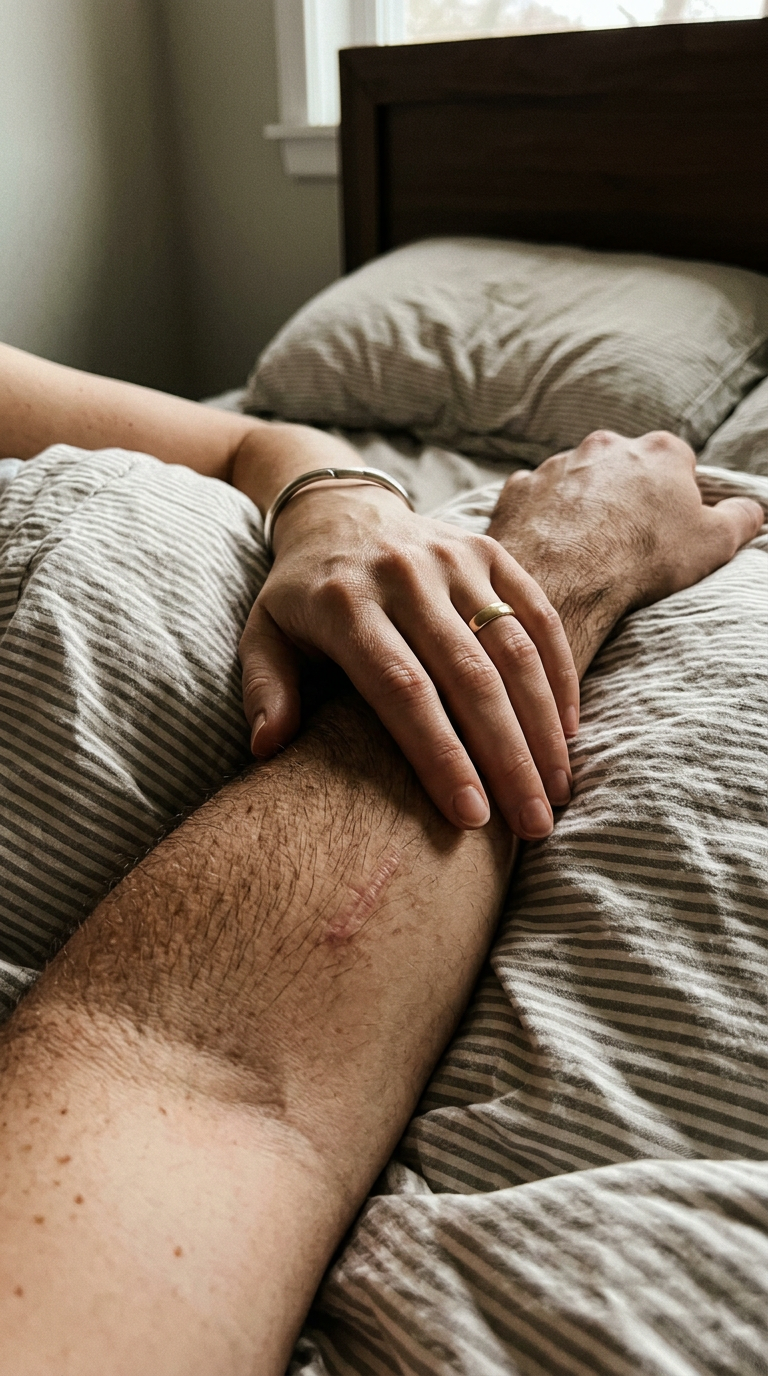
My hands remember a body my eyes can't find anymore. That's the thing nobody tells you about watching your husband change — your hands have a memory. Twelve years of reaching for a man in the dark, my hands know what his body is supposed to feel like. The shoulder with the cap of muscle. The arm with the bicep line. The stomach that was flat and firm and didn't require navigating. My hands reach for that body and find a different one. The shoulder is there but padded. The arm is there but softer. The stomach isn't flat — it's a geography my hands have to cross instead of rest on. My hands know the distance between who he was and who he is because my hands have been measuring it in the dark for four years. My husband was built at 36. Not gym-built — life-built. Fifteen years of consistent training had produced a body that was simply how he existed. He didn't think about it. I didn't think about it. It was the baseline. The way his body WAS. By 40, the baseline shifted. By 42, the baseline was gone. Same man. Same face. Different territory from the neck down. The territory my hands knew by heart was rezoned and nobody filed the permits. His doctor said "metabolism." Annual physical. Blood panel. Everything normal. "After 40, the body changes. Muscle mass decreases. Fat distribution shifts. It's normal for your age." The doctor wasn't entirely wrong. Bodies do change. But the doctor wasn't feeling what I was feeling at midnight. The doctor checked numbers on a screen. My hands checked the body in the bed. The numbers said normal. My hands said: something is missing that used to be here. And something is here that used to be missing. I watched him fight for four years. Not from a distance — from inches away. From the other side of the bed. From the doorway of the bathroom where the scale lived. From the kitchen where the punishment meals happened. I watched the 5 AM alarms. The bed shifting. The front door. The coming home sweating and sore. The stepping on the scale. The flat face — the one that meant the number hadn't moved or had moved wrong. I saw that face at 6:15 AM more mornings than I can count. The face of a man whose body was ignoring everything he threw at it. I watched the closet change. The fitted shirts he'd worn since I met him — the ones that showed the arms and the chest and the body I married — moving to the back. The front of the closet becoming dark, loose, oversized. A camouflage collection. I remembered when he bought shirts to show his body. Now he bought shirts to contradict his body. To make the body a rumor instead of a fact. I watched the meals. Chicken and broccoli across from my pasta. The clenched jaw. The eyes on my plate. The discipline of a man eating punishment while the woman he loves eats freedom. I felt guilty every dinner. I started eating his way when he was there and my way when he wasn't. His body shame became my eating secret. I watched the supplements arrive and the supplements fail and the next supplements arrive and the next supplements fail. A bathroom counter of bottles with promises. A graveyard of hope in capsule form. I watched him cut beer and gain weight. Cut carbs and gain weight. Run in the dark on destroyed knees and gain weight. Hire a trainer and gain weight. Do everything a man can do and have his body respond with the opposite of everything. There's a thing I need to say that wives don't say. I missed the body. Not for vanity — for familiarity. For the hands-in-the-dark version of my husband that I'd mapped over twelve years. I missed reaching for him and finding the shape I expected. I missed the specific weight of his arm across me at night — the arm that was muscle and bone without a layer between. I missed the flat stomach under my hand when we lay on the couch. The contact that was direct — skin to structure, no detour through padding. I'm not talking about attraction. I'm talking about RECOGNITION. My hands recognized a body that no longer existed and every touch was a micro-grief. The body under my hands was real and present and mine — but it wasn't the one my hands remembered. And the mismatch — between what my hands expected and what they found — was a loneliness I couldn't tell anyone about. Because how do you say "I miss my husband's body" without sounding like you're saying "I don't want this one"? I wanted this one. I wanted EVERY one. But my hands remembered the other one and the remembering was its own kind of loss. He felt it. I know he felt it. The way my hand would land on his stomach and I'd feel the flinch — the involuntary pull of a man whose body is being touched in the place he least wants to be touched. The flinch that meant: you found the part I'm hiding. The part the shirts cover. The part the dark is supposed to protect. Your hand just told me what I already know. I stopped reaching for his stomach. My hands rerouted. Found the shoulder instead. The arm. The safe zones — the parts that still felt like the parts I remembered. The body had zones now. Safe zones and shame zones. And my hands learned the map the way you learn a detour — automatically, without acknowledging you're avoiding the direct route. At 43, he stopped trying. Put the scale somewhere. Cancelled the gym. Stopped the supplements. Accepted the body. And I watched my hands adjust to the permanent version. The version that wasn't coming back. The rezoning was complete. I didn't accept it. Not because I needed the old body — because the new body came with a new man. A man who flinched when I touched him. A man who kept his shirt on. A man who turned the light off. The body change wasn't cosmetic. It was structural — it had changed the way he existed inside intimacy. The confidence was gone. The being-seen was gone. The man who used to reach for me now waited to be reached for. And flinched when I did. One night — midnight, he was asleep, I was awake in the way wives are awake when something in the marriage has shifted and the shift keeps you up — I searched. Not for diets. Not for gym programs. For the thing underneath. "Why does my husband gain weight while training. Why does muscle disappear under fat. Why does nothing work. What are doctors missing." I found an article about the nervous system. About chronic stress and cortisol. About survival mode. About bodies that store fat over muscle when the nervous system is in emergency — the body literally insulating itself against a perceived threat. Building padding. Over the structure. Over the muscle. Over the body the gym is building. Like bubble wrap around a package. The package is intact. The wrap is hiding it. The article mentioned Liven. Micro-Cycle Method. Five minutes a day. For the nervous system. The bubble wrap. Not the package — the wrap. I showed him on a Sunday morning. Coffee. Our calmest moment. "I think your body is wrapping itself," I said. "I think the gym is building something and your nervous system is covering it. And that's why nothing else has worked." He read the article. Took the quiz. Yes to everything. "Five minutes," he said. "For the wrapping." Week 1: sleep. The bed was stiller. The 3 AM jolt eased. My body relaxed because his body relaxed because the bed shared the calming. Week 2: his face sharpened. The first change I saw — the puffiness dropping. The jaw emerging. The face I married becoming visible through less cortisol bloat. Not the body yet — the face. The preview. Week 3: I reached for him in bed. My hand landed on his arm. And something was different under my fingers. Not bigger — defined. The muscle was closer to the surface. The padding between my hand and the structure was thinner. My hands noticed before my eyes did. Because my hands have been measuring for twelve years and they detect millimeters. Week 4: "Ten pounds," he said. Without the gym war. Without the punishment meals. My hands already knew. The body was shifting under my hands at night in ways the scale confirmed in the morning. Week 6: I reached for his stomach. Not the reroute — the direct route. My hand landed on the place I'd been avoiding. And the flinch didn't come. He didn't pull away. The stomach was still there — not flat yet — but the flinch was gone. The shame in that zone had eased enough that touch was allowed again. My hand rested on his stomach. His hand covered mine. We lay there. The first time in two years my hand had rested there without the flinch. Without the reroute. Without the detour. The direct route. Reopened. Week 8: he took his shirt off in bed. The light was on — the bedside lamp, not overhead. He reached for me. Not waited — reached. The reaching was the return. The man who used to reach for me with the confidence of a body he was proud of was reaching again. Not with the same body — with the same man inside a body that was moving in the right direction. "There you are," I said. My hands on his chest. Finding what they expected to find. Not the 36 version. But a version where the structure was emerging through less padding. Where the package was becoming visible through less wrap. "There I am," he said. It's been five months. My hands tell the story better than the scale. The shoulders have their shape back. The arms have their line. The stomach isn't flat yet but it's not the flinch zone anymore. The direct route is open. The detour is closed. He takes his shirt off. Not always — but more. The light stays on. He reaches for me. The confidence is rebuilding the way confidence rebuilds — not all at once. In touches. In the millimeters my hands measure at midnight. The closet is reorganizing. The fitted shirts are moving forward. He wore one last weekend — a polo from three years ago. It showed the body the way it used to show the body: shoulders, chest, a man whose shape is visible and worth seeing. I looked at him across the room at a party last Saturday. Fitted polo. Standing with his drink. Laughing with someone. And the thought came back — the one I hadn't had in four years: mine. It wasn't that metabolism didn't matter. It's that metabolism wasn't the wrapping. The wrapping was cortisol. The nervous system in survival. Insulating a body that was still being built by the gym. And once the wrapping thinned, the gym's work became visible and my hands found what they'd been looking for. If your hands remember a body your eyes can't find. If the flinch has replaced the welcome. If you reroute around the shame zones in the dark. If the man who used to reach for you now waits. The body is still there. Under the wrapping. The gym built it. The nervous system covered it. And the covering can come down. Liven has a quiz. A few minutes. Doesn't cost anything. Show it to him. Tell him: "My hands remember the body you built. And I think it's still there." Link is below. 💙
THIS IS what you need to do
LEARN MORELike this ad? Make it yours.
Crush rebuilds this exact creative around your product — your brand, your colors, your offer — in about a minute.