Non-toxic kitchen guide
 Facebook ad: “The Gift an Amish Mother Wouldn’t Let Her Daughter Use”
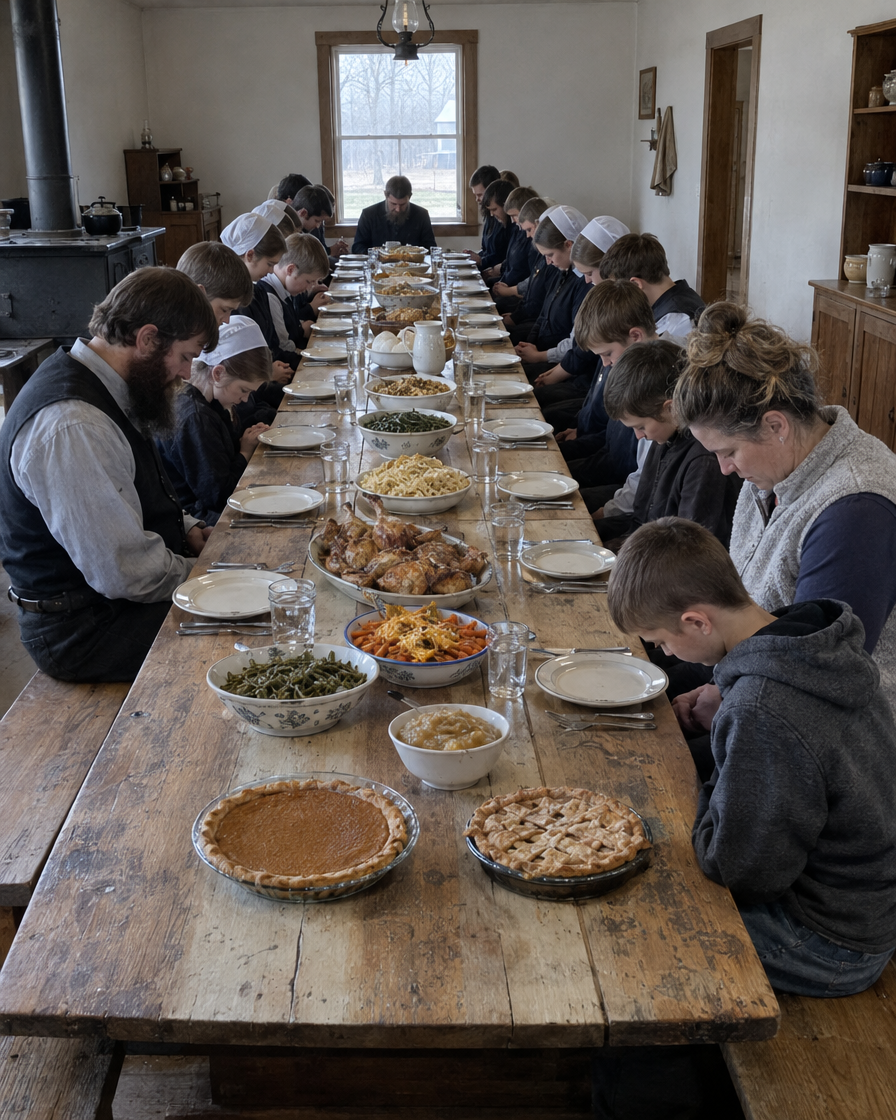
Running for 37 days since October 15, 2026. Crush last saw it on November 21, 2026.
Run by Non-toxic kitchen guide on Facebook. Crush is not the advertiser and does not verify its claims. See this ad in Meta's Ad Library(opens in a new tab)
Make your own version of this ad
Crush makes it, launches it in your own Meta ad account, scales the winners and pauses the losers.
About this ad
- Meta Ad Library ID
- 974067965773887
- Platforms
- Facebook, Instagram and Threads
- Relaunches
- 0
Ad text
For eight years, I've driven Amish families wherever a horse can't take them. The doctor. A funeral two states away. Nine hours to Wisconsin, if that's where the grandchildren are. Last November I was supposed to drop one of those families at their daughter's farm, eat Thanksgiving at a roadside café with my son, and pick them up again on Saturday. The mother wouldn't hear of it. And what I saw in that Amish kitchen over the next two days is why there are now three heavy boxes in our family, in three different states. My name is Joyce. I'm forty-six, and I live in northwest Missouri with my son, Caleb. He's nine. If you don't live near the Amish, you might not know driving them is a job. They don't drive themselves, but they still need to get places a buggy can't go. So they hire what they call an English driver. That's me, and my fifteen-passenger van. I know which families want the radio off. I know which grandmothers get carsick past the second hour. And the women in the families I drive have given me a nickname, dinn rint, which I was told is Pennsylvania Dutch for "skinny heifer." I've decided to take it as a compliment. Last November, the Yoders hired me for the biggest trip I'd ever done for them. Samuel and Esther Yoder and nine of their eleven children, from northwest Missouri up to Wisconsin, to spend Thanksgiving with their married daughter, Lena, who'd moved up there with her new husband in the spring. It was a nine-hour drive each way, over Thanksgiving. And I said yes before they'd finished asking. Because I didn't have anywhere else to be. That was our second Thanksgiving since the divorce. Caleb's dad had remarried and moved to Arizona. My parents are both gone. My sister lives in Oregon, and the flights that week cost more than my van payment. The Thanksgiving before, it had been the two of us at my kitchen table with a frozen turkey breast, a can of cranberry sauce and the parade on TV. Caleb had asked, around two in the afternoon, if this was what Thanksgiving was going to be now. I didn't have a good answer for him. So this year, I took the job. At least a nine-hour drive felt like going somewhere. Caleb came along, wedged in the back row of the van with a bag of pretzels and three Yoder boys who thought his tablet was the most wonderful thing they'd ever seen. My plan was simple. Drop the Yoders off on Wednesday night. Find a motel. Take Caleb to a roadside café on Thursday, the two of us, turkey and gravy in a booth. Pick the Yoders up again on Saturday morning. I'd even looked up the café. It had good reviews for its pie. We pulled into Lena's farm a little after dark on Wednesday. A white house, a red barn, a lantern in the kitchen window, and an uncle's family already there from Indiana with their own buggy in the yard. I helped unload the bags. I said my goodbyes. I told Esther I'd be back on Saturday at eight. Esther put her hand on my arm. "Where are you sleeping?" she said. "The motel by the highway." "And where are you eating Thanksgiving?" "There's a café," I said. "It has good reviews for its pie." Esther looked at me the way she looks at one of her boys when he's said something foolish. Then she looked at Caleb, half asleep on his feet with a pretzel in his hand. "No," she said. "Nobody eats Thanksgiving in a café. You'll stay here." "Esther, there are already twenty people in this house." "Then two more won't matter." I argued. I want that on the record. I argued for about a minute and a half. Samuel came over and said something to her in Pennsylvania Dutch, and she answered, and that was the end of it. Lena was already carrying two quilts up the stairs. That's how Caleb and I came to spend Thanksgiving at an Amish table. I'd been in a lot of Amish homes by then. I'd sat in a lot of Amish kitchens, waiting for someone to finish packing. But I'd never been inside one for two whole days. I'd never seen what happens when the van leaves and the door closes. Thanksgiving started before the sun came up. Amish women start cooking for a holiday days ahead, and Esther and Lena had been cooking since the minute the van stopped. When I came down at six on Thursday morning, the kitchen was already warm and every surface was covered. Pie crusts rolled out on the counter. A mountain of potatoes. Noodles drying on a clean cloth over the back of a chair, homemade, cut by hand into long ribbons. Lena's husband had raised the chickens himself, and butchered them the week before. Esther had brought green beans and carrots from her own garden in Missouri, canned in August and carried nine hours on her lap. The table took up most of the kitchen. It was long and thin, handmade, and worn smooth and pale down the middle by years of elbows and plates. Lena's husband's father had built it. There were benches on both sides and not a single matching chair. By noon, there were twenty-two of us around it. A year earlier, it had been two of us and a frozen turkey breast. I sat down on that bench next to Caleb and had to look at the ceiling for a second. When Samuel sat down, everyone sat down with him. Caleb watched the Yoder boys and did exactly what they did. Then Samuel bowed his head, and the whole table went silent. No one said grace out loud. There was just quiet. Twenty-two people, eleven of them children, and not one sound. Not a fork. Not a giggle. I could hear the stove ticking and a horse shifting out in the barn. I've never heard a room that full be that quiet. Then Samuel lifted his head, and the bowls started moving. Roasted chicken. Stuffing. Mashed potatoes. Esther's green beans and carrots with melted cheese on top. Lena's homemade noodles, cooked in the chicken broth, with pieces of chicken through them. A bowl of homemade applesauce, still a little warm. Bread. Simple food, and so much of it. And this is the part I need you to hear. Caleb is nine. He has never, in his life, voluntarily eaten a green bean. I have hidden green beans in his mashed potatoes. I have bribed him with dessert. I have watched him slide them under the rim of his plate like a magician. He took one bite of Esther's green beans. Then he took another. Then he reached across a Yoder boy and helped himself to more. I stopped chewing. "Caleb," I said. "Those are green beans." "I know," he said. "Mom, why doesn't yours taste like this?" Twenty-two people heard that. Esther's oldest daughter laughed so hard she had to put her fork down. I laughed too. But it went in like a splinter. Because here's the thing. I buy my vegetables from the Amish. The families I drive sell me their green beans and carrots every summer. I buy my chickens from a Mennonite farm forty minutes from my house. I make my noodles from scratch at Christmas, the way my mother did. "Esther," I said. "What do you put in the beans?" "Beans," she said. "Carrots. A little cheese. Salt. Butter." "That's it?" "That's it. Nothing you don't have." She was right. I had every one of those things in my kitchen at home. Some of them from her own neighbors. So why didn't mine taste like that? I didn't get an answer at the table. Dessert came first. Apple pie and pumpkin pie, so many of them they ran the length of the table. Caleb had both. I didn't stop him. When the meal was over, Samuel bowed his head again, and the table went silent a second time. A prayer after the meal, the same as before. And then they sang. It was a hymn from the Ausbund, the old Amish hymnbook, number 131. Esther told me later it's called "Das Loblied." They sing it at every church service, and they sang it at that table on Thanksgiving. There were no instruments. No harmony. Just twenty voices, rising slow and long, every word stretched out, in a language I didn't understand. It went on for a long time. Caleb sat absolutely still beside me with his mouth a little open. I had tears on my face and didn't wipe them, because nobody else was moving. Then the table broke up. The little ones ran off to play a game on the floor of the sitting room. Samuel, Lena's husband and the older boys settled into the front room to visit. And Esther and Lena and the older girls went straight to the dishes. I picked up a dish towel. No one told me to. It just seemed like the thing you do in that house. Two of the oldest girls washed. One scrubbed, one rinsed and stacked. I dried. Nobody hurried, nobody complained, and nobody turned on anything, because there was nothing to turn on. Just the water, and the girls talking low in Pennsylvania Dutch, and the stack of dry plates growing on the table. And that's when I started to notice what I was drying. I dried the big spoon from the mashed potatoes. It was wood, dark and heavy, and much heavier than I expected. It sat in my hand like it had been made for it. I dried the spoon from the green beans. Wood. Dark. Heavy. I dried the long, flat paddle Lena had stirred the noodles with. Wood, worn smooth as a river stone, with a grain running through it like the inside of a shell. I dried the ladle from the gravy. Wood. I dried every single thing that had touched our food that day. And I realized I hadn't dried one piece of plastic. Not a spatula. Not a ladle. Not a single silicone anything. I stood there with the dish towel in my hand and did the arithmetic. Same beans. Same carrots. Same chicken. Same noodles. The only thing in that kitchen that was different from mine was the thing I was holding. Esther saw me looking at the paddle. "That was my grandfather's," she said. "He carved it the winter I was born. I gave it to Lena when she married." "It's beautiful." "It's a spoon," Esther said, but she was smiling. Then Lena, drying her hands, laughed and said something to her mother in Pennsylvania Dutch. Esther laughed too, and then rolled her eyes, and then reached into a drawer and pulled out a box. It was a set of kitchen utensils, still half in the packaging. Light-colored wooden spoons, tied with a ribbon. A wedding gift, Lena explained, from a kind English neighbor down the road. "Mam won't let me use them," Lena said. "Because I know what they are," said Esther. "Esther," I said. "What are they?" She didn't answer right away. She took one of the spoons out of the box and turned it over in her hands. "This isn't one piece," she said. "Look. You see that line? That's glue. Little scraps of soft wood, glued together. A year of hot pots and the sink, and the glue lets go and it comes apart. And until it comes apart, that glue is going into your food." "What do you cook with?" she asked me. "A black spatula, mostly," I said. "But it says BPA-free." "They all say that now. They took one thing out and put another in. You just never heard of the other one." She tapped the edge of the sink. "Every time plastic touches a hot pan, a little of it goes into your food. Look at the edge of yours when you get home. Is it still straight? Then where did the rest of it go?" I opened my mouth. Then I closed it. I'd been stirring with that spatula for years. The edge had been straight when I bought it. It wasn't now. "And the bamboo ones?" I asked. "My sister sent me a bamboo set for my birthday." "Bamboo is grass," Esther said. "Grass glued together. More glue." Then she said the line I still think about every time I open my kitchen drawer. "The English worry so much about what goes in the pot. Nobody thinks about what's stirring it." I didn't say anything. Because there was something I hadn't told anyone. Not my sister. Not the doctor, really, not in the way I meant it. I hadn't felt like myself in a long time. Not sick. Just turned down. Tired by two in the afternoon for no reason I could find. Puffy by evening. Walking into a room and forgetting why. And I do everything right. I buy my food from the Amish. I cook from scratch. I'm on my feet all day, loading bags and folding wheelchairs into the back of a van. My doctor ran the bloodwork. Everything was fine. It's stress, she said. You're raising a boy on your own. I'd decided she was right. That's what everyone decides. Standing at that sink with Esther's grandfather's paddle in my hand, for the first time, I wondered if she was wrong. And then I thought about Caleb, nine years old, eating out of my pots every single day. Licking the spoon when I make frosting. My throat closed up. Esther was watching my face. She didn't say anything. She just nodded once, slowly, like she'd seen that look on an English woman before. Then she did something I didn't expect. She took two canning jars down from Lena's shelf and filled them at the sink. In one, she stood one of the wedding-gift spoons. In the other, her grandfather's paddle. She set them side by side on the windowsill over the sink. "We'll see in the morning," she said. And then, to Lena, "Both of us will see." Lena rolled her eyes at her mother, the way every new bride in the world rolls her eyes at her mother. But she didn't say no. That night I lay awake in Lena's spare room, under a quilt Esther's mother had made, listening to Caleb breathe and the wind come across the fields. I couldn't stop thinking about two jars of water on a windowsill. On Friday morning I came down before anyone else. The kitchen was dark and cold. The only light was the gray coming in through the window over the sink, and it came straight through the two jars. The one with the paddle was perfectly clear. The one with the wedding-gift spoon was the color of weak tea. I stood there in my socks for a long time. My hands wouldn't stop shaking. That was cold water, one night. I thought about my stew, three hours on the stove. My Christmas noodles. Every bowl I'd ever put in front of Caleb. Lena came down a few minutes later in her nightgown and shawl. She saw the jars and stopped. She didn't say anything. She just took the box of wedding-gift spoons out of the drawer and set it by the door. Esther came down behind her, looked at the jars, looked at the box by the door, and put the kettle on. Nobody said a word about it. Nobody needed to. We stayed through Friday. Caleb learned a card game from the Yoder boys and lost every hand cheerfully. In the evening Samuel read a story aloud from a little book while the children lay on the floor around his chair. On Saturday morning I loaded the van, and Esther would not let me leave without pie. Not a slice. Two whole pies, one apple and one pumpkin, wrapped in dish towels and handed through the driver's window. And a bag of Lena's noodles, and a jar of applesauce. "Esther, I can't take all this. You've fed us for three days." "You drove us nine hours," she said. "You paid me to drive you nine hours." "Then this is for the rest," she said, and that was the end of that, too. I'd driven for the Amish for eight years, and I finally understood something about them. They don't like to owe anybody. Not even for the part you weren't paid for. Caleb held one pie on his lap the whole way back to Missouri. He didn't eat any of it. He said it was for later. Somewhere in Iowa, he said, "Mom, are we going to get spoons like theirs?" "Yes," I said. "We are." When we got home, I didn't wait for morning. I filled a glass at my own sink and stood my own wooden spoon from the store in it, and then I took my black spatula out of the drawer and turned it over. The edge was chewed thin and wavy. Where had the rest of it gone? In the morning, the glass was the color of weak tea. I threw out every utensil in that drawer. Caleb held the trash bag. That afternoon I sat down at my kitchen table and went looking for what Esther had in her kitchen. First I wanted to know if she was right. She was. The black nylon spatulas in nearly every American drawer start releasing compounds into food at around 158 degrees. My stew simmers well above that. Researchers are finding tiny plastic particles in nearly everyone they test. What those particles do in the body, they're careful to say, they're still working out. Then I went down her list. Hard, heavy wood. One piece, no glue line. Nothing painted on. The wood that fit it best was small-leaf acacia. It's heavy for its size and full of its own natural oils, so water sits on top of it instead of soaking in. Nothing has to be painted on to protect it. Plenty of sellers said "acacia." Most wouldn't tell me which acacia, or whether it was one piece or glued scraps. I found one small company that would. Every piece hand-carved from one solid piece of small-leaf acacia. No glue. Just plant oil and beeswax. I ordered the 10-piece set for my kitchen in Missouri. Then a second one for my sister in Oregon, to replace the bamboo set, with a note telling her to stand one of her old spoons in a glass of water first. Then a third. That one I sent to Wisconsin, to a little farm with a red barn, addressed to Lena, with a note that said: For the drawer by the door. From the dinn rint. Three heavy boxes. Three different states. When mine came, I knew before I opened it. It was heavy. I took out the long spoon, and it sat in my hand exactly like the one I'd dried in Lena's kitchen. I stood one piece in a glass of water that night. In the morning, the water was clear. The next week, I made green beans. Beans, carrots, a little cheese, salt, butter. The same beans I always buy, from the same Amish families I drive. I stirred them with the long spoon. Caleb took one bite. Then another. Then he reached across the table and helped himself to more. "Mom," he said. "These taste like Esther's." I had to go stand at the sink for a minute. A few weeks after that, I noticed I hadn't needed my two o'clock sit-down in a while. I won't pretend to know why. But I know what changed in my kitchen. At the end of January, a letter came from Wisconsin. Amish women write letters the way the rest of us send texts. It was from Lena, two pages in pencil. Near the bottom she'd written: The spoons came. Mam held every one up to the light looking for the glue. She couldn't find any. She says you may keep your nickname. And underneath that, one more line: Mam says you are expected again at Thanksgiving. Bring the boy. I read it out loud at the kitchen table. Caleb didn't say anything. He just got up, went to his room and came back with his duffel bag. It was January. He packed it anyway. I spent two years thinking I was just tired. Divorced, raising a boy alone, driving a van all day. Maybe some of it was. But I'd bought the best food I could find, from the best people I know, and never once looked at what was stirring it. It took the loneliest Thanksgiving I'd ever planned, and a table of twenty-two strangers, for somebody to show me. If you eat well, cook from scratch and still don't feel like yourself, you've probably been told it's stress, or your age, too. It might not be either. And it was never your cooking. It might just be what's stirring it. All three sets are from Properware, a small American company. Every piece is hand-carved from one solid piece of small-leaf acacia, nothing on it but plant oil and beeswax. They'll replace any piece that ever cracks, for as long as you have it, and you have thirty days to send it back. Every piece is carved from one solid block, so they make them in batches. If they're between batches when you go to order, it's worth the wait. This is where I got mine: https://tryproperware.com/pages/acacia-utensils Joyce P.S. Before you order anything, do Esther's test. Stand your everyday wooden spoon in a glass of water tonight and look at it in the morning. Then turn your spatula over and look at the edge, and ask her question: where did the rest of it go? P.P.S. I got their acacia cutting board too. My white plastic one had a thousand knife grooves in it, and after that night at Lena's sink I couldn't stop wondering where all those little slivers went. The new one sits next to the spoons by my stove. https://tryproperware.com/pages/acacia-utensils
Where the ad sends people
tryproperware.com
The Gift an Amish Mother Wouldn’t Let Her Daughter Use
Properware
Learn more: tryproperware.com(opens in a new tab)