Deborah Washington
 Facebook ad: “Ceylon Cinnamon 7200mg Equivalent with MCT Oil”
Running for 40 days since September 30, 2026. Crush last saw it on November 9, 2026.
Run by Deborah Washington on Facebook. Crush is not the advertiser and does not verify its claims. See this ad in Meta's Ad Library(opens in a new tab)
Make your own version of this ad
Crush makes it, launches it in your own Meta ad account, scales the winners and pauses the losers.
About this ad
- Meta Ad Library ID
- 992988057150801
- Platforms
- Facebook, Instagram and Threads
- Relaunches
- 0
Ad text
I am going to say something that no Black woman who is 60+ with Type 2 diabetes wants to hear, and I don't give a d*mn if it upsets you. My sister Sharon cut out every single carb and sweet on July 8th, 2024. Threw out every box of Jiffy cornbread mix, every bag of rice, every box of pasta, every pie pan in her house. Went full keto. Walked three miles every morning before sunrise. Started drinking green juices, of all things. She did everything her doctor told her to do. She had a massive heart attack on October 19th at 2 AM. She was 63 years old. The paramedics brought her back in the ambulance. The cardiologist put in two stents. But we almost lost her. Four minutes later to the hospital and she would have been gone. Her heart stopped on the operating table for forty seconds before they got her back. Thank God she survived. The hospital bill was $68,000. The cardiac rehab was another $9,200. Her favorite coffee mug — the one with her Delta Sigma Theta emblem — is sitting on her kitchen counter right now. Her hand is wrapped around it. Fifteen months ago, I thought I was going to be planning her funeral. I need to tell you what happened to Sharon. Because I have been a Registered Nurse and diabetes educator for 24 years in Atlanta, and I am seeing the same posts in Black women’s Facebook groups and church chats that my own sister was making months before her heart attack — “My A1C is a little high, y'all have any tips?” — and it makes me physically sick. If you are a Black woman over 60 and you have Type 2 diabetes, or your mother, sister, or auntie does, please read every single word of this. I know it is long. I know you are scrolling. I know you have church, grandbabies, and a million things to do. Fifteen months ago, I would have given everything I owned for someone to tell me what I am about to tell you. And I am telling you this as a veteran Black diabetes educator who thought she knew everything. I taught the classes. I gave the lectures at community health fairs. I sat across from thousands of Black patients in clinics and told them what to cut out, how to check their sticks, and how to take their Metformin. And I still couldn't save my own sister from what was about to happen. Sharon went in for a routine checkup on June 28th, 2024. She felt fine. Better than fine. She had just turned 63. She was still hosting Sunday dinners for the family, tending her flower beds, and singing in the sanctuary choir every week. She thought she was invincible, and honestly, so did I. Two days later, her doctor called. A1C of 10.5. Fasting glucose of 238. — Your blood sugar numbers are dangerously high, Sharon. We need to talk about your diet immediately. Sharon was quiet on the phone. I was sitting in her kitchen listening. Ever since her husband Marcus passed three years earlier from stroke complications, I spent most of my week at her house. — What does a typical day of eating look like for you? — Grits with a little butter and toast for breakfast. Maybe some sweet tea. Sunday dinner is mac and cheese, collard greens with ham hocks, candied yams, and fried chicken. Peach cobbler when the grandbabies come over. — That is ending today. You need to cut all of it. No grits. No rice. No potatoes. No cornbread. No mac and cheese. No peach cobbler. No sweet tea. Absolutely no exceptions. We are starting Metformin today, and we will retest in three months. Sharon hung up the phone and sat at her kitchen table for an hour without making a sound. Then she stood up, walked into her pantry, and took everything out. I watched her throw away four boxes of cornbread mix. Two bags of long-grain white rice. A sack of russet potatoes. The leftover peach cobbler she had baked from our grandmother’s recipe. The sweet tea pitcher went straight into the sink. All of it went into the black trash bags. I asked her what she was doing. — I want to live to see my grandchildren graduate. I’m done. And she was. For 103 days, she didn't touch a single bite. No cornbread. No rice. No mac and cheese. No sweets. Not at our niece’s wedding reception in August where the entire buffet was soul food, and Sharon asked the caterer for plain grilled chicken and dry lettuce. Not at the church homecoming cookout in September where everyone was eating ribs, baked beans, and potato salad, and Sharon sat off to the side with a bottle of water. Not at her own 63rd birthday dinner where her daughter brought her signature sweet potato pie, and Sharon just drank black coffee. She stopped going to her Thursday night choir socials because she couldn't bear to sit there while the sisters enjoyed homemade pound cake and banana pudding. She felt isolated from her own family, her church community, and traditions she had carried for forty years. And she did it anyway. Because the doctor said so. She was miserable the entire time. The cravings never stopped. She’d stand in her kitchen at 9 PM looking into the empty pantry like it had robbed her. She lost 24 pounds in those three months. She bought a juicer. She started walking three miles every morning at 6 AM. She took her Metformin religiously. She took blood sugar supplements she saw advertised on Black health podcasts. She did everything right. Her follow-up labs came back on October 7th. A1C: 9.8. Fasting glucose: 202. She had stripped away every piece of joy from her diet for 90 days, lost 24 pounds, and her numbers had barely budged. Her doctor told her: “Diabetes management takes time. Keep doing what you're doing. If it doesn't drop in six months, we’ll start you on Ozempic or insulin.” Sharon came home, sat at her kitchen table, and cried. — Brenda. I gave up everything our family cooks. Everything I love. And it didn't work. I told her to hold on. I told her to trust her doctor. I used my best professional nurse voice: “Give the medication time, Sharon. Stay compliant.” Every word out of my mouth was the standard medical script I had recited to thousands of Black patients across two decades. Five days later—just five days—I woke up at 2 AM to a gasp that chilled my blood. Sharon was in the hallway, clutching her chest with both hands. Her skin was a dull, ashen gray. I didn't ask questions. I grabbed my keys and flew to the emergency department at Emory. By the time they rushed her into trauma, the ER chief—Dr. Alisha Washington, a brilliant Black cardiologist—looked at Sharon’s EKG, and her expression changed instantly. — Ms. Jackson, your sister is having a massive heart attack. Her left anterior descending artery is 95 percent blocked. We are taking her to the cath lab right now. Dr. Washington looked at me with deep empathy. — I’m so sorry, Nurse Brenda. We are going to do everything we can. They rolled her back. I sat in that waiting room chair for four hours, clutching my prayer beads, calling our family, shaking uncontrollably. At 6:15 AM, Dr. Washington walked out. — She is stable. We placed two stents in her main artery. She coded once on the table, but we brought her back within forty seconds. She is in the ICU now. Forty seconds. Forty seconds was all that stood between me and burying my big sister. Sharon spent nine days in the hospital. She came home with two stents, a blood pressure monitor, and a basket full of prescriptions. Then came the second wake-up call. Dr. Washington ordered a full-body diabetic complications panel. She told us directly: “When a Black woman with Type 2 diabetes has a cardiac event this severe, the disease has usually been silently damaging other systems for years. We need to look everywhere.” Over the next three weeks, Sharon saw four Black specialists across Atlanta: A nephrologist evaluated her kidneys. An ophthalmologist examined her eyes. A hepatologist checked her liver. A neurologist ran nerve conduction tests on her legs and feet. Every single report came back with damage. The nephrologist showed us that Sharon’s kidney filtration had been dropping quietly for two years—Stage 3 diabetic nephropathy. It had been sitting on her electronic chart, and nobody flagged it. The ophthalmologist found small vascular hemorrhages behind both retinas—diabetic retinopathy. Sharon had complained about blurry vision after church; I had assumed she just needed a new reading prescription. The liver scan showed moderate fatty liver disease. Her liver enzymes had been elevated for three years. Her primary care doctor had just said, “We’ll monitor it.” The nerve tests showed severe peripheral neuropathy in both feet. The burning and numbness Sharon felt at night—the pain she blamed on wearing her Sunday heels—was diabetic nerve death. Same disease. Same trapped sugar. Microvascular destruction in her feet, her kidneys, her eyes, her liver, and finally her heart. And her doctor had been calling her A1C "managed." That night, Sharon looked at me with tears in her eyes and said: “Brenda, my body was rotting from the inside out, and nobody saw it because they were only looking at a lab sheet.” That was the night I stopped thinking like a compliance-focused nurse and started researching like a desperate sister. I spent weeks digging through medical research at 2 AM. Endocrinology journals, microvascular studies from Japan and Germany, and integrative medical papers. And one fundamental truth kept appearing that I was never taught in my 24 years of medical training: Cutting carbs only stops new sugar from entering the body. It does NOTHING to remove the sugar already trapped inside the blood vessels. I needed to understand the exact biological mechanism, but the clinical papers were too dense. Then I stumbled upon a research forum discussing ancestral diets in West Africa and the Caribbean. A paper highlighted how older women in rural West African villages and traditional Caribbean communities ate high-starch diets—yams, cassava, plantains, rice—yet had almost zero rates of Type 2 diabetes or heart disease compared to African Americans in the U.S. The study cited traditional botanical preparations—specifically, wild heirloom Ceylon Cinnamon (Cinnamomum verum) prepared with fat-rich coconut oils. The paper cited a community clinic outside Washington, D.C., led by Dr. Evelyn Mensah, a retired Black researcher who had spent thirty years studying natural microvascular therapies for diabetes. The next morning, I drove six hours to her clinic. Dr. Mensah sat me down in her office. She listened to Sharon’s story—the 103 days of keto, the heart attack, the stents, the silent kidney and nerve damage. She nodded slowly. — Nurse Brenda, your sister’s doctors were fighting the wrong war. Metformin and carb-cutting quiet the sugar number on a lab printout so the physician stays calm. But they don't touch the trapped sugar. She held up two fingers. — There are two separate things happening in Type 2 diabetes: the sugar reading on the paper, and the vascular damage underneath it. They are NOT the same thing. She leaned forward. — When someone has Type 2 diabetes, the cellular 'doors' that let sugar out of the bloodstream and into the cells are locked shut. So every meal—even a low-carb one—leaves sugar trapped in the blood. That trapped sugar circulates through the blood vessels every second of the day. It acts like microscopic sandpaper, grinding through the tiny vessels in the feet, the kidneys, the eyes, the liver, and the heart. My chest tightened as I listened to a scientist explain what my nursing textbooks had missed. — When you give a patient Metformin or tell them to cut carbs, you reduce incoming sugar. But you never unlock the cellular doors. The sugar already trapped inside keeps grinding. That’s why Sharon’s heart attack happened despite her strict diet. I asked her what actually unlocks the doors. Dr. Mensah smiled and retrieved a dark bottle from her cabinet. — Real, true Ceylon Cinnamon contains a specific bio-compound called MHCP. MHCP acts like a master key—it unlocks the cellular doors so trapped sugar can finally leave the bloodstream and be burned for cellular energy. Once those doors open, the sandpaper effect stops. — The second compound is Cinnamaldehyde. It actively heals and restores the damaged endothelial lining of the blood vessels—the vessels feeding her heart, kidneys, eyes, and nerves. I told her Sharon had tried store-bought cinnamon pills before, and they did nothing. Dr. Mensah shook her head. — Grocery store cinnamon isn't true Ceylon. It’s cheap Cassia cinnamon from Asia, which contains high levels of coumarin—a compound that can cause liver toxicity. Furthermore, true Ceylon compounds are strictly fat-soluble. If you put raw cinnamon powder in a dry capsule, your body cannot absorb it; it passes right through you. In traditional preparations, it was always cooked into coconut oils. The lipids act as a bio-transport vehicle directly into the bloodstream. She handed me a paper with a specific formulation name. — There is a clinical-grade formulation called Primal Remedies. It uses 100% DNA-verified True Ceylon Cinnamon concentrated at a 12:1 ratio, suspended in pure organic MCT oil from coconut for maximum cellular absorption. It’s third-party tested and manufactured right here in the USA under strict standards. I ordered three bottles directly to Sharon’s house before I left her office. Seven days later, the bottles arrived. Sharon took her first softgel with breakfast. Week 1: Sharon’s chronic afternoon fatigue lifted. By day five, she sat up after lunch without needing a two-hour nap. Week 2: The severe burning and tingling in her feet quieted. For the first time in two years, she slept through the night without her feet burning under the sheets. Week 3: Her natural complexion returned. Her daughter walked into the house, looked at her, and burst into tears: “Mom, your face has its color back. You look like yourself again.” Week 4: Sharon was sitting at the kitchen table reading her Bible and suddenly paused. She realized she was reading the small study print without squinting or reaching for her reading glasses. Week 6: Sharon began testing her fasting blood sugar at home. Down from 202... to 142... then to 112. She started eating small portions of normal food again—a slice of cornbread, a side of rice—and her numbers stayed stable. Week 12: Full lab workup with Dr. Washington. A1C: Down from 9.8 to 5.6. Fasting Glucose: Down to 94. Kidney Creatinine: Returned to normal healthy baseline. Blood Pressure: 116 over 72 (down from 148 over 92). Dr. Washington looked at Sharon’s lab results, looked at her chart, and looked at us. — Sharon... what on earth have you been doing? Your cardiovascular risk markers have dropped dramatically, and your kidney markers are recovering. This is remarkable. Dr. Washington cut Sharon’s Metformin prescription in half on the spot. Today, Sharon is thriving. She sings in the choir again. She hosts Sunday dinners. She eats her favorite foods in moderation without fear. Her last A1C check was 5.5. We came within forty seconds of burying my sister because standard medical advice treats a lab number instead of fixing cellular damage. I am sharing this story because I refuse to let another Black matriarch suffer silently while being told her diabetes is "managed." Primal Remedies provide the exact clinical dose of DNA-verified True Ceylon Cinnamon suspended in organic MCT oil. One softgel every morning with breakfast. It comes with a 90-Day Money-Back Guarantee. If your blood sugar markers, energy, and overall health do not transform, you receive a complete refund. Please do not wait for an ambulance ride to take action. ~ Brenda Jackson, RN, BSN, Veteran Diabetes Educator, Atlanta, GA P.S. Dr. Washington told us that if Sharon had arrived at the hospital twenty minutes later that night, her heart wouldn't have survived the blockage. Please don't risk your health or the health of the women you love. P.P.S. I do not own Primal Remedies, nor am I paid to write this. I am writing this late at night because I know how many of our mothers, sisters, and aunties are doing everything right and still suffering. Share this with every Black woman you love today.
Where the ad sends people
primal-remedies.com
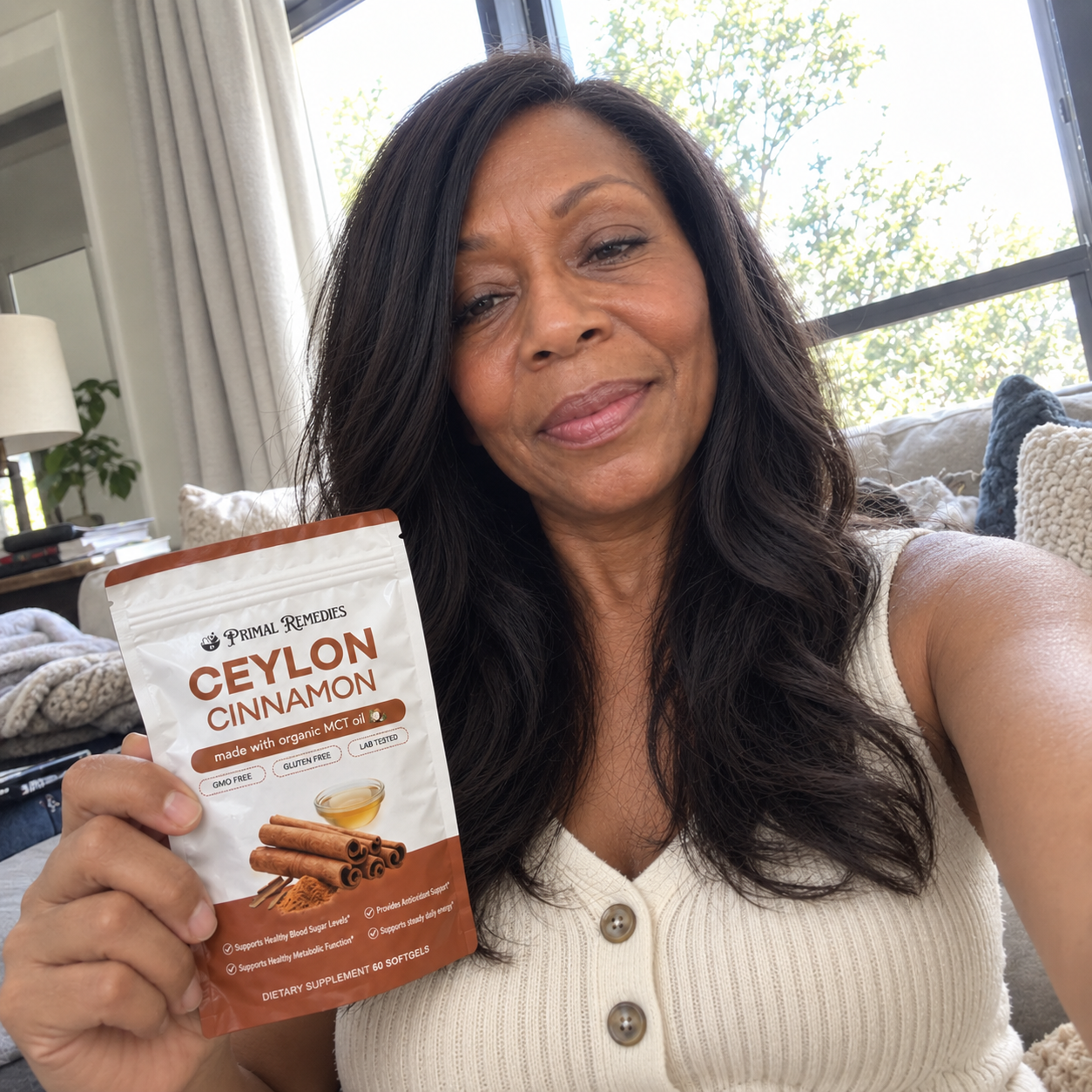
Ceylon Cinnamon 7200mg Equivalent with MCT Oil
Primal Remedies
Learn more: primal-remedies.com(opens in a new tab)