
Inactive· since Aug 18, 2026
- 16
- days it ran
- 1
- relaunches
Ad copy
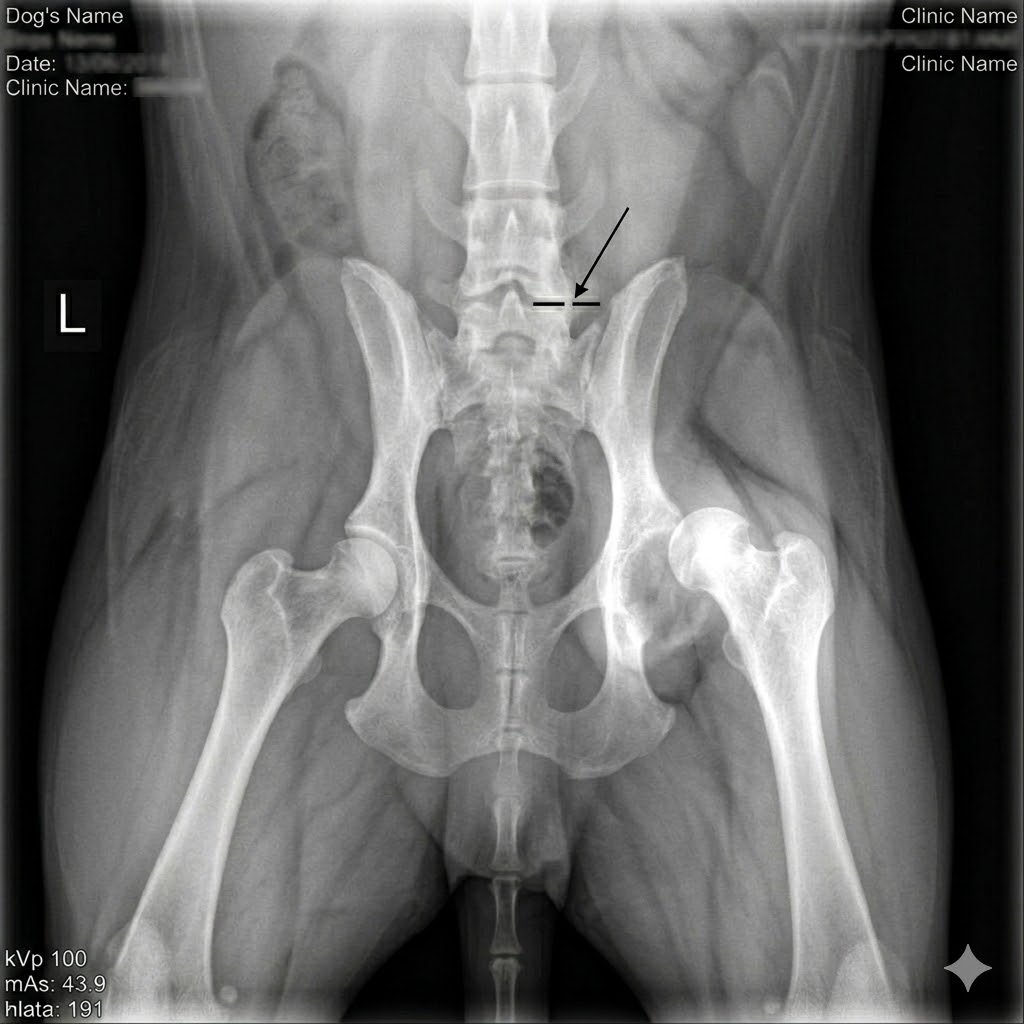
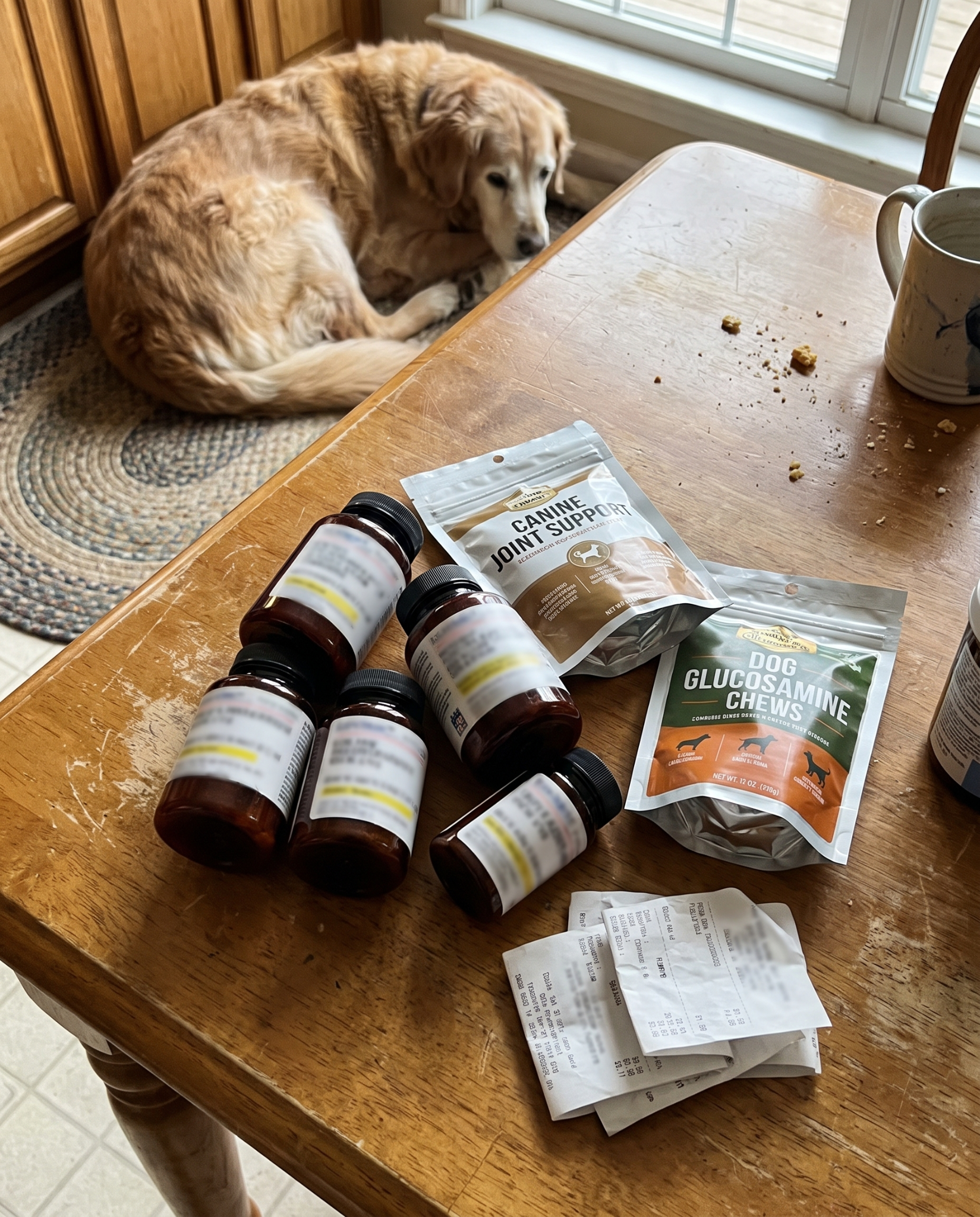
I have put my hands on the hips of more than 4,000 dogs. I'm a canine massage and rehabilitation practitioner. It's my job. And I can usually tell you what's on the label of the chew in your cabinet before you read it to me. Not because I'm clever. Because it's the same label. It has been the same label for twenty-five years, and it is the single best-documented failure in the entire supplement aisle, and almost nobody who sells it to you knows that. Let me tell you what I've seen. My name is Ruth Kessler. I've been doing hands-on rehabilitation work with dogs for nineteen years. I'm not a veterinarian. I don't diagnose anything, I don't prescribe anything, and every dog I work on comes to me because a veterinarian sent them or an owner asked their veterinarian first. I want that clear before you read another line, because the rest of this only matters if you know exactly what I am and what I'm not. Nineteen years. Four thousand-plus dogs. Somewhere north of nine thousand individual sessions with my hands on the same three or four joints. What I want to tell you is what they all have in common. Because once you see it, you'll understand why the bag you've been buying every month for two years hasn't changed anything, and what actually has to be different. Every dog who comes to me for slow, progressive hind-end decline follows the same arc. It starts somewhere around six or seven for the big ones. The first time something doesn't work the way it used to. The owner tells themselves it's the heat. Tells themselves he overdid it at the lake. Tells themselves he's just getting older. By eight, the pattern is undeniable. They go to the vet. The vet takes films, sees arthritis, and says the true thing: keep the weight off and get him on a good joint supplement. The owner walks out to the lobby and buys the bag on the counter. Glucosamine and chondroitin, first two ingredients. Eighteen months later, nothing has changed. They go back. Someone tells them to go up to the double dose. The bag gets bigger. Two years after that, they're on the double dose of a second, more expensive brand with the same two ingredients in a better-looking bag, plus a prescription anti-inflammatory for the bad weeks. Sometimes the dog seems better. Sometimes not. They start asking why. They're told these things take time, and that he'd probably be worse without it. By ten, the dog has four rooms. The owner is lifting him into the car. They've bought the ramp, the runners, the bed, the harness. They have spent between two and five thousand dollars and they cannot name one thing that got better. By the time they're on my table, that arc has been running for three to five years. The owners are tired. They're quietly ashamed, as though a dog's joints were a report card on their love. And they are usually convinced that everything that's happened was inevitable. I have watched that exact arc run several hundred times. Not once has the supplement been the thing that slowed it down. Here's what nobody told them, because most of the people selling the bag don't know it either. Glucosamine and chondroitin are not a weak version of a good idea. They are, on the pooled evidence, a non-event. In 2022, Barbeau-Grégoire and colleagues published a systematic review and meta-analysis in the *International Journal of Molecular Sciences* — fifty-seven articles, seventy-two separate trials of nutraceuticals in dogs. For glucosamine and chondroitin, the authors used the phrase "very marked non-effect." Eighty-eight point nine percent of the trials showed no effect. Zero percent demonstrated an effect. Their conclusion, in print, is that these ingredients "should no longer be recommended." That is not a lone contrarian. The Merck Veterinary Manual — the reference sitting on the shelf in the back of your clinic right now — states independently that the evidence "did not support the use of" them. So there are two things happening in your dog at the same time, and the bag addresses neither. The first is mechanical. Joint surfaces change. That process is real, it's progressive, and no chew on earth stops it. Anybody who tells you a supplement rebuilds or repairs your dog's cartilage is telling you something that isn't supported, and you should put that product down. The second is what I actually feel under my hands, and it's the one nobody talks about. A dog who hurts stops loading the limb. A limb that isn't loaded loses muscle. Less muscle means less support for the joint, which means more discomfort, which means less loading. That loop is the reason a dog can go from "slower on the stairs" to "four rooms" in eighteen months while his films barely change. The bag doesn't touch the joint surfaces. And because it does nothing measurable for the discomfort, it doesn't break the loop either. That is not "these things take time." That is a product that was never going to work, running out the clock on a dog who had a finite number of good years. I started noticing it properly about six years ago, when I began asking every new client to photograph their supplement label and bring the picture. Not to judge them. Because I wanted to know if what I was feeling in the muscle correlated with anything. The pattern was so consistent it stopped me cold. It didn't matter which bag. Fourteen ingredients or six. Twenty dollars or sixty. Pet store or clinic counter. If glucosamine was in the first two ingredients — and it nearly always was — the dogs on it looked exactly like the dogs on nothing. I want to say something here about how owners talk to me, because it's the reason I finally wrote this down. They apologize. Constantly. They get the dog up on the table and before I've touched anything they're explaining themselves. That they should have caught it sooner. That they should have kept the weight off better. That they know they should walk him more. Grown adults, apologizing to me for their dog's joints. It is not a moral failing. It is a joint surface, a muscle loop, and — for an enormous number of them — three to five years of faithfully buying an ingredient with the worst evidence in the category, every single month, because someone they trusted handed it to them at a counter. They didn't fail. They were handed the default. Once I understood that, I couldn't keep watching people buy it. So I read. Not the marketing. The actual literature on what does have controlled evidence in dogs. Here's what has the strongest published support, and I'll tell you exactly what each one is and is not. **Natural eggshell membrane.** This is the one with a real trial. Ruff and colleagues, 2016, in *Veterinary Medicine: Research and Reports* — a randomized, double-blind, placebo-controlled study in fifty-one dogs. Owner-assessed pain improved 19.4% over placebo at one week, P=0.010. Owner-assessed function improved 20.5%, P=0.028. At six weeks, veterinarian-assessed pain improved 23.6%, P=0.012, and quality of life 26.8%, P=0.033. I am going to be scrupulous about this, because you have been lied to enough. Not every endpoint in that trial reached significance — the objective mobility and lameness measures did not, and you should be suspicious of anyone who quotes you a mobility percentage for eggshell membrane, because there isn't one to quote. What that trial gives you is a modest, real, owner-visible change, and a *date*: one week. **Boswellia serrata.** A botanical with a long history of use for inflammatory-driven stiffness. In the Zoomies framing it's the fast one — days three through seven. This is the ingredient that gives you your early read. **Hyaluronic acid.** A compound naturally present in healthy joint fluid. Note what that sentence is: a statement about composition. It is not a claim that a chew lubricates your dog's joints, and I won't make that claim, because it isn't supported. Three mechanisms. Three separate clocks. Days, weeks, and a month-plus. I went looking for a product that was actually built that way. Most of what I found was garbage. Twelve and fourteen-ingredient blends at sub-meaningful inclusions, glucosamine sitting first because it's cheap and the label sells, the interesting ingredient listed ninth behind glycerin and flavoring so the front of the bag can name it. Products I'd never hand to a client. I found one that was three ingredients and nothing else. Natural eggshell membrane, boswellia serrata, hyaluronic acid. No glucosamine. No chondroitin. Not "reduced" — absent. No seed oils, no artificial fillers. Made and sourced in the United States. Zoomies Extra Strength Joint Chews. I started mentioning it to clients about two years ago. Specifically to the ones three-plus years into a glucosamine bag with nothing to show for it. Let me tell you about three of them. These are composites — I've changed every identifying detail, as I do whenever I write anything — but the arcs are ordinary and I could have picked twenty others. **The first** was a nine-year-old, ninety-four pounds, four years into two different glucosamine chews. He hadn't been on the couch in a year. His owner had stopped inviting him up because she couldn't stand watching him try. I asked her to do one thing: stop the glucosamine entirely, start a three-ingredient chew, and write one line in a notebook every night for six weeks. Not "how is he." Something countable. How long between hearing the fridge and standing up. At intake that number was eleven seconds. At day nine it was four. At week five he was on the couch. She cried in my treatment room and apologized for crying, which they all do. **The second** was seven, and the owner's complaint wasn't pain at all. It was that the dog had gone quiet. Stopped bringing things. Stopped following him room to room. Three years on the clinic-counter bag. Week two, the dog started shifting position in his sleep again — which the owner had never once registered as a symptom until it came back. Week six, the dog followed him to the mailbox and back. **The third** is the one I think about. Eleven and a half, and I want to be honest that I wasn't optimistic. Five years on glucosamine, a prescription anti-inflammatory for flares, and a hind end that had been going for two years. She got about six weeks of better. Then she leveled off, and she stayed roughly there for the rest of the year, and then she was old and it was time. Nothing in a bag changed that. Her owner told me those six weeks were the most she'd had of that dog since she was nine, and that she'd have paid ten times thirty dollars for them. I include this one on purpose. If every story I told you ended in a miracle, you should stop reading. Now — here's the part where a letter like this usually gives you a big impressive number. "289 of my 312 clients improved." I'm not going to do that, and I want to tell you why. I don't run a trial. I run a table. My clients aren't randomized, they aren't blinded, they're paying me and they want it to work, and half of them changed three things at once. Any percentage I gave you off that would be a number I made up in a nice-sounding shape. This industry is drowning in those. Ask where a percentage came from and watch what happens. So the only numbers in this letter that are real are the published ones. Seventy-two trials, 88.9% no effect, 0% demonstrated effect, "should no longer be recommended." And fifty-one dogs, 19.4% and 20.5% at one week, 23.6% and 26.8% at six. That's it. That's the entire evidentiary basis, and it's more than the bag on your counter has. What I will tell you, from nineteen years and four thousand dogs, is what separates the owners who see something from the ones who don't. It isn't the dog. It's whether they picked a countable thing and wrote it down for six weeks. Seconds to stand. Steps attempted. Times on the couch. The ones who track get an answer either way. The ones who don't spend another two years re-ordering out of hope. I'm going to be direct with you now. Nineteen years of this has stripped whatever diplomacy I started with. If your dog is on a glucosamine chew and has been for more than a year and you cannot name one thing that got better — you are inside the arc I've described. The bag was never addressing the joint and it was never breaking the muscle loop. It was always going to run out the clock. The only question was how many of his good years it took with it. That trajectory does not reverse on its own. Every month, the loop tightens. Every month, there's less muscle over the hips. Every month, the list of rooms gets shorter. And the next numbers anyone quotes you get bigger — a monthly injection runs roughly $75 to $150 depending on size, and a TPLO averages around $3,525 per knee, nationally. There is another way to spend the next six weeks, and it costs about what one office visit costs. Zoomies Extra Strength Joint Chews. Three ingredients. No glucosamine, no chondroitin, no seed oils, no fillers. 100% made and sourced in the United States. Relief in as little as 7 days. Up to 40% off when you buy in bulk, and a 90-day money-back guarantee. Pick your countable thing today. Write it down tonight. Give it six weeks. If nothing moves, send it back and you've lost six weeks and the price of a notebook. If something moves, you'll know the day it happens — the way the first owner knew when eleven seconds became four, the way the second knew when a dog rolled over in his sleep. That's the trade. It's what I'd do sitting where you are. https://www.zoomiespethealth.com Ruth Kessler Canine massage and rehabilitation practitioner, 19 years Not a veterinarian — ask yours first, always **P.S.** "Give it ninety days" is the most common instruction attached to a joint supplement, and it is the most useful sentence ever invented for selling a product that doesn't work. Ninety days is long enough that the weather changes, the season changes, and the dog has a good week on his own. You can't attribute anything inside ninety days, which means the product can never fail — you just re-order. The one-week window in the eggshell membrane trial is the opposite of that. It's a date. It lets a product lose. Any supplement that won't give you a date to judge it on has told you something about itself. **P.P.S.** If somebody in your house thinks this is another thirty dollars thrown at a dog who's just old — they're not being cruel and they're not wrong to be tired. You've spent thousands and they've watched every dollar of it produce nothing, so their prior is excellent. Here's what to say. This one has no glucosamine in it, which is the specific ingredient in everything we already tried that seventy-two trials say does nothing. It's three ingredients instead of fourteen. It has a seven-day window instead of a ninety-day one, so we'll know quickly instead of finding out in a year. And there's ninety days to get the money back. Then pick the countable thing together, and let the notebook settle it instead of the two of you. **One more thing, and it matters more than anything else in this letter.** If your dog's back end is failing but it doesn't appear to *hurt* — if the paws knuckle under and scuff, if the legs cross over, if he doesn't react to any of it — put this letter down and call your veterinarian this week. That presentation is not arthritis, no supplement addresses it, and the worst outcome of everything I've written here would be someone buying a bag instead of making that appointment. I would rather you take your dog in and buy nothing from anyone.
The Best-Documented Failure in the Joint-Supplement Aisle
“I trusted my vet for 4 years. We did Carprofen, then Adequan injections twice a week, then prednisone for the bad days. His pain was 'managed' the whole time. Then one morning he couldn't get up. The drugs never fixed anything — they just hid it while everything else fell apart.” — Robert T...
SEE DETAILSLike this ad? Make it yours.
Crush rebuilds this exact creative around your product — your brand, your colors, your offer — in about a minute.