Linda Baker
 Facebook ad: “12 years of restless legs, gone”
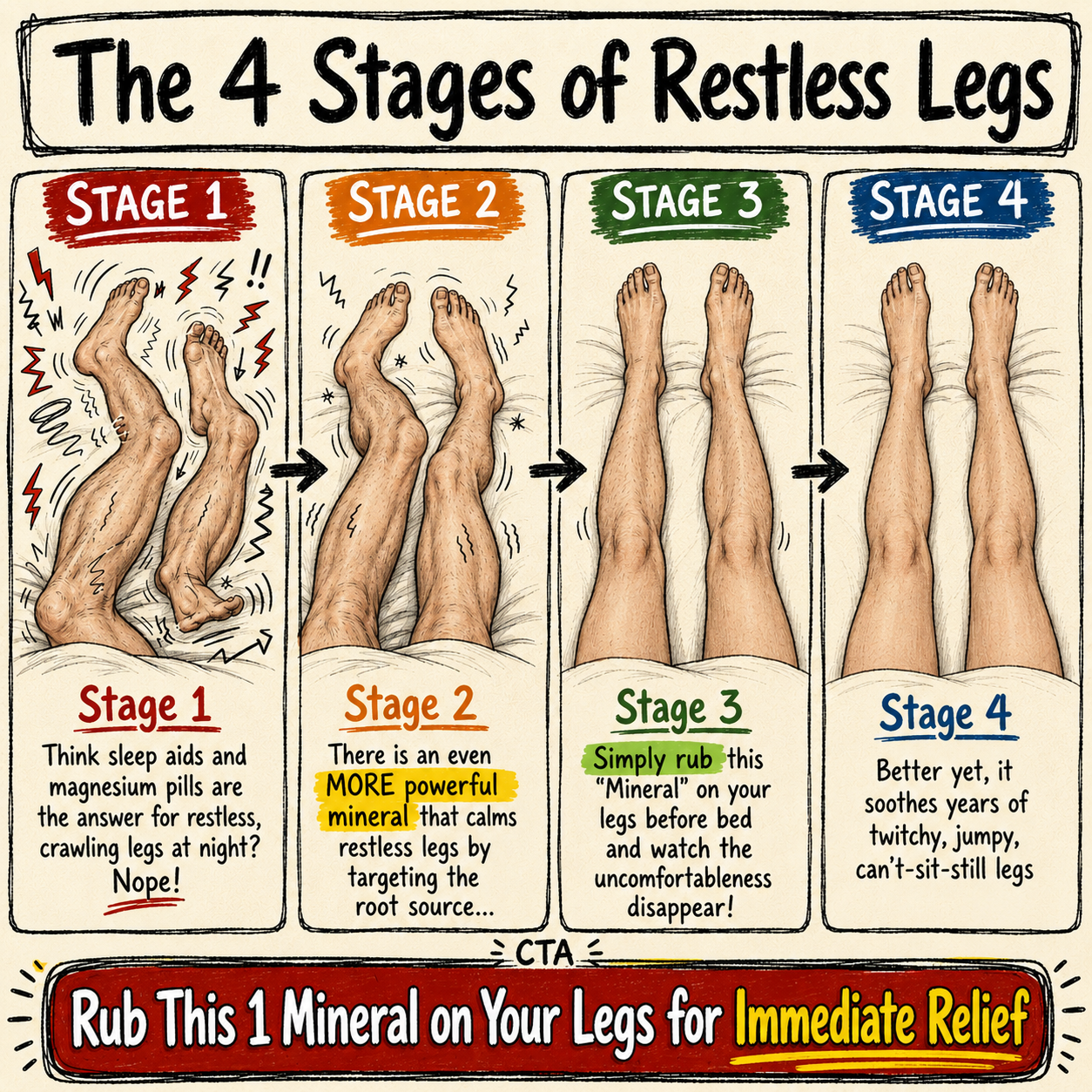
Ran for 30 days, from September 26 to October 26, 2026, the last day Crush saw it.
Run by Linda Baker on Facebook. Crush is not the advertiser and does not verify its claims. See this ad in Meta's Ad Library(opens in a new tab)
Make your own version of this ad
Crush makes it, launches it in your own Meta ad account, scales the winners and pauses the losers.
About this ad
- Meta Ad Library ID
- 1032076596529964
- Platforms
- Facebook, Instagram, Audience Network, WhatsApp and Threads
- Relaunches
- 1
- Niche
- Clinics & Medical
Ad text
If your doctor tells you your restless legs are a brain chemistry problem and hands you a prescription for a dopamine drug, ask him one question before you fill it. It's the question I never asked, and it cost my wife a year of nights walking the hallway. My name is Dr. Michael Reyes. 17 years in internal medicine, most of it in a practice full of patients over fifty. Restless legs walked into my office every week. The crawling under the skin at bedtime. The pulling, the buzzing, the leg that has to move or you'll come out of your skin. I gave those patients the same thing every doctor gives them. A dopamine drug, a pat on the shoulder, and a referral to neurology if it didn't take. Five hundred times, at least. I believed in it, because I watched it work. People came back sleeping again. Back to the long drives, the movies, the church pews. So when my wife Linda started getting up from the couch at nine every night to pace the kitchen, I was calm. I knew the map. I was wrong about every part of it. It started as a few bad evenings a month. Then most nights. I managed it the way I manage everyone's. Cut the coffee after noon. A hot bath before bed. An over-the-counter sleep aid to knock her out before the crawling started. I told her what I tell my patients. It's a nuisance, not a disease. We'll get ahead of it. The night I knew was a Tuesday. We were at our daughter's for dinner. Forty minutes in, Linda stood up in the middle of a sentence and went out to walk the driveway in the dark. She said she needed air. She didn't need air. Everyone at the table knew it. Nobody said anything. Neither did I. The next morning I wrote her the prescription myself. Seventeen years I had written that drug for other people's wives. Now I wrote it for mine. The first six weeks were textbook. She sat through a whole movie. She slept. I felt like a doctor again. Month four she told me the crawling was starting at four in the afternoon now, not nine at night. Month six it was in her arms. Month seven she told me, very quietly, that the legs felt different but not better. That whatever it was had spread. I told her the dose probably needed adjusting. I said it in my doctor voice. To my own wife. At our own kitchen table. She needed her husband that night. I gave her a consult and a higher dose. The higher dose bought three weeks. Then the afternoons got worse. Month eight, Thursday noon, lunch-and-learn in the practice conference room. Eleven of us around the long table, a rep from the drug company, the efficacy slide on the screen. Good numbers. Everyone nodded. Then the pause where anyone can ask a question. I had it right there in my mouth. Then why is my wife worse? I looked at the table. I let the pause close. Someone asked about samples. I had spent seventeen years at that table. I could have stopped the whole room with one sentence. I sat there and protected the slide instead, because saying it out loud would make it real, and because the drug had done exactly what the slide said it would, and the man who hadn't looked any further was me. I didn't tell Linda about that meeting either. Around month nine she stopped telling me about her legs. Not because they'd settled. Because she had figured out I had nothing left to give her. I kept looking anyway. Not as a doctor. As a husband out of answers. I switched her to the second-line drug and got a wife who slept but couldn't remember where she'd parked. A neurologist friend ran a nerve study and a sleep study and found what he expected to find. I sent her for iron, because the journals said to, and it did nothing but upset her stomach. And at midnight, when the doctor in me ran out of ideas, the husband took over. I ordered the things I would have rolled my eyes at in the office. Compression socks. A weighted blanket. A bar of soap under the sheet, because three different patients had sworn by it. Magnesium tablets from the pharmacy, which sent her running to the bathroom for two weeks before she quietly stopped taking them. Nothing held. Month eleven, one in the morning, she was walking the hallway in the dark. Up to the front door, back to the bedroom, up to the front door. I asked how bad it was tonight. She stopped walking. She looked at me a long time before she answered. "I think this is just what it is now." She wasn't angry. She wasn't asking me to fix it. She had stopped expecting me to. That night I lay in bed listening to her feet on the floor and counted the times I had told a patient, it's a nuisance, we'll get ahead of it. I never wondered what those patients' nights sounded like. Now I could hear one of them through the wall. Three weeks later, at a retirement dinner, I told a sports medicine doctor named Ruth about Linda. She asked me one question. "Before you went after her brain chemistry, did anyone look at the nerve in her leg? Not the dimmer switch upstairs. The wire." I gave her the answer I'd repeated for seventeen years. Restless legs is a dopamine problem. The signal comes from the brain. She shook her head. She said the dopamine drug turns down the dimmer in the brain so you notice the signal less. It doesn't touch the wire that's sending it. And a dimmer you lean on every night wears out. That's why the crawling came earlier. That's why it spread to her arms. The drug hadn't stopped working. It had done exactly what it does, and the wire underneath was still screaming. I started to give her the line I'd given five hundred patients. There's no fix for the legs themselves. You manage it from the brain. It stopped in my throat. Seventeen years of repeating that line, and I had never once checked whether it was true. I went home and read for three nights straight. Not the neurology I knew. The nerve physiology that never makes it onto a drug rep's slide. Here's how a nerve is supposed to rest. Every nerve ending in your leg has a gate. When the gate is shut, the nerve is quiet, and your leg can lie still under a sheet without sending anything upstairs. What holds that gate shut is magnesium. It sits in the opening like a hand on a door, and it only lets the nerve fire when something real asks it to. When you're young there's plenty, and the gate stays shut all night without you ever knowing it was there. After fifty the supply thins. The gut absorbs less of it. And some of the most common things in a fifty-year-old's medicine cabinet either drain it or kick the gate open on their own. Acid reducers for heartburn drain it. Antihistamines, the ingredient in nearly every over-the-counter sleep aid, are known to make restless legs worse. Linda was taking both. One of them on my advice. And a nerve with the gate hanging open doesn't quietly retire. It fires static. Low, constant, meaningless signal, strongest at night when the leg is still and there's nothing real to drown it out. The brain doesn't have a word for static, so it reads it as crawling. Pulling. Buzzing. An itch inside the bone. And it sends the only order it knows will help. Move. That's why walking works. Real movement floods the wire with real signal and buries the static. And that's why it comes back the second you sit down. Restless legs isn't a leg that won't sit still. It's a nerve that won't stop talking. Then I went back through everything I had given my wife. The sleep aid. It was kicking the gate open wider every night I told her to take it. The dopamine drug. It dimmed the brain's volume on a wire that never stopped firing. When the dimmer wore out, the static came through earlier and louder and in more places. That's not a side effect. That's the whole design. The second drug. It quieted the whole nervous system, which is why she couldn't remember where she'd parked. The wire in her leg was the last thing it reached. The pharmacy magnesium tablets. The cheapest form, the one in almost every bottle, and only a fraction of it ever leaves the gut. The rest stays there and does what it did to Linda. So the one thing that might have put a hand back on the gate was the one thing she couldn't stay on. That's why the crawling spread after a textbook prescription. We turned down the volume on the brain and left the wire wide open. Linda was walking the hallway. I sat in the kitchen with her chart until the sky got light. I had been adjusting the dimmer in the living room while the wiring in the wall sparked. I called Ruth in the morning. She said the cleanest approach she'd ever seen wasn't another dopamine drug, and it wasn't another sedative. It came down to one mineral, and a triple-action method built around it, one that reaches the nerve in the leg through the skin instead of getting lost in the gut. Here's what she meant by triple-action, and why it finally made sense. For seventeen years I'd been asking the wrong question. Never once had I asked how to put a hand back on the gate in the leg. I'd only ever asked how to make the brain stop listening. This one mineral does all three at once. It quiets the gate so the nerve stops firing when nothing asked it to. It settles the muscle fibers underneath that twitch and pull along with it. And it refills the reserve in the tissue itself, so the hand stays on the door the next night, and the one after. Quiet, settle, refill. Miss one and it doesn't hold. And applied right over the calves and shins, it never has to survive the stomach to get there. That's the part no prescription pad had ever touched. I got Linda started on it that night. No lecture. I just told her I was sorry it took me this long to look at the leg. Night four she sat through the whole ten o'clock news. She said it like a question. Week two she slept until the alarm. First time since before the prescription. Week three she drove three hours to her sister's without pulling over once to walk a rest stop. She called me from the driveway. I stood in the kitchen and kept my mouth shut. I didn't trust my voice. And last Sunday at our daughter's, she sat through dinner, dessert, and two hours of cards. She never once looked at the door. She didn't notice. I did. Her doctor is still weaning her off the dopamine drug, slowly, the way it has to be done. But the wire it was covering for isn't firing static anymore. The gate is finally being held. When I tell people this, they can hardly believe the difference came from one mineral. They expect me to say she found some new drug, some specialist, some sleep clinic only a doctor's wife could get into. It was none of that. Let me be straight with you, because I still believe in medicine. Some restless legs are a warning. If it came on suddenly, if it came with numbness or weakness, or if you're pregnant or on dialysis, that belongs in a doctor's office, and I still send those there. But most restless legs aren't that. Most are a nerve with the gate hanging open, and nobody is closing it, because there's no billing code for closing it, and nobody in my world gets paid to reach for a mineral instead of a prescription pad. My wife lived inside that gap for a year. So if you're up at one in the morning walking your hallway, and there's a dopamine prescription on your nightstand or one waiting at the pharmacy, I'm not telling you to stop it. I'm telling you to find out what that one mineral is before you accept another year of it. That's why I sat down and wrote a short article that lays out exactly how the triple-action method works, and names the one mineral behind it. Read it tonight, before the crawling starts. Nobody handed my wife this before her year in the hallway. You don't have that problem yet. Tap below to read the short article. ~ Dr. Michael Reyes, an internist who couldn't fix his own wife's restless legs P.S. Don't stop anything your doctor has you on, and never stop a dopamine drug on your own. Bring the article to your next appointment and ask them one question: are we treating the brain, or the nerve in the leg? You're not fighting your doctor. You're asking about the one thing a prescription pad was never built to reach. P.P.S. The article is free, and it's short. In it, I explain what the mineral is, why the nerve stops holding its gate shut after fifty, which common medications make it worse, and what the research says about quieting the wire where the static actually starts. Read it while it's still up.
Where the ad sends people
health.morningvitality.com
"12 years of restless legs, gone"
Top MD Warns: Rub This 1 "Mineral" Behind Your Knees at Night to Reduce Restless Legs By Dr. Andy Salazar, Medical Director, Peak Health Research I'm about to piss off every sleep clinic, neurologist, and drug company that's spent years telling you the crawling in your legs is just something you hav...
See details: health.morningvitality.com(opens in a new tab)