Dr. Alex Larowe
Dr. Alex Larowe Facebook ad: “You might be checking the wrong thing”
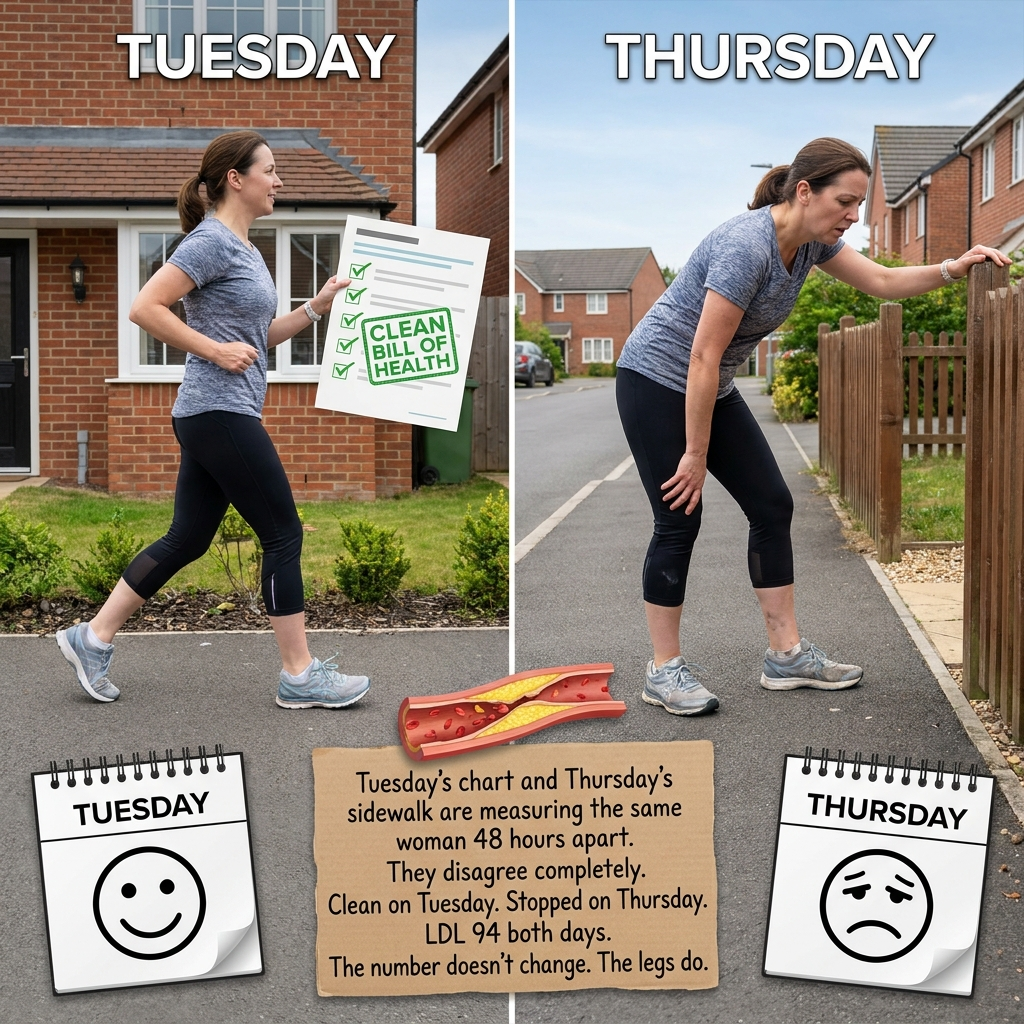
Ran for 3 days, from June 15 to June 17, 2026, the last day Crush saw it.
Run by Dr. Alex Larowe on Facebook. Crush is not the advertiser and does not verify its claims. See this ad in Meta's Ad Library(opens in a new tab)
Want an ad like this for your product?
Crush makes new ad images for your product from this ad: your logo, your product photo, your offer.
Trials from $19.95 USD, then $79.95 USD a month. Cancel anytime.
About this ad
- Meta Ad Library ID
- 1087814124248972
- Platforms
- Facebook, Instagram, Messenger and Threads
- Relaunches
- 0
Ad text
The woman who walks dogs in our neighborhood noticed my husband's decline before I did. She sees him every morning — 7 AM, through the living room window, in the recliner where he's been since 6:30 because the bed released him but the morning didn't start. Her name is Jennie. She's forty-three. She walks eight dogs in our subdivision every weekday — a professional dog-walking business she started after leaving pharmaceutical sales. She left pharma because, as she told me later, "I spent twelve years selling medications I increasingly didn't believe in, and the dogs are better company than the doctors." Jennie walks past our house at 7:03 AM every morning with a rotating cast of golden retrievers, labradoodles, and one ancient beagle named Herbert who sets the pace for the entire group at approximately 1.2 miles per hour. From the sidewalk she can see through our living room picture window. The window faces east. The morning light illuminates the room. The recliner is positioned against the west wall, directly visible from the sidewalk. For two years Jennie has been watching my husband in that recliner at 7:03 AM. She's watched the progression — the way the man in the chair was sitting upright in year one, then reclined in year two, then fully reclined with a blanket in year three, then fully reclined with a blanket and the television on and the specific, motionless posture of a man who is not resting but depleted. She told me all of this on a Saturday morning when I was in the front yard pulling weeds and she was walking past with Herbert and three labradoodles. "Can I tell you something?" she said. I straightened up. The weeds in my hand. The dogs at her feet. A conversation between two women on a suburban sidewalk that would change the trajectory of my husband's health. "Your husband. In the recliner. I see him every morning." "I know. The window." "He's getting worse." She said it without judgment. Without drama. The clinical assessment of a woman who spent twelve years in pharmaceutical sales and who knows how to deliver a difficult observation with the precision of a medical professional and the warmth of a neighbor. "I know," I said. Because I did know. But hearing it from someone outside the household — someone whose daily observation provided a longitudinal dataset that my inside-the-household perspective couldn't generate — made the knowing heavier. "How long has he been on a statin?" she asked. I stared at her. "How did you—" "Because I sold them for twelve years. I know what they do to people long-term. I watched the clinical trial data while I was a rep. The data the prescribing physicians never see because the reps are trained to emphasize the LDL reduction and de-emphasize the adverse event profiles." She looked at the living room window. At the recliner. At the shape of my husband visible through the glass. "I sold atorvastatin for six of those twelve years. I know what it does to CoQ10 levels. I know about the fatigue and the cognitive decline and the grip loss and the recliner trajectory. I saw it in the post-market surveillance data that my company tracked internally but that never made it into the rep's sales materials." My husband's name is Dennis. He's sixty-two. Rosuvastatin for five years. LDL 94. Doctor says controlled. The former pharmaceutical sales rep who walks dogs past our window every morning says something different. Jennie told me about her transition from pharma to dogs. The specific moment was a ride-along with a physician — a family practice doctor in a suburb of Cleveland — where she watched the doctor prescribe atorvastatin to a sixty-year-old man and the man's wife asked, "Are there side effects?" and the doctor said, "Minor muscle aches that usually resolve" and Jennie — standing in the corner with her sales bag and her product samples — knew that the answer was incomplete. "I knew about the CoQ10 depletion. I knew about the oxidized LDL the medication doesn't address. I knew the muscle aches weren't minor and they didn't usually resolve. I knew that man was going to follow the same trajectory I'd seen in the surveillance data — the declining energy, the cognitive changes, the recliner." She couldn't say anything. She was there to sell, not to inform. The role of the pharmaceutical rep is to support the prescribing decision, not to complicate it. She left the industry four months later. Started walking dogs. Because dogs don't need pharmaceutical interventions justified and their side effects minimized. Dogs need walks. And walking dogs past houses with recliners visible through picture windows gave her a different kind of surveillance data — the real-world version of the post-market data she'd tracked at her desk. "I've walked past fifty houses in this subdivision for three years," she said. "I can identify the statin houses by sight. The recliner in the living room. The car in the driveway that doesn't move. The wife in the front yard doing the outdoor work the husband used to do." She counted. In our subdivision alone: fourteen statin households she could identify by the pattern visible from the sidewalk. Fourteen men in recliners at 7:03 AM. "Your husband is one of them." Then she told me what the pharmaceutical company never included in the sales materials. Oxidized LDL. The form of cholesterol the statin doesn't address. The form that hydroxyl radicals create when they attack the remaining LDL. The form that builds plaque while the chart says controlled. The mechanism that kills 47% of controlled patients. CoQ10 depletion. The energy molecule. The same enzyme pathway. The recliner trajectory explained biochemically. And the intervention she found after leaving pharma — the one that former pharmaceutical reps discover because they know the gaps in the products they sold. Molecular hydrogen. H2. The smallest selective antioxidant. Targets only the hydroxyl radicals. Supports mitochondrial ATP production. The mechanism the sales materials never mentioned because the sales materials existed to sell one product, not to acknowledge its limitations. Dr. Tyler LeBaron's 24-week RCT: approximately 10% total cholesterol reduction, 22.9% TAG/HDL improvement, 8% HDL increase by week 4, blood pressure from 127/83 to 112/70. Hydronate. One tablet dissolved in water. 12+ parts per million. "I don't sell this," Jennie said. "I walk dogs. But I've been telling the wives in the houses where I see the pattern. Because I spent twelve years selling the medication that creates the pattern and I can't sell dogs without addressing the silence." She gave me a card. Hydronate.com. Her phone number. "Call me if you have questions. I know the biochemistry because I was tested on it for twelve years." I started Dennis on Hydronate the next morning. One glass on the counter at 6:30 AM. Before the recliner. Week one. The recliner timing shifted. 7 AM to 8:30 AM. The morning that used to start in the chair started at the kitchen table. Dennis ate breakfast sitting upright at a table instead of reclined in a chair. Week two. He went outside. To the front yard. Where I'd been pulling weeds alone for two years. He pulled weeds. Twenty minutes. Standing, bending, gripping, pulling — the sustained physical output the recliner had been replacing. Jennie walked past at 7:03 with her dogs. She looked at the front yard. Dennis was standing in it. Not in the recliner. In the yard. She raised her hand. A wave. The small acknowledgment of a woman who has been tracking a data point for two years and who just watched it change. Week three. Dennis walked with me to meet Jennie and the dogs at the end of the street. He petted Herbert the beagle. He walked back with us — a quarter mile round trip. The first sustained walking he'd done in over a year. Week four. Bloodwork. HDL: 57, up from 38. Nineteen points. TC/HDL improved 22%. Blood pressure from 134/86 to 120/74. Three months in. The recliner is occupied in the evening — 8:30 PM, the reasonable hour that a sixty-two-year-old man settles in after a day of being a person instead of a patient. The 7:03 AM window no longer shows a depleted man in a chair. It shows an empty living room because the man is in the kitchen or the yard or the garage. Jennie walks past every morning. The data point has changed. One of the fourteen statin households in the subdivision has broken the pattern. She's told three other wives in the subdivision. The data points are changing. Hydronate. One tablet. One glass. Every morning. 90-day money-back guarantee. Buy 3, Get 2 Free. $0.56 per tablet. If the dog walker sees what the doctor doesn't. If the window tells a story the chart can't hold. If the pattern is visible from the sidewalk at 7:03 AM. One glass. Every morning. The mechanism the pharmaceutical rep sold around for twelve years and that the dog walker addresses for free. 👉 hydronate.com P.S. Herbert the beagle is fourteen. He walks 1.2 miles per hour. He has arthritis and cataracts and the general complaint list of an elderly dog. But he walks. Every morning. Past fourteen houses with recliners. Herbert's owner, Jennie, says Herbert is the standard: "If a fourteen-year-old beagle with arthritis can walk past your window every morning, the man in the recliner should be walking too." One glass. Every morning. For the man who should be at least as functional as the beagle.
Where the ad sends people
hydronate.com
You might be checking the wrong thing
Hydronate
See details: hydronate.com(opens in a new tab)