Actinic Keratosis Recovery
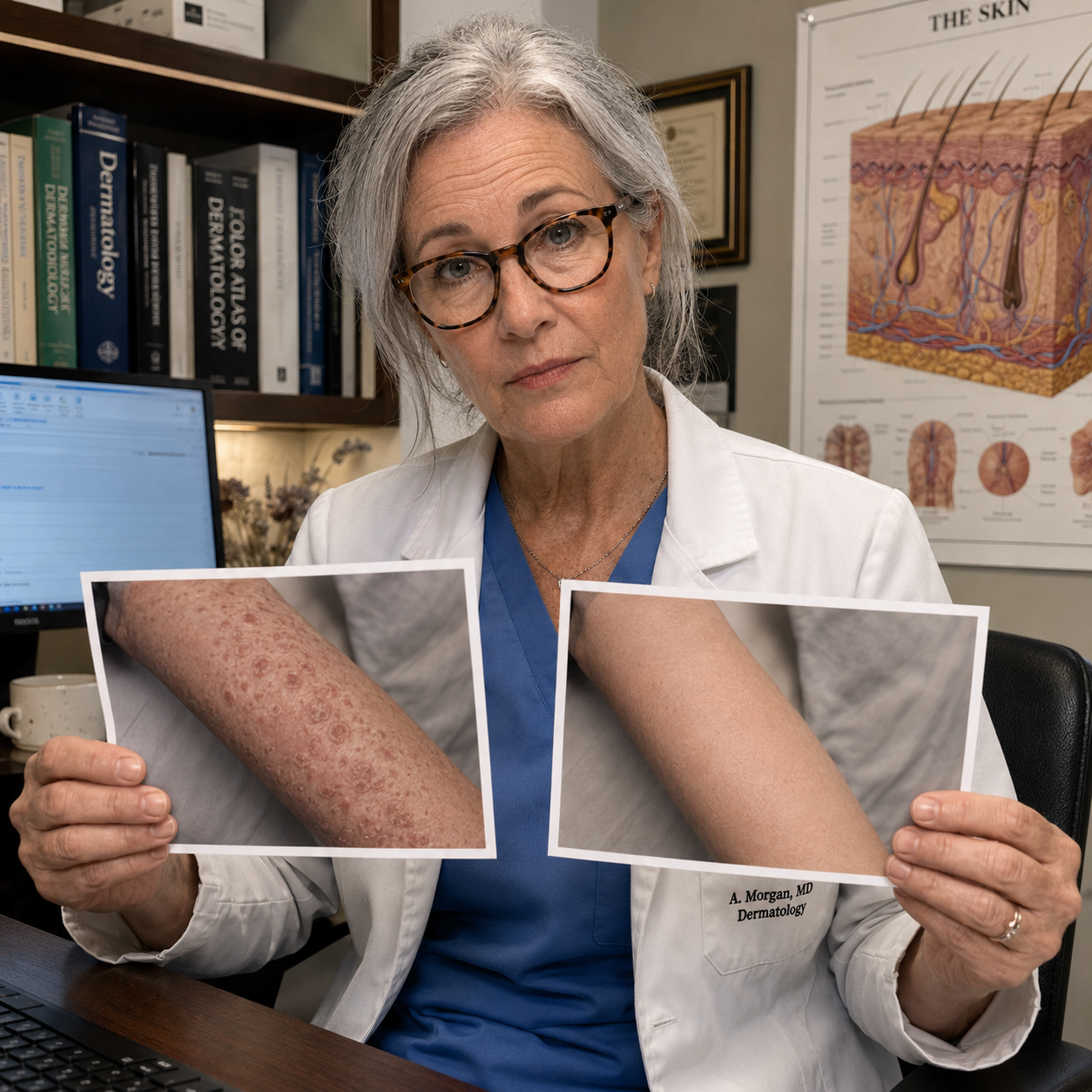
Actinic Keratosis Recovery Facebook ad: “Left Is Healthy Skin. Right Is What 5 Years of Diclofenac…”

Ran for 8 days, from August 27 to September 4, 2026, the last day Crush saw it.
Run by Actinic Keratosis Recovery on Facebook. Crush is not the advertiser and does not verify its claims. See this ad in Meta's Ad Library(opens in a new tab)
Want an ad like this for your product?
Crush makes new ad images for your product from this ad: your logo, your product photo, your offer.
Trials from $19.95 USD, then $79.95 USD a month. Cancel anytime.
About this ad
- Meta Ad Library ID
- 1088202030320792
- Platforms
- Facebook, Instagram, Audience Network, Messenger and Threads
- Relaunches
- 0
Ad text
If you are a woman over 60 and your actinic keratosis patches have thickened, started spreading to new areas, or keep appearing on skin that looked clear last visit, you have somewhere between three and five years before the same hidden field could cover your forearms, hands, chest, and shoulders. I am a dermatologist with 19 years of practice. I have spent the last decade watching this exact timeline unfold in women past 60 while telling none of them what was actually happening underneath. I am writing this letter to break that silence. The single most common phrase I hear from women over 60 who come into my clinic with spreading rough patches, thickening skin, and patches that keep returning after freeze sessions is "it's just sun damage." That phrase was given to them by a GP in an eight-minute appointment, and it has cost more women their skin confidence than any other phrase in modern dermatology. I'm Dr. Sarah Whitfield. I'm a consultant dermatologist who spent fifteen years repeating that phrase to thousands of women over 60 without telling them what was actually happening underneath their patches. When my own actinic keratosis started spreading at 51, I knew something I had never explained to a single patient. The patches aren't the disease. The rough texture isn't the disease. The spreading isn't the disease. They are all symptoms of one underlying problem — the subclinical field of UV-damaged keratinocytes that sits deep in the dermis of nearly every woman past 50, and grows more entrenched in every woman past 60, regardless of how diligent she's been with SPF or how many freeze sessions she's attended. The hidden field is active in almost every woman in this age group. The only question is which patch you notice first, and whether you let the NHS pathway mask it with freeze sessions while the underlying field continues generating across your body. I have treated thousands of women over 60 in my career. I have seen what happens at 62. At 65. At 68. At 72. And I have seen what almost no dermatologist documents properly because the appointments are too short and "it's just sun damage" has become a clinical shortcut that closes the conversation. The 62-year-old. Came in last spring with rough patches spreading to her upper arms and waking up running her fingers across her forearms before she'd even opened the curtains. No treatment working long-term. Her GP had told her for the last two years that her patches were "normal for her age." Her freeze sessions were keeping the visible lesions at bay. Her field never let up. Her morning ritual of checking her arms had been going for over a year and she had stopped believing it would ever change. She was cycling through diclofenac and her subclinical field had been silently generating for at least a decade. She was almost certain to start the cascade. The fluorouracil she was about to be prescribed would have been the first escalation. Within six months a round of PDT. Within two years imiquimod added. Within four years the referral for field chemotherapy nobody wanted. The 67-year-old. "It's just sun damage, Doctor. Nothing serious." Her patches had been progressing for eight years. The rough texture had spread from her forearms to her hands three years ago. Her coverage had been getting worse for five. Her GP had told her every one of these was a normal part of ageing and had not connected them to anything systemic. Then her consultant found field cancerisation markers during a routine skin check. Then her dermatologist started her on diclofenac and added freeze sessions every quarter. By the time she came to me for a second opinion, three different doctors had been managing three different body areas with three different protocols and not one of them had told her the patches were connected to a single subclinical field. I see these women in follow-up appointments. They do not complain. They are grateful I am "managing" their condition. They have accepted that their skin is simply doing what skin does after 60. But I know what they lost. They had years, sometimes more than a decade, to address the UV-damaged field that was generating every one of their patches simultaneously. Years to reach the dermis. Years to save themselves from the cascade. Their skin had been screaming the warning the entire time. Their doctors had answered each scream with "it's just sun damage" while the underlying field compounded toward the full coverage their bodies had been warning them about for ten years. What almost no doctor explains to a woman over 60 with chronic actinic keratosis is this. Your skin has a protective barrier called the stratum corneum. It is a dense lipid shield that sits on top of all seven skin layers. Its job is to keep water-based compounds out. Inside that shield, deep in the dermis, the subclinical field of UV-damaged keratinocytes is invisible to the surface and untouched by water-based treatments. Without penetrating that barrier, your diclofenac slides off. Your vitamin C serums bounce away. And your skin keeps sounding the alarm the only way it knows how — by pushing rough, scaly patches to the surface that never clear. Field generation accelerates with age. By age 50, most women carry UV-damaged keratinocytes in the dermis. By age 60, the field is more active. By age 70, more active still. The progression is steeper in women with decades of sun exposure, but it happens to every woman who has spent time outdoors, regardless. Every rough patch, every new lesion between visits, every spreading coverage, every thickening texture in a woman over 60 traces back to the same underlying subclinical field. "It's just sun damage" is technically close. But it is incomplete in a way that has cost women their skin and their confidence. Yes, this is what happens with age and UV exposure. No, you do not have to accept the cascade that follows. The field can be reached, calmed, and reset — even at 65, 70, or older — if the right compound is delivered through the right pathway. The rough patches you have been quietly living with are not the warning. The new patches appearing on clear skin are the warning. The spreading that came before it is the warning before the warning. The field silently generating underneath, calm for now, visible later, is the disease. Published research has documented this timeline. Chronic subclinical AK field involvement precedes full field cancerisation by an average of three to five years. Women with documented spreading patches and subclinical field markers carry a progression risk that is substantially higher than women in the same age group without either. Your patches are not embarrassing. Your spreading coverage is not just "what happens after 60." They are your 10-year early warning system. I was not going to start the cascade I had been writing into the notes of thousands of women past 60. And I needed to find a path that actually addressed the field rather than masking it with surface treatments. I tried what women past 60 try. Diclofenac gel. Twice daily. On schedule. Never missed. The patches smoothed for a few weeks. Then they came right back. On rawer skin. Retinoid cream. Every night. The prescription tube from the hospital pharmacy. Surface slightly smoother. The patches? Still spreading. SPF 50 every morning. Full sun protection. Four months. Fully committed. New patch frequency dropped slightly. Coverage? Nothing changed. Vitamin C serum from Boots. Every morning and night. Bottle after bottle. My skin felt softer on the surface. My patches? Nothing. My scans were stable. My protocol was textbook. But my patches stayed rough. My coverage stayed spreading. My mornings stayed a ritual of checking my arms and finding new ones. The surface treatments had moved some things while the field kept generating at the age-driven rate. But I kept thinking about something that made no sense in standard practice. The subclinical field can be reached if the right lipid-soluble compound penetrates the stratum corneum. The field can be calmed even in women past 60. The research had been showing this for fifteen years. Almost no one in NHS dermatology was applying it. So why was I not applying it to myself? November 14th. 10:23 PM. I was reviewing journals after a long clinic day. Couldn't sleep. The patches on my chest were worse. A new one had appeared on my shoulder. I was scrolling through research on lipid-barrier penetration and UV-damaged keratinocyte populations. Not looking for anything specific. Just exhausted. I found a paper on cold-pressed botanical oils and dermal field delivery. Cold-pressed camellia oil and sea buckthorn oil are lipid-soluble carriers. Because the stratum corneum is itself a lipid barrier, these oils merge directly into it and penetrate through all seven skin layers to the dermis — a pathway that remains effective in older patients even when years of water-based topicals have failed. Oil-soluble vitamin C — ascorbyl tetraisopalmitate — carried through by the lipid base neutralises the UV-induced oxidative cascade at the source. Bakuchiol supports normal keratinocyte cycling from the dermis out. Once the field is reached, the damaged keratinocytes stop misfiring. The patches stop being pushed to the surface. The skin stops generating. The mechanism didn't just support symptom relief. It supported calming of the field across age groups. Sustained lipid-delivered actives had been shown in multiple studies to reach the dermis, address the UV-damaged keratinocyte cycling at the source, and travel through all seven skin layers at once — including in study populations over 60. I sat there at 10:23 PM staring at the diagram. Freeze sessions destroy patches that are exposed and visible. The clearance lasts until the field generates the next one. The subclinical field hiding under the stratum corneum does not improve. The recurrence is the price you pay for the brief surface clearance. Oil-soluble actives penetrate the barrier your skin was designed to seal. Direct delivery to the field. Natural calming of the generating layer. Your skin heals instead of being repeatedly frozen on the surface. The field causing your patches, your spreading, your new lesions, and your accumulating coverage simultaneously, actually calms. I have been a dermatologist for 19 years. And I had never connected lipid-delivered botanical oils to chronic AK field management in older women. The shared mechanism — the underlying age-related field that explains why women over 60 cluster spreading patches, new lesions, thickening texture, and rising coverage in the same individual — was never part of any NHS dermatology curriculum. At 11:11 PM I went looking for a properly formulated botanical body oil. What I learned during that search is something every woman over 60 who tries a body oil needs to know. The actives have to be oil-soluble. When you apply a water-based serum or gel, the stratum corneum — your skin's waterproof lipid barrier — blocks it. Less than 4% penetrates. The field sits underneath, unreached. For the actives to actually reach the UV-damaged field where they work, they must be delivered in a lipid oil so they merge with the barrier instead of bouncing off. Like dissolves like. A proper oil carrier takes penetration from a fraction to nearly complete. Almost no skincare product on the market does this. Most use water-based formulations with a trace of active ingredient. The same formulations documented to sit on the stratum corneum. The delivery works against the active compound. I found one brand that was different. Dermèvia Actinic Keratosis Correcting Body Oil. Cold-pressed camellia and sea buckthorn oil as the lipid carrier — the two oils with the molecular structure to penetrate all seven skin layers to the dermis. Oil-soluble vitamin C — ascorbyl tetraisopalmitate, not ascorbic acid — at clinical concentration. Bakuchiol at clinical concentration for natural cellular turnover. Sixteen active botanicals. Zero water. Zero filler. I ordered a bottle that night. Applied morning and evening to every sun-exposed area — not just the patches I could see, the whole field. I started November 15th. November 22nd. One week in. The rough sandpaper texture was calmer. Not gone. But the patches felt less raised for the first time in over a year. November 29th. Two weeks in. I ran my fingers across my forearm three mornings in a row. Smoother. Smoother. Smoother again. Consistent. Something was reaching the field from inside. December 13th. Four weeks in. The flattening was visible. Three areas showing the same pattern. Smooth skin where patches had been raised for years. My husband noticed I wasn't pulling my cardigan sleeves down at dinner. January 10th. Eight weeks in. Smooth forearms. Flat where the patches had been raised. No new lesions. The spreading that had been progressing for years had stopped. I went back to my colleague for a skin check. She looked at my forearms. Looked at her notes from six months ago. "Sarah, what did you do? Your coverage has improved more than anything I've seen on the standard protocol." I explained the lipid-barrier delivery. The oil-soluble actives merging with the stratum corneum. The cold-pressed carrier reaching the dermis. The way it stayed effective even with years of entrenched field involvement. She was quiet for a long moment. "I have hundreds of patients over 60 I have been telling for years that their patches were just sun damage. If what you are describing is reproducible..." "The mechanism is real. It works in older patients. The oil-soluble concentration matters. The lipid carrier matters. And the timeline matters." She started recommending it for her patients over 60 with chronic spreading AK. I am not writing this letter because I think freeze sessions are bad. Cryotherapy works. Diclofenac works. Fluorouracil works. They treat the patches they were designed to treat. But they do not penetrate your stratum corneum. They do not reach the subclinical field that generates the patches in the first place. They do not calm your UV-damaged keratinocytes. They do not stop the field. They temporarily clear each visible patch while the underlying field compounds toward full coverage that no specialist on your team is currently addressing. And I see what happens five years later when women past 60 who masked their spreading with freeze sessions walk into a consultant's office with field cancerisation, coverage across seven body parts, and a field that nobody was reaching. Your patches are not failing you. Your spreading is not failing you. They are warning you. The same subclinical field that is causing your rough patches, your new lesions between visits, and your spreading coverage is right now generating across every sun-exposed area of your body. You have two choices. Freeze each patch while the underlying field accelerates. Or reach the field that is causing all of them simultaneously. I think about what I almost did. I almost started another round of fluorouracil myself. I almost accepted spreading patches as the cost of "managing" my AK. I almost became the patient I had been making for fifteen years — the woman in her late fifties on three treatments for three body areas with no doctor connecting them to the underlying field that age and UV damage had been quietly generating. Eight weeks. That is how long it took my patches to flatten, my coverage to stabilise, my spreading to stop, and my skin to recover to where it had been years earlier. Eight weeks of letting my skin do what it was designed to do once the field was reached. Heal. I am not saying age is reversible. I am saying the cascade is not inevitable. Your spreading patches are your check engine light. A freeze session is electrical tape over the indicator. The field is still there underneath. You just can't feel the next patch yet. But I see it every day in the women over 60 who come back to me three years after their first freeze session, asking why their coverage has got worse, and six years later when their consultant calls me to ask what I'd recommend next. Every single one of them says the same thing. "I wish someone had told me my patches were connected to a field underneath." I am telling you now. Dermèvia Actinic Keratosis Correcting Body Oil. Cold-pressed camellia and sea buckthorn as the lipid carrier. Oil-soluble vitamin C at clinical concentration. Bakuchiol for natural cellular turnover. Sixteen botanicals. Zero water. Applied morning and evening. 90-day money-back guarantee — if your patches haven't visibly flattened, full refund. 👉 https://trydermevia.com/pages/actinic-keratosis-reset Keep your quarterly appointments. The oil reaches the subclinical field from the inside. The freeze sessions manage the visible patches. Add, don't replace. — Dr. Sarah Whitfield, MBBS FRCP Consultant Dermatologist, 19 years. London P.S. Give it 60 to 90 days. The upside is the version of yourself that does not accept "it's just sun damage" as the explanation for skin that has been trying to warn her for a decade. P.P.S. You are not too late. Your skin is older but the field is not beyond reaching. The stratum corneum still opens to lipid-soluble carriers. The UV-damaged keratinocytes still respond. Please reach the field now, before the spreading your GP has been calling "just sun damage" finally becomes the coverage they call field cancerisation.
Where the ad sends people
trydermevia.com
Left Is Healthy Skin. Right Is What 5 Years of Diclofenac Left Untouched.
Learn more: trydermevia.com(opens in a new tab)