
Inactive· since Jun 10, 2026
- 14
- days it ran
- 2
- relaunches
Ad copy
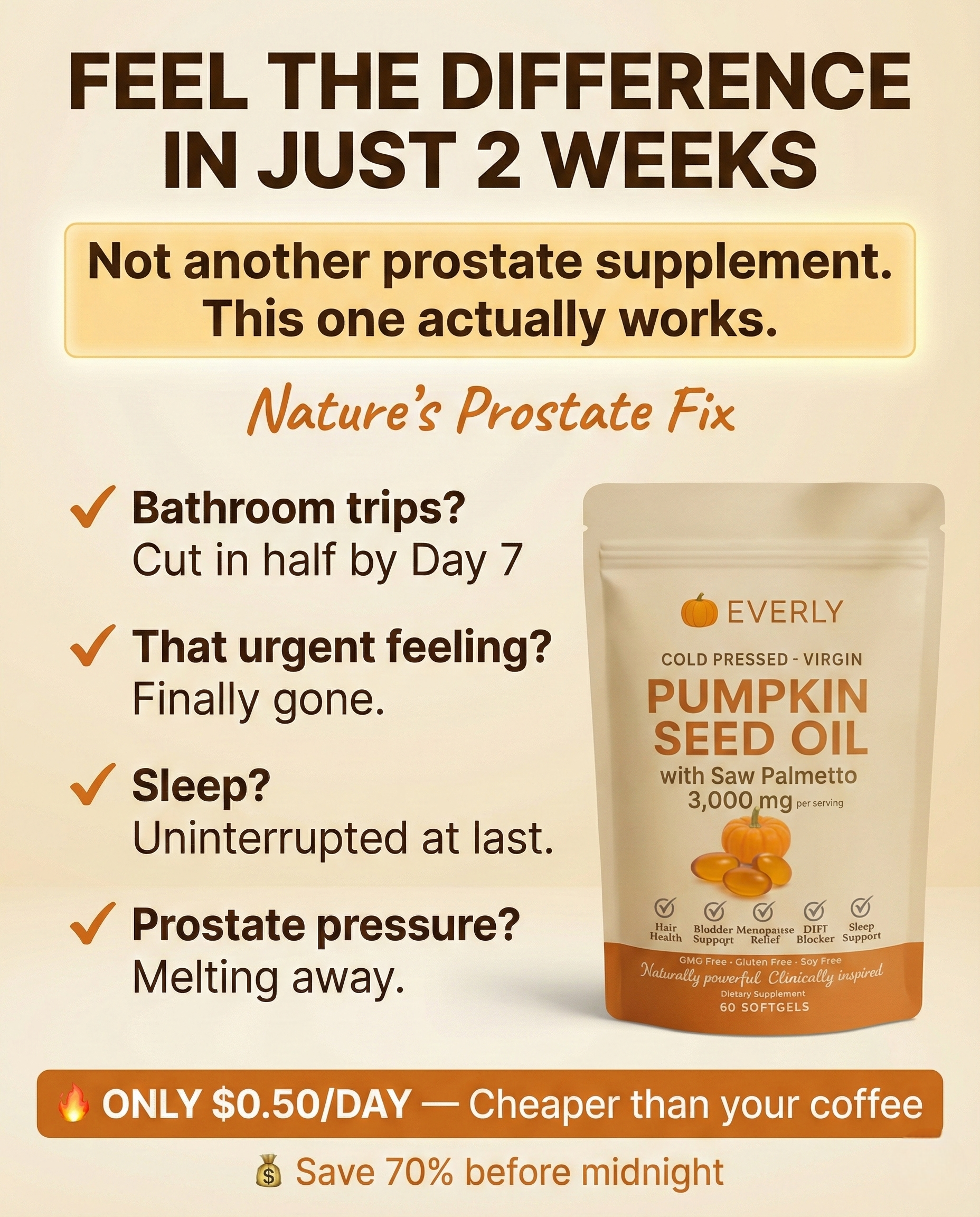
My husband refused Flomax for four years. Here's what happened to his prostate. I've been a nurse for 28 years. I've catheterized men who couldn't empty their own bladders. I've charted post-op notes on men whose prostates had swollen so large they needed surgery just to urinate. I've watched patient after patient come back every three months with the same complaints—the urgency, the weak stream, the getting up four, five, six times a night—while their doctors adjusted the dose and said, "Give it time." Then my husband started getting up every ninety minutes. And I realized "give it time" was the most dangerous phrase in urology. I need to tell you about my father first. Because until you understand what I watched happen to him, nothing else I'm about to say will make sense. My father was diagnosed with an enlarged prostate at 58. His doctor started him on tamsulosin immediately. 0.4 milligrams. Once daily. He was a good patient. The kind who never missed a dose. He cut back on coffee. Stopped drinking anything after 7 PM. Did everything they told him. His symptoms improved slightly. His urologist smiled at the flow test. "Looking better, Frank. Stay the course." Stay the course. For eleven years, he stayed the course. Eleven years of tamsulosin. Eleven years of "manageable symptoms." Eleven years of his urologist looking at a chart and calling it a success. But the side effects were never manageable. The dizziness started in year two—he couldn't stand up without grabbing the wall. The fatigue was constant. He'd fall asleep in his recliner at 6 PM like someone had unplugged him. And the one thing he never talked about—the thing my mother only told me about after he was gone—was that the medication destroyed their intimacy. Completely. For the last eight years of his life, they slept in the same bed like roommates. And his prostate kept growing. While the medication relaxed the muscles around his bladder, the gland itself never stopped swelling. Because tamsulosin doesn't shrink the prostate. It doesn't stop whatever is causing the growth. It just forces the muscles to loosen so urine can squeeze past the obstruction. Like putting a bigger doorframe around a door that's still being blocked. The obstruction never moves. It just gets bigger. And eventually, the bigger doorframe isn't enough. At 67, my father couldn't urinate at all. Acute urinary retention. They rushed him to the ER and inserted a catheter. He came home with a bag strapped to his leg. For five weeks, my father—a man who built his own deck, who coached Little League, who never let anyone see him struggle—walked around with a catheter bag under his pants. He stopped going to church. He stopped going to the hardware store. He sat in his recliner and watched the bag fill. The TURP surgery was supposed to fix everything. They scraped out the prostate tissue that was blocking his urethra. The surgeon called it "routine." My father came home wearing adult diapers. The incontinence was supposed to be temporary. It wasn't. He leaked for the rest of his life. Every cough. Every laugh. Every time he stood up from a chair. The man who built things with his hands was now carrying spare underwear in a plastic bag whenever he left the house. He stopped leaving the house. He died at 71. Not from the prostate. From pneumonia. But I'll tell you what killed him—it was the giving up. A man who quits going outside, quits moving, quits seeing friends because he's terrified of leaking through his pants in public—that man's immune system collapses. My father didn't die of pneumonia. He died of eleven years on a medication that masked the symptom while the actual problem destroyed his body from the inside. Three years ago, my husband Robert started getting up at night. Once at first. Then twice. Then four times. Then every ninety minutes like clockwork. I'd lie in bed listening to him get up. The mattress shifting. His feet on the floor. The bathroom light clicking on. The stream that sounded like it took thirty seconds to start and another thirty to finish. The flush. The mattress shifting again. And then, forty-five minutes later, all of it again. His doctor examined him. Digital rectal exam. PSA blood test. Ultrasound. "Robert, your prostate is moderately enlarged. Very common at your age. I'm going to start you on tamsulosin—Flomax. 0.4 milligrams, once daily. We'll recheck in 90 days." He reached for the prescription pad. And all I could see was my father. The dizziness. The fatigue. The catheter bag. The adult diapers. The recliner. The giving up. "He'd like some time to try managing it naturally." The doctor looked at me. Then back at Robert. "Mrs. Moretti, your husband's prostate volume is 48 cubic centimeters. That's well above normal. Delaying treatment risks urinary retention. This is not something that resolves on its own." Robert took the prescription. Looked at me. I looked at him. He never filled it. For three and a half years, we tried everything. Saw palmetto capsules from the drugstore. Five months. The nighttime trips went from four to three. Then back to four. Forty dollars a month for a number that barely moved. Pygeum bark extract. Three months. Stomach cramps so bad he stopped eating dinner. His stream improved slightly during the day but the nights were the same. Four trips. Sometimes five. Limiting fluids after 6 PM. He did it for six months. Went to bed thirsty every single night. Still got up three times. Except now he was dehydrated, and the headaches every morning were brutal. Cranberry supplements. I should have known better. Cranberry is for UTIs, not prostate swelling. But we were desperate. Two months. Nothing. Beta-sitosterol pills from the vitamin aisle. Four months. His stream improved slightly during the first few weeks, then stalled. The dose was too low—maybe 60 milligrams when the research I'd later find used 300 to 500. And the capsules were pale yellow, which I now know means heat-processed. The active compounds were already degraded before they hit his stomach. His doctor checked him again last spring. Prostate volume: 54 cubic centimeters. Up from 48. "Robert, your prostate has grown. The tamsulosin discussion—we really need to have it. I'm also recommending we schedule a cystoscopy." Robert looked at me that night the same way my father used to look at my mother. Defeated. Exhausted. Embarrassed. He'd been sleeping in four 90-minute blocks for over three years. He was 56 years old and he looked 70. I almost gave in. I found the original prescription in the kitchen drawer. Still folded. Still in his doctor's handwriting. Tamsulosin 0.4mg. Once daily. I almost called the pharmacy. Then about ten weeks ago, a patient changed everything. One of my regulars came in for a blood pressure check. Good man, 64, been coming to our clinic for years. Enlarged prostate since his late fifties. I'd watched him struggle—the urgency so bad he'd map out every bathroom before going anywhere. The sleep deprivation that made his blood pressure worse. The frustration in his eyes every single visit. But that day he looked different. Rested. Calm. There was color in his face that hadn't been there in years. I asked how he was sleeping. He said something I didn't expect. "I'm sleeping straight through. Seven hours. Haven't gotten up once in three weeks." I almost dropped the blood pressure cuff. This was a man who hadn't slept more than two hours straight in six years. "My daughter found something online. Pumpkin seed oil softgels. Cold-pressed. With saw palmetto. I've been taking them for about two months." I almost dismissed it. I've heard every prostate supplement pitch in existence. Saw palmetto alone. Zinc. Stinging nettle. Lycopene. All of them promise the world. None of them delivered for my husband. But this man was sleeping through the night. His blood pressure was down 12 points. And when I asked about urgency, he said he could sit through a two-hour movie without getting up. That same night, Robert got up four times. I lay in bed after the third trip and thought about my father. The Flomax. The catheter. The diapers. The recliner. The pneumonia. I opened my laptop and started researching cold-pressed pumpkin seed oil, beta-sitosterol, and prostate volume. What I found in a study published in Nutrition Research and Practice connected everything. And it made me furious. Here's what they teach us about enlarged prostate: the gland grows, it presses on the urethra, medication relaxes the muscles, symptoms improve. Simple. Here's what they don't teach us: Your prostate doesn't just randomly decide to swell. Think of it like a faucet that won't stop running. Somewhere upstream, a valve is stuck open. If the valve works properly, your body converts a small, controlled amount of testosterone into a hormone called DHT—just enough for normal function. If the valve gets jammed open, testosterone floods through and converts into massive amounts of DHT. That excess DHT accumulates directly in your prostate tissue. And DHT is what makes the gland grow. The valve is an enzyme called 5-alpha reductase. After age 40, this enzyme becomes increasingly overactive. By 55, most men are producing two to three times the DHT they need. That excess DHT binds to receptors inside the prostate and literally signals the tissue to multiply. The gland swells. It presses on your urethra. You can't empty your bladder. You get up four times a night. And here's where the medication trap starts—and why Flomax is a ticking time bomb. Tamsulosin does nothing to stop DHT production. Nothing. It doesn't touch the enzyme. It doesn't reduce the hormone. It simply relaxes the smooth muscle around the bladder neck so urine can push past the growing obstruction. The prostate keeps swelling. Year after year. The drug just keeps loosening the muscles around it. Like loosening your belt because your pants keep getting tighter—instead of addressing why your waistline is growing. That's why patients on Flomax still get worse. The dizziness, the fatigue, the destroyed intimacy—those are the side effects. The real cost is that the prostate never stops growing, because nobody stopped the DHT. That's what happened to my father. Eleven years of "managed" symptoms. His flow test looked acceptable. But his prostate grew from 45 to 92 cubic centimeters while everyone watched the flow rate and called it success. By the time they finally operated, the damage was irreversible. Then I found the clinical research on beta-sitosterol—specifically from cold-pressed pumpkin seed oil. A plant compound that blocks 5-alpha reductase at the source. It stops the enzyme from converting excess testosterone into DHT. Researchers tested this on 200+ men over 50 with benign prostatic hyperplasia. No medication. Just concentrated plant sterols from pumpkin seed oil. After 12 weeks, nighttime urination frequency decreased by an average of 63 percent. Urinary flow rate improved significantly. And because they weren't just relaxing the muscles around the problem—because they were actually turning off the faucet—patients reported no dizziness. No fatigue. No loss of intimacy. The prostate tissue actually began reducing in volume because it was no longer being stimulated by excess DHT. It fixed the problem instead of masking it. But here was the catch: most pumpkin seed oil supplements are garbage. They're heat-processed. That's why the capsules are pale yellow—the heat destroys the beta-sitosterol and oxidizes the fatty acids before they ever reach your system. They're dosed way too low—maybe 500 milligrams when clinical research used 2,000 to 3,000. And they're loaded with filler oils that dilute whatever active compound survived the processing. I found one company that did it right. Cold-pressed. Virgin. 3,000 milligrams per serving. Combined with saw palmetto—which works on a different pathway to further inhibit DHT. Deep red softgels, not pale yellow. That deep red color is how you know the oil hasn't been heat-damaged. Third-party lab tested. No fillers. No synthetic additives. I ordered a bag of Everly Pumpkin Seed Oil Softgels that night. I didn't tell Robert's doctor. Didn't tell anyone at the clinic. Just started him on two softgels in the morning, one at night. The first thing I noticed was the mornings. By day four, he wasn't waking up with that desperate urgency—the kind where he'd practically run to the bathroom the second his eyes opened. He still got up at night, but the urgency had softened. It wasn't an emergency anymore. It was just a trip to the bathroom. By week two, he was down to two nighttime trips. From four. I counted, because he didn't believe me. I'd been lying awake counting his trips for three and a half years. I knew the difference. By week three, something happened that wasn't about urination. We were at his nephew's birthday party. After dinner, someone suggested a movie in the living room. Robert sat down on the couch. And he stayed. For two hours. Didn't get up once. He didn't even shift in his seat the way he used to—that constant, subtle repositioning that I'd learned to recognize as "I have to go but I'm trying to hold it." He just sat there. Watched the movie. Laughed at the funny parts. Like a normal man. And I sat next to him and tried not to cry. Because I couldn't remember the last time he'd done something that simple without planning his exit. By week four, he slept through the night. I woke up at 6:15 AM. Looked at the clock. Looked at him. He was still asleep. The mattress hadn't shifted once. I lay there staring at the ceiling for ten minutes because I didn't want to wake him up. I wanted him to have this. At eight weeks, we went back to his doctor. Repeat ultrasound. PSA recheck. Urinary flow test. His doctor pulled up the comparison on his screen. Prostate volume: 46 cubic centimeters. Down from 54. Urinary flow rate: improved by 38 percent. PSA: dropped from 4.8 to 2.9. He took off his glasses. Rubbed his eyes. Looked at Robert. "Robert, I want to be honest with you. These numbers are better than what I typically see at twelve months on combination therapy. Your prostate has actually decreased in volume. That almost never happens without a 5-alpha reductase inhibitor." He paused. "Whatever you're doing—continue. I want to see you again in six months instead of three. That's a good sign." He didn't write the Flomax prescription. He didn't schedule the cystoscopy. Robert was quiet in the car on the way home. Then he said something I wasn't expecting. "I forgot what it feels like to not think about it." Not think about it. For three and a half years, every moment of every day had been organized around a bathroom. Where's the closest one. Can I make it through this meeting. Should I sit on the aisle. How many trips will tonight be. Do I have time to drive to the store and back without stopping. And now he just... didn't think about it. I thought about my father. What if someone had told him about beta-sitosterol eleven years ago? Before the catheter. Before the surgery. Before the diapers. Before the recliner. Before the giving up. He'd be 78. He'd be at Thanksgiving. He'd be alive. I'm not writing this to sell you anything. I'm a nurse. I don't sell supplements. I'm writing this because I watched my father's body destroyed by a medication that everyone called "management." And I watched my husband almost follow the same path. If your husband gets up three, four, five times a night and you lie there counting every trip—I hear you. I was in that bed. If he's already on Flomax or tamsulosin and the dizziness, the fatigue, and the silence in your bedroom are destroying the man you married—I hear you. That is what happens when you relax the muscles while the prostate keeps growing. If he's tried saw palmetto, pygeum, zinc, cranberry, limiting fluids, and nothing moves the needle—I hear you. Because none of those stopped the enzyme that's flooding his prostate with DHT. Everly Cold Pressed Virgin Pumpkin Seed Oil Softgels. 3,000 milligrams of cold-pressed, virgin pumpkin seed oil with saw palmetto. It blocks 5-alpha reductase—the enzyme that converts testosterone into the DHT that's swelling his prostate. It works with his body instead of against it. https://try.shopeverly.shop/esl P.S. — I told four nurses on my floor. Three of them went home and told their husbands. Within six weeks, two of those men had stopped getting up at night entirely. One of them—Gary, 61, enlarged prostate for eight years, urologist pushing Flomax—went back for his follow-up. His prostate volume had decreased for the first time since his diagnosis. His urologist didn't write the prescription. P.P.S. — You'll feel it working within the first week or two. Not the prostate numbers—those take weeks to show on labs and imaging. But the nighttime urgency easing. The stream getting stronger. The mornings not starting with a desperate sprint to the bathroom. That's the DHT production finally slowing down and the pressure on his urethra releasing. If he's taken cheap drugstore pumpkin seed oil before and felt nothing—look at the capsules. If they're pale yellow, the oil was heat-processed and the beta-sitosterol was destroyed before it reached his system. Everly's softgels are deep red. That color is the proof. P.P.P.S. — Everly has a 30-day money-back guarantee. If his numbers don't improve, full refund. No questions. In 28 years of nursing, I've never seen a pharmaceutical company offer to give your money back when their drug makes your husband dizzy, exhausted, and unable to be intimate. P.P.P.P.S. — Right now, they're running up to 60% off on multi-bag packages, and they sell out regularly because these are cold-pressed in small batches—not mass-produced in a factory. If he's got a urology appointment in the next 30 to 60 days and you want to give his body a real chance at fixing the root cause before that visit, check availability now. Every day his prostate keeps absorbing DHT is another day closer to the catheter, the surgery, or worse. I waited three and a half years. My father waited eleven. Don't burn his timeline. https://try.shopeverly.shop/esl
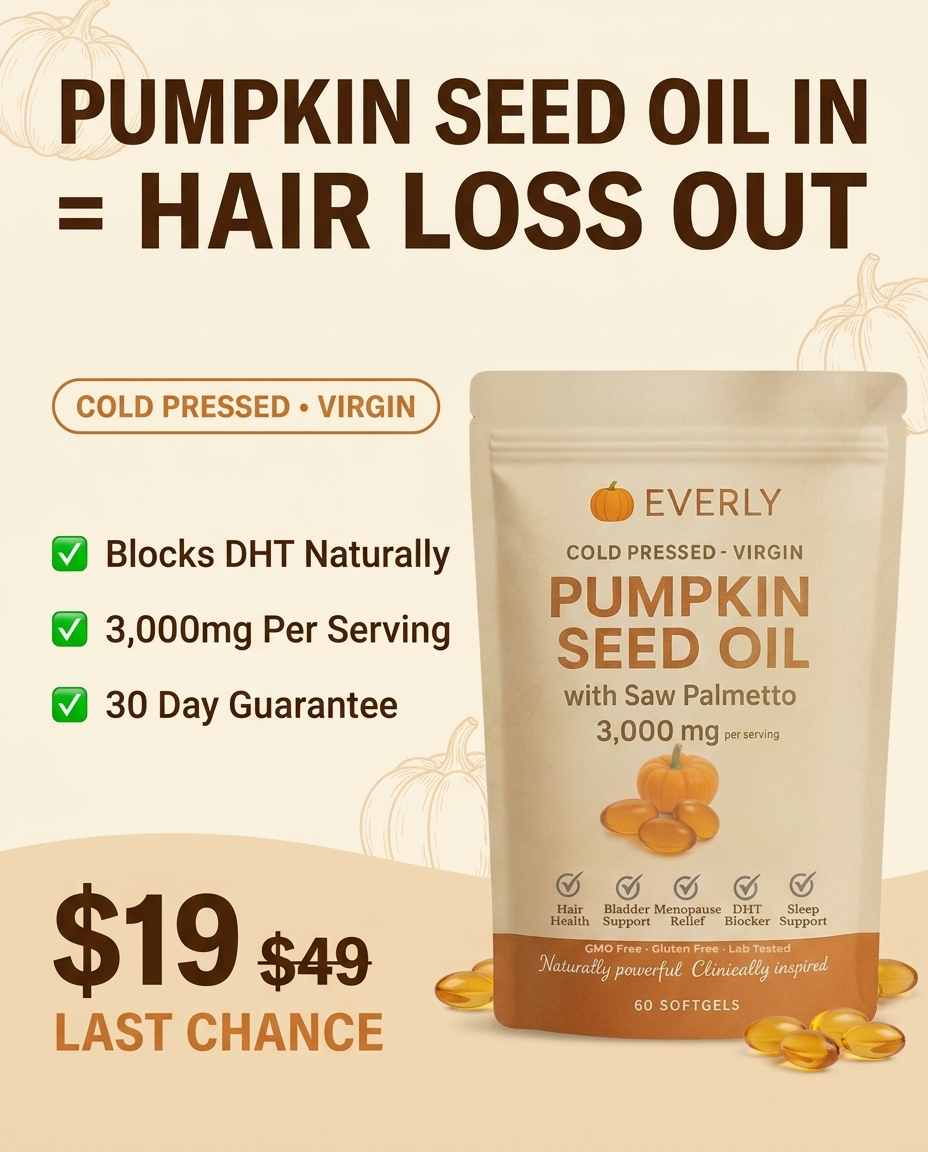
🎃 Natural Support for Your Daily Routine
“I’ve been feeling stronger and more balanced since taking Everly Pumpkin Seed Oil. My bladder feels so much calmer, I’m sleeping through the night again, and my hair feels thicker than it has in years. I love how natural it feels — just pure support for my body.”
LEARN MORELike this ad? Make it yours.
Crush rebuilds this exact creative around your product — your brand, your colors, your offer — in about a minute.