

Inactive· since Apr 4, 2026
- 12
- days it ran
- 1
- relaunches
- 804
- EU reach
Ad copy
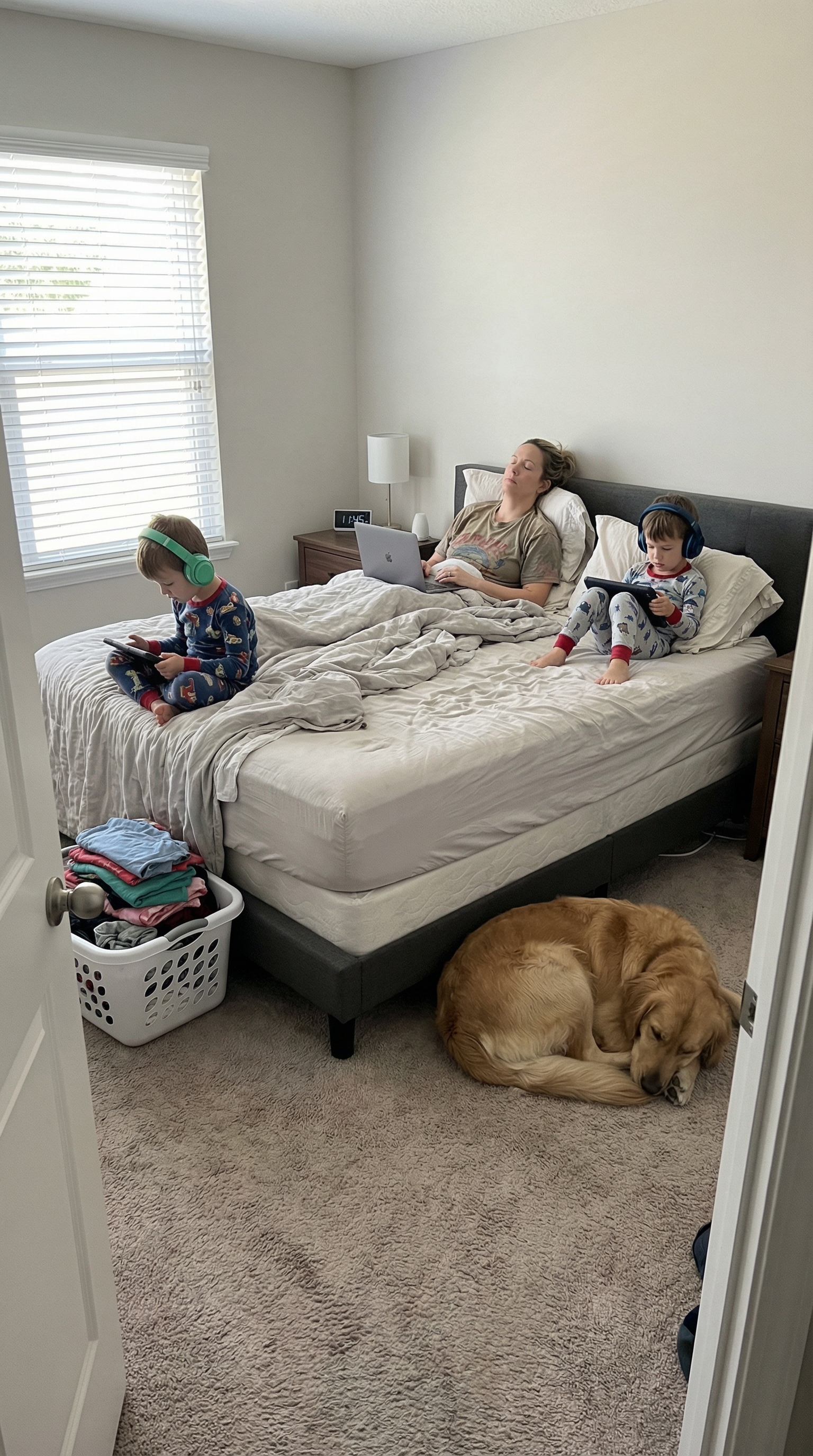
I knew exactly where my son learned to slam doors. I just wasn't ready to admit it. Tuesday. 7:15 PM. The moment I couldn't unsee. At 42, I thought I was a pretty good mom. Patient. Intentional. The kind who reads the parenting books and tries to do better than her own parents did. Then my 8-year-old son slammed his bedroom door so hard the picture frames in the hallway shook. And in the half-second before the crash, I heard him mutter: "I can't do ANYTHING right in this house." My words. My exact words. The ones I'd said to my husband three nights ago when the dishwasher broke and the kids wouldn't stop fighting and I lost it over nothing. I stood in that hallway with my hand still raised to knock. And I didn't move. Because I wasn't looking at a defiant kid anymore. I was looking at a mirror. Here's the thing nobody tells you about parenting. You can read every book. Practice every gentle phrase in the shower before school drop-off. And your nervous system will still hijack you at 5:47 PM on a random Tuesday when someone spills milk on the homework you just helped finish. I didn't choose to become the mom who sighs too loud. Who says "fine" in that voice. Who slams cabinets when she's overwhelmed and then feels like garbage for the next three hours. I didn't choose any of it. But my son was learning it anyway. The worst part wasn't the door slam. It was what happened after. My daughter — she's 6 — came out of her room and whispered, "Is Mommy mad again?" Again. She said again. That word sat in my chest like a rock. Because I realized: this wasn't a bad moment. This was a pattern. And my kids had already memorized it. They knew to get quiet when my shoulders went up. They knew to disappear when I got "that look." They were reading my body like a weather report. And I had taught them all of it. Not with lectures. With my energy. I tried to fix it the way I try to fix everything. More discipline with myself. More willpower. More deep breaths. I downloaded three apps. I bought a journal. I set reminders on my phone: "Stay calm. You've got this." None of it worked. Because I was trying to fix behavior when the actual problem was underneath. My nervous system was wired for threat. Every whine, every mess, every ignored request — my body reacted like something was wrong. Like I was in danger. I wasn't choosing to snap. My body was choosing for me. And forty-two years of wiring doesn't change because you want it to. My husband found me crying in the car one night. Just sitting in the driveway with the engine off. "What's going on?" he asked. I didn't know how to say it. That I could see myself becoming someone I didn't want to be. That I was watching my kids adapt to my moods instead of feeling safe with me. I wanted to be different, but wanting wasn't enough. "I don't know how to stop," I finally said. He didn't try to fix it. He just sat with me. A few days later, he texted me a link. "Someone in my work chat mentioned this. Said it helped with the stuff willpower can't reach." I almost didn't click. Another app. Another promise. Another thing that would make me feel worse when I didn't follow through. But I was tired of watching my kids flinch when I walked into the room too fast. So I took the quiz. The questions weren't what I expected. Not "how often do you yell." But deeper. Do you catch yourself reacting the way your parents did? Does your child mirror your stress during tense moments? That second one broke me a little. Because yes. Every single day. The results didn't call me a bad mom. They explained something I'd never understood: Reactive parenting isn't a character flaw. It's a nervous system pattern. And patterns can be interrupted. Liven uses something called the Micro-Cycle Method. Five minutes a day. That's it. Not another self-improvement marathon. Just small, daily interruptions that help you notice the space between trigger and reaction. I didn't believe it at first. Five minutes felt like nothing. But by week two, something shifted. My son knocked over his water at dinner. I felt the heat rise — that familiar surge in my chest. But this time, there was a pause. A tiny gap I'd never noticed before. I didn't snap. I just said, "Grab a towel, bud." His face changed. Confusion first. Then relief. Then something I hadn't seen in a while. He looked safe. Week four: My daughter started telling me things again. Little things. Things she used to hide because she didn't want to "make me stressed." Week six: I set a boundary without yelling. Firmly. Calmly. My husband looked at me like I'd grown a second head. Week ten: My son got frustrated with his homework. And instead of slamming his door, he came to me. "Mom, I need help. I'm getting really mad." He came to me. Not away from me. That's when I knew something had actually changed. It's been four months now. I'm not a perfect mom. I still have hard days. The old patterns still try to surface, especially when I'm tired. But my kids don't walk on eggshells anymore. They don't read the room before they talk to me. They just… talk to me. And I'm finally becoming the mom I always wanted to be. Not the one I was afraid I was becoming. If any of this felt familiar — the guilt after you react, the patterns you can't seem to stop, the fear that your kids are learning things you never meant to teach — You're not broken. You're not a bad mom. You're running on patterns that got installed before you had any say. But you have a say now. Not to fix you. But to finally stop passing down what was passed to you.
THIS is what you need to do
LEARN MORELike this ad? Make it yours.
Crush rebuilds this exact creative around your product — your brand, your colors, your offer — in about a minute.


