
Active· since Feb 11, 2026
- 216
- days running
- 0
- relaunches
Ad copy
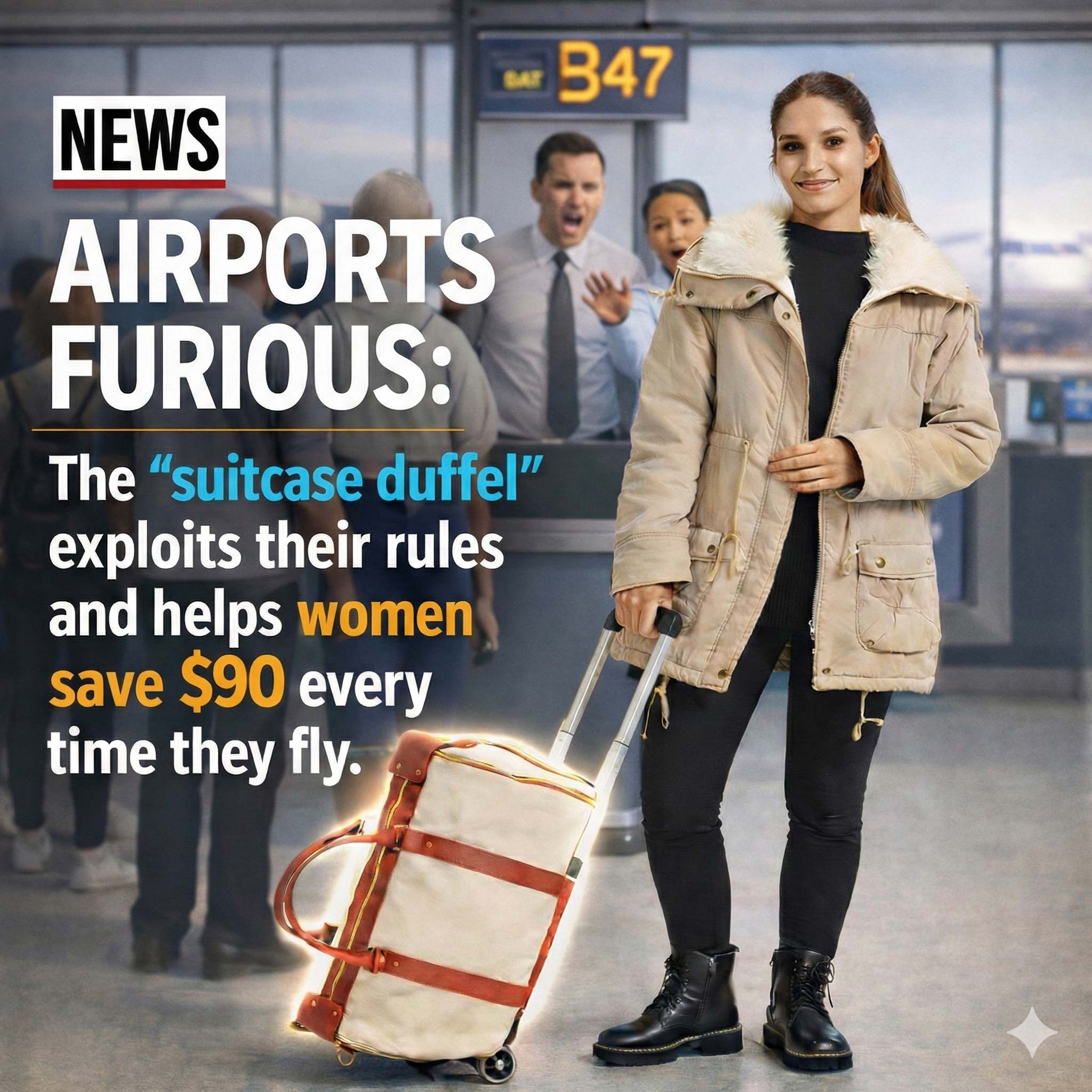
She spent 25 years serving first class at 30,000 feet. Now she's exposing the design flaw, every luggage company has been hiding since the 1980s. READ MORE: According to a new report from the Bureau of Transportation Statistics, U.S. airlines collected a record-breaking $7.27 billion in baggage fees last year. That's not a typo. $7.27 billion. From your suitcases. And they're not even taking care of them. A separate report reveals that during last winter's peak travel window, over 36 million bags were mishandled, lost, or damaged globally. That's 36 million travellers arriving at their destination without the clothes they packed, the medication they need, or the outfit they planned for the event that was the whole reason for the trip. But here's what the reports don't tell you, and what one retired flight attendant is now saying publicly for the first time. The bags themselves are the problem. Not the airlines. Not the handlers. The bags. And every major luggage company knows it. THE WOMAN WHO WATCHED 9 OUT OF 10 SUITCASES FAIL Her name is Sarah Nicholson. She's 52. She spent twenty-five years as a flight attendant for a major international carrier 6,000 flights across four continents. And she watched more luggage fail, than anyone in the industry wants to talk about. "I didn't read about luggage problems in a report," she told us from the floor of her 40,000-square-foot factory. "I watched them happen in real time. Every flight. For twenty-five years. I could predict which bags were going to fail before they hit the carousel." The failures, she says, always followed by the same pattern. Zippers split first. One overstuff, one cold runway that makes the teeth brittle, one handler who throws instead of places, and your clothes are spread across the belt in front of two hundred strangers. The zipper that runs the full perimeter of every suitcase on the market is the single weakest structural point in modern luggage. And every brand builds their entire product around it. Wheels snapped second. Cobblestone streets in Europe. Curb edges in Manhattan. The gap between the jet bridge and the aircraft door. She watched travelers drag $400 suitcases through terminals on one wheel. Then no wheels. Then they carried them. Hard shells cracked third. "Everyone thinks rigid means strong," she said. "I watched hard shells get destroyed for two decades. Samsonites with dents. Aways with cracked corners. Rimowas that looked like they'd been in a car accident. Here's what no luggage company will explain to you: Rigid material doesn't absorb impact. It transfers it. Every drop, every throw, every overhead bin slam goes straight through the shell and into your belongings. The thing people think is protecting their stuff is actually the thing destroying it. We asked her: if the problem is this obvious, why hasn't anyone fixed it? She didn't hesitate. "Because the failure is the business model." THE DESIGN FLAW THAT GENERATES BILLIONS We took her claim to an independent retail consultant, who has advised three of the five largest luggage brands in North America. He agreed to speak on condition of anonymity. "The average consumer replaces their suitcase every two to three years," he confirmed. "A cracked shell. A blown zipper. Wheels that give out. At $300 to $500 per unit, that's recurring revenue the industry depends on. The structural failure isn't a flaw they're trying to fix. It's a cycle they've optimized for." He continued: "Every major suitcase on the market regardless of brand, regardless of price, is built on the same fundamental architecture. Rigid shell. Perimeter zipper. Bolted wheels. The materials change. The colors change. The logo changes. But the failure points are identical across the entire industry. They have been since the 1980s." When we asked whether any brand had attempted to redesign the core architecture, he was blunt. "One. And the major retailers won't carry it. Because a bag that doesn't break doesn't generate replacement sales." The bag he was referring to is called LUHXE. INSIDE THE BAG THE LUGGAGE INDUSTRY DOESN'T WANT ON SHELVES LUHXE — pronounced "lux" — is manufactured by a small, female-founded company based in the United States. It has no retail distribution. No national advertising budget. No partnership with any major luggage retailer. It has sold over one million units. We visited the company's factory to see the product firsthand. What [Founder's Name] showed us was unlike anything currently on the luggage market. From the outside, LUHXE looks like a sleek, structured carry-on. Modern. Minimal. The kind of bag a gate agent wouldn't look at twice. You'd assume it was a premium weekender from a company like Tumi or Away. It's not a suitcase. It's a duffel. And the difference matters. "I didn't try to build a better suitcase," she explained. "I eliminated the suitcase. The entire concept. The rigid box, the perimeter zipper, the bolted wheels, I removed every component that fails." She laid the bag on a table and opened it. "This is what I call the Garment Vault." Beneath the interior lining, invisible unless you know it's there, is a full-width, flat compartment built directly into the architecture of the bag. She lifted the lining to reveal it. "Your suits, your blazers, your dresses lay completely flat in here. No folding. No rolling. No creasing. You're not stuffing garments into a cavity and praying. They're lying flat in a protected bay, separated from everything else in the bag." She loaded it in front of us. Three complete outfits: a blazer, a cocktail dress, a linen suit went in flat. She replaced the lining. Then she packed the main compartment above it: A week's worth of casual clothes, shoes, a toiletry kit, a laptop. The Garment Vault was invisible. The garments were untouched. The bag closed easily. "No garment bag on the market can do this," she said, "because garment bags can't hold a full week of clothes. No hard-shell suitcase can do this, because you're forced to fold everything. No traditional duffel can do this, because there's no internal structure, it's just a fabric hole." She paused. "The Garment Vault exists in one bag. This one." THE PHYSICS OF WHY IT DOESN'T BREAK We asked about durability, the claim every luggage brand makes and few deliver on. She didn't give us a speech. She gave us a demonstration. She picked up the loaded LUHXE and dropped it from chest height onto the concrete factory floor. It landed with a soft thud. She picked it up. It was the same shape as before. She dropped it again. Same result. Then she placed it on the ground and stood on it with both feet. Then sat on it. Then asked an employee to stack three heavy boxes on top of it, simulating the crush weight of an overhead bin. When she removed the boxes, the bag returned to its original shape within seconds. "I've run over 2,500 abuse cycles on this bag personally," she said. "Drops, compressions, drags across concrete, exposure to extreme temperatures. Because I spent twenty-five years watching, what baggage handlers do when they think nobody's looking." She looked at us. "I was always looking." The principle, she explained, is simple. "A rigid shell can't flex. When it takes an impact beyond its tolerance, it cracks, dents, or shatters, and the damage is permanent. A flexible structure absorbs the same impact and distributes it across the entire surface area. Then it returns to its original form. Rigid breaks. Flexible survives. It's not marketing. It's material science." LUHXE uses 1680-denier ballistic nylon, the same textile specification used in military field equipment, reinforced at every stress point. There are no wheels to snap off. There is no zipper to split. There is no rigid surface to crack. "The things that kill every suitcase on the market every two to three years," she said, "do not exist in this design." WHAT ONE MILLION TRAVELERS FIGURED OUT We spent a morning at JFK Terminal 4 talking to passengers. We found six LUHXE owners without trying. Catherine Park, 47, a corporate attorney from Chicago, was the most direct. "I used to travel with a $600 Tumi roller. I replaced it twice in four years. The second time, the zipper split open during a layover in Denver and I had to stuff my clothes into a plastic bag from Hudson News to make my connection. I'm a partner at a law firm. I was standing at a gate holding a plastic bag of underwear." She bought a LUHXE the following week. That was two years and approximately forty flights ago. "Same bag. Not a scratch. And I haven't checked luggage once. I haven't paid a single baggage fee. I haven't waited at a single carousel. My clothes come out unwrinkled because of that compartment underneath. I don't even know how to explain it to people, I just show them." Diana Reeves, 51, a sales director from Dallas, did the math for us unprompted. "I flew 38 legs last year. At $95 per checked bag each way, that's $3,610 I would have spent on baggage fees alone. My LUHXE cost a fraction of that. It paid for itself before my second trip." She added: "But honestly, the money isn't even the main thing. It's the time. I land and I leave. I don't stand at the carousel. I don't wait. I don't worry. I walk off the plane and I'm gone. That feeling alone is worth whatever they charge." THE MATH THE AIRLINES HOPE YOU NEVER DO The average American takes 2.5 round-trip flights per year. At current baggage fee rates, that's $475 annually just to transport your own belongings in the cargo hold of a plane, where they have a 1-in-200 chance of being lost, damaged, or delayed. Over five years, that's $2,375. Over ten years, that's $4,750. That's a European vacation. A kitchen renovation down payment. A semester of tuition. Exposed to damage, loss, and delay, while generating $7.27 billion in annual revenue for the same airlines that are losing your bags. Now factor in the suitcase itself. At $300 to $500 per replacement every two to three years, you're spending an additional $1,000 to $2,000 per decade on a product architecturally designed to fail on the same timeline. The total cost of luggage ownership over ten years for an average traveler: approximately $5,750 to $6,750. Or one LUHXE. A PRODUCTION WARNING We asked LUHXE about current availability. Their response was candid. "We manufacture in controlled batches, because we refuse to compromise material quality for speed," a company representative told us. "Our current production run is nearly sold out. Once it's gone, the next shipment won't be available for approximately eight weeks. We don't pre-sell. We don't take backorders. When it's out of stock, it's out of stock." The company confirmed a 340% increase in orders following the recent wave of airline baggage disasters that made national headlines. "We're a small team. We own our own factory. We have over three hundred employees. But we can't manufacture faster than our quality standards allow. We'd rather turn customers away temporarily, than ship a product that doesn't meet the standard." THE BOTTOM LINE In a year where airlines extracted $7.27 billion from traveler's' luggage, while simultaneously mishandling 36 million bags, the most rational travel purchase isn't a luggage tracker, a TSA lock, or a more expensive version of the same suitcase that's been failing you since the 1980s. It's a bag designed by someone who spent 25 years and 6,000 flights watching every single one of those failures happen, and systematically eliminated every cause. LUHXE is currently offering free shipping while their present inventory lasts. Based on their current sell-through rate, that window is measured in days, not weeks. Catherine Park is somewhere over the Pacific right now, her week of clothes packed neatly in a single bag beneath seat 3A. Everything pressed. Everything organized. No carousel. No fee. No stress. Her colleague checked a Tumi. He's currently on hold with United. The difference between them is one bag.
Like this ad? Make it yours.
Crush rebuilds this exact creative around your product — your brand, your colors, your offer — in about a minute.