Monika Hausmann
Monika Hausmann Facebook ad: “When your curious child suddenly can't focus anymore”
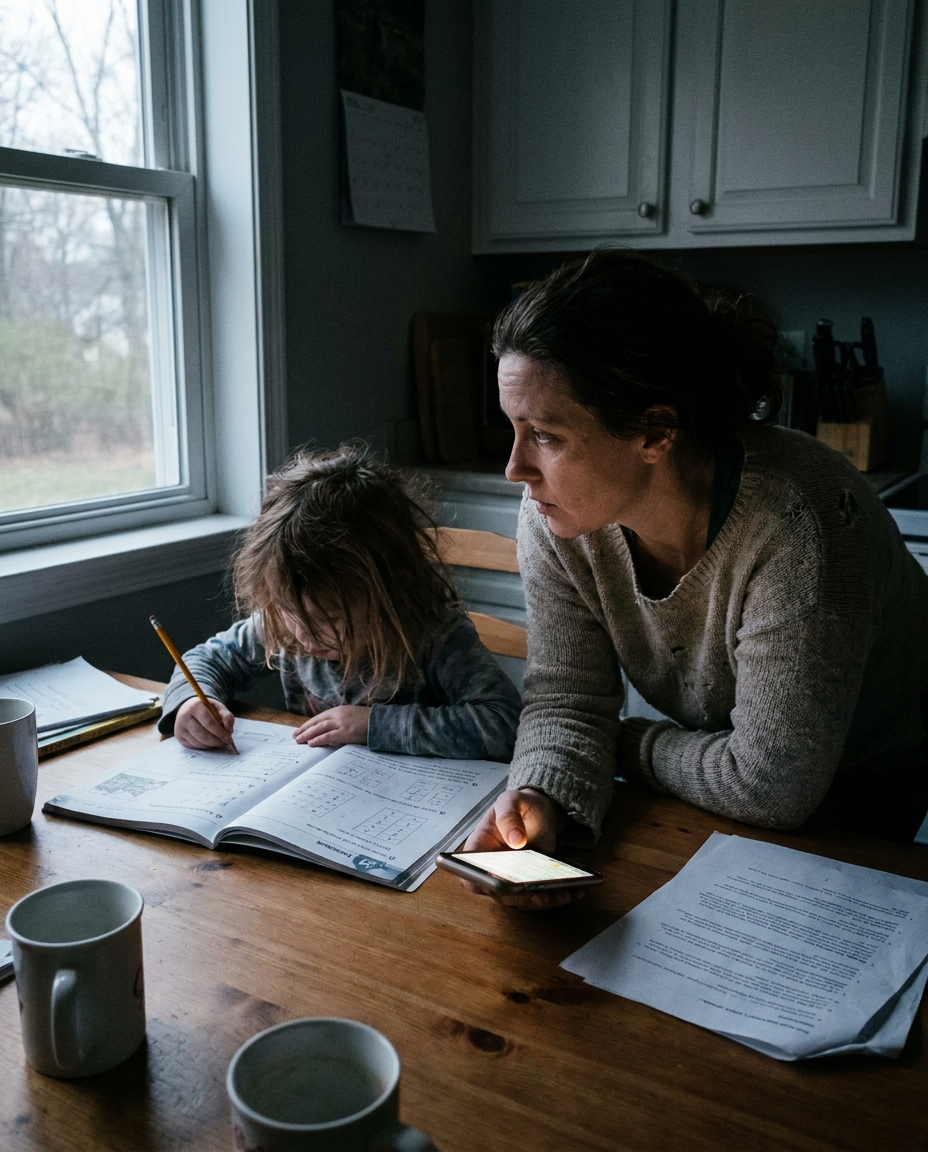
Ran for 5 days, from June 9 to June 14, 2026, the last day Crush saw it.
Run by Monika Hausmann on Facebook. Crush is not the advertiser and does not verify its claims. See this ad in Meta's Ad Library(opens in a new tab)
Want an ad like this for your product?
Crush makes new ad images for your product from this ad: your logo, your product photo, your offer.
Trials from $19.95 USD, then $79.95 USD a month. Cancel anytime.
About this ad
- Meta Ad Library ID
- 1310862400637193
- Platforms
- Facebook, Instagram, Audience Network, Messenger and Threads
- Relaunches
- 0
Ad text
My son used to explain everything. How planes stay up. Why the sky turns orange at sunset. Whether sharks can smell a single drop of blood from a mile away — and how far exactly a mile was if you were swimming. He was eight years old and I genuinely could not keep up with him. I'm Monika. I'm 41, I live in a small house in the kind of neighborhood where everyone still waves at each other when they take out the trash. My son Luca is nine now. And for the better part of the last year, I have watched the boy who used to lecture me about tectonic plates at breakfast become someone who cannot sit still long enough to finish a sentence. Not won't. Can't. There's a difference. I know it in my body now, even if it took me almost twelve months to trust what I was seeing. Let me back up. Luca started third grade in the fall, and somewhere in those first few weeks, something shifted. Not dramatically. Not in a way that would've made me pick up the phone and call the pediatrician. More like the way light changes in October — you don't notice it happening, and then one morning you realize the days are short and you don't remember them getting that way. He started taking longer on homework. Not longer like he was confused. Longer like the homework was there, open on the table in front of him, and he was also somewhere else entirely. I'd come in to check and find him staring at the corner of the room. Or picking at the edge of the workbook. Or — and this is the one that made my stomach drop the first time — with his phone under the table, angled so I couldn't see the screen from the doorway. I took the phone away. Of course I did. He cried. He said I was ruining his life. He was nine, so I understood the theater of it. I held the line. Homework still took forever. He'd sit back down, and within four minutes he'd be somewhere else again. Tapping his pencil. Picking at a hang nail. Getting up to get water. Coming back and asking me what the question was again even though I'd just read it out loud thirty seconds before. I told myself it was adjustment. New teacher, new grade, new expectations. Kids hit walls. Everyone says so. By November, I was Googling things I didn't want to Google. "Can't focus third grade." "Eight year old attention span normal." "Should I get my kid tested for ADHD." "How much screen time is too much screen time." "Signs of attention problems in children." I read everything. I read it at eleven p.m. and I read it again at two a.m. and I didn't feel better, I felt like I had downloaded a hundred different opinions and none of them agreed with each other and none of them were about my specific son in my specific kitchen with his specific homework on a specific Tuesday night. I tried the things everyone suggests. I tried breaking homework into smaller pieces. I tried timers — five minutes on, two minutes off, the kind of thing I'd read about in three different parenting articles. I tried sitting with him. I tried leaving him alone. I tried bribery in the form of dessert, screen time, extra stories at night. Some of it helped a little. None of it held. And then, somewhere around January, I stopped trying to solve the homework problem. Because I realized the homework wasn't the problem. The problem was that Luca had stopped being curious. That sounds abstract. I know how it sounds. But when you've watched a child spend two years asking questions about everything — genuinely, hungrily, couldn't-stop-him curious — and then watch that same child shrug when you point out a hawk perched on the fence post outside the kitchen window, you know exactly what I mean. He used to care about things. Deeply, specifically, all the time. Now he didn't not care. He just... moved past things before they had the chance to catch. Everything was half a second long. He'd start a Lego set and abandon it after the first bag of pieces. Pick up a library book, read four pages, put it down and never ask for it again. Start telling me something that happened at school, lose the thread somewhere in the middle, and sort of trail off like it didn't matter anymore. I mentioned it to his teacher at conferences in February. She was kind. She said Luca was doing fine academically, that he was bright, that she noticed he sometimes needed redirection but that was very common for third grade boys. She said all the right things. I drove home and sat in the driveway for longer than I meant to. Fine wasn't what I was worried about. Fine wasn't what I'd lost. I want to be honest about something because I've read enough parenting content to know how this part usually goes. Usually there's a turning point where someone gives you a piece of advice and everything clicks and you feel hope again. And I did eventually get there. But first there were three more months of trying things that didn't work. I bought a science kit. He was excited for exactly one afternoon. I ordered a children's magazine subscription about animals. He read the first issue and stacked the rest by the door. I reduced screen time again. He was miserable. The focus didn't come back. It turns out that when you drain a swamp, you don't automatically get a garden — you just get a different kind of mess. I want to say something here that I have not seen said anywhere in all the articles I've read, and I have read so many articles. The problem was not that Luca was spending too much time doing shallow things. The problem was that he had lost the habit of going deep. Curiosity isn't like a switch. You can't just turn off the distractions and watch it come back on. It's more like a muscle — and more specifically, it's like a muscle that only stays strong if it gets used in a specific way. Not just any movement. The right movement. A curious child doesn't just wonder. A curious child asks a question, finds a satisfying answer, and discovers that the answer opens up two more questions. And those questions lead somewhere. And somewhere leads somewhere else. That loop — ask, find, discover, ask again — is what curiosity actually is. It's a process, not a feeling. And when that loop breaks often enough, the brain gets efficient. It stops expecting answers. It stops going deep. It learns that wondering doesn't lead anywhere useful, so wondering isn't worth starting. Luca's loop had been breaking for a year. Every time he asked me something and I said "I don't know, let's look it up" and then we never did. Every time the search results were too long or too complicated or just sent him somewhere else entirely. Every time wondering felt like it led to a dead end. His brain had quietly, efficiently concluded that questions weren't worth the investment. I understood that in April, sitting in my car in the school parking lot waiting for pickup, reading a post from another mother in a parenting group I barely participated in. She described exactly this. The loss of the loop. The way it snuck up on her. The thing that brought it back. I went home and ordered The Focus Drain that same night. I want to be honest about that too: I was skeptical. I had bought things before that promised to help and didn't. I had spent money I didn't need to spend and felt foolish about it. I knew the feeling of the optimism at checkout and the resignation three weeks later. But I was also out of ideas. And the premise made sense to me in a way that felt different from the usual advice. Not "reduce screens." Not "reward good behavior." Something more specific: give his questions somewhere to go. Rebuild the loop. Let his brain remember that wondering leads somewhere real. The book arrived two days later. I put it on the kitchen table before Luca got home from school. He walked in, dropped his backpack, and looked at it. Didn't say anything. Poured himself a glass of water. I didn't make it a thing. I didn't say "this is for you" or "I thought you'd love this" — both of which would have guaranteed he didn't touch it for a week. I just left it there. That evening, while I was making dinner, I heard him flip the cover open. He looked at it for maybe three minutes. Put it down and went to watch TV. I told myself that was fine. I told myself to wait. Two days later I walked past his room in the late afternoon and he was on his bed, on his stomach, reading. I stood in the doorway long enough to confirm it was real and then walked back to the kitchen and stood at the sink for a minute doing nothing. That night he asked me why hiccups happen. Not "what do hiccups feel like" or "can I have a snack." Why they happen. The actual mechanism. He had a follow-up question about the diaphragm. He wanted to know if animals got hiccups too. We looked up whether elephants get hiccups. They do, apparently. He thought this was the funniest thing he had ever heard. I don't know exactly what to tell you about the weeks after that because it didn't happen in a clean, dramatic way. It happened the way October light changes — gradually, and then you realize the days are different and you can't quite point to when it shifted. He started leaving the book on his nightstand. I'd find it open to a different page than I'd last seen it. He started asking questions at dinner about things I hadn't said anything about. He started a Lego set in March and finished it. All of it. Including the small annoying pieces at the end. His teacher stopped me at pickup one afternoon in May. She said Luca had been "different lately." More engaged. More likely to raise his hand. More likely to keep following a thought instead of dropping it halfway through. I thanked her and walked to my car and sat there for a minute again. But this time it wasn't because I felt stuck. It was because I had this sudden, specific memory of Luca at age six, explaining to me at the dinner table that the Great Wall of China could not actually be seen from space, that this was a myth, and that he had some follow-up information about the moon. He was back. Not all the way. Not overnight. But the questions were back. The loop was running again. I don't think screens were the enemy. I don't think I failed him by letting him have an iPad. I think his brain got very good at something that didn't require going deep, and that crowded out the habit of depth until the habit barely existed anymore. And I think what changed wasn't about removing things. It was about giving the questions somewhere to go. The Focus Drain isn't a screen detox. It's not a punishment or a rule or a reward system. It's something you put on a table and leave there, and it does the one thing nothing else I tried was designed to do: it meets a child where curiosity lives, and it gives that curiosity a place to go that actually pays off. If your child used to ask you questions and doesn't anymore. If they start things and drop them. If they seem fine but not all the way there. If you've looked at them across the dinner table and felt this low, quiet ache that you couldn't quite name. You haven't lost them. The loop is just quiet. You can give it somewhere to go. 👉 https://trysteady.shop/products/the-focus-drain-e-book P.S. — The one thing I wish someone had told me sooner: it doesn't start on day one. Luca barely looked at it for the first two days. Don't make it a big deal. Just leave it somewhere he'll find it. Let him come to it. He will.
Where the ad sends people
trysteady.shop
When your curious child suddenly can't focus anymore
Steady
Learn more: trysteady.shop(opens in a new tab)