Linsay - Menopause Matters
Linsay - Menopause Matters Facebook ad: “Over $800 worth of failed products in the trash”
Ran for 2 days, from July 26 to July 28, 2026, the last day Crush saw it.
Run by Linsay - Menopause Matters on Facebook. Crush is not the advertiser and does not verify its claims. See this ad in Meta's Ad Library(opens in a new tab)
Want an ad like this for your product?
Crush makes new ad images for your product from this ad: your logo, your product photo, your offer.
Trials from $19.95 USD, then $79.95 USD a month. Cancel anytime.
About this ad
- Meta Ad Library ID
- 1317816777101982
- Platforms
- Facebook, Instagram, Audience Network, Messenger and Threads
- Relaunches
- 1
- Niche
- Skincare & Beauty
Ad text
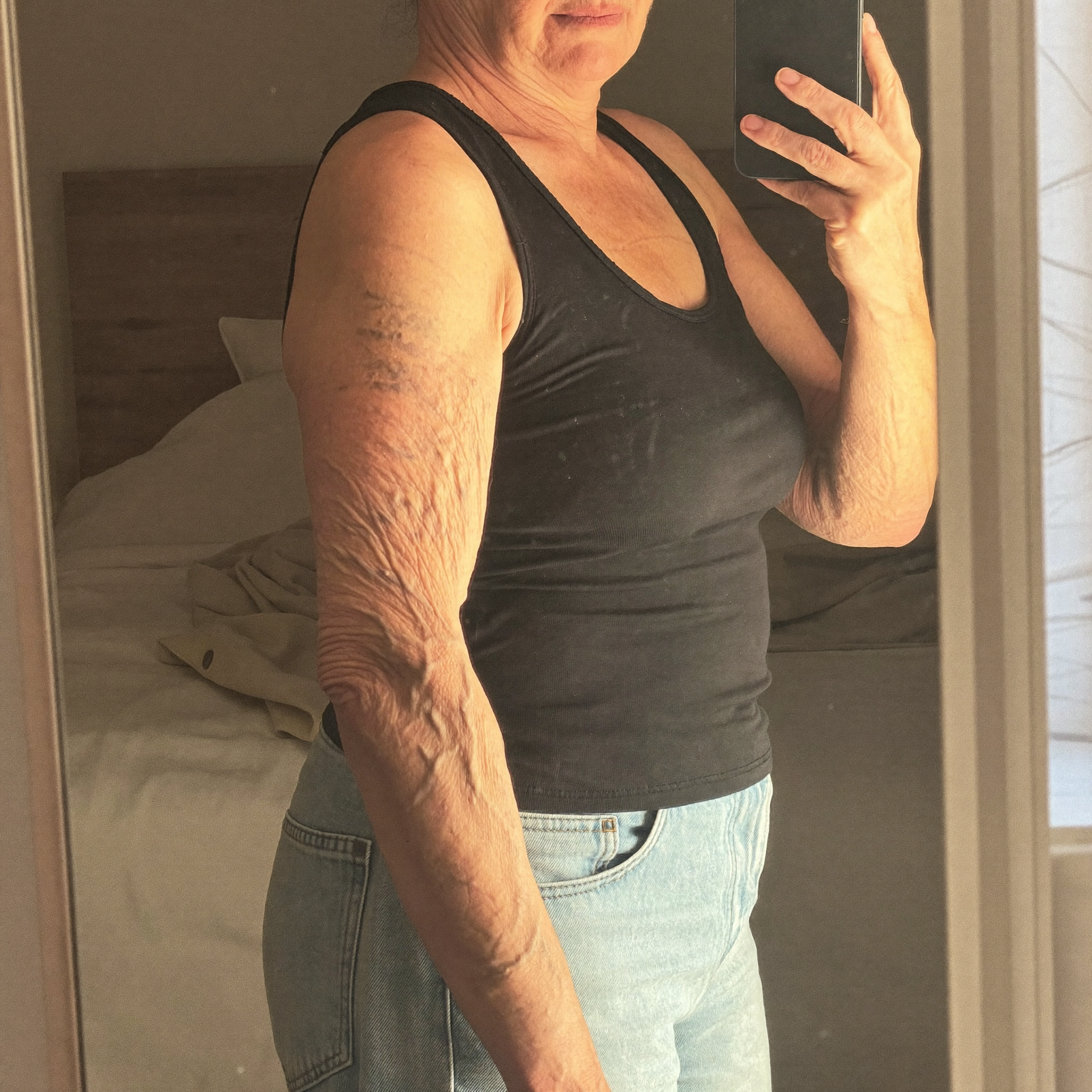
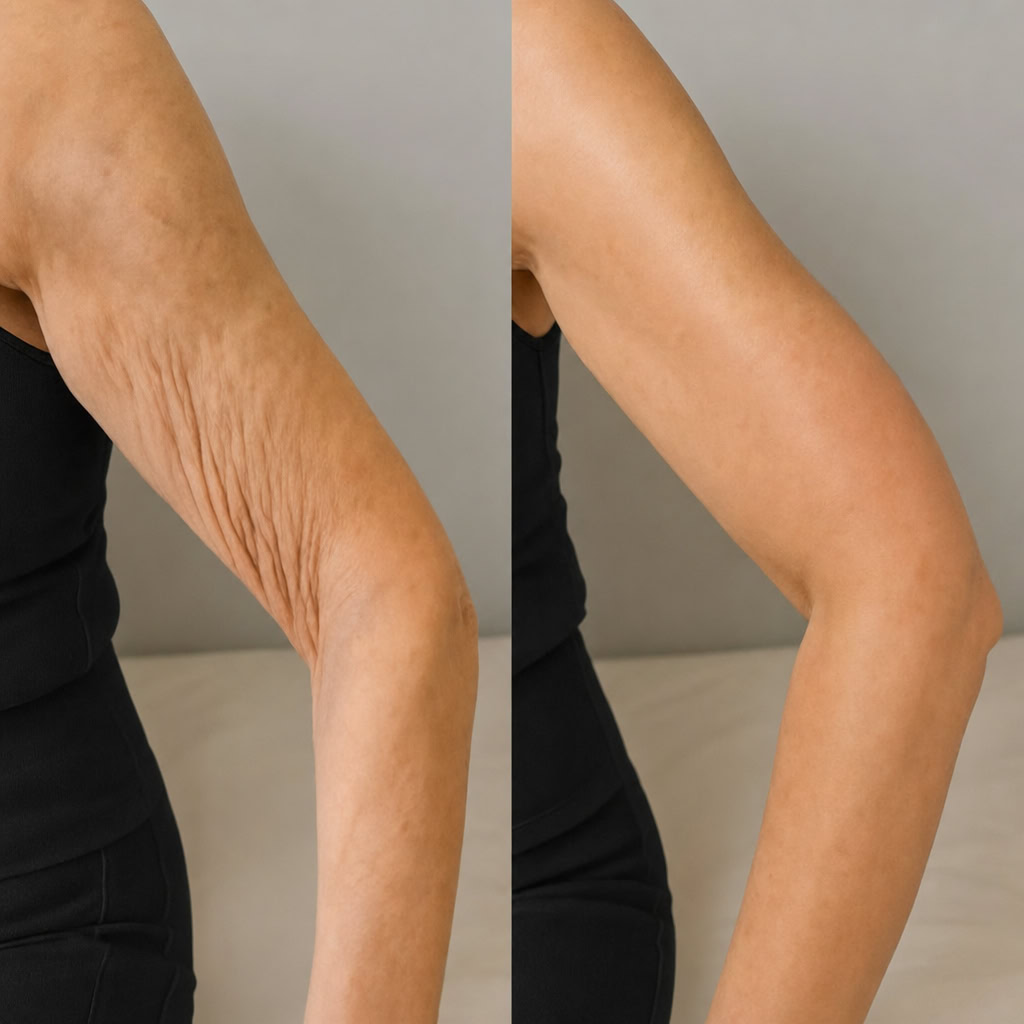
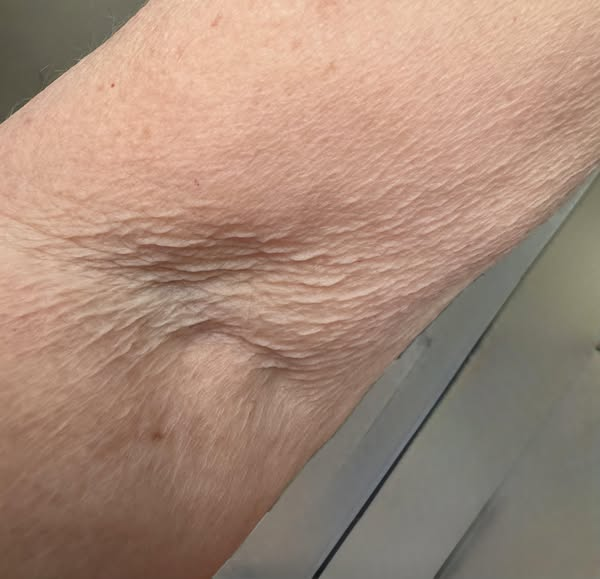
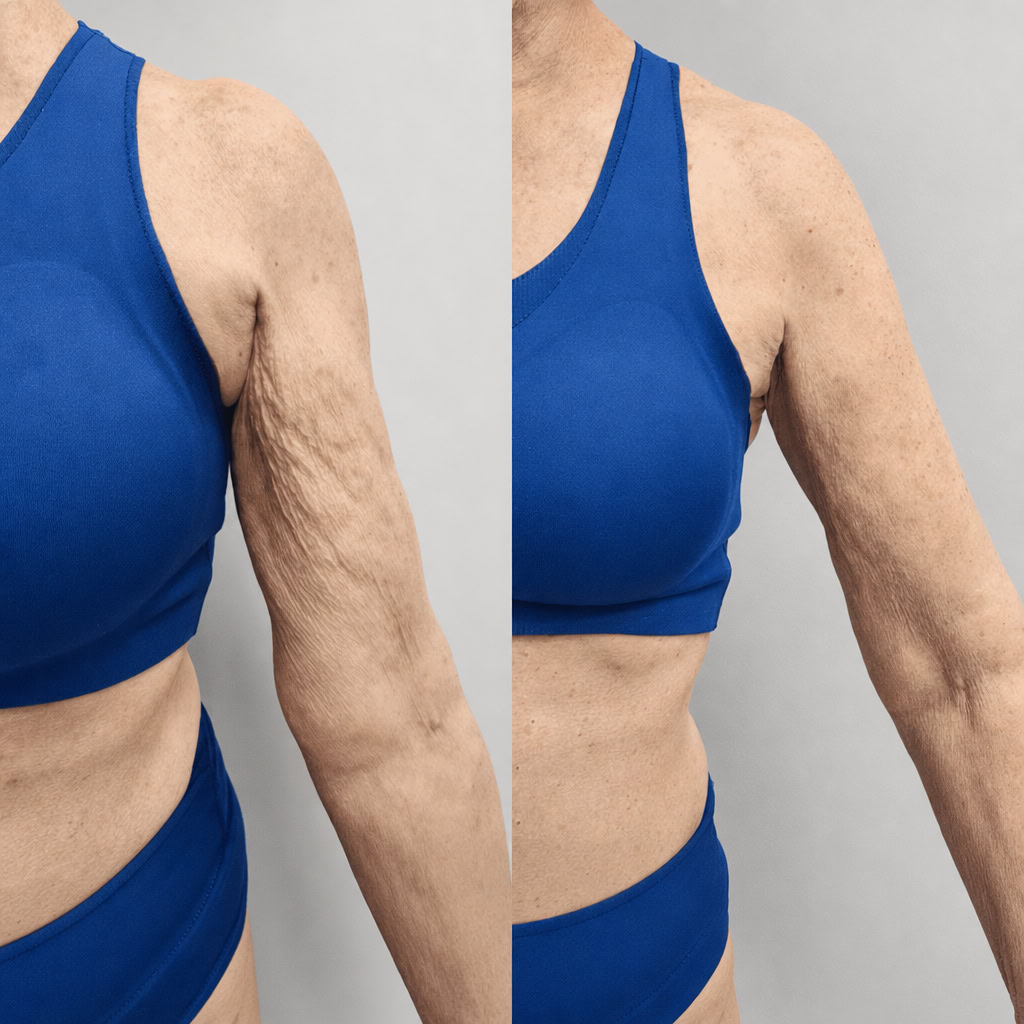
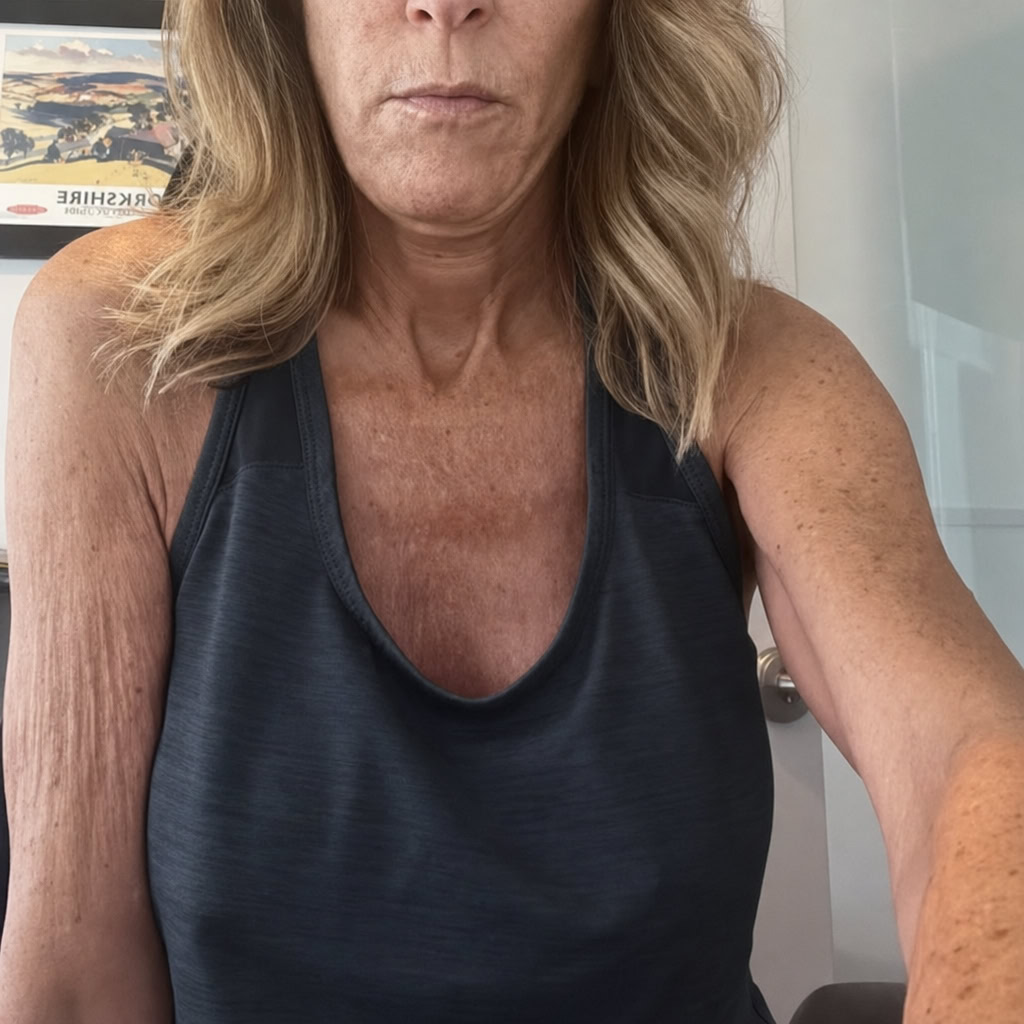
I'm 52 and I now buy t-shirts by sleeve length before anything else. Elbow-length first. Then longer. I gave away every short-sleeve top I owned in one afternoon and didn't tell anyone I'd done it. Here's what I can't get past: my friends are exactly my age. 51, 53, 54. They wore tank tops all summer and their arms are fine. Everyone keeps telling me this is normal. It can't be normal if it's only happening to me. ═══════ I'm going to be precise about the dates, because that's the detail nobody wants to hear. Last summer. Between June and the end of August. Three months. Not three years, not "gradually since my forties." Three months. In June I wore a sleeveless dress to my neighbor's daughter's wedding and thought I looked good in the pictures. In September, I pushed my sleeve up to wash my hands in a restaurant bathroom, and I watched the skin on the inside of my arm pleat like an accordion when I bent my elbow. I stood there with the water running, looking at my own arm like it belonged to somebody else. I had good arms. Not twenty-year-old arms — the arms of a fifty-year-old woman who's doing fine. Firm at the top. Smooth on the inside. The kind of arms nobody notices, which is exactly the point of an arm. ═══════ So I did what we all do. I started managing it. Three-quarter sleeves for the office. A thin cardigan over my shoulders even when it's warm. I always stand on the same side in group photos, arm pinned to my body. I have a friend who photographs everything, and I've developed an entire science for never being the one with her arm up. At my husband's birthday in July it was brutally hot. I kept my linen cardigan on all evening. Someone asked if I was cold. I said yes. That's the part that did the most damage, I think. Not the arm. The lying. Saying I'm cold at ninety degrees so I wouldn't have to say the truth. ═══════ I went to my dermatologist in October. A woman I've seen for years. Kind, serious. She looked. She pinched the skin a little. She nodded. "It's age. It's completely normal at menopause. There's no cream that really repairs that. You can moisturize, it helps with comfort." She wrote down the name of a firming cream to pick up at the drugstore and moved on. I smiled, I said thank you, and in the car I thought one very simple thing that I'm telling you now because it was the beginning of everything. If it's "age," why does Diane, who's 54 and two years older than me, have arms I'd envy? If it's "menopause," the three of us are at the same point in our lives, and I'm the only one. Normal doesn't mean anything when it only happens to one out of three. She didn't lie to me. She had the wrong category. Those aren't the same thing, and the difference changed everything that came after. ═══════ The months that followed, short version, because if you're reading this you've lived them. The firming cream from the drugstore, the one my dermatologist wrote down. $44. Three months, morning and night. Nothing. A "body firming" serum at Sephora — the woman swore it was made for mature skin. $68. Two months. Nothing. Six months of collagen powder in my coffee, because a friend swore by it. About $175. My nails grew faster. My arms didn't. A cream I ordered online because of an ad, $56 with shipping. One month. It smelled nice. That's all. A massage brush and a "draining" oil from a spa. $92. I used it faithfully three times a week. Nothing measurable. Total: $435 over eight months. Five things. Not one of them changed the texture by a millimeter. And the real cost isn't the money. It's that for eight months I kept wearing long sleeves, lying about the temperature, standing on the right side — while something underneath kept quietly going. ═══════ A friend was the one who told me about Anne. Anne is a French esthetician. She spent almost forty years in practice in Paris, working with women's skin after menopause. She doesn't do miracles — she explains. My friend had seen her, and said one thing that stopped me cold: "She didn't mention my age once." I eventually got an appointment. She pressed her thumb into the skin at the top of my arm. One second. She let go. The dent stayed. She counted out loud. Four seconds before it came back up. She wasn't looking at my arm. She was looking at me. "When did this start?" Last summer. Three months. I told her about June, about September, about the running tap. She nodded slowly, like I'd just confirmed something she already knew. "Your dermatologist didn't lie to you. She had the wrong category. This isn't aging." ═══════ She sat me down and explained it. No jargon, just her hands. Normal aging, she said, is slow. You lose about one percent of your collagen a year, steadily, starting in your thirties. That's what my dermatologist was trained to recognize — the gentle slope. That's what Diane and the others are living. Slow, steady, almost invisible. "What happened to you is not the gentle slope. It's a collapse." During the hormonal shift, in some women — not all, which is exactly why your friends are fine — the structure doesn't lose one percent. It loses the equivalent of two or three years of collagen in a few months. The cushion that supports the skin underneath deflates all at once. The skin doesn't shrink at the same speed. It ends up in excess. And it creases — that crepe-paper texture, that accordion when you bend your elbow. "That's why it happened so fast. And that's why it happened to you and not to her. You didn't age faster. You had a collapse, and she didn't." Then the part that made my hands go cold. "And that's also why none of your creams did anything. The problem was never on the surface. It's four or five millimeters down. Everything you spread on top sits above the problem. It never touched it." Eight months of creams. Sitting on top. While the collapse was underneath. ═══════ And then she told me the one thing she was in a hurry about. Not a sale. A clock. "The cells that make collagen — the fibroblasts — aren't dead. They went dormant during the collapse. Dormant, not dead. They can be woken up." "But not indefinitely. You have a window of roughly eighteen to twenty-four months from when it started. After that, they settle into the dormant state, and then, yes, it becomes permanent." She asked me to count again. Last summer. June. It was now June again. Twelve months. "You're right in the middle of it. This is exactly when it works best. It would be a shame to spend another year putting on creams that don't go down." Then she added something I haven't forgotten: "Don't run to a surgeon. Surgery removes the excess skin. It doesn't put the cushion back. Here, there's still a cushion to put back — for a few more months." ═══════ She didn't name a brand. She wrote three requirements on a piece of paper and said: "Check these against whatever you decide to try." One — it has to penetrate. "Your creams stay on the surface because they're creams. You need an oil fine enough to cross the barrier and get down into the collapse zone. A cream that sits on top will never work where the damage is." That's where she named bakuchiol — an active that wakes up fibroblast renewal the way retinol does, without the irritation and without making the skin sun-sensitive. Two — it has to rebuild the barrier. At menopause, the skin loses the lipids it used to make on its own. You have to give them back in a form it recognizes. She named Camellia oil — a lipid that mimics sebum, which the skin takes in instead of pushing away. Three — it has to feed the rebuild. New collagen, in skin that's been through this, is fragile. It has to be fed while it forms, with the specific lipids menopause took away from you. "All three. Morning and night. One out of three isn't enough." ═══════ I went home and spent the evening searching. Cushion collapse. It's a real thing. There's real European research on it, clinics in Paris and Milan. Then I went into two Facebook groups full of women my age and searched arms. The same name kept coming up. Eraé Queen Oil. I looked at the formulation. Bakuchiol. Camellia. And the oils that feed the rebuild, exactly the way Anne had described them. Anne's requirements, off her piece of paper, were in the bottle. I hadn't given her name to anyone. The product came back on its own. I didn't believe it right away — I'd rather be honest about that. I'd already spent $435 confirming there was "nothing to be done." But this wasn't a cream sitting on the surface. It was an oil that goes down. And there was a 60-day money-back guarantee — no forms, nothing to ship back. My one real fear, paying again for nothing, defused. I ordered it that night. $59 a bottle. ═══════ The bottle came within a few days. Amber glass, heavy. It smells like an actual plant, not perfume. First application: absorbed in thirty seconds. No greasy film. Day 6 — the thumb test on myself. The dent came back up in three and a half seconds. It had been four and over. I decided I was imagining it. Day 14 — out of the shower, I looked at the inside of my arm. The creasing looked less deep. Not smoothed over on top — like something underneath was slowly filling back in. I told myself again that I just wanted to believe it. Week 4 — I bent my elbow in front of the mirror, on purpose, to see the accordion. It's there, but lighter. Fewer folds, finer. It isn't perfect. But this time I wasn't imagining it. Week 7 — a Saturday morning, without thinking about it, I grabbed a tank top I'd forgotten to give away, the one stuck at the back of the drawer. I wore it to get bread. I didn't take a cardigan. I noticed at the bakery, my bare arm against the counter. And I didn't do anything to cover it. ═══════ Eight weeks: Thumb test: a little under two seconds. It was four. The creasing on the inside of my arm: still visible when I look for it, but I don't look for it all the time anymore. That's what actually changed. I stopped monitoring myself. Last month, dinner at Diane's. It was warm. I took my cardigan off without doing the math, without looking for the right side of the table. At one point I reached up for the water pitcher and froze for half a second — the old reflex — and then I just took it. Nobody noticed anything. That's exactly the gift. Being a woman in a room again, instead of a woman managing an angle. ═══════ If your arms changed last summer and not ten years ago — If your friends the same age are fine and you're the only one — If someone told you "it's your age, it's normal" — it isn't wrong out of unkindness. It's the wrong category. This isn't the gentle slope of aging. It's a collapse. Recent, and fixable — for a while. That window is eighteen to twenty-four months from when it started. Count backward: most of us find out what's happening when we're already at twelve, fifteen months. Almost all of us have less time than we think. Eraé Queen Oil does the three things Anne requires: ✓ It penetrates — it's an oil, not a cream. It goes down where your creams sat on top, and bakuchiol wakes the cells that went dormant during the collapse. ✓ It protects — Camellia Japonica gives the skin back the lipid barrier menopause took away. ✓ It rebuilds — Sea Buckthorn and Evening Primrose feed the new collagen while it forms. Four plant-and-sea-derived heroes. All three jobs, at once, morning and night. 60-day money-back guarantee. Full refund. No forms, nothing to ship back, no questions. I'm not going to pressure you about the bottle — a bottle you can send back. What you can't send back is the months you have left in the window. I'll put the link just below. ═══════ P.S. Three months later, second bottle. $118 all in. For comparison: $435 over eight months of creams and serums sitting on top of the problem, that physically could not reach where the damage was. The short-sleeve tops I gave away in one afternoon, I never re-bought. I bought exactly one, last week — a plain blue tank top. I wore it to lunch on a patio with Diane and I didn't think about my arms once the whole meal. P.P.S. My dermatologist didn't lie to me. She had the wrong category. If yours tells you "it's your age, it's normal," ask her one question: then why is my friend the same age doing fine? Normal shouldn't pick one woman out of three. That isn't the gentle slope. It's something else. And for that something else, there's a window — and you're either inside it right now, or you're not.
Where the ad sends people
erae-paris.com
Over $800 worth of failed products in the trash
French Wisdom
Learn more: erae-paris.com(opens in a new tab)