Children Parenting Advices
Children Parenting Advices Facebook ad: “read this if you have kids or grandkids”
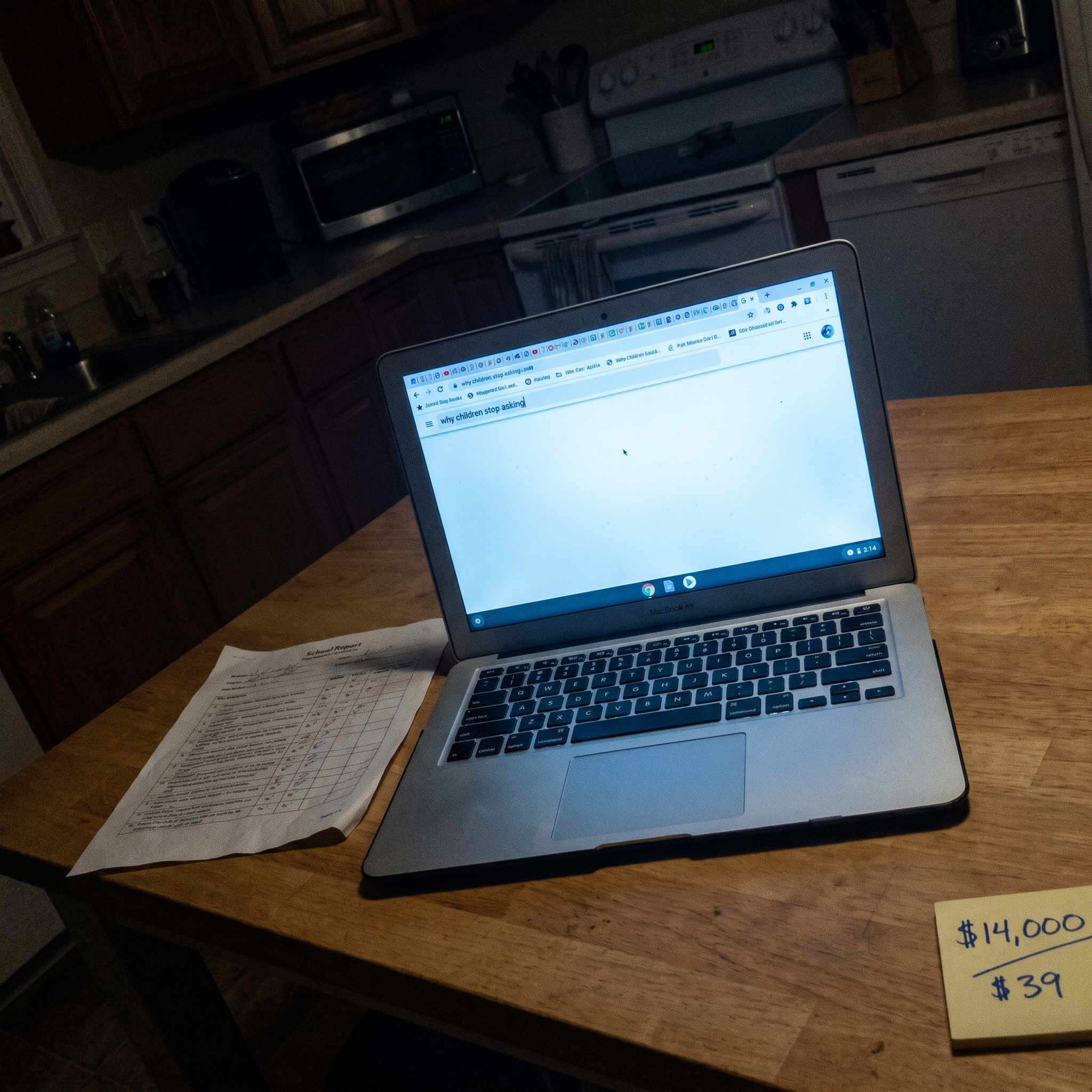
Ran for 2 days, from May 19 to May 21, 2026, the last day Crush saw it.
Run by Children Parenting Advices on Facebook. Crush is not the advertiser and does not verify its claims. See this ad in Meta's Ad Library(opens in a new tab)
Want an ad like this for your product?
Crush makes new ad images for your product from this ad: your logo, your product photo, your offer.
Trials from $19.95 USD, then $79.95 USD a month. Cancel anytime.
About this ad
- Meta Ad Library ID
- 1326648842671591
- Platforms
- Facebook, Instagram, Audience Network, Messenger and Threads
- Relaunches
- 0
- Niche
- Education & Courses
Ad text
Sarah's daughter just got a school report that said "shows no curiosity in her own learning" — and I looked at Emma across the dinner table and realized I teach creative thinking for a living but... ⠀ Emma hadn't asked me a single why-question in three weeks. ⠀ She was nine years old. ⠀ I had been teaching inquiry-based learning to other people's children for eleven years. ⠀ My own daughter had stopped wondering and I had not noticed. ⠀ --- ⠀ I teach fourth grade. Eleven years. For the last four, I've run our school's inquiry program — the thing we do specifically to protect children from losing their questions. I know exactly when it happens. Between six and nine, usually. Between the first time a teacher corrects a wrong guess and the first time a phone answers everything in three seconds. I've watched it happen to thirty children a year. I have intervened every time. ⠀ Except once. ⠀ Three years ago I attended a professional development day. The speaker said one sentence. I wrote it down. I have quoted it to parents at information evenings ever since. ⠀ "We don't grow into creativity. We grow out of it. We get educated out of it." ⠀ I used it in workshops. ⠀ I trained colleagues with it. ⠀ I went home that night to Emma, who was six, who asked why dogs' eyes look the same as ours but see completely differently, and I thought: not her. She's mine. She asks everything. She is safe. ⠀ I heard the sentence. ⠀ I nodded. ⠀ I never once applied it at home. ⠀ --- ⠀ Wednesday. 6:47 PM. Kitchen table. ⠀ I asked Emma why leaves change color in autumn. ⠀ She looked at me. ⠀ "I don't know." ⠀ "What do you think is happening?" ⠀ "I don't know, Mum. Can I just Google it?" ⠀ Can I just Google it. ⠀ Four words. ⠀ The question muscle hadn't weakened. It had been replaced. Wondering had been outsourced to the rectangle in her hand. ⠀ I sat there after she left the table. ⠀ Counted backward. ⠀ Last real why-question: three weeks ago. She'd asked why the moon looks bigger near the horizon. I said "optical illusion" and handed her my phone. ⠀ Three weeks. ⠀ I tested her the next morning. ⠀ "Why do we have fingerprints?" ⠀ She reached for my phone on the counter. ⠀ "Why is the sky different colors at sunrise?" ⠀ Reached again. ⠀ "Why are some people left-handed?" ⠀ "Mum, why can't I just look it up? That's what it's for." ⠀ Three questions. Three reaches. ⠀ I had eleven years of data on this. Children who outsource wondering at nine rarely recover the instinct before thirteen. The habit sets. The phone becomes the permanent first response, structurally, before the window closes. ⠀ I had taught this to other parents at information evenings. ⠀ I had never once brought it home to Emma. ⠀ --- ⠀ Sarah's daughter Lily is thirteen. ⠀ Private school since kindergarten. Piano. Mandarin. Academic coaching every Saturday for four years. ⠀ After the report, Sarah told me: "She can retrieve anything. Ask her a fact and she has it in ten seconds. Ask her why something is true and she just stares. Completely blank. Like the question itself confuses her." ⠀ I looked at Emma. ⠀ She was nine. ⠀ She already stared. ⠀ Lily is thirteen. The window I had been telling parents about for four years had already closed on her. ⠀ Sarah had spent $14,000 on Lily's primary education. ⠀ Lily's report said: "shows no curiosity in her own learning." ⠀ Emma was nine. Four years from Lily's age. Three weeks since her last spontaneous question. ⠀ My stomach went flat. ⠀ --- ⠀ 2:14 AM. Thursday. Laptop open. Kitchen dark. ⠀ I searched: ⠀ "How to restore curiosity in children after age eight." ⠀ "Why children stop asking questions." ⠀ "Inquiry learning at home practical methods." ⠀ Three hours. Forty-one tabs. Everything said limit screens. Everything said reduce technology. Nothing said how to rebuild the instinct once it was already gone. ⠀ 4:07 AM. I closed the laptop. ⠀ Saturday. 10:23 AM. ⠀ I was at Mrs. Patel's house next door, returning something borrowed. Her daughter Priya, twelve, was on the sofa with a large illustrated book across her knees. Heavy pages. Diagrams. Not a screen. ⠀ "What's she reading?" ⠀ Mrs. Patel smiled. "She's had it five weeks. Last Tuesday she asked me why different languages put their verbs in different positions in a sentence. She spent forty minutes on her own theory before she looked anything up. I hadn't thought about language like that since college." ⠀ She paused. ⠀ "She was exactly like Emma a year ago. Phone for everything. Now she thinks first. She won't stop." ⠀ "What's the book?" ⠀ Mrs. Patel turned the cover toward me. ⠀ I ordered it that night. ⠀ --- ⠀ First night. Emma at the kitchen table. ⠀ "Mum, can't I just look up the answer?" ⠀ "Read the question first. Think. Then read." ⠀ She read it. ⠀ "Why do trees lose their leaves in winter?" ⠀ Silence. Two minutes. ⠀ "I don't know." ⠀ "Try." ⠀ "I can't. I don't know where to start." ⠀ She wasn't being difficult. ⠀ The starting position was genuinely gone — the willingness to sit inside not-knowing before reaching for the answer. That muscle. The one that makes a child a thinker rather than a retriever. Gone. ⠀ We read the two pages together. ⠀ One small question from her at the end: "Do all trees lose their leaves or just some?" ⠀ I didn't answer. ⠀ "Think about it tonight." ⠀ She did. ⠀ --- ⠀ Week 3. 7:18 AM. ⠀ She came downstairs before I'd made breakfast. ⠀ "Mum, I was thinking. If trees drop their leaves to save energy in winter, why don't they drop their bark too? Bark is heavy. Wouldn't dropping bark save even more energy?" ⠀ I stood at the counter. ⠀ Didn't move. ⠀ "What do you think?" ⠀ "Maybe bark protects something essential underneath. The leaves are optional — extras that get cut when resources are low — but the bark is the tree's armour. It stays no matter what. The tree knows the difference between what's essential and what's expendable." ⠀ She looked at me. ⠀ "Is that right?" ⠀ "Let's find out." ⠀ That was not a retrieved answer. ⠀ That was a thought. Her own thought. Before 7:30 AM. Unprompted. Arrived before breakfast, before a screen, before I asked for it. ⠀ The instinct wasn't gone. ⠀ It had been asleep. ⠀ --- ⠀ Week 5. ⠀ She started arguing with the questions themselves. ⠀ "Mum, the book asks why we dream but I don't think that's the right question. The right question is whether dreaming is something the brain does on purpose or a side effect of something else. Those are completely different questions with completely different answers." ⠀ Nine years old. ⠀ Epistemological distinctions at the breakfast table. ⠀ Her phone was two feet away. ⠀ She had not touched it. ⠀ --- ⠀ Week 7. Sunday afternoon. ⠀ Her cousin Rowan visited. Eleven years old. Emma spent forty minutes at the dinner table explaining why different trees evolved different leaf-dropping strategies — the energy tradeoffs, the evolutionary pressures, the exceptions that prove the rule. ⠀ Rowan: "Why do you know so much about trees?" ⠀ Emma, without looking up: "I just think about them." ⠀ I had to leave the room. ⠀ Not because I was proud. ⠀ Because I recognized her. ⠀ She was six again — the child who couldn't stop, who asked why dogs' eyes look like ours but see differently, who I thought was safe. She had been there the whole time. ⠀ Asleep under the phone. ⠀ Two pages a night had woken her up. ⠀ --- ⠀ Week 6. Tuesday. 3:48 PM. ⠀ Emma's teacher, Mrs. Clarke, called. ⠀ Unsolicited. ⠀ "I need to ask what's changed at home. Something has shifted with Emma. Last Thursday during our photosynthesis lesson she stopped the entire class. She said — I'm quoting exactly — 'but that assumes the plant is choosing to grow toward the light, and choosing requires consciousness, so is the plant conscious or are we just projecting?' I had to stop the lesson. We debated it for twenty minutes. Emma drove the whole discussion." ⠀ She paused. ⠀ "She hasn't been like this before this month. What changed?" ⠀ I sat in my car in the school parking lot. ⠀ Two pages. ⠀ Fifteen minutes. ⠀ Forty-two nights. ⠀ It had done what eleven years of professional knowledge had not: it had given Emma back the instinct I had been protecting in other people's children while it quietly left my own house. ⠀ --- ⠀ Nine years ago Emma was born. ⠀ Six years ago she could not stop asking why. ⠀ Three years ago I heard a sentence, nodded, and applied it to every classroom but mine. ⠀ Three weeks before I found the book, she had not asked a question in three weeks. ⠀ Six weeks in, her teacher calls to say she stopped a class on plant consciousness. ⠀ Sarah spent $14,000 on Lily's education. ⠀ Lily's report: "shows no curiosity in her own learning." ⠀ 100,000 Whys: $39. ⠀ Two pages. Fifteen minutes. Forty-two nights. ⠀ The sentence was right. ⠀ We don't grow out of it. ⠀ We get educated out of it. ⠀ But you can educate back in. ⠀ --- ⠀ If you sat at a talk or read an article about children losing their questions, nodded hard, went home, and changed nothing. ⠀ If your child reaches for a phone before they attempt a thought — before they even pause to wonder. ⠀ If you tried to remember the last spontaneous question they asked and couldn't place the date. ⠀ If you have been spending on schools and tutoring and enrichment activities and not on the one thing that keeps the instinct alive. ⠀ The window is six to thirteen. ⠀ Not as a theory. As a developmental fact. The inquiry instinct consolidates before thirteen. The habit of outsourcing wonder — to a phone, to Google, to the nearest available answer — becomes structural. Not because something is wrong with your child. Because nothing challenges the alternative. ⠀ Emma is nine. ⠀ Four years. ⠀ Lily is thirteen. ⠀ That window is closed. ⠀ Don't spend three more years nodding while the education does exactly what the sentence warned you it would do. ⠀ --- ⠀ The encyclopedia that gave Emma back her questions is called 100,000 Whys. ⠀ Over 200 topics. More than 1,000 illustrated entries. Organized by the questions children actually ask. ⠀ Two pages. Fifteen minutes. Ages six to thirteen. ⠀ The method is simple: read the question, think before the answer, let the wondering happen before the knowing. The book rebuilds the habit the phone removes. ⠀ $39. Available worldwide. ⠀ Don't let Emma become another Lily. ⠀ Not because you didn't care. ⠀ Not because you weren't paying attention. ⠀ Because you read this, recognized your own child in it, nodded — ⠀ and went home and changed nothing. ⠀ The window closes at thirteen. ⠀ Sarah's is already closed. ⠀ Don't wait until yours is.
Where the ad sends people
eduquestkids.com
read this if you have kids or grandkids 👆
INTELLECTUAL ADVANTAGE DAILY Children's Encyclopedia ➡ Children's Intellectual Development Report Top Educator Exposes the "Cognitive Window": Why Most 8-Year-Olds Lose Their Intellectual Edge (And the "Elite Secret" to Getting It Back) By David Sterling, Retired Academy Director April 01, 2026 at...
Shop now: eduquestkids.com(opens in a new tab)