
Stopped· since Jul 11, 2026
- 4
- days it ran
- 0
- relaunches
Ad copy
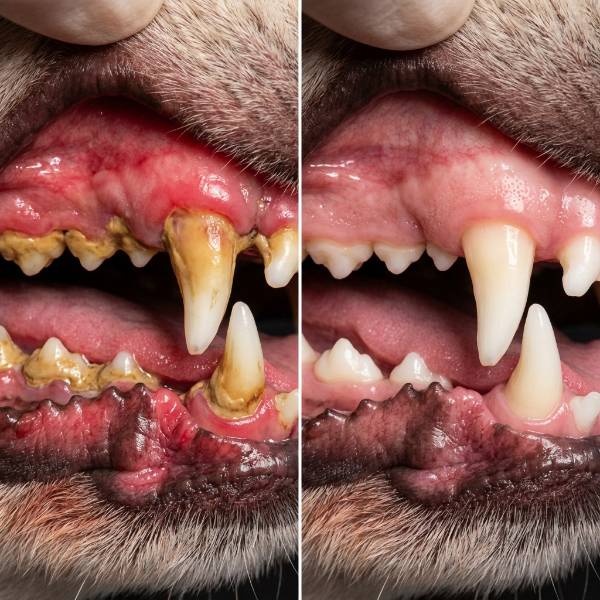
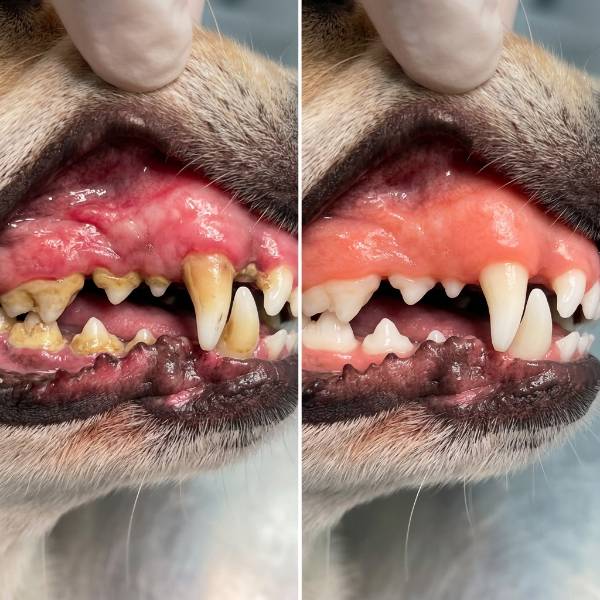
89% bacterial reduction in the first 14 days. That number came from a board-certified veterinary dental specialist who documented exactly what happens to bacterial colonies when you use an enzyme formula daily instead of chews, additives, or professional cleanings. The results were uncomfortable for the industry. Here is why. But first, the outcome. Susan, 63, had a 13-year-old Labrador named Cooper. Swollen gums. Foul breath so thick she could smell it from across the room. Her vet quoted $1,400 for a cleaning under anesthesia. Cooper was too old. Too risky. Susan had already spent two years rotating through Greenies, Tropiclean water additive, and a toothbrush Cooper refused to tolerate past day three. She started using an enzyme-based spray. Applied it in about 10 seconds a day. Day 4: the smell dropped noticeably. Not masked. Reduced. Day 10: the thick slimy drool Cooper left on her couch cushions stopped. Day 21: his gums started shifting from angry red back toward pink. Day 45: her vet examined Cooper and asked what changed. Susan saved $1,800 she did not have. Now. You are reading that and thinking it cannot be right. Because brushing does not work that fast. Professional cleanings do not hold that long. Greenies disappear down your dog's throat in 8 seconds and never touch the back molars where disease actually starts. You are not wrong to be skeptical. Everything you have tried before was designed to fail you. Not because you did it wrong. Because those products were never built to reach where the bacteria actually live. Here is what is actually happening inside your dog's mouth right now. Below the gumline, in the pockets between tooth and tissue, bacterial colonies build a structure called a biofilm. Think of it as a fortress. Hard. Layered. Self-protecting. No chew can scrape it. No water additive can dilute it. No toothbrush bristle can reach it. Even a $1,200 professional cleaning under anesthesia only disrupts it temporarily. How temporarily? Dr. Sarah Mitchell, a board-certified veterinary dental specialist with 14 years of clinical practice and over 3,500 patients, documented the recolonization rate after professional cleanings. Within 48 to 72 hours, bacterial colonies begin rebuilding. Within two weeks, the biofilm is back to pre-cleaning density. You paid $1,200 for 48 hours of clean. And those bacteria do not stay in the mouth. Every time your dog eats, chews, or swallows, bacteria from those subgingival pockets enter the bloodstream. They travel to the heart valves. The kidneys. The liver. An 8,500-dog longitudinal study found that untreated dental disease shortens a dog's lifespan by an average of 6.8 years. This is not a teeth problem. It is a bloodstream problem that starts in the mouth. So Dr. Mitchell asked a question nobody in the $4.2 billion pet dental industry wanted asked: what if you targeted the biofilm itself, daily, without anesthesia, without a toothbrush, without sedation? She spent 8 months researching enzymatic approaches vet school never taught her. She developed what she calls the Sub-Gumline Enzyme Protocol. A 3-phase process. Penetrate the biofilm structure. Eliminate the bacterial colonies underneath. Protect the tissue so recolonization slows dramatically. The formula uses Cornell-derived enzymes combined with 0.015% hypochlorous acid. The same antimicrobial compound the body's own immune cells produce. It dissolves the biofilm fortress that protects subgingival bacteria. She tested it on her own 12-year-old Golden Retriever, Bella, first. Then on 25 high-risk patients whose owners could not afford anesthesia or whose dogs were too old to go under safely. 23 of 25 showed measurable improvement within 60 days. 92% breath improvement in 5 days. Published and cited in the 2019 Journal of Veterinary Dentistry. Here is the week-by-week progression she documented: Week 1. The enzyme formula begins dissolving biofilm structure. Bacterial colonies lose their protective layer. Volatile sulfur compounds, the chemicals bacteria produce that cause the smell, start dropping. Week 2. Bacterial populations decline measurably. Breath changes first because VSC production falls. Owners report the foul smell fading. Week 3 to 4. Gum inflammation reduces as the immune system gains ground against weakened colonies. Pink tissue begins replacing swollen red. Week 6. Tartar starts softening and breaking away naturally. Without the bacteria anchoring it from below, surface buildup loses its grip. Week 8 to 12. Veterinary examination shows measurable improvement in periodontal metrics. Pocket depth. Gum attachment. Bacterial counts. Patricia's 16-year-old cat had kidney disease. Anesthesia was completely off the table. Her vet had no options left. After 10 weeks on the enzyme spray, her vet confirmed visible gum improvement and told Patricia to keep doing whatever she was doing. Anna had spent $4,000 across three professional cleanings in two years. Each time, the tartar returned within months. Each time, another quote for another cleaning. She stopped the cycle. Her vet confirmed the improvement at Anna's next checkup. The industry response to this data has been predictable. Dr. Mitchell received cease-and-desist letters. A supplier cut her off without explanation. The article you are about to read has been flagged multiple times. Because if a daily enzyme spray that costs less than one bag of Greenies per month can do what a $1,400 anesthesia cleaning cannot sustain for more than 72 hours, then 80% of the recurring revenue model collapses. If you have tried dental chews, water additives, and brushing, that was not failure on your part. Those products were never built to reach where the bacteria actually live. You were solving a surface problem while the real disease grew underneath. Brushing was never going to work. 80% of dogs over age 3 already have dental disease. None of this was your fault. But now you know. And every week of delay means more bacteria crossing into the bloodstream. More silent damage to the heart, kidneys, and liver. The $1,400 cleaning is not the worst outcome. The 6.8 stolen years are. There is a 120-day money-back guarantee. Four full months to see pink gums and clean breath, or every dollar back. No questions. Keep the bottle. Dr. Mitchell published the full investigation, including the 48-to-72-hour recolonization data the industry tried to bury, Bella's complete recovery timeline, and the exposed suppression campaign. 67,000 pet owners have already read it. Read the full article before it gets flagged again: https://furaqua.com/pages/a1-adv
What Actually Changes Inside Your Dog's Mouth Week By Week
The science your vet never explained
LEARN MORELike this ad? Make it yours.
Crush rebuilds this exact creative around your product — your brand, your colors, your offer — in about a minute.