Tricia Jenner
Tricia Jenner Facebook ad: “Stop taking biotin. Your hair isn't the problem.”
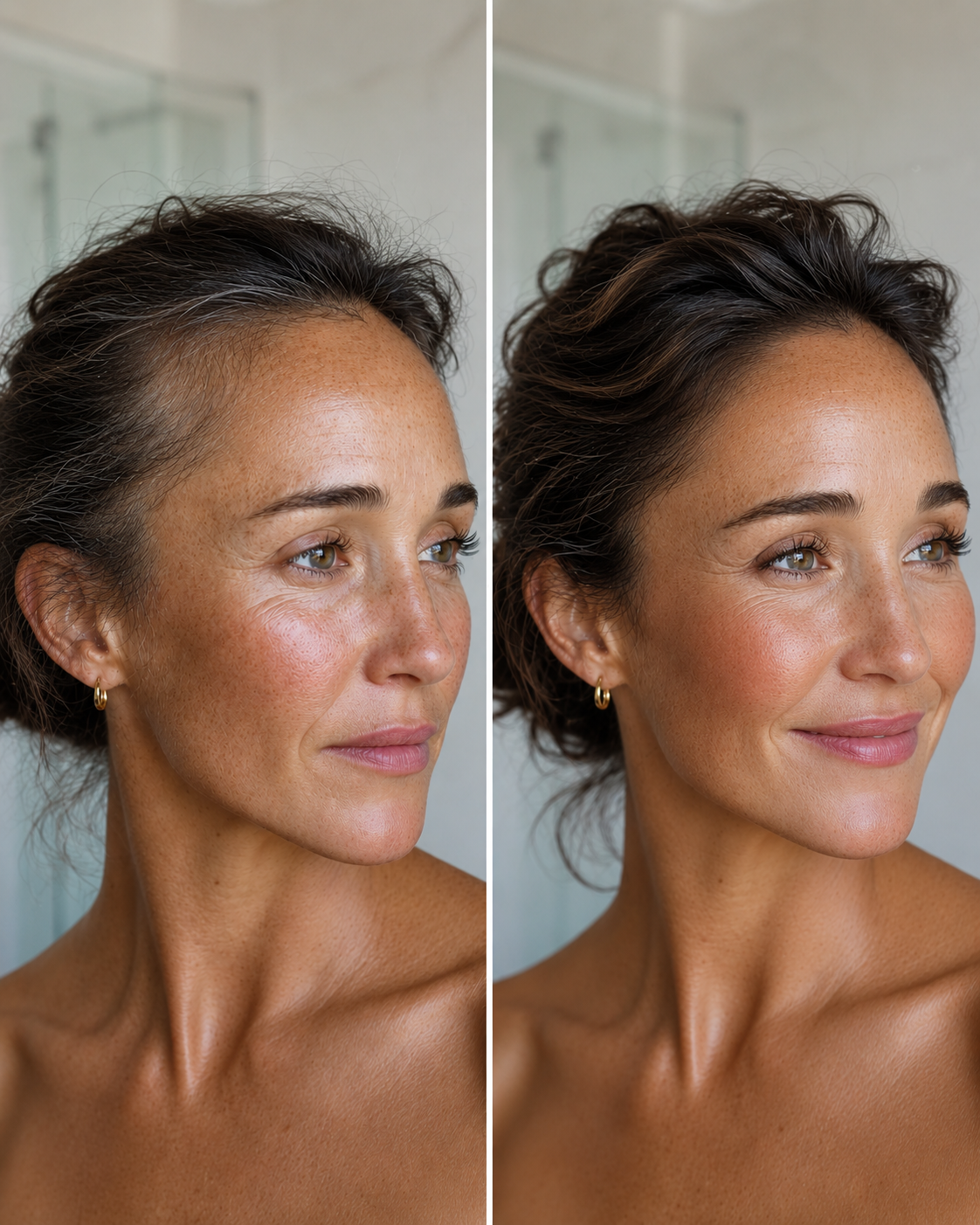
Ran for 62 days, from June 30 to August 31, 2026, the last day Crush saw it.
Run by Tricia Jenner on Facebook. Crush is not the advertiser and does not verify its claims. See this ad in Meta's Ad Library(opens in a new tab)
Want an ad like this for your product?
Crush makes new ad images for your product from this ad: your logo, your product photo, your offer.
Trials from $19.95 USD, then $79.95 USD a month. Cancel anytime.
About this ad
- Meta Ad Library ID
- 1341016484805655
- Platforms
- Facebook, Instagram, Audience Network, Messenger and Threads
- Relaunches
- 0
- EU reach
- 9,478
- Niche
- Skincare & Beauty
Ad text
Please STOP buying another bottle of biotin and waiting six months for hair to grow back that may never grow back. I know that sounds harsh — every supplement bottle, every scalp serum, every "doctor-formulated" capsule promises it's the one that will finally work — but if you've been swallowing pills and rubbing in serums for a year while watching your part get wider every month, you are solving the wrong problem with the slowest tool available. I used to be just like you. Standing in front of my bathroom mirror at 6:15 in the morning, parting my hair four different ways trying to find the angle that hid the crown best. Discovering a new "thin spot" I hadn't noticed before and feeling my chest tighten. Pulling strands forward to cover the patch. Spraying dry shampoo on my scalp to make it look darker so it would blend with my hair. Watching the dry shampoo turn my scalp a strange chalky color in the bathroom light. I'd been doing this every morning for almost three years. Buying every supplement on the shelf. Biotin. Collagen. Marine collagen. The expensive ones with saw palmetto. The "hair, skin, and nails" gummies that taste like dessert. The doctor-formulated capsules that cost $90 a month and come with a subscription you can't cancel without phoning during business hours. Trying Minoxidil. The 2% one. Then the 5% one. The smelly liquid that made my hair greasy at the roots and left a wet patch on my pillow every night. I used it religiously for eight months. I saw a little baby fluff regrow at my hairline that fell out the moment I stopped, which Reddit told me would happen, which made me feel stupid for trying. I tried scalp serums. Rosemary oil. Castor oil. Caffeine treatments. A "regrowth roller" with tiny needles I ran across my scalp at night while watching TV, like a fool, every single night for four months. My husband asked what I was doing. I told him I'd read it was good for circulation. I didn't tell him the truth. I tried hair fibers. Toppik. Caboki. Both. The fibers clung to my forehead and my neck and inside my collar. They turned my pillowcase brown. They came off in the rain in a way that made me look like I was crying mascara out of my scalp. I left a meeting early once because I felt them moving on my head and I couldn't be sure they were still where I'd put them. I tried thickening shampoos. Volumizing sprays. Teasing my hair at the crown until my arms hurt. Dry shampoo packed onto my scalp until it looked like I had dandruff. I bought a hair topper online — $180 — and wore it twice before I started crying at my own reflection and put it back in the box. I tried changing my part. The middle part showed too much scalp. The left side part exposed the crown. The right side part made my forehead look enormous. There was no part that hid it. Three years and there was no part that hid it. And the spot kept getting wider. I did the math one Sunday morning at my kitchen table. I'd spent over $2,000 in two years on supplements, serums, fibers, toppers, and "miracle" treatments. Two thousand dollars. To still be standing in front of my bathroom mirror every morning trying to part my hair around a thin spot that was bigger than it had been a year ago. Here's what made it unbearable: I was 54 years old. I was healthy. My bloodwork was perfect. My thyroid was fine. I'd gone to a dermatologist who'd told me, very kindly, that this was "just genetic" and there wasn't really much I could do beyond what I was already doing. I left her office and sat in my car for forty-five minutes before I could drive home. The thing about thinning hair that nobody tells you — that no campaign and no influencer and no "empowering" Instagram post talks about — is the shame. The shame of it is worse than the thinning itself. I stopped letting my husband touch the top of my head. We've been married twenty-six years and he used to run his fingers through my hair when we sat on the couch. I started flinching when he reached up. He stopped doing it. He didn't ask why and I didn't tell him. I stopped going to the hair salon. My hairstylist of nine years would lift up sections of my hair to cut them and I knew she could see. I knew she was being kind. I knew she would never say anything. I couldn't bear knowing she knew. I started going to a different salon every six months — a stranger every time — telling them to just "do a trim, nothing fancy, dry cut please" so they couldn't wash my hair and feel how thin it was at the crown. I stopped swimming. I'd been swimming twice a week for twenty years. I told my friends I'd hurt my shoulder. I hadn't. I just couldn't bear the thought of my hair getting wet and showing the scalp through. I haven't been in a pool in two and a half years. I stopped going to the hairdresser before family weddings. I'd do my own hair, badly, in the hotel bathroom, parted carefully, hairsprayed in place, terrified of the wind. At my niece's wedding I sat in the church pew calculating where the photographer was standing. I sat where the overhead light wouldn't hit me. I tilted my head down in every photo. There are no photos of me from that day where I look up. I stopped wearing my hair up. Ever. Not a ponytail. Not a bun. Not a low chignon. Not even a half-up at the back. My hair has been down, every day, for almost three years. In the heat. At the gym. When I'm cooking. When I'm sleeping, sometimes, because if I sleep on it weirdly the part shifts in the morning and I have to fix it before my husband sees. I stopped letting anyone stand behind me on stairs. I stopped sitting in the front row at conferences. I stopped getting up first at restaurants because then everyone would be looking at the back of my head as I walked away. I didn't tell anyone any of this. Not my husband. Not my sister. Not my best friend of thirty years. The shame of saying it out loud felt heavier than the shame of carrying it alone. And then one Saturday I had brunch with my friend Rachel. Rachel is a trichologist. She's been one for twenty-two years. She runs a small scalp clinic out of a converted Victorian house in town. Her clients are mostly women between 45 and 70 with the same problem I had, and they pay her £180 a session to look at their scalp under a magnification camera and tell them what's actually going on. We've been friends since our daughters were in primary school together. She'd watched me grow out my hair, change my part, refuse to swim with her in Greece two summers running, and she'd said nothing. Because Rachel is professional like that. But that Saturday I just broke. I told her everything — the biotin, the Minoxidil, the topper in the box, the swimming, my husband, the dry-cut salon strangers, all of it. She put her coffee down. And she said something I'll never forget: "Love, you don't have as much hair loss as you think you do. You have a scalp visibility problem. Those are two completely different things." I stared at her. "Come back to the clinic with me on Monday. I'll show you under the camera." I went. She put me under a 60x scalp magnification camera that costs more than my car. And what she showed me changed three years of shame in about ninety seconds. "Look here," she said, pointing at the screen. "This is your crown. Now look at the actual follicle density." She started counting. "One, two, three, four... You have approximately 78% of the follicle density of a woman in her thirties. That's not bald. That's not even close to bald. That's normal, age-related thinning." "But it looks so much worse than 78%," I said. "Because you're not seeing it correctly," she said. "Your brain isn't doing follicle math. Your brain is doing contrast math. It's looking at the ratio of hair to scalp. And the moment scalp starts showing through — even a tiny bit — your brain reads the white space as 'gone.' Not 'thinner.' Gone. So a crown that's lost 22% of its density reads as a crown that's lost 70%. The hair is mostly still there. You just can't see it because your eye is fixated on what's showing through." She zoomed out. "If I could just cover the scalp gap between the existing strands — just darken the visible scalp the same color as your hair — your crown would look almost completely normal. The hair you still have would do the rest of the work." For the first time in three years, I felt like I could breathe. Because if the problem wasn't that I was going bald — if the problem was that the hair I still had was being made invisible by the scalp showing through between strands — that meant the entire approach I'd been taking was wrong, not my body. That's why everything had failed. Minoxidil tried to regrow hair. Supplements tried to grow hair. Serums tried to grow hair. Fibers tried to add fake hair. Toppers tried to replace hair. Not one of them addressed the actual visual problem, which was that the scalp underneath was reflecting light back to the viewer and broadcasting "thin" to everyone who looked at me, including me, every single morning. "What do you tell your clients to use?" I asked her. She said most of the products marketed to thinning women are either trying to regrow hair (slow, often disappointing) or trying to add fake hair (messy, unnatural, transfers). What works fastest, she said — what the women in her clinic actually keep coming back for — is something that addresses scalp visibility directly. A pigment that goes on the scalp itself, between the existing strands, and stops the white reflection. Not on the hair. On the scalp. "It's the same optical principle as scalp micropigmentation," she said. "Which costs about $3,000 and lasts a few years. Except in a powder form, that you do yourself, that washes out at night." A few days later she texted me a photo. A small white compact with a pressed powder inside and a precision puff. She said, "This is what most of my clients are using now. Try this before you spend another penny on serums." The brand was Rumi Cosmetiques. I'd never heard of them. When I looked them up, I found they'd been making cosmetics specifically for women over 40 for years. 17,000+ reviews on the product Rachel was recommending. 4.5 stars. Their whole positioning was that they make beauty products for the hair and skin women actually have now — not the hair and skin they had at 25. The product was called HairMagic+ Hairline Powder. I looked at the page. It wasn't a supplement. It wasn't a serum. It wasn't fibers. It wasn't a topper. It was a pressed powder with adaptive pigments designed to be applied directly to the scalp at the thin areas — making the scalp read as hair instead of as white space. Adaptive iron-oxide pigments that shift to match warm brunette, cool brunette, salt-and-pepper, or blonde. Soft-focus mica and silica that diffuse light instead of bouncing it back — so the scalp stops reflecting white under overhead lights. Argan oil, panthenol, and vitamin E that condition the scalp instead of irritating it like Minoxidil does. Water-resistant and transfer-resistant, but rinses out in the shower. Lasts 2 to 4 months per compact. The reviews stopped me cold. Real women in their 50s, 60s, 70s. Talking about thinning crowns. Widening parts. One woman wrote, "My thinning hairline made me feel self-conscious for years and this is the only thing that has helped." Another said, "It fills in my sparse area so naturally that even my hairstylist couldn't tell I was using anything." A 67-year-old wrote, "I've started wearing my hair up again for the first time in four years." I read every single review. There were dozens that read like they'd been written about me. I was skeptical. God, was I skeptical. I'd spent $2,000 over two years on things that promised the world. The idea of trying one more thing genuinely made me feel sick. But there was a deal running that made the decision easier: 2-Pack at 32% off — about $17.68 per compact. Less than a single bottle of the supplement I'd been taking for a year. And they had a 30-day money-back guarantee. If it didn't work, I'd get my money back. For the first time in two years, I wasn't actually risking anything. I went for the 2-Pack. Not because I was confident — but because Rachel had said something else that stuck with me: "If it works, you'll want one at home and one in your bag. The morning you forget it, you'll wish you hadn't." I ordered it on a Tuesday. It arrived Friday. The first thing I noticed was how different it felt from anything I'd tried before. It wasn't a wet serum. It wasn't sticky fibers. It was a soft, pressed powder — actually soft, not "soft" in the way cheap powders lie about. The precision puff picked up just enough product. I tapped it directly onto the scalp at my crown, the way Rachel had shown me — not on the hair, on the scalp itself, between the strands. It looked like a soft shadow for about three seconds. Then I patted the surrounding hair down over it gently with my fingers. And the bare patch I'd been hiding for three years — the one I'd built my entire morning routine around — was gone. Not covered with fake fibers. Not regrown. Just no longer broadcasting "scalp" to my own eyes. The hair I still had — and Rachel was right, I had a lot more than I'd thought — was doing the work. The powder had just stopped the white from showing through. I stared at myself in the bathroom mirror. The crown that had looked like a betrayal for three years looked like a crown. Just a head of hair. Slightly thinner than it had been at 35, sure. But not the disaster I'd been seeing every morning. Not the disaster I'd been hiding from my husband for three years. I went downstairs. My husband was making coffee. He looked up and said, "Did you do something different? You look really well-rested." He didn't say anything about my hair. He didn't notice it had changed. Which was exactly the point. He didn't see the powder. He didn't see "more hair." He saw his wife, looking like herself, on a Saturday morning, for the first time in three years. The second week, I let him run his fingers through my hair when we sat on the couch. I almost cried. He didn't notice anything. He kissed the top of my head and went back to his book. The third week, I went back to my old hairstylist. The one I'd been avoiding for three years. She washed my hair and cut it, and she said, "Your hair is looking really good lately. What are you doing?" I laughed and pulled the little compact out of my bag and showed her. She asked me to write down the name. By the fourth week, I'd run out of the first one and started on the second compact in the 2-Pack. (Rachel was right. I never wanted to be without it. The first one lived on my bathroom counter. The second one lived in my handbag.) By the end of the second month, I went swimming. For the first time in two and a half years. The compact obviously doesn't stay on in chlorinated water, and that was fine. I went in, swam my laps, came out, dried off in the locker room, and reapplied it before I came out into the world. It took 75 seconds. I swam twice a week from that day on. By the third month, I wore my hair up to a wedding. A French twist. The first time my crown had been exposed in public since 2023. Nobody said a word. Nobody stared. Nobody noticed anything except that I looked happy. It's been six months now. I'm not going to lie and tell you I have the hair I had at 30. I don't. I'm 54 years old. My hair is genuinely thinner than it was, and no amount of powder is going to grow me a new follicle. But I don't look like a woman who's losing her hair anymore. I look like a woman with a normal head of hair for her age. Because — and this is the part Rachel was right about that took me three years to believe — that's actually what I am. I just couldn't see it because the scalp was screaming louder than the hair was. I've stopped buying supplements. I stopped Minoxidil four months ago. My bathroom drawer has space in it for the first time in years. The hair topper is going in a charity bag this weekend. If you're reading this and you see yourself in my story — if you've been buying supplements and serums and fibers and changing your part four times a morning for years — I need you to hear something: It's not your body. It's not your hormones. It's not your age. It's the approach. You've been trying to grow new hair when the actual problem is that the hair you already have is being made invisible by your scalp showing through. That's not the same problem. And it cannot be solved by growing hair, because the hair was never the main issue. And the moment you address the scalp visibility directly — with a pigment built specifically to make scalp read as hair — you stop looking like you're losing your hair. Because mostly, you weren't. You were just looking at a contrast problem and reading it as a hair-loss problem. Like I did. For three years. I wasted $2,000 in two years chasing the wrong solution. Then I spent $35 on a 2-Pack of HairMagic+ and it gave me back swimming, my hair up in public, my husband running his fingers through my hair, and my mornings. Right now, HairMagic+ is running the 2-Pack at 32% off — about $17.68 per compact. Two compacts. One for your bathroom. One for your bag. (Trust me. You'll want both.) To put that in perspective: one month of the supplement I was taking cost more than the entire 2-Pack. One month. And the supplement did nothing I could see in eight months of taking it. Each HairMagic+ compact lasts 2 to 4 months of daily use and works the morning you open it. And it comes with a 30-day money-back guarantee. Use it for a full month. If it doesn't make your thinning areas look fuller — if your scalp still shows through when you part your hair — you get your money back. No questions. Not another disappointing bottle sitting in your bathroom drawer. I'm not a trichologist. I'm not Rachel. I can't promise it'll work for your specific thinning pattern. Some hair loss is more advanced than what coverage can address, and I won't pretend otherwise. But I can tell you what happened to me. And I can tell you that if you've spent years buying things that promised to grow hair and watching nothing change, maybe the question isn't which supplement to try next. Maybe the question is: am I actually losing as much hair as I think I am — or am I looking at scalp showing through and reading it as hair loss? For me, answering that question gave me back three years of my life. Click below to see HairMagic+ and the scalp-visibility method that finally made the difference. You don't have to keep hiding your crown, changing your part four times a morning, or pretending you hurt your shoulder when really you just can't bear the pool. You just have to stop trying to grow what hasn't gone, and start covering what's showing through. And for me, that changed everything.
Where the ad sends people
rumicosmetiques.com
Stop taking biotin. Your hair isn't the problem.
Here's what I use now.
See details: rumicosmetiques.com(opens in a new tab)