Inactive· since Sep 2, 2026
- 14
- days it ran
- 0
- relaunches
Ad copy
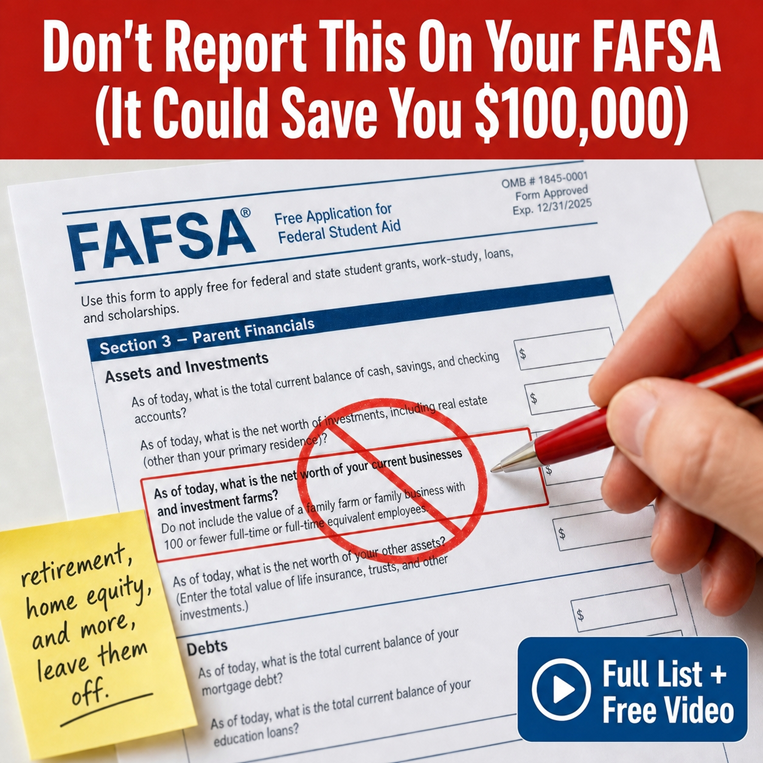
Don't report this on your FAFSA. It could save you $100,000. If you think that your high school counselor, financial advisor, or the college financial aid office would tell you if you were making expensive mistakes on your FAFSA, well, I'm sorry to say, but you are in for a rude and costly awakening. That is exactly why you need this free training called Cut Your Student Aid Index for US Families going to US Colleges and Universities. It shows you why nobody in the system has any incentive to tell you what not to report, which is leaving families to accidentally sabotage their own aid eligibility. Because when the people you trust for guidance stay silent about FAFSA exemptions, you end up paying tens of thousands more than necessary. Here's what most families don't realize about the systematic silence around FAFSA mistakes and why nobody is coming to save you. The first thing is high school counselors don't know the financial details. Your counselor helps hundreds of students with college applications, test prep, and deadlines. They're not trained financial aid experts, and they're certainly not reviewing your specific asset reporting line by line. They might tell you, "Fill out the FAFSA," but they're not going to catch that you reported $500,000 in retirement accounts that should be exempt. The second thing is financial advisors focus on investments, not college aid. Your advisor knows portfolio management and retirement planning, but college financial aid calculations, that's a completely different specialty. They won't review your FAFSA to catch over-reported assets because it's not in their area of expertise. Meanwhile, their silence costs you $25,000-plus per year. The third thing, colleges benefit from your mistakes. Here's the uncomfortable truth. When you over-report assets on your FAFSA, you qualify for less aid, which means the college keeps more of your money. Financial aid offices aren't going to proactively audit your FAFSA looking for exemptions that you missed. They'll process what you submitted and move on. It's not their job to reduce your cost. Let me tell you what this silence costs families. One family reported their $450,000 home equity on the FAFSA for two years straight. Their high school counselor never mentioned that it doesn't belong there. Their financial advisor never reviewed their FAFSA. The college financial aid office, well, they processed it without question. And the result over $50,000 in lost aid that nobody told them about until it was too late. Here's why this systematic silence exists. It's not malicious, it's just that nobody in the traditional system has the specific expertise or incentive to optimize your FAFSA reporting. Counselors are overwhelmed with applications. Advisors focus on investments. Colleges want tuition revenue. You're on your own to figure out that retirement accounts, primary home equity, cars, life insurance cash value, and way more exemptions than 99% of parents realize shouldn't be on your FAFSA. We're putting on a free workshop that reveals all the exemptions that nobody tells you about and shows you exactly what should and shouldn't be reported on your FAFSA. Register for the free training now and discover how to stop relying on a system that has no incentive to save you money, and start protecting your family from $100,000 in unnecessary expenses. https://go.yorkshirecollegeplanning.com/invitation-workshop-2
Cut Your SAI for $100k+ Families: LIVE WORKSHOP!
LEARN MORELike this ad? Make it yours.
Crush rebuilds this exact creative around your product — your brand, your colors, your offer — in about a minute.