
Inactive· since Jun 10, 2026
- 8
- days it ran
- 0
- relaunches
Ad copy
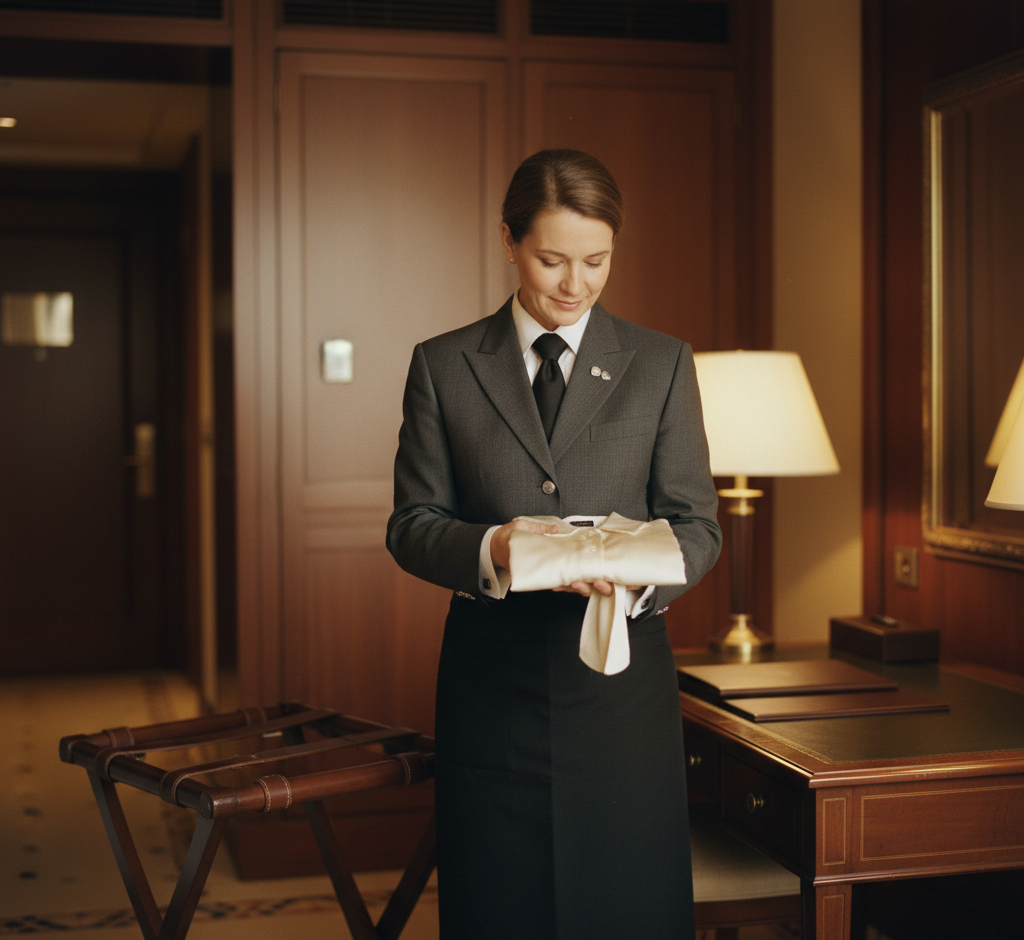
I have unpacked luggage for some of the wealthiest women in the world. I have also spent fifteen years quietly fixing what their suitcases did to their clothes before they ever opened the wardrobe. More times than any of them ever knew. I am telling you now. My name is Margaret Chen. I have been a head butler at one of New York's most recognized five-star properties for fifteen years. Before that I trained at properties in London and Hong Kong. My job is to be invisible. The guest arrives, the room is perfect, the wardrobe is pressed and hung, the bag is unpacked with everything in its place. She never sees what came before that. She was never supposed to. Which is exactly why I can tell you what I am about to tell you. There is a room in every luxury hotel that guests are never shown on the property tour. It sits somewhere between the laundry facility and the service corridor and it runs twenty-four hours a day. It is staffed by people who have spent years learning how to undo what transit does to fabric. Steamers. Industrial pressing equipment. Fabric shavers. A temperature chart on the wall that tells you exactly how much heat each material can take before it becomes a different problem than the one you started with. This room exists because the hotel industry built it. Not as a luxury amenity. As emergency infrastructure. Because the industry knew, long before I started working in it, that checked bags would always destroy clothes. The guest never sees the damage. She never sees the repair. She opens her wardrobe and everything is perfect and she assumes that is simply how it arrived. It is not how it arrived. I want to tell you about the woman I will call Catherine. She traveled to New York for work every two weeks for four years. I recognized her from the frequency of her stays and the consistency of her itinerary. She always checked two bags. She always requested pressing service the evening of arrival. She always had a seven o'clock dinner reservation that gave us approximately three hours to receive her bags from the bellman, assess the damage, and have everything guest-ready before she needed it. Three hours is enough time. Usually. The problem was not that Catherine's clothes arrived destroyed. The problem was more specific than that. A fold here. A compression crease across a jacket lapel that took twenty minutes to press out properly without distorting the canvas. A silk blouse that had been sitting under four days of clothing weight for six hours and arrived with a pattern of wrinkles in the fabric grain that our most experienced presser called "suitcase memory." The fabric had been compressed in the same position for long enough that it remembered the fold. I fixed it every time. My team fixed it every time. Catherine went to her dinners looking exactly as she had intended to look when she packed. She tipped generously at checkout and thanked me for the service. She never knew how close it came. That was the job. But sitting in the pressing room one evening watching my colleague work a travel steamer across a $900 Roland Mouret dress for the third time in twenty minutes, I understood something I had spent fifteen years not examining directly. We were not solving the problem. We were treating the result. Every shift. Every guest. The same damage. The same repair. The same wardrobe that looked perfect because of what happened in a room the guest would never see. I started asking why the damage kept happening. Not as a complaint. As a professional question. I had spent fifteen years on the repair side of the equation and I had never once been asked to think about the cause. **Why everything you have tried has failed** Clothes wrinkle for one reason. Pressure applied to a fold. That is the complete mechanism. It is not about how carefully you pack. It is not about the rolling technique or the tissue paper or the dry cleaner bags or the packing cubes. If a fold in your garment is held under load during transit, a crease is physically set into the fiber. The fabric remembers the position it was held in. We called it suitcase memory in the pressing room. The industry term is residual deformation. The mechanism is identical regardless of what you call it. Every solution the luggage industry has ever sold you applies pressure to a fold. Rolling reduces some folds and creates different ones under different load. Packing cubes organize the problem without addressing the cause. Compression bags actively worsen it by maximizing the force applied to every fold in the bag simultaneously. Wrinkle-resistant fabric slows the damage. It does not stop it. The only thing that stops it is removing the fold from the equation before the garment ever enters transit. The only environment where clothes reliably do not wrinkle is the one where they have always not wrinkled. Your closet. A garment hanging freely in your closet has no fold under load. Gravity distributes the fabric along its natural grain. You take something out after two weeks and it looks exactly as it did when you put it in. Not because of the fabric. Because of the physics of how it was stored. I have known this for fifteen years. I managed the consequence of it every single day. What I did not know was that someone had finally built a carry-on bag around it. **The first bag I ever unpacked that did not need the pressing room** A guest checked in on a Thursday evening in March. Single bag. Carry-on dimensions. Full-grain leather exterior that looked nothing like the rolling bags I had been unpacking for fifteen years. She handed it to me in the suite and asked me to unpack while she took a call in the sitting room. I set the bag on the luggage stand and opened it. The interior had a hanging compartment. Not a fold-over flap. A genuine suspension system inside carry-on dimensions that allowed garments to hang freely during transit. Three blazers, two dresses, four blouses. All hanging. No fold under load. No compression. No suitcase memory. I stood looking at the interior for a long moment before I continued unpacking. Every garment went straight from the bag to the wardrobe without a single pass from the steamer. I hung them and stepped back and looked at them and there was nothing to do. Not because the guest had packed lightly or chosen wrinkle-resistant fabric. Because the bag had removed the mechanism of damage entirely. I transferred the shoes from their dedicated compartment. Separated from the clothing by design. Seven compartments total, each with a specific function. I had unpacked thousands of bags in fifteen years. I had never unpacked one that made the pressing room irrelevant. I asked the guest about the bag when she came through to dress for dinner. "I stopped checking bags the year I found it," she said. She said it the way people describe a decision so obvious in retrospect they can barely remember making it. I wrote the name down before she left the suite. I call it the Closet Principle now when I explain it to people. The bag replicates the only environment that has always worked. Not a new discovery. Not a clever packing trick. The physics of your wardrobe, built into a carry-on that fits in an overhead bin. **What two people noticed without being told** The first was Irene. She has been head of housekeeping at the property for twenty-two years. I showed her the bag during a shift handover the following week. She looked at the hanging interior for a moment and then looked at me with the expression of someone who has just been shown a solution to a problem they stopped expecting to find. "We've been pressing the same damage out for twenty years," she said. "Same crease patterns. Same fabrics. Same fixes." She did not say anything else. She did not need to. The second was a woman staying at the property for a long weekend, writing a review for a travel publication I recognized. She saw the bag in my possession near the service corridor during a moment that was not intended to be a conversation. She asked about it with the directness of someone professionally obligated to ask about things that catch her attention. I explained the Closet Principle. The suspension system. The physics of why every other solution treats the result rather than the cause. She had a notepad out before I finished. "I have been traveling for work for eleven years," she said. "I have a line item in my expense reports specifically for hotel pressing services. I have never thought about why that line item exists." She photographed the bag before she left the corridor. I do not know whether she wrote about it. I know her question was not polite conversation. **What the Luhxe bag actually is** It is the only carry-on I have encountered in fifteen years of professional garment handling that applies the Closet Principle at full carry-on capacity. The hanging interior suspends garments during transit. Seven compartments. Dedicated shoe storage fully separated from clothing. Laptop section. Detachable wheels that come off clean for the overhead bin and snap back on when you land. Full-grain leather construction. 2.2 pounds empty. Compliant on more than 150 airlines. It holds ten or more days of clothing in carry-on dimensions. The clothes arrive the way they left. The pressing room does not enter the equation. For the average traveler the financial case is straightforward. A round-trip checked bag fee runs between $85 and $125. At four trips per year that is between $400 and $500 handed to an airline annually for a service that damages your clothes and occasionally loses them entirely. Over ten years the number reaches $4,000 to $5,000 at conservative estimates. The bag pays for itself on the first trip. But the fee calculation, as real as it is, is not why I am writing this. I am writing this because I spent fifteen years managing the downstream damage of a problem that had a solution nobody had thought to put in a carry-on bag. The guest never saw what we fixed. She never knew how close it came. She tipped at checkout and traveled again two weeks later and the same thing happened. Catherine still travels to New York every two weeks. She still checks two bags. I still receive them from the bellman and send them to the pressing room and have everything guest-ready before her seven o'clock dinner reservation. I have never told her. That is not my place. But it is yours to know. **What you need to understand right now** Luhxe manufactures in limited production runs. This is not a phrase chosen for urgency. It is the operational reality of a bag made in the United States to a quality standard that does not permit unlimited volume. The current run has a fixed number of units. When this run closes, the next availability is not guaranteed. The waitlist from the previous sellout ran for several weeks. Every production run has come in at a higher price than the one before it. Manufacturing costs have increased consistently and the pricing history of this product reflects that without exception. If you are reading this after the current inventory window has closed, you will pay more for the same bag. That is not a sales device. That is the record. If you have travel in the next ninety days, the timeline is not abstract. Shipping takes time. Understanding how the hanging system works with your specific wardrobe, getting one trip under your belt before you rely on it for something that matters, these are not things to figure out at the airport. You want to have done them already. Luhxe offers a 90-day money-back guarantee. Use it on a real trip. If it does not do what I have described, contact them and get your money back. The risk of trying it is as close to zero as any purchase you will make this year. The cost of not trying it is measured in every garment that arrives needing repair, in every pressing fee on every hotel bill, in every version of Catherine's wardrobe that came through my corridor and left looking perfect only because of what happened in a room she never saw. The current production run will not last. Your move. Margaret Chen trained at luxury properties in London and Hong Kong before joining The Langham New York, where she has served as Head Butler for fifteen years.
Limited Time Offer
JUST IN: 🏆 New & Improved 2.0 Version is is here! 👜 Fits 3 dresses plus 10+ days of clothes ✈️ Save $45 on extra luggage fees ⏳ Get 2 Free Gifts included with every order made today only!
SHOP NOWLike this ad? Make it yours.
Crush rebuilds this exact creative around your product — your brand, your colors, your offer — in about a minute.