Burning & Tingling Feet Community
Burning & Tingling Feet Community Facebook ad: “After Years Of Pain, Finally pain-free”
Ran for 38 days, from August 1 to September 8, 2026, the last day Crush saw it.
Run by Burning & Tingling Feet Community on Facebook. Crush is not the advertiser and does not verify its claims. See this ad in Meta's Ad Library(opens in a new tab)
Want an ad like this for your product?
Crush makes new ad images for your product from this ad: your logo, your product photo, your offer.
Trials from $19.95 USD, then $79.95 USD a month. Cancel anytime.
About this ad
- Meta Ad Library ID
- 1395011796025724
- Platforms
- Facebook, Instagram, Audience Network, Messenger and Threads
- Relaunches
- 0
Ad text
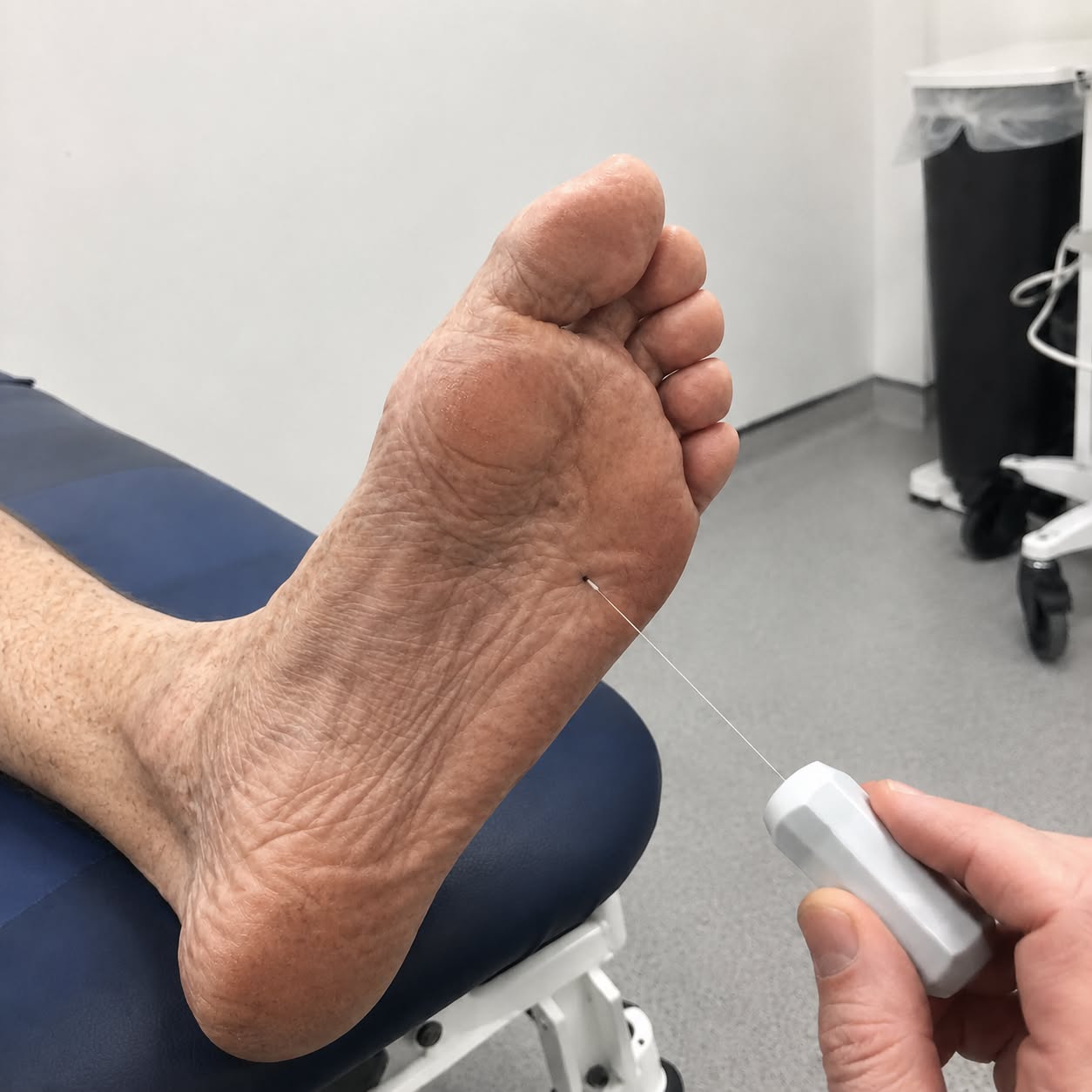
A doctor stuck a needle in my foot. I didn’t feel a thing. Six months earlier, my GP had called it “just age.” I had a fall last April. Not a trip over the rug — a proper fall. Down the stairs, in the dark, and I hit my head so hard I couldn't get up. I lay there until my husband found me. They rushed me to A&E. CT scan. Blood tests. Everything. And when they finally told me what had caused it, I couldn't take it in. It wasn't my heart. It wasn't my blood pressure. It wasn't a mini-stroke. It was my feet. I couldn't feel them anymore. I'd had the burning and the numbness for years. Neuropathy, they call it. Tingling, burning, then that dead, far-away feeling. "Just what happens after 60," everyone said. It happens to millions of us. And as a retired nurse, I genuinely thought I was doing everything right. But about two years before the fall, I knew something was wrong. I'd wake in the night with my feet burning like they were on hot coals. Then the electric jolts. The pins and needles. Then the worst part — the numbness. Like I was walking on someone else's feet. My legs felt like lead by teatime. And I hadn't had a full night's sleep in months. I went to my GP. Every test came back normal. She said, "You're 68. This is just what age looks like." And she put me on gabapentin. Repeat prescription. Off you go. So I tried everything. The gabapentin turned me into a zombie. Menthol creams. Lidocaine patches. Magnesium tablets by the fistful. Nothing changed. If anything, I got worse. Then, about six months before the fall, I started waking at 3 a.m. every single night. Wide awake. Heart going. A low panic I couldn't explain. And I'd started holding onto the furniture just to cross the room. I told myself it was nothing. Then one night in April, I got up to use the loo. I put my foot down on the landing — and it wasn't there. Not numb. Dead. Like someone had cut the strings. I reached for the banister and missed. And I went down the whole flight. I remember the crack when my head hit the bottom stair. Then nothing. My husband found me in a heap in the dark, blood on the carpet, not moving. His hands were shaking so badly he could barely dial 999. And that's when I knew how bad it was. Because my husband never shakes. At the hospital, the consultant went through everything. My heart was fine. My blood pressure was fine. I hadn't blacked out. It wasn't a stroke. "Then why did I fall?" I asked. He paused. Then he said, "Because your feet have stopped telling you where the floor is." He took a thin nylon thread and pressed it against the sole of my foot. "Tell me when you feel this." I never felt it. He'd been pressing the whole time. "Do you take anything for your feet?" he asked. "Gabapentin. Creams. Magnesium tablets." He nodded slowly. "That's what everyone does. Unfortunately, none of it reaches the nerve." He drew it for me on a scrap of paper. A nerve is like a wire, he said — wrapped in a protective coating called the myelin, like the insulation on a cable. When the nerve is starved, that insulation frays. First the bare wire sparks at random. That's the burning. The jolts. Then it short-circuits and goes silent. That's the numbness. "And this is the part that frightens me," he said. "When you can't feel your feet, you don't feel an injury either. A blister. A burn. A cut you never notice. It festers. It ulcerates. That's how people in your position lose a foot." Then he looked at me. "You didn't just fall. You've been walking towards this for two years." I felt like I'd been punched in the chest. I went home terrified. Terrified to get up in the night. Terrified of my own stairs. They gave me a walking frame. I stopped going out. My husband would find me sitting on the edge of the bed in the dark, pinching my own toes — just to check I could still feel something. Anything. Everyone told me to "adapt." Get a frame. Get a stairlift. Manage it. But I didn't want to manage it. I wanted my feet back. My son lives three hours away. He came up two weeks after the fall. When he walked in and saw me clinging to the kitchen worktop, I watched his face fall. He thought he was losing me. We sat at the table and I tried to act normal. But my hands shook when I poured the tea, and he saw it. "Mum," he said quietly. "You're not alright." And I started to cry. I hadn't cried in front of him since we lost his brother. I told him everything. The 3 a.m. panic. The frame. The terror of the stairs. He didn't say anything for a long while. Then: "I'm going to sort this out." Four days later he rang. His voice was urgent. "Mum. I think I've found something." He turned up that weekend with a box. "Before you say anything," he said, "I know you're sceptical. Just… trust me. Please." He took out a small white jar. "It's called Nuracalm Total Relief. It's a cream. It puts magnesium back into the nerve — through the skin — right where the damage is. Not a tablet that gets lost in your stomach. Pharmaceutical-grade, straight to the nerve." He looked at me. And I saw something in his face I hadn't seen since he was a little boy. Fear. Not of the cream — of losing me. "Mum, I can't watch you live like this. Frightened every single night. Please." I'm a retired nurse. I know every miracle-cure con going. But I realised: he wasn't trying to sell me anything. He was trying to save me. So I said yes. That night I read the research he'd sent. Study after study — magnesium deficiency, dying nerves, neuropathy. Three in four of us are short of it. And I kept thinking: why didn't I know this? Thirty-five years on the wards. All those patients who'd had a fall. Why did nobody ever ask about their feet? Because we still treat neuropathy like it's 1965. Take a pill. Numb it. Hope for the best. But you don't repair a frayed wire by switching off the alarm. The tablets never fixed anything. They just drugged me so I couldn't hear my own nerves screaming. The consultant had said it plainly: the nerve was starving. So the answer was simple. Feed it. But feeding a nerve in your foot is harder than it sounds. A tablet can't do it — it's torn apart in your gut long before it reaches the far end of you, the furthest point from your heart. It has to go on. Right where the nerve is dying. And it has to be built to get through skin. I used it that night. I braced myself for the usual — that greasy menthol film that sits on top and does nothing. But this just… vanished. Into the skin. Gone in two minutes. No grease. Nothing to wipe off. My skin drank it in like it had been parched for years. Then I stood up. There was a light coolness — and then something I hadn't felt in two years. The floor. The actual floor. Cold and solid under my bare feet. I stood in the bathroom and cried. Week one: the burning eased, and I slept. Week two: the pins and needles came back — and my son had to explain why that was a good thing. The nerve was waking up. Week three: I could feel the carpet. The cold kitchen floor. The edge of each stair. Week four: I came down the stairs without gripping the banister. My husband stood at the bottom, ready to catch me. I didn't need him. He had to sit down. Within two months I was a different woman. The burning, the fog, the lead in my legs — gone. But more than that: the floor was back. I could trust my own feet again. I went back to Dr Bennett for my check-up. He ran the thread test again. This time I felt it. Every single touch. He looked at the chart, then at me. "What on earth have you been doing?" I told him about Nuracalm. He wrote it down. Then he said, "I wish I'd known to tell you this before your fall." Me too. If I'd found it two years ago — when the burning started — I might never have gone down those stairs. No head injury. No walking frame. No look on my son's face when he thought he'd lost his mother. That's why I'm sharing this. If you recognise even one of these — the burning at night, the tingling, the feet that feel far away, the reaching for furniture — please don't wait. And before you go searching for any magnesium cream on Amazon or in Boots, let me save you the heartache: most of them do absolutely nothing. I know. After my fall, I tried them all. Here's why. Nearly all of them use magnesium sulphate — Epsom salts. The molecule is far too big to pass through the skin. It just sits on top. And the tablets? Torn apart in your gut before they ever reach your feet. What actually works is magnesium chloride — pharmaceutical grade — broken down by MSM into particles fine enough to slip through the skin barrier, so it absorbs up to three times better. Add vitamin B6 to help the nerve signal cleanly, and arnica to calm the inflammation. That's the difference between a cream that feeds the nerve and one that just sits there smelling of menthol. I spent thirty-five years dressing wounds and caring for nerve-damaged feet. I know the difference between something that heals and something that only masks. Nuracalm Total Relief is the only one I've found that puts all of it together — pharmaceutical-grade magnesium chloride, the MSM carrier, B6 and arnica. That's why it works. And that's why the cheap imitations don't. I bought two. One for me. One for my husband — his feet had been going the same way and he'd never said a word. Then I bought one for my sister. Three weeks later she rang me in tears. "Margaret, I didn't realise how bad I'd got until I started feeling like myself again." That's the cruel thing about dying nerves. They go quietly. Slowly. You start gripping the banister, you call it "your age," and you never realise it's a nerve crying out to be fed. Nuracalm sells out constantly. Every time a paper runs a story about the link between neuropathy and falls, it's gone for weeks. A friend of mine saw it, meant to order it, put it off. By the time it came back in stock, she'd already had another fall. Broken hip. She's in a care home now. "I wish I'd ordered it the first time I saw it," she told me. I don't want that to be you. If you're reading this and it's in stock — get it. Don't tell yourself "I'll do it later." Because a fall is like a stroke. It gives you no warning. One minute you're getting up in the night. The next you're at the bottom of the stairs and you can't get up. I got a second chance. My sister got hers. Not everyone does. Nuracalm Total Relief comes with a 90-day money-back guarantee. If you don't feel the difference, you get every penny back. But I don't think you'll be sending it back. I felt it. My sister felt it. My friend felt it — too late. Don't wait until you're the one on the floor. Don't wait until your family is frightened. Don't wait until it's too late. Get it now. While it's in stock. While you still can. 👉 https://try.nuracalm.com/ — Margaret Ellison, RN (Retired) 35 years in nursing Fall survivor And someone who wishes she'd found this sooner
Where the ad sends people
try.nuracalm.com
After Years Of Pain, Finally pain-free
Learn more: try.nuracalm.com(opens in a new tab)