
Inactive· since Jul 23, 2026
- 51
- days it ran
- 1
- relaunches
Ad copy
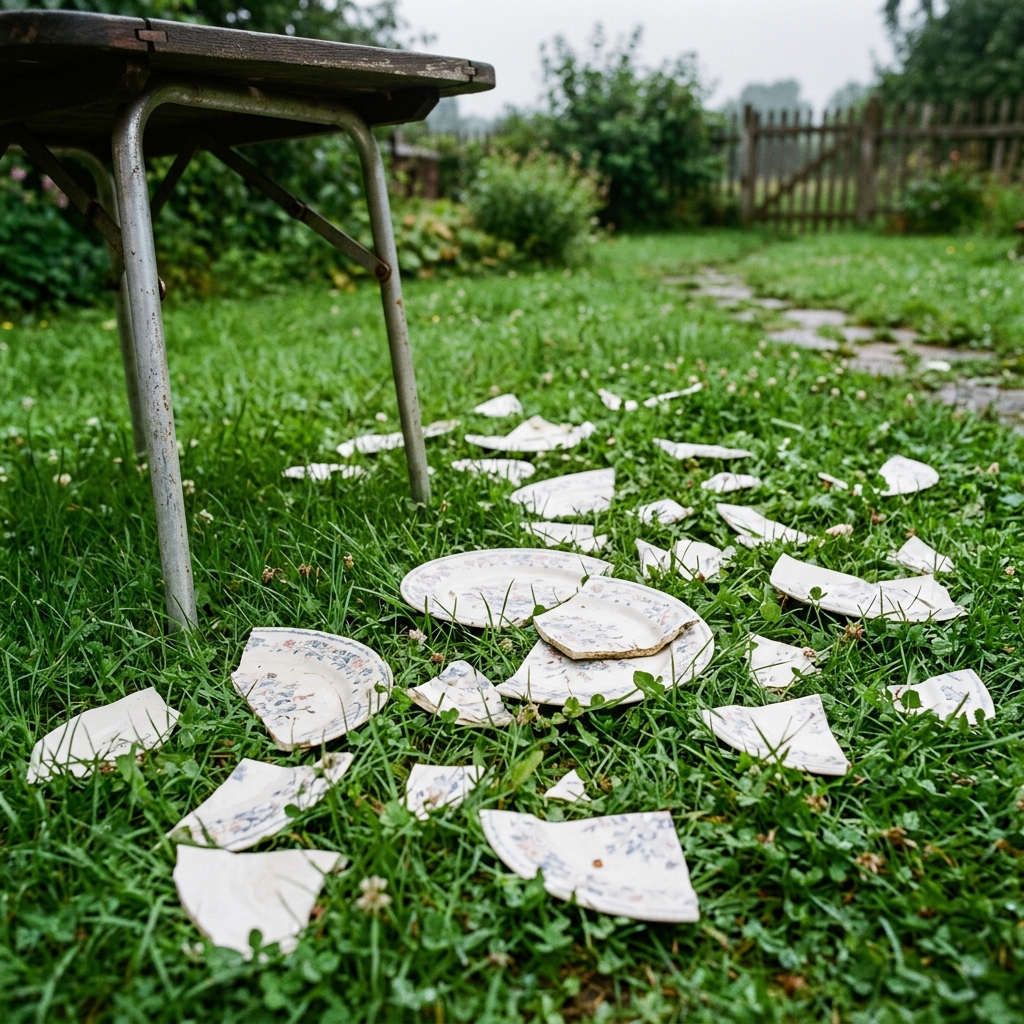
I found a wallet in a shopping cart at Walmart last Tuesday. Wait. That's not my story. Let me start over. I dropped a box of my dead wife's china on my own front lawn last Saturday morning in front of 14 strangers, and that's the story. It was the estate sale. The one my daughter Karen had been begging me to do for two years. Lorraine's been gone three years come November and the house still looked like she was just in the other room. Karen finally sat me down at the kitchen table back in August and said "Dad, the dishes. The dishes have to go." So I said okay. We priced everything Friday night. Karen drove up from Tulsa with her husband Rick and they put little blue stickers on everything. The Pfaltzgraff. The good crystal Lorraine got from her mother. The Christmas plates with the holly leaves around the rim that she only used on Christmas Eve. All of it stickered. All of it priced. All of it going. Saturday morning came up cold and grey, the kind of Springfield morning where the fog sits in the bottom of the yard until almost 10am. I was carrying a box of the Pfaltzgraff from the dining room out to the folding table on the lawn when my hands went. That's the only way I know how to describe it. They went. I've had the numbness for about four years now. Started in my feet. The doctor said it was just from sitting too long in the truck. I drove long-haul for 38 years out of the Springfield terminal, Lubbock to Pittsburgh and back, every route you can name. He said feet go numb. He said it happens. Then it moved to my hands. He still said it was just the driving. Vibration from the wheel. Said to take some B12 and not worry about it. But Saturday morning at 9:15 with that box of Pfaltzgraff in my arms, I didn't feel the box anymore. I felt nothing. Like my hands had gone underwater. I looked down and saw my fingers had let go and the box was already falling and there was nothing I could do about it because by the time my brain told my hand to grip, the hand was already empty. Fourteen people on my front lawn turned around at the sound. Six dinner plates. Four salad plates. Two coffee cups with the saucers. Lorraine's mother's set. The one she got for her 30th birthday. The one she made me promise we'd pass to Karen when the time came. I just stood there. Karen came running out of the garage and she was crying before she even got to me. She thought I'd had a stroke. She kept saying "Dad. Dad. Are you okay. Dad." I couldn't answer her. Not because of a stroke. Because I was 63 years old standing on my own lawn looking at the smashed pieces of my dead wife's china and I'd dropped it because my hands didn't work anymore, and there were 14 strangers watching, and I couldn't speak. My name is Dale. I'm 63. Retired three years now from Yellow Freight after they shut the Springfield terminal down. Born in Joplin, raised in Carthage, lived in Springfield since Lorraine and I got married in 1986. Two grown kids. Karen in Tulsa, my son Mark in Kansas City. Four grandkids I see twice a year on the holidays. I'm a quiet man. Always was. Lorraine did most of the talking for both of us for 36 years and when she went I lost my translator. After the box fell I went inside and I sat on the couch and Karen took over the sale and most people had the decency to pretend they hadn't seen anything. A few of them bought things at the prices on the stickers without haggling, which Karen told me later is the rural Missouri way of saying I'm sorry. But there was one woman. Younger than the rest. Maybe 40, 42. Dark hair pulled back. She'd been looking at Lorraine's bookshelf. The pine one I built her in 1991 for her romance paperbacks. She came inside through the open front door without being invited and she stood in my living room with her purse on her shoulder. "I'm sorry," she said. "I shouldn't be in here. I just. I saw what happened." I didn't say anything. She sat down on the coffee table across from me even though there were two open chairs. Sat right down on the coffee table like she was at her own grandmother's house. "My name is Theresa," she said. "I work at the hospice over on Battlefield. I'm a nurse. I've been a nurse 18 years." I still didn't say anything. "I watched your hands when you were carrying that box," she said. "The way your fingers were curling under. I've seen that exact thing maybe 200 times. I'm not going to tell you what it is. I'm not your doctor. But I'm going to ask you something, and I want you to be honest with me. Can you feel the bottoms of your feet right now?" I thought about it. I tried to wiggle my toes inside my work boots. I tried to feel the floor. I shook my head. "How long?" "Four years." "Hands?" "Two." "What's your doctor say?" "Driving. Says it's from driving the truck." She did this thing with her mouth. Not a smile. Not a frown. Just a tight line that pulled to one side. "You retired three years ago," she said. It wasn't a question. Karen must have told her at the sale. Or she'd just figured it out. I don't know. "Yes." "And it's gotten worse. Not better." "Yes." She looked at me for a long minute. Then she reached into her purse and she pulled out one of those little notebooks with the spiral on top. She tore out a page. She wrote something on it with a pen from the bottom of her bag. She folded it in half and she put it on the coffee table next to her thigh. "Mr. Dale, I'm going to leave this here. I'm not going to talk about it any more than that. You don't know me. I don't know you. But I lost my dad two years ago to something that started the same way you're describing and got ignored the same way you're describing, and if I left here today without writing this down and putting it on your coffee table I wouldn't sleep tonight. So I'm putting it on the coffee table. What you do with it is your business." Then she got up. She bought the bookshelf for the asking price. Sixty dollars. She and her husband loaded it into a Honda Pilot and they drove away and I never saw her again. The note sat on the coffee table for three days. I'd walk past it. I'd look at it. I'd think about throwing it out. I'd think Karen would see it and ask about it and I'd have to explain. I thought about the way Theresa's mouth pulled to one side when I told her what my doctor said. On the third night I picked it up. The note had two things on it. One was the name of a website. The other was three lines of writing in nurse handwriting, which is a particular kind of handwriting I'd seen on Lorraine's discharge papers from the hospital so many times in those last months. It said: Mr. Dale. This isn't a cure. It's a starting place. Your hands aren't gone. They're starving. Read about mitochondria and AMPK. Then read about amla. That was the whole note. I read it again. Then again. I went and got my reading glasses out of the kitchen and I sat back down on the couch and I read it a fourth time and then I went and got the laptop Karen set up for me last Christmas, the one I almost never use because Lorraine was the one who did the computer in our house. I sat at the kitchen table and I typed in the word mitochondria. It was 8:47pm. I know because the clock on the microwave was the only thing I could see clearly from where I was sitting. I sat at that kitchen table until 1:30 in the morning. Here's what I learned, in plain words, the way I had to learn it because I'm not a science man, I drove a truck for 38 years. Every cell in your body needs power to do its job. Not metaphorical power. Actual power. Like the cells run on something close to electricity, and they make that something themselves in tiny little engines inside them called mitochondria. The mitochondria take the food you eat and the oxygen you breathe and they turn it into cellular energy, which is what every cell in your body uses to do everything it does. That's not a sales pitch. That's biology. I checked it on three different websites. Now here's the part Theresa wanted me to understand. The cells in your nerves are some of the most energy-hungry cells in your whole body. They have to maintain a protective coating around themselves. They have to fire signals down their length, which is sometimes three feet long if you count the ones running from your spine to your toes. They are absolute power hogs. When your mitochondria start to slow down, and they do slow down, all of them, in everybody, as you get older and as you go through 40 years of diesel exhaust and convenience store food and not enough sleep and the kind of stress that comes from watching your wife die, the cells that feel it first are the ones that need the most power. The nerve cells. That's why my feet went first. Furthest from the spine. Longest signal path. Most energy required. Then my hands. I sat there at that table and I thought about every long-haul driver I ever knew who couldn't feel his feet by 55. I thought about Jim Petty, who I drove with out of Joplin for 12 years, and how he used to laugh and say his feet had quit on him. We all just called it driver feet. Like it was a job hazard. Like calluses. Nobody ever told us our nerves were starving. The doctor sure as hell didn't. I kept reading. There's a pathway in your body called AMPK. Stands for something I can't pronounce. Think of it like the master switch for your mitochondria. When AMPK gets activated, your mitochondria can start working better. They can start making more cellular energy. And when there's more cellular energy in your system, it flows to the cells that need it most. The nerve cells. The starving ones. And there's a fruit. Grows in India. Called amla. Indian gooseberry. They've been using it over there for 3,000 years as something they call a "rasayana" which means rejuvenator. The research on it is real. I read studies on it for two hours that night, the kind of studies with the names of the universities at the top of them. Amla has been shown to influence AMPK activity. It's also got one of the highest antioxidant profiles ever measured in a food, which matters because all that diesel exhaust and stress and bad food creates something called oxidative stress, which is what wore my mitochondria down in the first place. It's like rust on an engine. You can't just keep adding more gas to an engine that's rusting out. You have to deal with the rust. That's what amla is supposed to do. Help with the rust. Help support the engine. I read until my eyes hurt. The last website I landed on was a company called Alevia. They make a capsule with a standardized amla extract. The whole thing is just amla. No filler list a mile long. Made in the USA. Two capsules a day. Their website was alevia.com/amla/33. The number 33 was their offer code or something. I don't know. I clicked it. It said they'd send me a 30 day bottle and if I didn't feel anything in 90 days I could send the empty bottles back for a full refund. Ninety days. Three full bottles. Money back. No questions. I sat there at the kitchen table at 1:30 in the morning, an old retired trucker who'd dropped his dead wife's china on his own lawn 72 hours earlier in front of 14 strangers, and I thought about a hospice nurse named Theresa who'd sat on my coffee table because she didn't want to lose another father. I ordered two bottles. Free shipping. Sixty days. I figured if I was going to do it I was going to do it. The bottles came on Thursday. I'd like to tell you that on day one my hands came back. They didn't. I took two capsules with breakfast and I took two with dinner and I drove down to the QuikTrip on Glenstone and I got a coffee and I came home and nothing was different. Day three. Same. Day eight. I noticed I'd reached for the kitchen drawer handle and I'd actually felt the handle. The little bumps on the plastic where they textured it for grip. I stopped. I ran my finger over it again. There it was. I didn't trust it. Day 14 my feet started talking to me again. That's the only way to describe it. They started talking. Little tingles. Like static. Karen called me from Tulsa that Saturday and I almost told her but I didn't, because what was I going to say. My feet are talking to me. Day 21. I was carrying a bag of groceries in from the truck and I realized I'd carried it from the truck without thinking about it. You don't understand what that means unless you've had numb hands for two years. You can't just carry a bag. You have to plan it. You have to grip it consciously. You have to look down to check if you're still holding it. Every single time. Otherwise you drop it. I'd carried the bag without checking. I sat down on the steps of the front porch in the parking lot of my own life and I put my face in my hands and I cried for the first time since the funeral. Week five I went to the garage. Lorraine and I built that garage workshop in 1994. It's a small thing. A pegboard. A workbench. A vise. A few hand tools. I built her bookshelf in there. I built our grandson Cooper a stepstool with his name carved in the side when he was three. I built Karen a jewelry box for her sweet 16. I hadn't been in that garage in two years. I picked up a chisel. I felt the handle. I felt the cold of the metal. I set it down. I picked it up again. My hand wasn't shaking. My hand wasn't shaking and my hand wasn't numb. I stood there for I don't know how long. Week eight I drove out to Battlefield Road and I tried to find the hospice but I didn't go in. I sat in the parking lot. I thought about going in and asking for a nurse named Theresa. To say thank you. To tell her my hands had come back. I didn't go in. I'm a quiet man. I figured she'd done what she'd done and she didn't need me showing up on her shift making a scene. But I sat in that parking lot and I said her name out loud one time. Just so it was said. Then I drove home. Week twelve Karen came up from Tulsa for Thanksgiving. She walked into the kitchen and she stopped and she looked at me. I was cutting onions for the stuffing. The way Lorraine used to. "Dad," she said. "Your hands." "I know." "Your hands are. Dad." "I know, sweetheart." She didn't cry. Karen doesn't cry in front of me. She just came over and she put her hand on top of my hand on top of the cutting board and she held it there for a minute. Then she said "what are you doing, Dad. What are you taking." I told her. She wrote it down on the back of a grocery list. Now look. I'm a retired truck driver from Springfield Missouri. I'm not a scientist. I'm not a doctor. I can't tell you what's going to happen if you order Alevia Amla. I can tell you what happened to me. I can tell you a hospice nurse named Theresa sat on my coffee table on a Saturday morning and she wrote me a note because she didn't want to lose another father, and I followed the note, and my hands came back. I can tell you that the research on amla and AMPK and mitochondria is real and you can read it the same way I did, on a kitchen table at 1 in the morning with a cup of coffee and a pair of reading glasses. I can tell you that the cells in your nerves are starving and nobody at the doctor's office ever told you that, because the doctor's office is set up to manage symptoms, not to fuel cells. I can tell you that Alevia ships free, that it's made in the USA, that two capsules a day is the whole protocol, and that they have a 90 day money back guarantee. Three full bottles. Send the empties back. Get your money. That's the deal. I can tell you that if you've been told for years it's just aging, just driving, just standing, just whatever, and your hands have been quietly going on you, you owe yourself at least the kitchen table. The reading glasses. The hour at 1 in the morning. The decision. Here's where you go. 👉 alevia.com/amla/33 P.S. I broke six dinner plates and four salad plates and two coffee cups with the saucers on my front lawn on a Saturday morning in October. Lorraine's mother's china. The set Lorraine made me promise we'd pass to Karen. Karen swept the pieces up into a dustpan and put them in a Ziploc bag and put the Ziploc bag in a box in the basement, and last week I went down and got that box and I'm taking the pieces to a woman in Ozark who does mosaic work. She's going to make Karen a serving tray out of the broken pieces for Christmas. The china is going to Karen after all. Just not the way Lorraine and I planned. The hands that are giving it to her are working hands again. That's the part that matters. P.P.S. The 90 day money back guarantee is on three bottles. Not one. Alevia ships them in 30 day bottles and they want you to try it the full 90 because they know what I know now, which is that the mitochondria don't wake up in a week. They wake up slow. They wake up the way an engine wakes up after a long cold night. You give it time. If at the end of three months nothing's happening for you, you send the empty bottles back to the address they give you and you get every dollar back. That's not a gimmick. That's how they do it. The risk is on them. P.P.P.S. Theresa, if you ever read this, which you probably won't, I went back to the parking lot on Battlefield three times. I didn't go in. I'm sorry I didn't go in. I should have. But you should know my hands work and I'm using them and there's a serving tray being made out of china I thought was gone forever. Thank you. Thank you for not letting me believe what the doctor said. Thank you for sitting on my coffee table. 👉 alevia.com/amla/33
Like this ad? Make it yours.
Crush rebuilds this exact creative around your product — your brand, your colors, your offer — in about a minute.