Amalia Serrano
Amalia Serrano Facebook ad: “Top Psychiatrist Warns: Take This 1 Mineral Before Bed to…”
Ran for 16 days, from June 15 to June 30, 2026, the last day Crush saw it.
Run by Amalia Serrano on Facebook. Crush is not the advertiser and does not verify its claims. See this ad in Meta's Ad Library(opens in a new tab)
Want an ad like this for your product?
Crush makes new ad images for your product from this ad: your logo, your product photo, your offer.
Trials from $19.95 USD, then $79.95 USD a month. Cancel anytime.
About this ad
- Meta Ad Library ID
- 1508816567284027
- Platforms
- Facebook, Instagram, Audience Network, Messenger and Threads
- Relaunches
- 0
Ad text
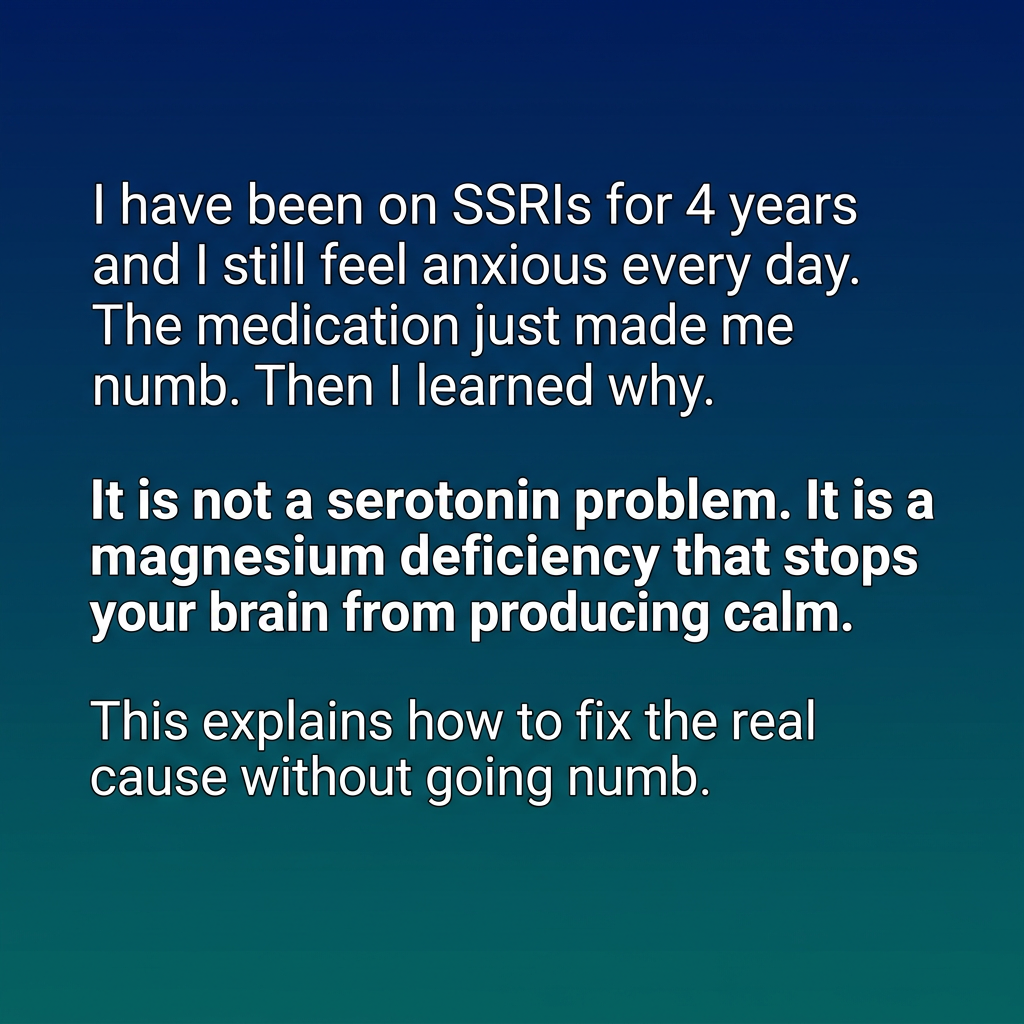
I'm about to upset every psychiatrist, GP, and pharmaceutical sales rep in this country. Because I'm about to tell you why your anxiety isn't a mindset problem, a personality flaw, or a chemical imbalance that needs managing with pills. And why every SSRI, every meditation app, and every cheap supplement you've tried has failed you for exactly the same reason. What I'm about to say could end my career. I don't care anymore. Because last year a patient rang me at 2:14am and said five words that broke something inside me. And by the time you finish reading this, you're going to be furious too. If you're waking up every morning with a knot in your stomach that nothing shifts, if your resting pulse sits above 100 for no reason, or if you've tried medication and meditation and supplements and nothing has actually fixed it — the next few minutes could change everything. My name is Dr. Marco Ventori. I'm a clinical neurobiochemist with 16 years at the Integrative Neuroscience Research Institute in Cambridge. I've spent my career studying what happens to the nervous system under chronic stress. And for most of those years, I believed the system worked. I believed the guidelines were built on good science. I believed the people writing the prescriptions had all the information. Then Claire rang me. And I started asking questions my colleagues didn't want to answer. THE NIGHT EVERYTHING CHANGED… It was a Tuesday. 2:14am. I was sitting in my study going through patient follow-up data when my phone lit up. Claire. 58 years old. Retired teaching assistant. Grandmother. The kind of woman who makes everyone else feel calm while she's silently falling apart inside. "DR. VENTORI, I CAN'T DO THIS ANYMORE." She wasn't being dramatic. Claire had been living with constant anxiety for eleven years. Not the occasional worry everyone gets. The kind that starts before your feet touch the floor and doesn't stop until you pass out from exhaustion. She'd done EVERYTHING — sertraline for three years (emotional blunting so severe she couldn't cry at her own mother's funeral), escitalopram (brain zaps, weight gain, libido gone), propranolol (stopped the trembling but did nothing for the racing thoughts), private CBT at £85 a session for six months (her therapist told her the thoughts were "already rational" — the feelings were the problem). She'd spent over £9,000 across treatments in the last decade. She'd tried magnesium tablets. Ashwagandha. CBD oil at £40 a bottle. Meditation apps. Breathing exercises. Every single one had either numbed her, done nothing, or made things worse. "I CAN'T DO THIS ANYMORE." She said it three times. Each time quieter than the last. I sat there staring at her file. Eleven years of prescriptions, referrals, supplement receipts, and therapy notes. Every pathway tried. Every pathway failed. And something inside me snapped. THE 4-MONTH OBSESSION For the next four months, I lived like a man possessed. I pulled every published study I could find on the GABA-magnesium-glutamate axis. I went through archives at the Karolinska Institute, the Cleveland Clinic, the Max Planck Institute, and a research lab in Okinawa that had been quietly studying mineral depletion in populations with near-zero anxiety rates. I spent £8,500 of my own money on research papers, journal access, and out-of-print neuropharmacology textbooks from the 1920s. My wife thought I was losing my mind. What I found made me want to put my fist through the screen. THE £4.2 BILLION LIE The entire anxiety treatment industry is built on a lie. A £4.2 billion lie in the UK alone that keeps you anxious, desperate, and coming back for another prescription. Here's what they don't tell you. Your anxiety isn't caused by a serotonin imbalance. It's caused by a magnesium deficiency spiral that shuts down your brain's ability to calm itself. The counter-evidence is staggering. Cleveland Clinic acknowledges that approximately 70% of the Western population is magnesium deficient. Yet this is almost never screened for, tested, or even mentioned in a standard GP consultation. Your doctor checks your cholesterol. Your blood pressure. Your thyroid. They never check the one mineral that controls whether your brain can produce calm. THE REAL ROOT CAUSE OF CHRONIC ANXIETY Picture your nervous system like a network of brake lines in a car. When everything works, you feel the stress, you process it, and you come back to baseline. The brakes work. You slow down. But here's what happens. Chronic stress triggers cortisol. Every stressful meeting, every sleepless night, every time you lie awake at 3am worrying about something you can't control. Cortisol tells your kidneys to flush magnesium. And magnesium is the brake fluid. Without it, the GABA receptors in your brain stop responding. GABA is the primary inhibitory neurotransmitter. It's the signal that tells your nervous system to stand down. Without magnesium, the GABA brake pedal goes to the floor and nothing happens. Meanwhile, glutamate — the excitatory neurotransmitter, the accelerator — stays high. The brain is stuck with the accelerator floored and the brakes cut. This is "Magnesium Depletion Spiral." That's why the anxiety feels like it has no off switch. Because it doesn't. The off switch needs a mineral your body has been flushing for years. And the data backs this up completely. In 1900, average daily magnesium intake was 475 to 500mg. Today it's 175 to 225mg. A collapse of more than 50% in a single century. Intensive farming has stripped soil mineral content by up to 30%. Food processing removes 80 to 90% of what remains. Dr. Jack Bhatt at MIT won recognition from the National Academy of Sciences for his work on mineral transport across cell membranes in the early 2000s. (He'd spent 20 years studying how nutrients cross the blood-brain barrier before anyone in psychiatry bothered to connect the dots.) But here's the truth. There is no money in fixing this. You can't patent magnesium. You can't bill the NHS £200 per visit for a mineral supplement. So they keep you on the hamster wheel. GP visit. SSRI prescription. Side effects. New prescription. Therapy waitlist. Repeat. It's a masterpiece, really. If you're a sociopath who sees human suffering as a revenue stream. TO FIX CHRONIC ANXIETY, YOU NEED THREE THINGS — NOT ONE To fix chronic anxiety, you need to do three things at the same time. RESTORE the GABA receptor function. Without bioavailable magnesium reaching the brain, the calming system stays offline. The mineral has to be in glycinate form, bonded to glycine, which absorbs at 50 to 80% compared to 4% for the cheap oxide tablets they sell at every pharmacy in Britain. Without it, the brakes stay cut. INHIBIT the nervous system directly. Glycine is an inhibitory neurotransmitter in its own right. Scientists at the Wertheim UF Scripps Institute published in Science in 2023 that glycine sends a direct "slow-down" signal to the brain via the GPR158 receptor. Without it, the nervous system stays stuck in the on position even after magnesium is restored. REDUCE the excitatory overload. L-theanine crosses the blood-brain barrier within approximately 30 minutes and increases alpha brain waves while reducing glutamate. Without it, the accelerator stays floored even after the brakes are back. Miss even ONE of these steps, and you're wasting your time. That's why SSRIs don't work. They alter serotonin. Wrong pathway entirely. That's why meditation doesn't work. It tries to override a bottom-up nervous system response with top-down prefrontal activity. And that's why cheap magnesium doesn't work. Oxide barely absorbs and it's missing the other two pathways completely. You need all three. At the same time. In the right forms. THE FORMULA I FOUND THAT ACTUALLY WORKS It's called RestRem™. I didn't make it. A small team of neuroscience-trained formulators in a research facility outside Stockholm did. They'd been working on this specific combination for years before I ever heard of them. When I tested it with Claire, something happened that made me sit up. Within three hours, her chest loosened. She rang me the next morning and said, "I had my coffee in peace. I can't remember the last time I did that." RestRem™ is the only formula I've found that delivers all three requirements. Magnesium glycinate, 200mg, absorbs at 50 to 80% and restores GABA receptor function. Glycine, 300mg, acts directly on the mGlyR receptor to send a calming signal to the brain independently of the magnesium pathway. L-theanine, 50mg, crosses the blood-brain barrier, increases alpha waves, and reduces glutamate. Now — let me tell you what I learned about this company before I'd recommend them. Because I don't attach my name to supplements. Ever. I contacted the team. Asked difficult questions. Wanted to see the formulation data, the sourcing, the testing protocols. Here's what I found. Third-party tested. GMP-certified facility. The glycinate is pharmaceutical-grade, not the cheap bulk powder most brands use. The L-theanine is Suntheanine-grade. No fillers. No proprietary blends hiding behind vague labels. That's why I'm willing to put my name next to theirs. THIS BREAKTHROUGH IS MAKING AN ENTIRE INDUSTRY UNCOMFORTABLE Within weeks of publishing my clinical observations, the pushback started. First the "friendly" emails from colleagues suggesting I was "overstepping my speciality." Then a letter from a pharmaceutical marketing firm suggesting my public statements could "create confusion among patients currently on prescribed pathways." Then the quiet freezeout. Conference invitations withdrawn. A research collaboration "postponed indefinitely." They wanted me gone because I'd pointed at something that could make their entire business model unnecessary. A simple daily supplement that: Fixed the ROOT CAUSE of chronic anxiety, not just the symptoms. Worked in hours, not the 4 to 6 weeks SSRIs require. Cost less than a single NHS prescription charge. Let people take control of their own nervous system at home. Over the last 18 months, more than 12,000 people have tried RestRem™ for anxiety. The team shared their numbers with me before I'd write a word about them. Over 89% report a noticeable reduction in anxiety symptoms within the first two weeks. Most reduced or eliminated other supplements they'd been spending money on. Many avoided the SSRI prescription their GP had already written. But the number that convinced me? Their refund rate is 0.7%. That's 7 people per thousand. (Two of those were because the parcel got lost in the post.) Look. I'm not selling anything. I don't get a kickback from this brand. I don't have equity. I'm not on their payroll. I'm a clinical neurobiochemist who got tired of watching the system fail people like Claire. If you've been living with that knot in your stomach for years. If the SSRIs made you numb. If meditation can't reach it. If you're spending £40, £50, £60 a month on things that don't fix the actual problem. Read the article I wrote. It walks through the "Magnesium Depletion Spiral," the research, and the brand I now refer my own patients to. You don't have to take my word for any of this. But you should at least understand what's actually wrong before you accept another prescription. https://www.zynvista.com/UK/anxiety-relief — Dr. Marco Ventori, Integrative Neuroscience Research Institute
Where the ad sends people
zynvista.com
Top Psychiatrist Warns: Take This 1 "Mineral" Before Bed to Calm Anxiety Fast?
Because last March, a 43-year-old primary school teacher named Helen sat in my consulting room at 8:47 in the morning and told me, with her hands shaking so badly she couldn't hold her cup of tea, "I CAN'T DO THIS ANYMORE."
Learn more: zynvista.com(opens in a new tab)